

Volume 1, Issue 1 (2025) – 10 articles
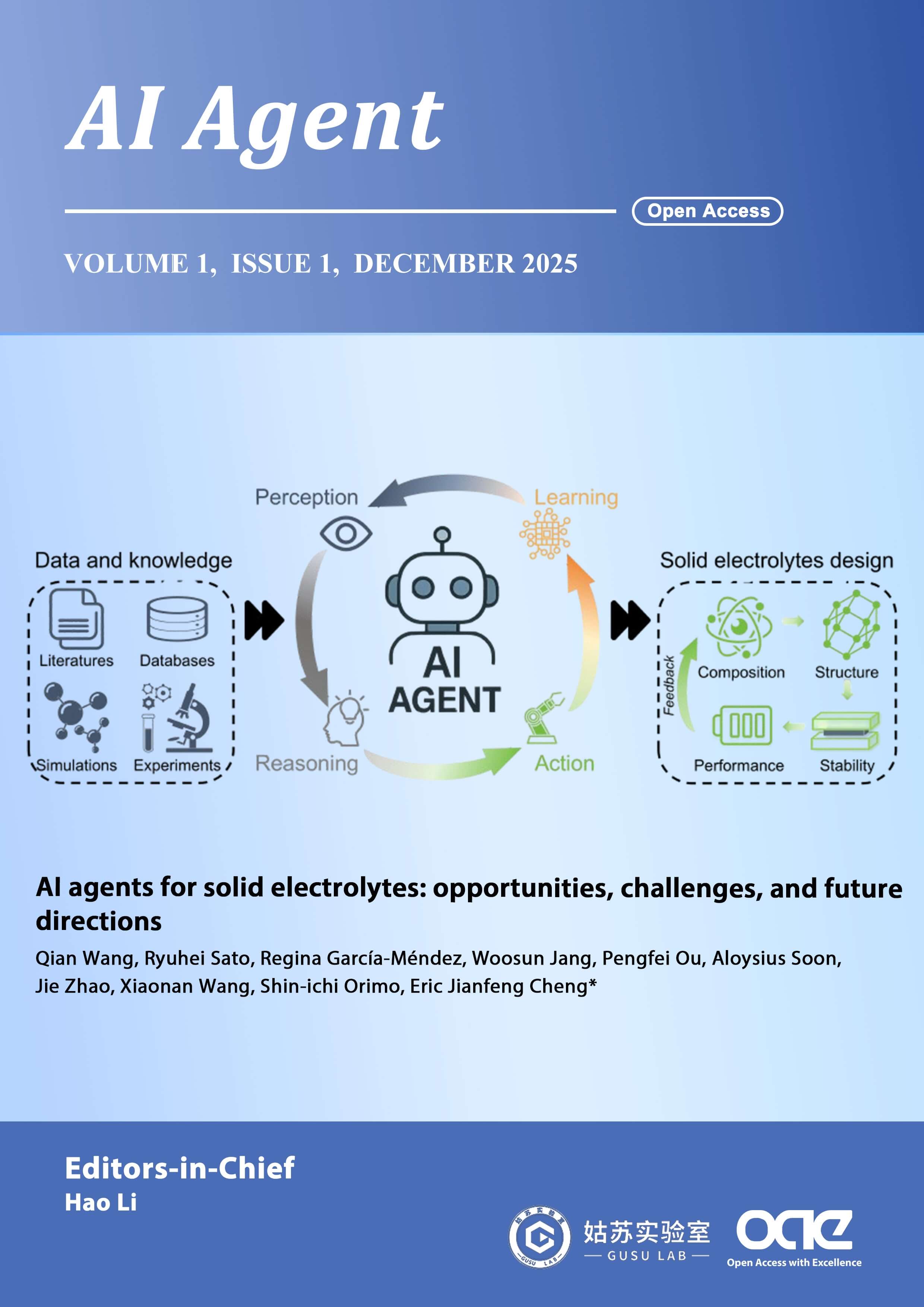
Cover Picture: Artificial intelligence (AI) and autonomous agents are transforming the discovery and optimization of solid electrolytes, a class of materials crucial to the safety and performance of next-generation batteries. This review summarizes recent progress in integrating machine learning, molecular dynamics, and density functional theory within closed-loop or semi-autonomous workflows that accelerate the evaluation of ionic conductivity, electrochemical and chemical stability, and processability. Data-driven frameworks now accelerate the screening of sulfides, oxides, and halides, while phase-field and multiscale models have provided mechanistic insight into dendrite formation, interfacial degradation, and chemo-mechanical coupling. Autonomous laboratories that combine robotic synthesis, in situ characterization, and Bayesian optimization further enable closed-loop experimental discovery. Despite this progress, challenges remain in data quality, model interpretability, and the limited autonomy of current systems. Future development will rely on five key directions: (1) constructing interoperable multiscale databases, (2) developing explainable and data-efficient algorithms, (3) tightly integrating computation with experiment, (4) exploring new solid-electrolyte chemistries via agent-driven optimization, and (5) fostering coordinated global collaboration among open AI agents. Together, these developments mark a transition from empirical discovery to an integrated, self-improving research paradigm, where AI evolves from a predictive assistant into an active collaborator that learns, reasons, and supports materials innovation alongside human researchers.
view this paper