


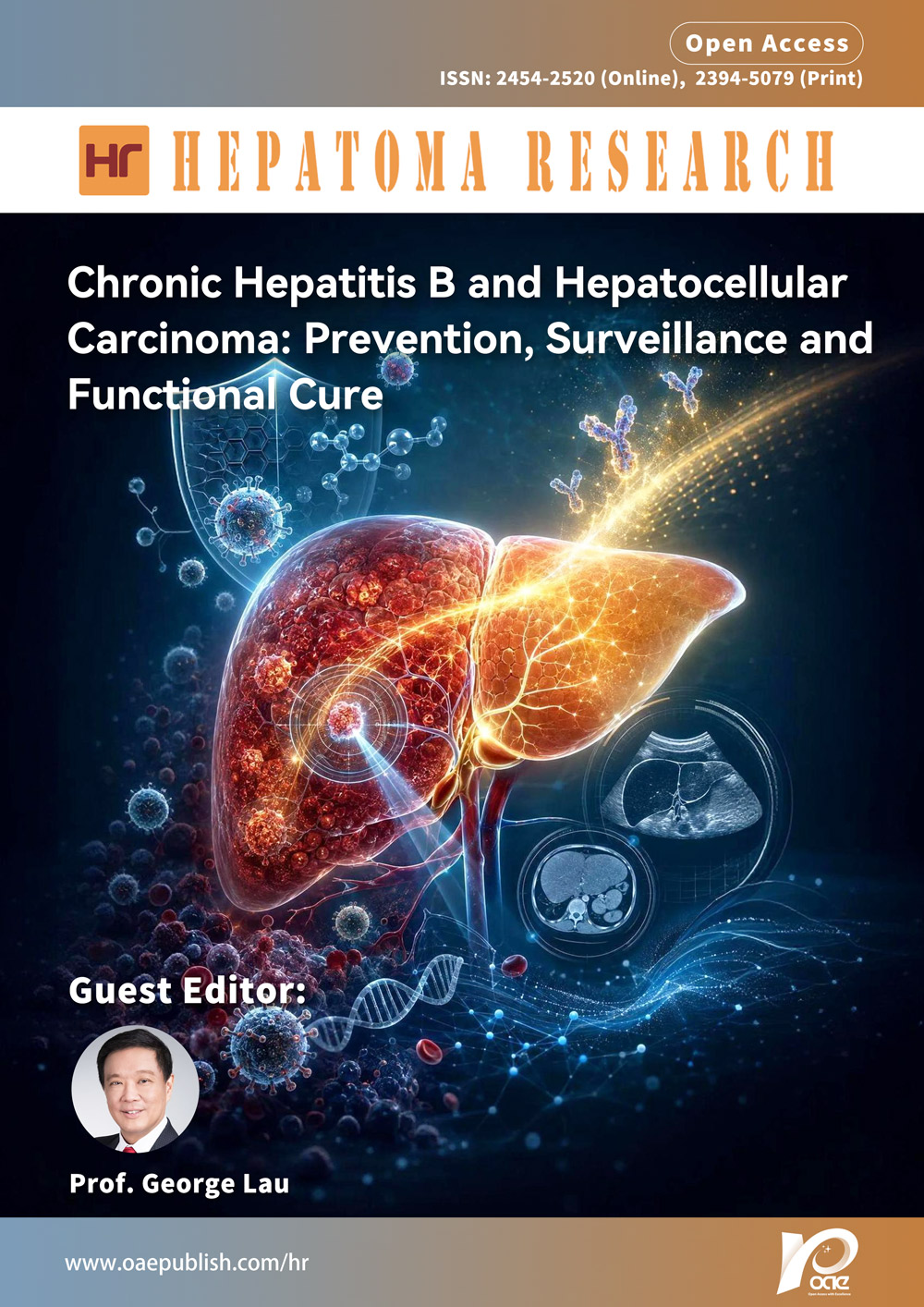
Topic: Chronic Hepatitis B and Hepatocellular Carcinoma: Prevention, Surveillance and Functional Cure
A Special Topic of Hepatoma Research
ISSN 2454-2520 (Online) 2394-5079 (Print)
Submission deadline: 20 Dec 2026
Guest Editor
Special Topic Introduction
This outlines nine pivotal frontiers in Chronic Hepatitis B (CHB) and Hepatocellular Carcinoma (HCC) research, encompassing novel therapeutic pipelines, residual oncogenic risk, expanded clinical criteria, precision biomarkers, computational surveillance, metabolic co-pathologies, cccDNA targeting, universal PMTCT elimination, and bench-to-bedside implementation science.
We welcome original research articles, reviews, mini-reviews, clinical trials, methodological studies, and perspectives focused on, but not limited to, the following topics:
1. Novel Combination Therapies for Functional Cure
Finite-duration regimens combining direct-acting antivirals (siRNA, antisense oligonucleotides like bepirovirsen, CAMs) and immunomodulators (Peg-IFNα, therapeutic vaccines) to achieve sustained HBsAg seroclearance.
2. Residual Hepatocellular Carcinoma (HCC) Risk Post-Functional Cure
Investigating persistent oncogenic mechanisms (HBV DNA host genomic integration, clonal hepatocyte expansion, epigenetic alterations) in patients achieving HBsAg clearance, and developing precision long-term surveillance protocols.
3. Expanding Antiviral Treatment Eligibility Criteria
Global and regional guideline revisions advocating for early treatment initiation in indeterminate-phase, gray-zone, and minimally viremic patients to prevent subclinical fibrosis progression and hepatocarcinogenesis.
4. Novel Biomarkers for Infection Monitoring & Surveillance
Clinical integration of quantitative hepatitis B core-related antigen (HBcrAg), circulating HBV RNA, and ultra-sensitive HBsAg assays to monitor intrahepatic cccDNA transcription, predict relapse post-NA cessation, and stratify HCC risk.
5. AI-Assisted and Liquid Biopsy-Driven HCC Surveillance
Overcoming sensitivity limitations of standard ultrasound and AFP screening through multi-analyte blood panels (GALAD score), cell-free DNA (cfDNA) methylation signatures, extracellular vesicles, and machine-learning risk prediction models.
6. Compounding Impact of MASLD/MASH in CHB Patients
Evaluating the synergistic pathogenic acceleration of hepatic steatosis, metabolic dysfunction, and chronic viral replication on accelerated fibrogenesis, cirrhosis progression, and elevated HCC incidence.
7. Targeting cccDNA Persistence and Epigenetic Silencing
Mechanisms and preclinical translational discovery targeting intrahepatic covalently closed circular DNA (cccDNA) degradation or permanent transcriptional inactivation using CRISPR/Cas gene editing, epigenetic modulators, and host restriction complexes.
8. Universal Birth-Dose Implementation and PMTCT Roadmaps
Implementation science and global policy to eliminate mother-to-child transmission (PMTCT), overcome delivery bottlenecks for universal 24-hour birth-dose vaccination, and optimize maternal antiviral prophylaxis in high-viremic pregnancies.
9. Implementation Science & Public Health Delivery
Translating guideline innovations into decentralized community delivery, point-of-care diagnostics, simplified primary-care treatment algorithms, health system policy frameworks, and regional viral elimination initiatives.
Submission Deadline
Submission Information
For Author Instructions, please refer to https://www.oaepublish.com/hr/author_instructions
For Online Submission, please login at https://www.oaecenter.com/login?JournalId=hr&IssueId=hr26082610590
Submission Deadline: 20 Dec 2026
Contacts: Vivienne Yan, Science Editor, yanweiwei@oaemesas.net