

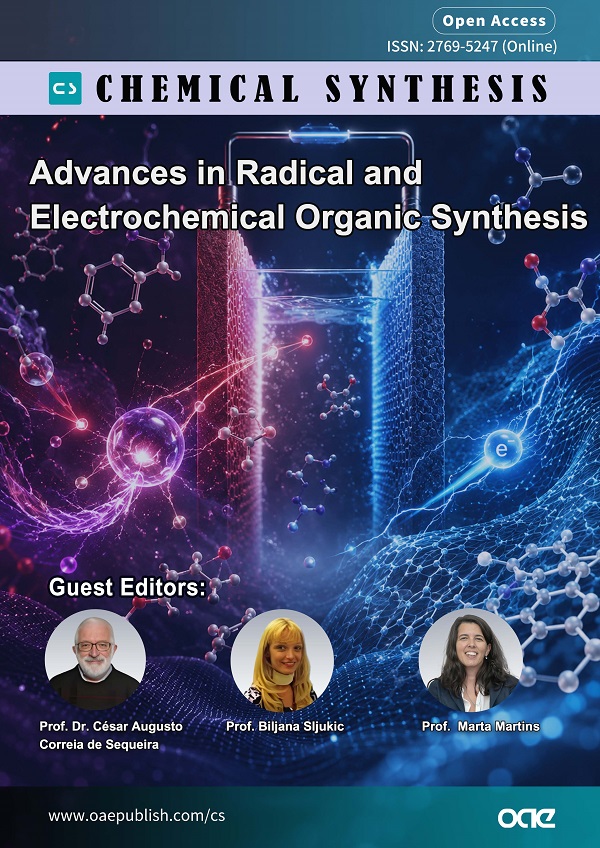
Topic: Advances in Radical and Electrochemical Organic Synthesis
Guest Editors
Special Topic Introduction
Recent studies on radical organic synthesis consider advanced ways for the formation of chemical bonds, paying particular attention to photoredox catalysis, electrochemical processes, polymerization and the construction of complex heterocyclic structures. Among the novel studies focusing different types of organic synthesis and their characterisation based in radicals, it seems to be important to cite studies such as:- Radical decarboxylation strategies for the synthesis of nitrogen-containing heteroaromatics using facile and efficient protocols; Expanding the scope of hyperbranched polymer synthesis by transfer-dominated branching radical telomerisation; Short lived radical characterisation, novel radical trap synthesis, application and methodology development; Chemistry of spin and stable organic radicals;Photocatalysis and visible light; etc. The suitability of these materials candidates as prospective film-forming materials and other advanced materials is being very discussed nowadays, leading to recomendations provided for potentially productive avenues for future research investment.
Another branch requiring deep research is organic electrochemical synthesis that has become an exciting area of research within the chemical sciences. The ability to replace stoichiometric reductants and oxidants with electrons themselves, arguably the simplest of reagents possible, has led to a myriad of synthetic applications fuelled partially by the drive for green chemistry. Furthermore, within the field of organic electrosynthesis the use of flow chemical reactors has become common due to the significant advantages these reactor designs possess over conventional batch electrolysis, which includes enhanced mass transport phenomena coupled with relatively easily realised high conversion rates. A recent and relevant example focuses on the reductive electrolysis of aryl halides resulting in the generation of aryl radicals, by using electrochemical mediators, which act as an electron shuttle from the electrode to the starting material resulting in a reaction layer that detaches from the electrode surface. This brings further advantages to electrosynthesis through an enhanced selectivity for the desired pathway by promoting single electron reductions and negating the effects of over-reduction. This methodology was applicable for the synthesis of benzofurans, furopyridines, and select examples of indoles and was easily scalable to multi-gram synthesis. This Special Issue deals with these topics that presently constitute key aspects of chemical science. It is believed that more than 10 experts would submit their excellent manuscripts to our SI, resulting in an excellent book of Chemical Synthesis.
Keywords
Radical organic synthesis, heterocyclic structures, radical decarboxylation, polymerization synthesis, organic electrosynthesis, electrochemical mediators, flow chemical reactors, scalable synthesis for green chemistry
Submission Deadline
Submission Information
For Author Instructions, please refer to https://www.oaepublish.com/cs/author_instructions
For Online Submission, please login at https://www.oaecenter.com/login?JournalId=cs&IssueId=cs26080310570
Submission Deadline: 31 Mar 2027
Contacts: Laura Chen, Managing Editor, editorialoffice@chesynjournal.com