
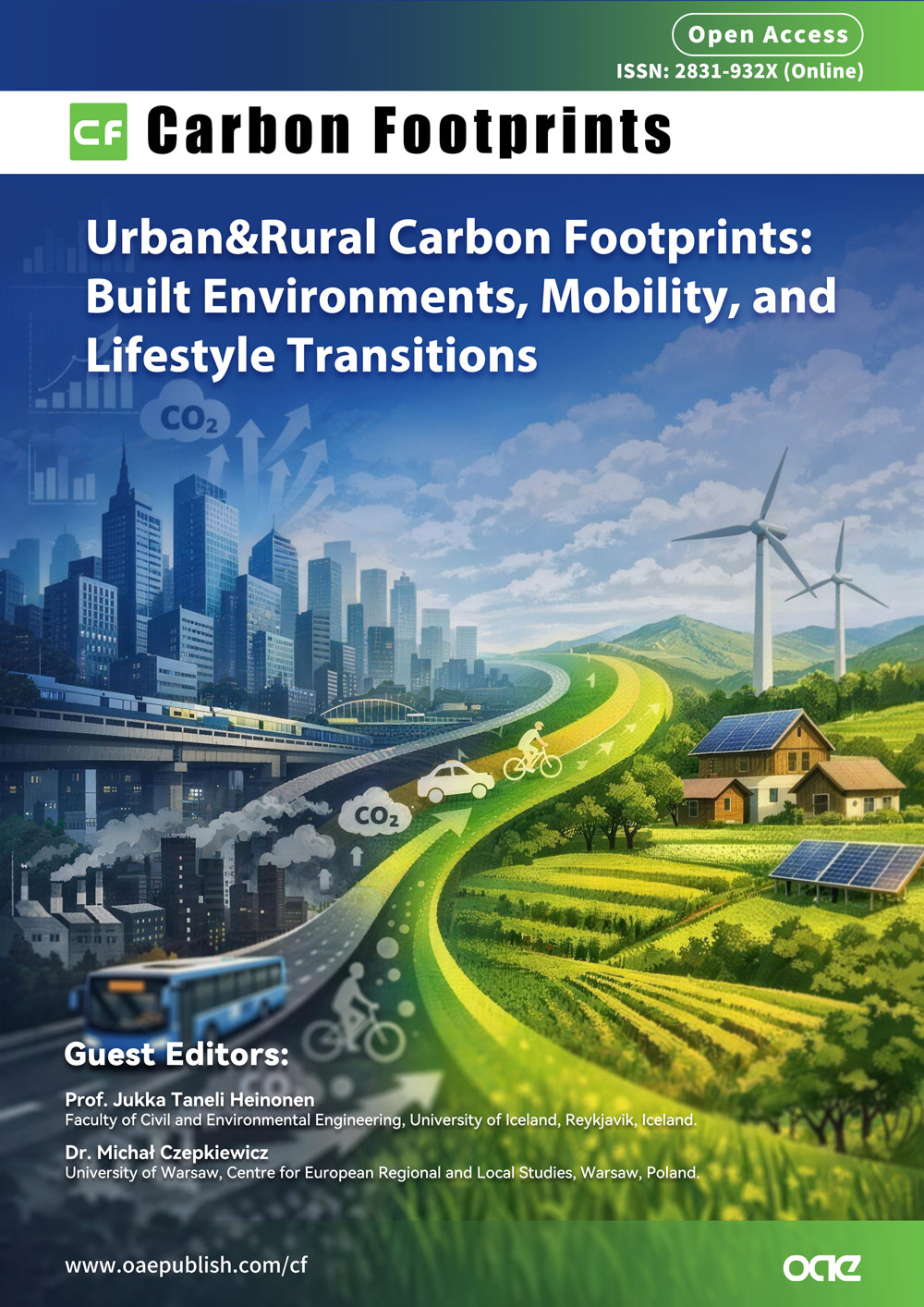
Topic: Urban & Rural Carbon Footprints: Built Environments, Mobility, and Lifestyle Transitions
Guest Editors
Special Topic Introduction
There has been a longstanding academic debate about how the built environment shapes greenhouse gas (GHG) emissions associated with human settlements. A substantial body of research has examined differences along the urban-rural gradient, particularly in the transport sector. Higher population density is generally associated with lower private car ownership and use, making urban densification an important climate mitigation strategy in transport.
However, the relationship between settlement patterns and emissions is far more complex. The built environment influences not only mobility but also lifestyles, daily routines, time use, and consumption opportunities across multiple domains. Urban dwellers, for example, often express greater concern about climate change and adopt certain pro-environmental behaviors, such as lower meat consumption. At the same time, they tend to undertake more long-distance travel, particularly by air, and to consume more goods and services. These patterns are linked not only to higher average incomes in cities but also to the greater availability, diversity, and accessibility of consumption options in dense urban settings.
As a result, the overall effect of the built environment on total carbon footprints remains contested. While urban form can reduce emissions from local transport, these savings may be offset by higher emissions from other lifestyle-related domains. Across both urban and rural contexts, affluence remains a dominant driver of emissions, and in many high-income regions, consumption-based carbon footprints far exceed climate sustainable levels regardless of settlement type.
At the same time, built environments are long-lasting and slow to change, and the global population is already distributed across a wide range of settlement forms. Nevertheless, many regions continue to experience urbanization, rural depopulation, and deagrarianization, all of which reshape livelihoods, lifestyles, and associated emission patterns, with significant social and ecological implications.
In this context, transformations in the built environment must contribute to reducing carbon footprints while supporting human well-being at low emission levels. This will require parallel changes in technologies, institutions, and social practices. The crucial question, therefore, is not whether urban or rural living is inherently more sustainable, but how different types of built environments can best enable people to “live well within ecological limits”.
Addressing this challenge requires attention to both material infrastructures and everyday lifestyles, and to how their interaction varies across contexts from the Global South to the Global North. This Special Issue invites contributions that advance understanding of the interconnections among built environments, lifestyles, well-being, and carbon footprints. We particularly welcome empirical studies that quantify the potential of different solution pathways, while also encouraging assessments of current emission patterns, policy analyses, and theoretical contributions that refine how we conceptualize and measure the ecological burdens associated with human settlements.
Subtopics:
1. Carbon footprint assessments related to human settlements and theoperation of the built environment;
2. Mitigation potentialof low-carbon development and lifestyle changes;
3. Achieving well-being and quality of life within remaining carbon budgets;
4. Built environments that support well-being at low carbon footprint levels and “safe and just corridors”;
5. Built environment development in relation toemissions, carbon sinks, and carbon storage;
6. Urban and rural lifestyle differences and associated GHG emissions;
7. Urbanization, rural depopulation, and deagrarianization: implicationsfor lifestyles and carbon footprints;
8. Development pathways acrossdiverse socioeconomic contexts from the Global South to the Global North.
Keywords
Carbon footprints of human settlements, built environment and urban-rural gradient, mobility, consumption emissions, lifestyle changes, affluence, well-being, carbon budgets, low-carbon transitions, policy pathways, living well within ecological limits
Submission Deadline
Submission Information
For Author Instructions, please refer to https://www.oaepublish.com/cf/author_instructions
For Online Submission, please login at https://www.oaecenter.com/login?JournalId=cf&IssueId=cf26012810368
Submission Deadline: 15 Aug 2026
Contacts: Leah Zhang, Assistant Editor, carbonfootprints@oaemesas.com