



Continuous glucose monitoring in insulin-treated diabetes beyond glycemic control and towards precision metabolic care
 0
0 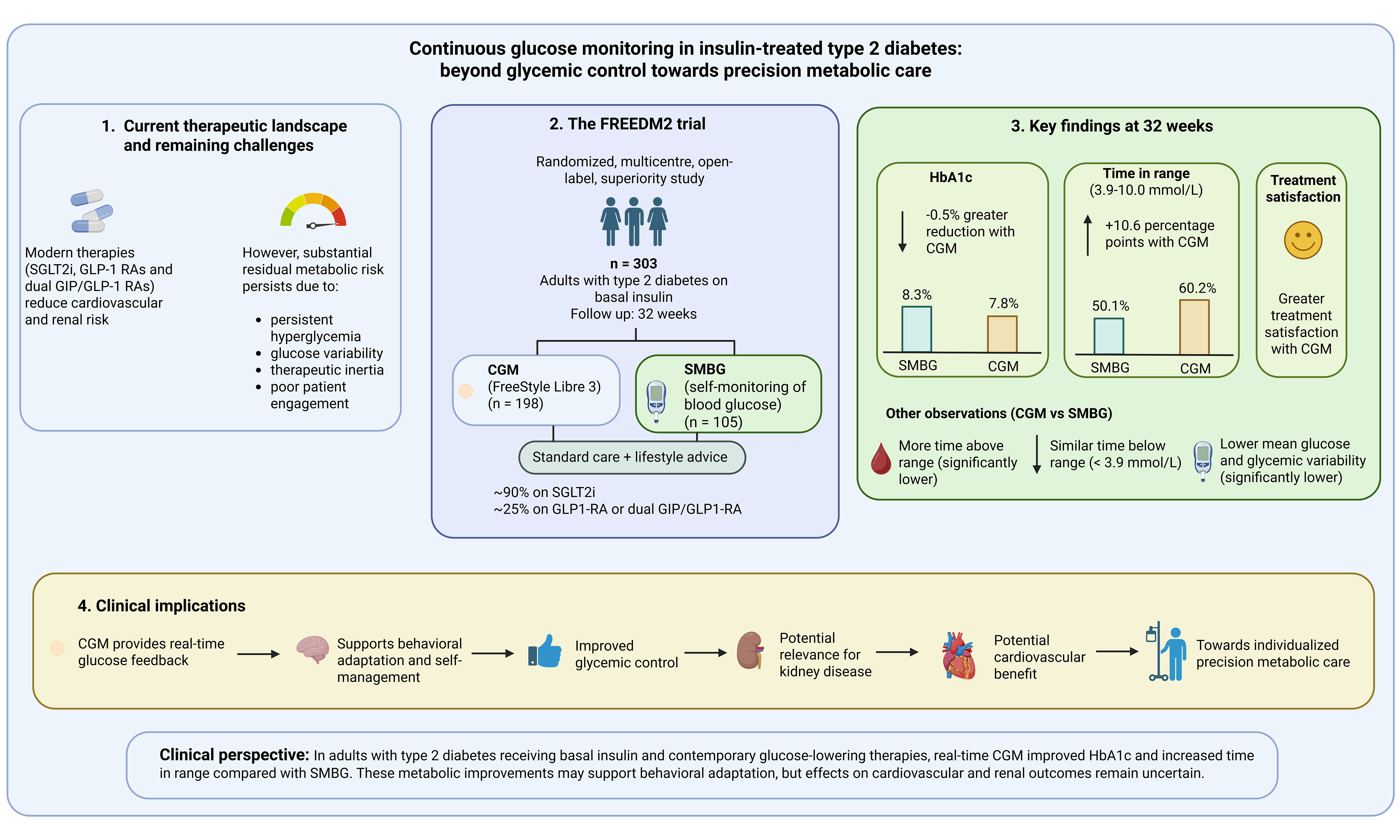
THE CHANGING THERAPEUTIC LANDSCAPE OF TYPE 2 DIABETES
The landscape of type 2 diabetes (T2D) treatment has changed dramatically over the past decade. Diabetes management no longer focuses solely on maintaining blood sugar levels. There is a growing trend toward using pharmaceuticals such as sodium-glucose cotransporter-2 (SGLT2) inhibitors, glucagon-like peptide-1 receptor agonists (GLP-1 RAs), and dual glucose-dependent insulinotropic polypeptide (GIP)/GLP-1 receptor agonists to substantially reduce the risks of cardiovascular disease (CVD), chronic kidney disease (CKD), heart failure, and premature death[1-3]. Despite these advances, a substantial residual metabolic risk remains. This is largely due to persistent high blood sugar, blood sugar fluctuations, delayed therapy, and poor patient engagement. In this context, the FreeDM2 trial by Wilmot et al. addresses an essential clinical question that has remained unclear despite rapid progress in drug treatment[4]. In other words, is continuous glucose monitoring (CGM) associated with clinical improvements in patients already receiving modern, organ-protective therapies? FreeDM2 turns the spotlight on CGM and questions the well-entrenched belief that CGM is mostly a tool for optimizing insulin dosing. Instead, FreeDM2 suggests that CGM may be viewed as an individualized metabolic management tool that facilitates behavioral adaptation and therapeutic decision-making. Rather than demonstrating cardiovascular or renal benefit, the trial provides evidence that CGM improves metabolic control within contemporary pharmacological care and may inform future precision metabolic management strategies. Whether these improvements ultimately translate into fewer cardiovascular events, slower CKD progression, or lower mortality remains unknown and cannot be inferred from the present study.
Previous randomized controlled trials (RCTs) have shown that glucose monitoring systems remain relevant tools for optimizing drug therapy, even in complex T2D scenarios, such as those involving basal insulin. Previous basal insulin CGM trials were conducted in populations with less extensive use of contemporary glucose-lowering therapies than FreeDM2. Notably, the MOBILE study permitted concomitant noninsulin therapies and included participants receiving GLP-1 RAs, although use of newer cardiorenal protective agents was substantially less prominent than in FreeDM2[5,6]. Therefore, FreeDM2 provides important evidence regarding the incremental metabolic effects of CGM in a population receiving more contemporary multidrug therapy. At baseline, 88% of participants in the CGM group and 86% in the self-monitoring of blood glucose (SMBG) group were receiving SGLT2 inhibitors, while 26% and 27%, respectively, were treated with GLP-1 RAs or dual GIP/GLP-1 RAs. Overall, these findings indicate that the study population reflected contemporary guideline-based pharmacotherapy[4].
But the extensive use of highly effective glucose-lowering medications also makes it more difficult for studies to show that a treatment offers more benefit than simply lowering glucose levels (i.e., additional clinical benefit). At this stage, the significant reduction in glycated hemoglobin A1c (HbA1c) does not necessarily reflect a clinically meaningful additional benefit. However, the clinical usefulness of CGM depends heavily on its ability to fill therapeutic gaps that pharmacological therapy alone cannot fully address, such as fluctuating blood glucose levels, limited opportunities for therapy adjustments, and poor patient involvement.
FreeDM2 IDENTIFIES A BEHAVIORAL MECHANISM OF ACTION FOR CGM
One major advantage of FreeDM2 is its research approach, which isolated the impact of patient-directed behavioral changes from that of clinician-directed therapeutic intensification[4]. This step-by-step method provided a rare opportunity to separate behavioral effects from those attributable to pharmacological optimization, a major limitation of previous CGM trials in which medication adjustments and glucose monitoring were conducted simultaneously. Results showing clinically significant improvements in glycemic control even before clinician-directed treatment intensification support the idea that CGM’s main advantage goes beyond simply helping insulin titration. FreeDM2 suggests that continuous physiological feedback may facilitate behavioral adaptation, potentially influencing diet, physical activity, and medication adherence. Those given CGM showed significantly more physical activity, a healthier diet, and greater satisfaction with their treatment than those who did SMBG only. Moreover, these behavioral changes occurred even before differences in pharmacological intensification became apparent. This temporal sequence supports the hypothesis that early improvements in glycemic control were largely mediated by behavioral adaptation rather than medication escalation, although alternative explanations cannot be excluded.
CGM functions as a behavior-interactive support technology, not merely a glucose-measuring device. However, this may raise questions about the justification for treating CGM as a digital therapeutic (DTx). Digital therapeutics are typically defined as software interventions that prevent, manage, or cure diseases through a therapeutic mechanism and demonstrate a clinically meaningful advantage, supported by strong clinical evidence such as RCTs[7-9]. Unlike traditional digital health technologies, which mainly measure physical parameters or enable communication, DTx aims to deliver a direct therapeutic effect by altering patient behavior, increasing adherence, or providing evidence-based therapeutic interventions.
The FreeDM2 trial exhibits several characteristics that align with this conceptual framework[4]. As discussed above, the behavioral changes observed before clinician-directed treatment intensification support the hypothesis that continuous physiological feedback may facilitate self-management. Although the causal contribution of this mechanism remains uncertain, these findings are consistent with behavioral frameworks in which feedback, self-efficacy, and motivation can contribute to health-related behavior change[10,11].
However, numerous counterpoints suggest CGM should not be categorically labeled as DTx. One counterargument is that CGM mainly measures and displays physiological data rather than delivering well-defined therapeutic interventions, which can be linked to software-only digital behavioral therapy, digital diabetes prevention programs, or digitally prescribed therapeutic products that regulatory agencies have already cleared. The health gains the researchers observed may also have stemmed mainly from a combination of factors, including continuously displayed blood glucose levels, which can give the patient an overview of their body’s condition; active involvement of medical staff; patient education; self-monitoring support; and subsequent therapeutic change. In other words, the study is unlikely to show how much of the improvement is attributable to the behavioral software intervention alone. Third, DTx models increasingly emphasize demonstrating substantial clinical outcomes rather than improvements in surrogate biomarkers alone. Although the FreeDM2 trial achieved a marked HbA1c reduction and improved time in range (TIR) that clinicians consider clinically meaningful, it evaluated metabolic efficacy rather than hard clinical outcomes. This issue is discussed in more detail below in the section on TIR as a surrogate endpoint.
In terms of regulation, software is most often grouped by what it is expected to do and how it functions; for example, it is rarely assigned to a specific DTx category. The U.S. Food and Drug Administration (FDA) classifies software that aims to diagnose, cure, treat, prevent, or mitigate disease as medical device software that may be regulated, while other functions related to clinical decision support may not fall under the device definition. So, even though CGM systems could change people’s behavior for treatment, these systems are mainly seen as glucose-measuring and monitoring medical devices by the regulatory bodies and not as therapeutic standalone software interventions[12,13]. Future generations of CGM, integrated with artificial intelligence-driven behavioral coaching, individualized therapeutic recommendations, and validated clinical decision support, may increasingly blur this distinction.
Importantly, although the observed temporal sequence supports the biological plausibility of a behavioral mechanism, the FreeDM2 trial cannot establish causality. CGM is a composite intervention that delivers feedback about the patient’s physiology, promotes self-monitoring, encourages patients to take part in their management, heightens clinicians’ focus, and may change behaviors via ‘Hawthorne’ effects[14]. As a result, the extent of behavioral adjustments that led to better glycemic control cannot be clearly distinguished from other confounding factors. Importantly, the behavioral improvements observed in FreeDM2 were not sustained throughout the study. Improvements in total physical activity and diet quality were evident at week 16 but were no longer significantly different between groups at week 32[4]. This attenuation suggests that the behavioral effects associated with CGM may diminish over time and highlights the need for longer-term real-world studies incorporating objective assessments of dietary intake, physical activity, medication adherence, and behavioral factors to determine whether CGM can produce sustained behavioral changes and whether those changes translate into improved clinical outcomes.
BEYOND HbA1c: THE IMPORTANCE OF CGM-DERIVED METRICS
The clinical relevance of FreeDM2 extends beyond its modest decrease in HbA1c, highlighting the value of CGM-derived indices in assessing overall metabolic control. HbA1c, unlike glucose variability or hypoglycemia, is a single value that summarizes average glycemia over time without detailing fluctuations or low-blood-sugar episodes. In contrast, CGM quantifies not only TIR and time above range (TAR) but also the full dynamic picture of daily glucose exposure. The major clinical finding in FreeDM2 was improved TIR (3.9-10.0 mmol/L). Baseline TIR was 39.7% in the CGM group and 41.9% in the SMBG group. At 32 weeks, TIR increased to 60.2% and 50.1%, respectively, corresponding to an adjusted between-group difference of +10.6 percentage points [95% confidence interval (CI): 4.8 to 16.3; P = 0.0004]. Although higher TIR has been associated with a lower risk of several diabetes related complications and adverse outcomes, such observational associations alone cannot establish TIR as a valid surrogate endpoint. As established in biomarker evaluation systems, such as Prentice’s operational criteria for surrogate endpoints[15] and the FDA-NIH BEST (Biomarkers, EndpointS, and other Tools) Resource[16], biomarker requirements go far beyond demonstrating predictive value. A validated surrogate endpoint must reliably reflect intervention’s impact on the chosen clinical endpoint, such that changes in the surrogate due to therapy consistently correspond to and predict proportional changes in patient-important clinical outcomes across different RCTs.
At present, TIR is best regarded as a clinically useful biomarker rather than a validated surrogate endpoint. The Consensus Statement on Time in Range from an international group recognizes TIR as an important CGM metric in clinical practice, alongside HbA1c, which together enable assessment of glycemic levels and support decision-making for managing diabetes[17]. A close relationship between TIR and HbA1c has been well documented across various patient groups, further confirming TIR’s utility as a measure of overall glycemic exposure[18]. Higher TIR has been associated with a lower risk of diabetic retinopathy and albuminuria[19], while observational studies have also reported associations between higher TIR and lower prevalence of peripheral neuropathy[20] and lower risks of all-cause and cardiovascular mortality[21]. However, these associations do not establish TIR as a validated surrogate endpoint for these clinical outcomes. People with higher TIR tend to have less severe diabetes, follow better treatment schedules, live healthier lives, have fewer comorbidities, and are more attentive to the diabetes care program, aspects that will probably result in a better prognosis independently.
RCTs showing that interventions raise TIR do not necessarily confirm that TIR is an adequate surrogate endpoint. To claim TIR is a surrogate endpoint, one must provide evidence that improvements in treatment-induced TIR consistently relate to benefits in hard clinical endpoints. Such a relationship should be formally demonstrated through patient-level or trial-level surrogate validation across different drugs and populations, as Prentice first did and later incorporated into modern biomarker qualification structures[15,16]. Currently, no such body of evidence exists for TIR.
The FreeDM2 trial therefore provides important evidence that CGM substantially improves TIR, with an adjusted between-group difference of 10.6 percentage points at week 32. However, it was neither designed nor powered to determine whether this improvement translates into reductions in long-term complications. Consequently, the observed improvement in TIR should be interpreted as evidence of improved metabolic control rather than proof of improved cardiovascular or renal prognosis.
CGM AS A COMPLEMENTARY STRATEGY TO REDUCE RESIDUAL CARDIORENAL RISK
The broader significance of FreeDM2 lies in identifying a plausible mechanism through which components of residual metabolic risk may eventually be addressed. Some factors, such as chronic high blood sugar, fluctuations in blood sugar levels, slow or lack of change in treatment, and poor self-management, are still not fully addressed even after the latest drug therapies are administered. FreeDM2 demonstrates improvements in several intermediate determinants of metabolic control, including HbA1c, TIR, behavioral engagement, and treatment satisfaction[4].
An equally important question is whether the incremental benefit of CGM will remain constant as pharmacological management evolves. As the use of highly effective incretin-based therapies that substantially reduce glucose variability and body weight increases, the absolute clinical benefit attributable to CGM may progressively diminish. Future studies should therefore identify the patient subgroups most likely to benefit, rather than assuming uniform effectiveness across the increasingly heterogeneous population with T2D. The concept of precision metabolic care is not, by itself, proof that CGM can prevent cardio- and renal-related events. Rather, it is the use of CGM as a precision medicine tool that targets patients most likely to benefit, with an incremental effect. Possible candidate groups include people with high blood sugar levels even after using maximum doses of appropriate drugs; those with large fluctuations in blood sugar levels; people who experience very low blood sugar levels too often; patients experiencing therapeutic inertia despite persistent hyperglycemia; people with long-term kidney disease; elderly patients who are at risk of very low blood sugar levels; and those who require very complicated combinations of medication to be taken at one time. RCTs need to validate these clinically based characteristics to see whether they are the best criteria for identifying which patients will respond best to CGM, apart from their medications.
IMPLICATIONS FOR KIDNEY DISEASE
From a nephrology perspective, FreeDM2 raises the important question of whether sustained improvements in glucose stability can augment the renoprotective effects of contemporary pharmacologic therapy. Although biologically plausible, the hypothesis that improved glucose stability provides additive renal protection remains untested. Existing renoprotective therapies derive their benefits predominantly from hemodynamic and pleiotropic mechanisms rather than from glucose monitoring itself. Consequently, no evidence currently demonstrates that CGM independently slows CKD progression or reduces albuminuria beyond its effects on glycemic control.
LIMITATIONS AND FUTURE DIRECTIONS
Despite its strengths, several limitations should temper interpretation of the findings. First, the open-label design may have increased behavioral engagement and treatment satisfaction among participants allocated to CGM, although objective endpoints such as HbA1c were unlikely to have been substantially affected. Second, the 32-week follow-up is insufficient to determine whether the observed behavioral adaptations and improvements in glucose control are sustained over the prolonged periods during which diabetic complications develop. Finally, it would be difficult to expect the very high adherence found in this trial to be replicated in typical care. Therefore, long-term pragmatic studies are needed to determine whether CGM’s advantages are sustained in routine clinical practice.
Another important limitation is that FreeDM2 was not powered to evaluate hard clinical endpoints. Decreases in HbA1c and increases in TIR are positive signs; yet the expectation that they will ultimately lead to fewer heart problems, less CKD progression, and better overall outcomes remains unproven.
Although improved glycemic control and treatment satisfaction are desirable outcomes, these benefits must be balanced against the substantial costs of long-term CGM use. Future economic assessments should incorporate long-term clinical outcomes.
Comprehensive cost-effectiveness analyses that incorporate cardiovascular, renal, and quality-of-life outcomes should establish whether the clinical benefits of CGM justify widespread implementation in insulin-treated T2D. FreeDM2 suggests that CGM may increasingly complement evidence-based pharmacological therapy by supporting individualized metabolic management.
CONCLUSIONS
FreeDM2 showed that real-time CGM use improves blood glucose levels, as measured by HbA1c and TIR, and encourages patient engagement, particularly among patients with T2D who use insulin and are receiving current glucose-lowering treatments. These findings support a broader role for CGM as a tool for individualized metabolic management, extending beyond insulin dose optimization.
DECLARATIONS
Acknowledgments
Graphical Abstract created by the authors using BioRender [Created in BioRender. Speeckaert, M. (2026) https://BioRender.com/wbdbrf4].
Authors’ contributions
Conceptualization, literature review, writing, original draft preparation, and critical revision of the manuscript: Delrue C
Conceptualization, supervision, literature review, writing, review and editing, and critical revision of the manuscript: Speeckaert MM
Availability of data and materials
Not applicable.
AI and AI-assisted tools statement
Not applicable.
Financial support and sponsorship
None.
Conflicts of interest
Both authors declared that there are no conflicts of interest.
Ethical approval and consent to participate
Not applicable.
Consent for publication
Not applicable.
Copyright
© The Author(s) 2026.
REFERENCES
1. American Diabetes Association Professional Practice Committee. 9. Pharmacologic approaches to glycemic treatment: standards of care in Diabetes-2025. Diabetes Care. 2025;48:S181-206.
2. Davies MJ, Aroda VR, Collins BS, et al. Management of hyperglycaemia in type 2 diabetes, 2022. A consensus report by the American Diabetes Association (ADA) and the European Association for the Study of Diabetes (EASD). Diabetologia. 2022;65:1925-66.
3. Kidney Disease: Improving Global Outcomes (KDIGO) Diabetes Work Group. KDIGO 2022 Clinical Practice Guideline for Diabetes Management in Chronic Kidney Disease. Kidney Int. 2022;102:S1-127.
4. Wilmot EG, Moore P, Sathyapalan T, et al. ; FreeDM2 Study Group. Continuous glucose monitoring versus self-monitoring of blood glucose in individuals with type 2 diabetes: a randomised, multicentre, open-label, superiority trial. Lancet Diabetes Endocrinol. 2026;14:463-74.
5. Aleppo G, Beck RW, Bailey R, et al. ; MOBILE Study Group, Type 2 Diabetes Basal Insulin Users: The Mobile Study (MOBILE) Study Group. The effect of discontinuing continuous glucose monitoring in adults with type 2 diabetes treated with basal insulin. Diabetes Care. 2021;44:2729-37.
6. Martens T, Beck RW, Bailey R, et al. ; MOBILE Study Group. Effect of continuous glucose monitoring on glycemic control in patients with type 2 diabetes treated with basal insulin: a randomized clinical trial. JAMA. 2021;325:2262-72.
7. Dang A, Arora D, Rane P. Role of digital therapeutics and the changing future of healthcare. J Family Med Prim Care. 2020;9:2207-13.
8. Phan P, Mitragotri S, Zhao Z. Digital therapeutics in the clinic. Bioeng Transl Med. 2023;8:e10536.
9. Ribba B, Peck R, Hutchinson L, Bousnina I, Motti D. Digital therapeutics as a new therapeutic modality: a review from the perspective of clinical pharmacology. Clin Pharmacol Ther. 2023;114:578-90.
10. Bandura A. Self efficacy: the exercise of control. New York: W.H. Freeman and Company; 1997. Available from https://search.worldcat.org/zh-cn/title/36074515. [accessed 24 September 2026].
11. Michie S, van Stralen MM, West R. The behaviour change wheel: a new method for characterising and designing behaviour change interventions. Implement Sci. 2011;6:42.
12. U. S. Food and Drug Administration. Policy for device software functions and mobile medical applications: guidance for industry and Food and Drug Administration staff. Silver Spring, MD: U.S. Food and Drug Administration; 2022. Available from https://www.fda.gov/media/80958/download. [accessed 24 September 2026].
13. U. S. Food and Drug Administration. Clinical decision support software: guidance for industry and Food and Drug Administration staff. Silver Spring, MD: U.S. Food and Drug Administration; 2022. Available from https://www.fda.gov/media/109618/download. [accessed 24 September 2026].
14. McCambridge J, Witton J, Elbourne DR. Systematic review of the Hawthorne effect: new concepts are needed to study research participation effects. J Clin Epidemiol. 2014;67:267-77.
15. Prentice RL. Surrogate endpoints in clinical trials: definition and operational criteria. Stat Med. 1989;8:431-40.
16. FDA NIH Biomarker Working Group. BEST Biomarkers EndpointS and other Tools Resource. Silver Spring, MD: Food and Drug Administration; Bethesda, MD: National Institutes of Health; 2016. Available from https://www.ncbi.nlm.nih.gov/books/NBK326791/. [accessed 24 September 2026].
17. Battelino T, Danne T, Bergenstal RM, et al. Clinical targets for continuous glucose monitoring data interpretation: recommendations from the international consensus on time in range. Diabetes Care. 2019;42:1593-603.
18. Vigersky RA, McMahon C. The relationship of hemoglobin A1C to time-in-range in patients with diabetes. Diabetes Technol Ther. 2019;21:81-5.
19. Beck RW, Bergenstal RM, Riddlesworth TD, et al. Validation of time in range as an outcome measure for diabetes clinical trials. Diabetes Care. 2019;42:400-5.
20. Mayeda L, Katz R, Ahmad I, et al. Glucose time in range and peripheral neuropathy in type 2 diabetes mellitus and chronic kidney disease. BMJ Open Diabetes Res Care. 2020;8:e000991.
Cite This Article
 Open Access
How to Cite
Delrue C, Speeckaert MM. Continuous glucose monitoring in insulin-treated diabetes beyond glycemic control and towards precision metabolic care. Metab Target Organ Damage. 2026;6:62. https://dx.doi.org/10.20517/mtod.2026.169
Download Citation
Export Citation File:
Type of Import
Tips on Downloading Citation
Citation Manager File Format
Type of Import
Direct Import: When the Direct Import option is selected (the default state), a dialogue box will give you the option to Save or Open the downloaded citation data. Choosing Open will either launch your citation manager or give you a choice of applications with which to use the metadata. The Save option saves the file locally for later use.
Indirect Import: When the Indirect Import option is selected, the metadata is displayed and may be copied and pasted as needed.
About This Article
Copyright

Data & Comments
Data
0






Comments
Comments must be written in English. Spam, offensive content, impersonation, and private information will not be permitted. If any comment is reported and identified as inappropriate content by OAE staff, the comment will be removed without notice. If you have any queries or need any help, please contact us at support@oaepublish.com.