



A novel homozygous variant in the ABCG8 gene identified in a child with sitosterolemia
 0
0 Abstract
To investigate the etiology of anemia and recurrent epistaxis in a Chinese boy, we conducted a comprehensive blood morphological examination. Whole-exome sequencing (WES) was performed to identify potential pathogenic variants. Gas chromatography-mass spectrometry (GC-MS) was used to measure plasma phytosterols. Peripheral blood film analysis revealed stomatocytosis and large platelets. A novel homozygous missense variant (c.680T>C; p. Leu227Pro) was identified in the ABCG8 gene. GC-MS demonstrated significantly elevated plasma phytosterol levels. In vitro minigene assays indicated that this variant may disrupt ABCG8 mRNA splicing. This study suggests that abnormal blood morphology can hint at potential inherited metabolic disorders; however, a definitive diagnosis requires genetic testing and specific biochemical indicators. Exonic variants may not only alter single nucleotides but also affect splicing. Our findings expand the spectrum of pathogenic ABCG8 variants.
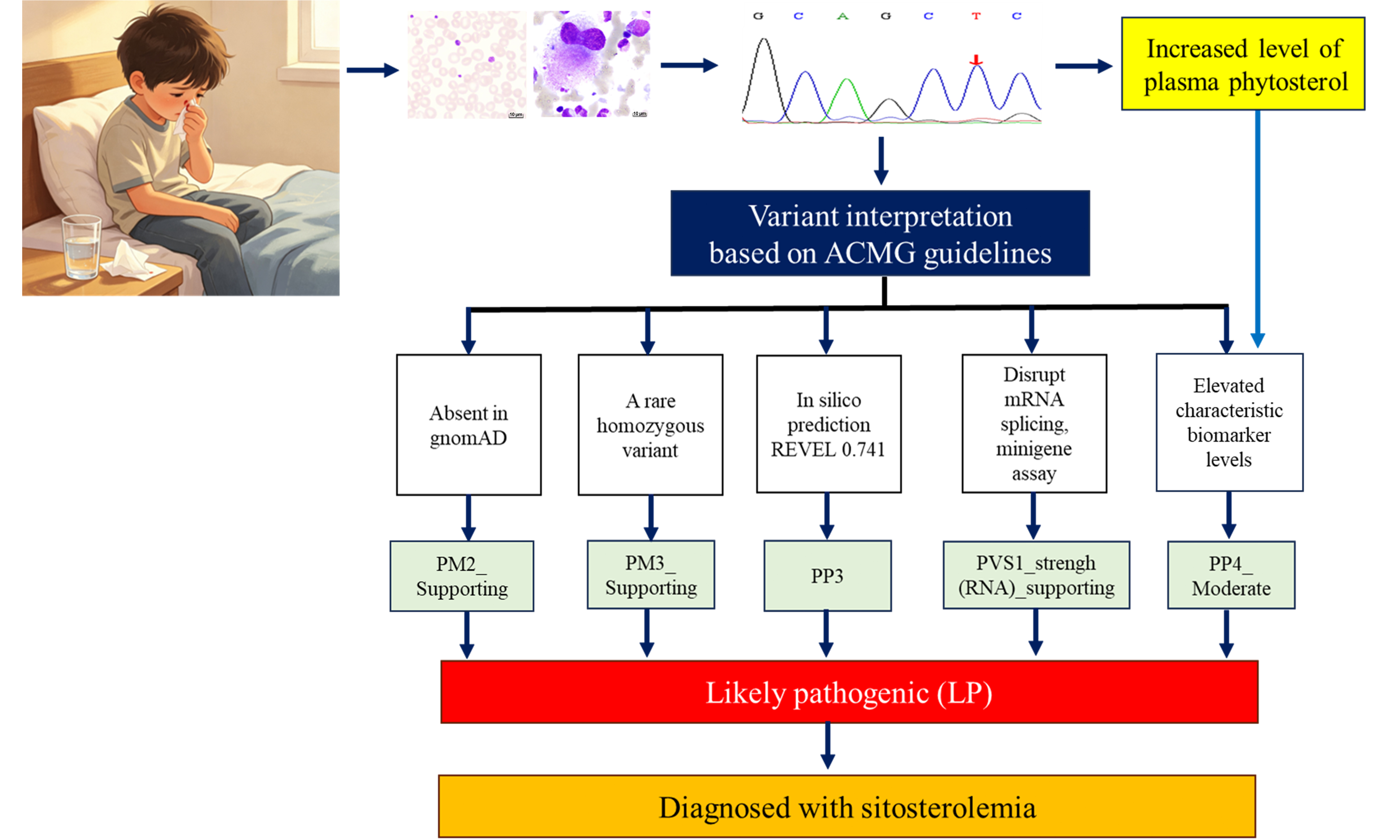
Keywords
INTRODUCTION
Sitosterolemia is a rare autosomal recessive disease. It was first reported in 1974[1]. The disease is related mainly to the adenosine triphosphate (ATP)-binding cassette subfamily G member 5 or member 8 (ABCG5 or ABCG8). Mutations in these two genes predispose patients to reduced biliary excretion and increased intestinal absorption of sterols[2]. The carrier frequency of deleterious mutations in ABCG5 and/or ABCG8 in the general population may exceed 1 in 200,000 individuals[3].
The disease typically presents with xanthomas, hematological disorders, arthralgia, atherosclerosis, splenomegaly, and markedly elevated phytosterol and low-density lipoprotein (LDL) levels[4]. However, patients with only hematological symptoms are likely to be missed or misdiagnosed[5]. The diagnosis of sitosterolemia depends on plasma phytosterols and/or mutations in the ABCG5/ABCG8 genes[6].
Here, we describe a boy with sitosterolemia 1 (OMIM#210250) caused by a novel homozygous missense variant in the ABCG8 gene inherited from both parents. This variant was initially classified as a variant of uncertain significance (VUS). Minigene experiments subsequently demonstrated a greater proportion of aberrant splicing in the mutant construct, which led to the reclassification of the variant as likely pathogenic (LP)[7].
CASE PRESENTATION
Patient phenotype
A 3-year-old male with a history of refractory nasal hemorrhage was admitted. The patient exhibited pallor and fatigue during severe episodes. Physical examination revealed no xanthomas, petechiae, hepatosplenomegaly, or musculoskeletal abnormalities. Ecchymoses, hematochezia, and other hemorrhagic manifestations were not observed. Anthropometric measurements showed a height of 100 cm (3rd-10th percentile) and a weight of 14 kg (3rd-10th percentile).
The patient was born at term via vaginal delivery (G2P2) and has two healthy sisters and no family history of inherited metabolic disorders. The parents are of Han Chinese ethnicity and are not consanguineous. He exhibited selective eating behaviors, avoiding vegetables and meat (particularly fatty meat) and mainly eating rice.
Hematological evaluation revealed bicytopenia, with red blood cell (RBC) and platelet counts below the lower limit of normal. The platelet large cell ratio (P-LCR) exceeded the upper limit of normal [Supplementary Table 1]. Peripheral blood film analysis demonstrated anisocytosis with macrocytes, polychromatic erythrocytes, and stomatocytes. Numerous large platelets were observed [Figure 1A and B]. Bone marrow aspiration revealed trilineage hyperplasia, with frequent large platelet precursors [Figure 2A]. The proportion of platelet-producing megakaryocytes was 22%, lower than the normal median of 35.24% but within the range between the 2.5th and 97.5th percentiles (reference range 10.12%-64.06%) [Figure 2B][8]. The patient’s lipid and coagulation parameters were within normal limits. Cardiac, vascular, and abdominal visceral ultrasound examinations were unremarkable. Flow cytometric analysis revealed normal expression of the platelet membrane glycoproteins CD41a, CD42a, CD42b, and CD61 (data not shown).
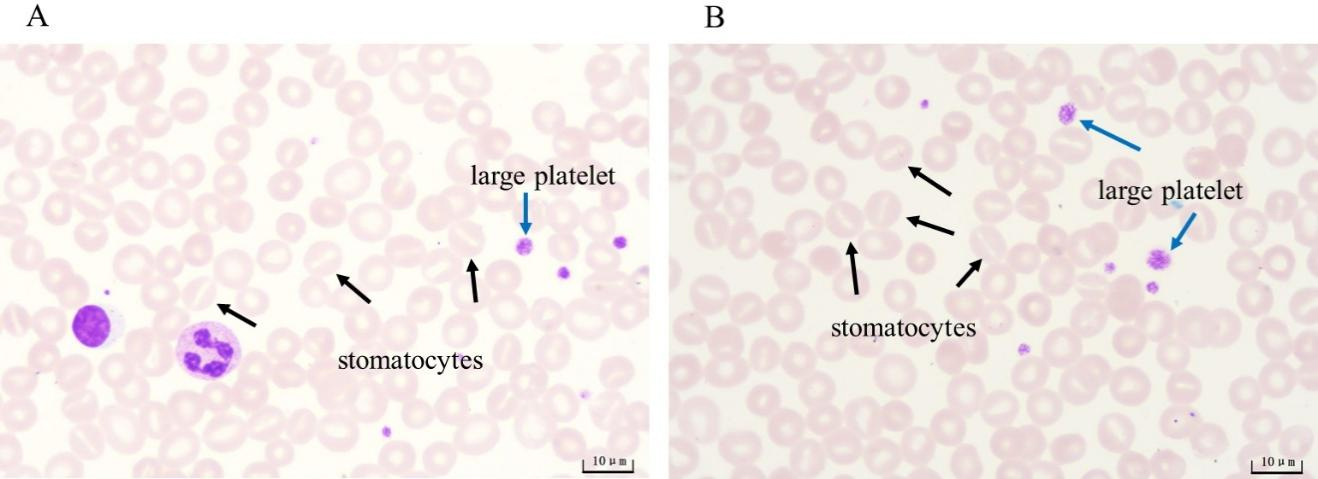
Figure 1. (A and B) Representative images from different fields of view of the same slide. Peripheral blood smears revealed large platelets (blue arrows) and stomatocytes (black arrows).
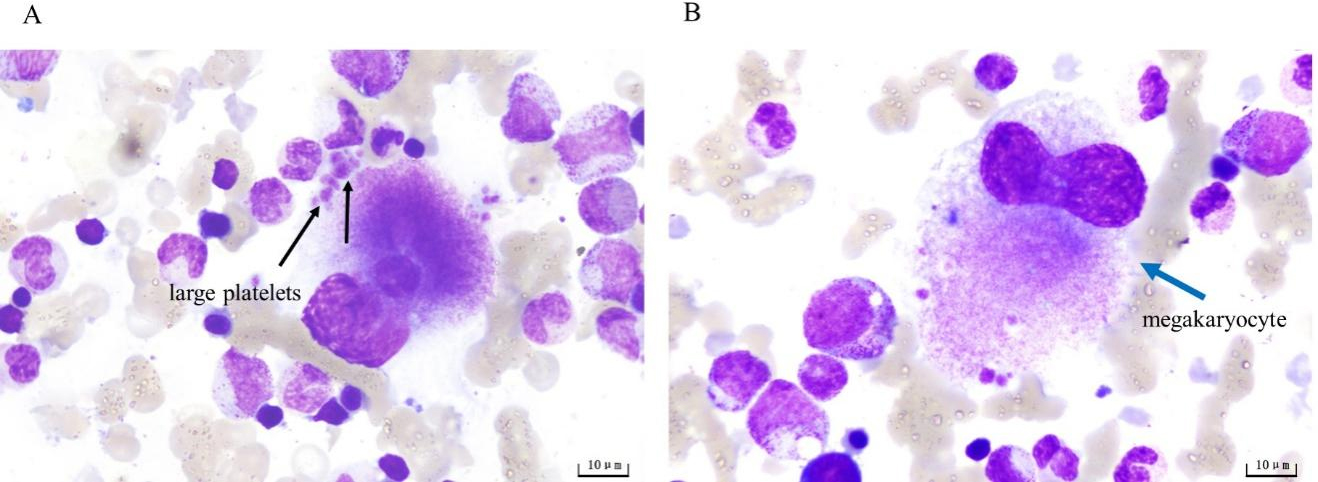
Figure 2. (A and B) Representative images from different fields of view of the same slide. Bone marrow smear showed (A) large platelets distributed in clusters (black arrows); (B) a platelet-producing megakaryocyte (blue arrow).
The patient underwent iron replacement therapy. Although hematological parameters improved significantly (hemoglobin concentration increased to 123 g/L; platelet count fluctuated between 101 and 138 × 109/L)
Genetic testing and functional validation
To elucidate the underlying etiology, we conducted whole-exome sequencing (WES). Peripheral blood samples were collected from the proband, both parents, and sisters for WES. Online prediction tools (https://swissmodel.expasy.org/, https://rddc.tsinghua-gd.org/) were used to predict the pathogenicity of the variant.
Plasma phytosterols were tested by gas chromatography-mass spectrometry (GC-MS). In vitro minigene experiments were used to verify the abnormal splicing function caused by the variant. Briefly, the mutant and wild-type vectors of the ABCG8 gene were constructed using the vector backbones pcDNA3.1 [Figure 3A] and pcMINI-C, respectively. The resulting constructs were transiently transfected into HeLa and 293 T cells. After 48 h of culture, the cells were harvested for transcriptional analysis.
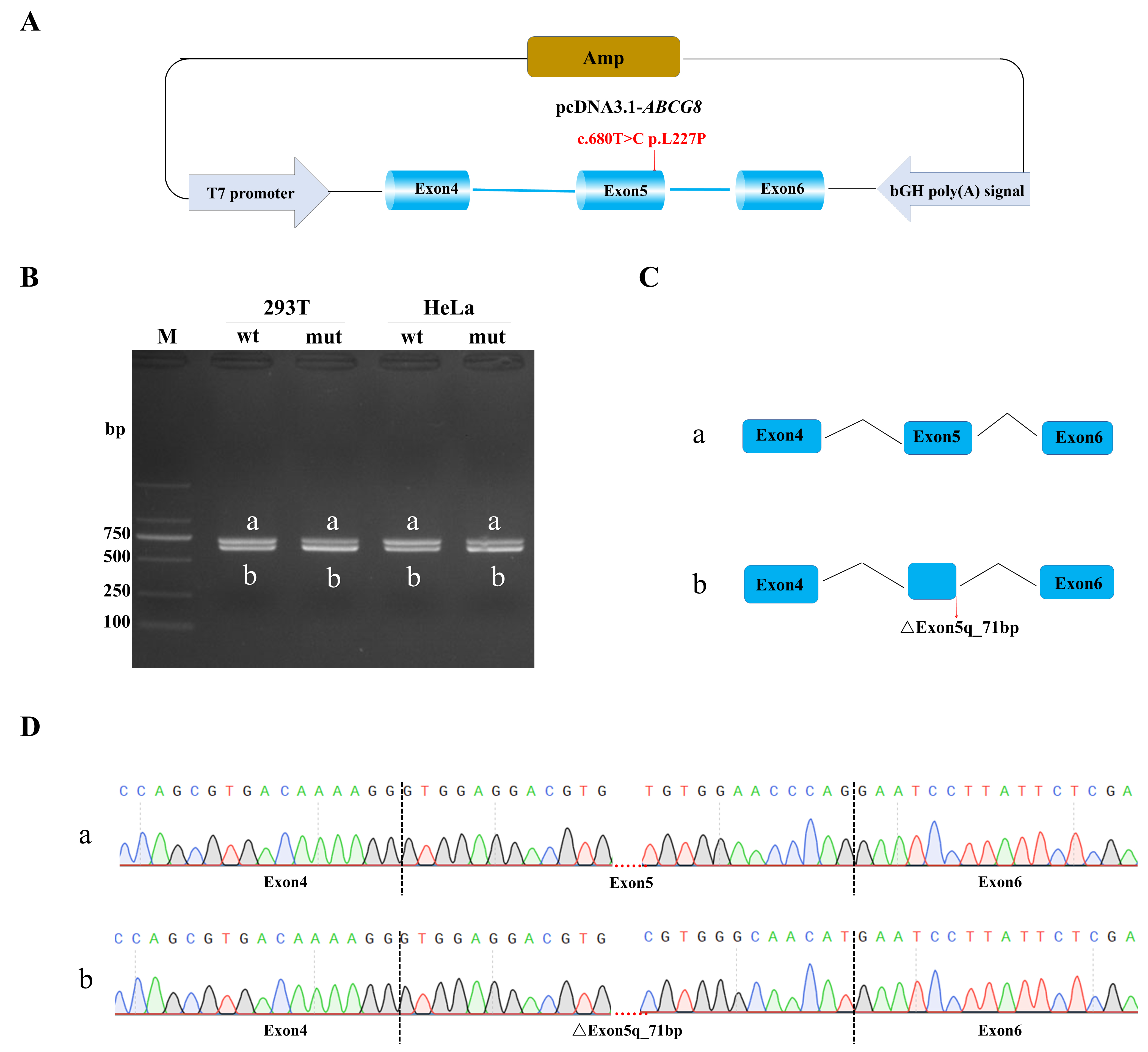
Figure 3. The results of minigene verification. (A) Minigenes were constructed with the pcDNA3.1 vector; (B) Transcription analysis of the minigene. Band a corresponds to the normally spliced transcript (713 bp), whereas band b shows a deletion of 71 bases from the 3’ region of exon 5; (C) Cartoon illustration of the splicing abnormalities in the minigene experiment. “a” means band a, normal transcript; and “b” means band b, aberrantly spliced product; (D) Sanger sequencing of the minigene cDNA. “a” means band a, normal transcript; and “b” means band b, aberrantly spliced product.
Results of GC-MS
GC-MS results showed that plant sterol levels increased significantly [Supplementary Table 2].
Results of WES and in silico predictions
A novel homozygous missense variant in the ABCG8 gene (NM_022437.3), c.680T>C, was found in the proband [Figure 4A and B]. Sanger sequencing confirmed that his parents and two sisters were heterozygous carriers of the variant. This variant is unreported. Conservation analysis revealed that this variant site is highly conserved across multiple species [Figure 4C]. Three-dimensional structural prediction indicated that this amino acid substitution (p.Leu227Pro) may disrupt the hydrogen bond with isoleucine at position 223 [Figure 4D]. An online prediction suggested that this variant may disrupt normal mRNA splicing [Figure 4E].
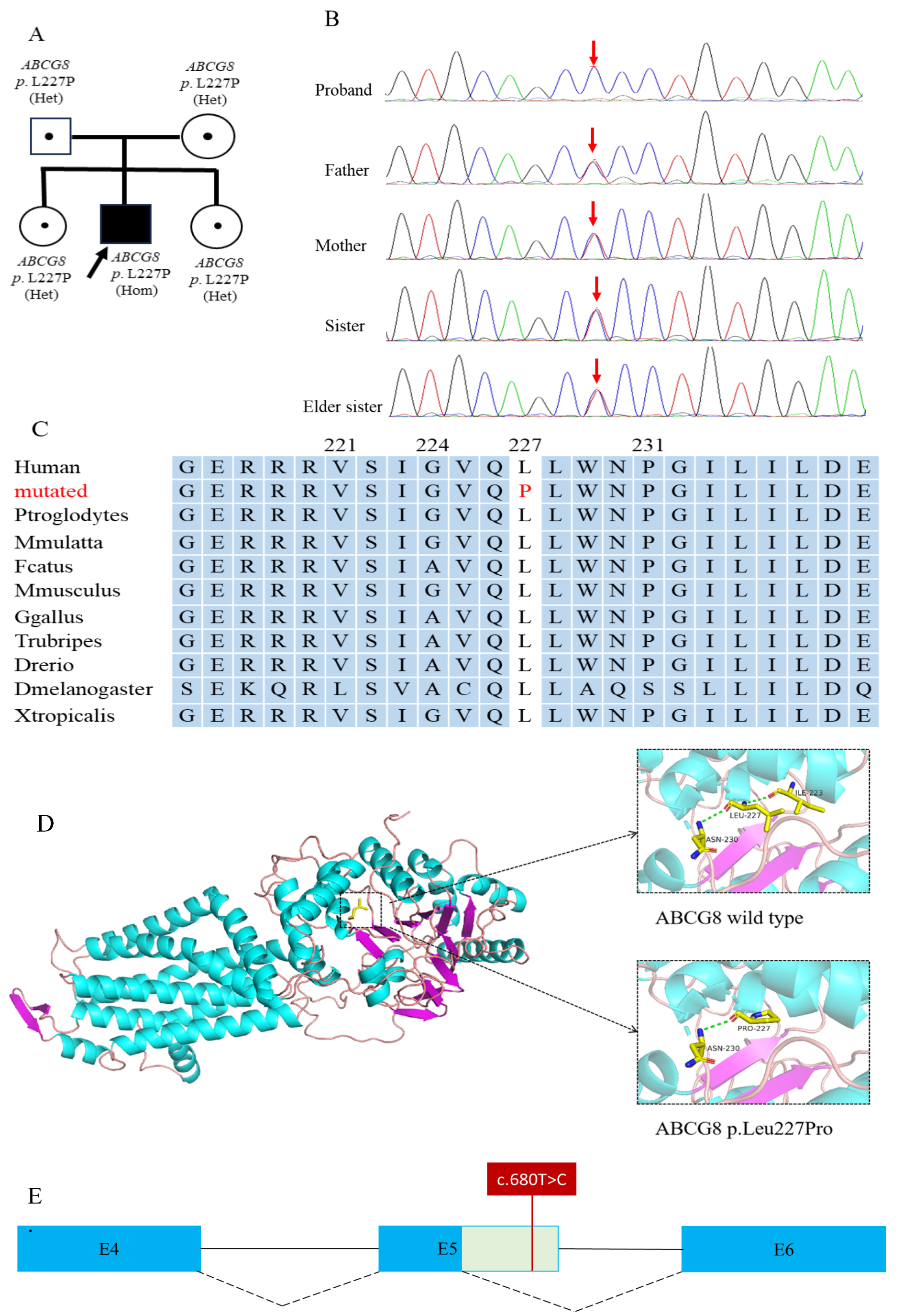
Figure 4. Genetic test results for the patient and pathogenicity analysis of the variant. (A) Pedigree of the family: the black arrowhead indicates the proband. The proband is homozygous for c.680T>C in the ABCG8 gene, and his parents and sisters are all heterozygotes; (B) Sanger sequencing of the ABCG8 gene in the family; red arrowheads indicate the variant c.680T>C in the ABCG8 gene; (C) Conservation analysis of the affected residue across species revealed strong evolutionary preservation of this amino acid position; (D) Computational modeling predicts that this missense variant disrupts a critical hydrogen bond between Leu227 and Ile223; (E) An online prediction indicates that this variant may cause abnormal mRNA splicing. The blue regions correspond to exons, whereas the light-colored areas indicate a 71-bp deletion at the 3’ end of exon 5.
Results of minigene assay
The results of the in vitro minigene assay demonstrated that the mutation (c.680T>C, p.L227P) may disrupt ABCG8 mRNA splicing [Figure 3B-D and Supplementary Figures 1-3]. Consistent findings were observed when two distinct vector systems (pcDNA3.1 and pcMINI-C) were used. Both the wild-type and the mutant exhibited both normal and aberrant splicing (71 bp deletion on the right side of Exon5). The proportion of aberrantly spliced band b was slightly less than 50% in the wild-type, whereas it approached 60% in the mutant [Figure 3B and Supplementary Figure 1]. The deletion of 71 base pairs at the 3’ end of Exon 5 may induce a frameshift, equivalent to c.624_694del, p.Tyr209AsnfsTer43. It is predicted to produce a truncated protein consisting of 250 amino acids [Supplementary Figure 4].
Minigenes may not fully represent the splicing behavior of endogenous genes in vivo. We attempted
Diagnosis, treatment, and follow-up
The diagnosis of sitosterolemia was established by the greatly increased plant sterol concentrations in his plasma and the variant in the ABCG8 gene. Once diagnosed, we recommended that the patient avoid foods rich in plant sterols and shellfish sterols, including chocolate, nuts, shellfish, soy products, and vegetable oil. If the condition becomes uncontrolled, we recommended administration of the sterol absorption inhibitor ezetimibe. As the patient did not take the medication regularly, the plant sterol levels decreased after treatment but remained significantly above the normal reference range [Supplementary Table 2].
At the last follow-up (age 7 years), his electrocardiogram was unremarkable, and his height (113.8 cm) and weight (18.6 kg) were below -2 and -1 standard deviations (SD), respectively.
DISCUSSION AND CONCLUSION
We report a case of sitosterolemia primarily presenting with epistaxis and bicytopenia. WES revealed a novel homozygous missense mutation inherited from both parents. This variant has not been recorded in the natural population (gnomAD v4.1, https://gnomad.broadinstitute.org/), supporting the potential pathogenicity of the variant (PM2_supporting). Based on in silico predictions, this missense variant is likely to alter protein structure and function [Figure 4D; REVEL score of 0.741 (PP3)]. Splicing prediction suggested that this variant might disrupt RNA splicing [Figure 4E]. Subsequent in vitro minigene experiments indicated that the variant may affect ABCG8 mRNA splicing. This aberrant splicing may lead to protein truncation [Figure 3, Supplementary Figures 1 and 4]. Because ABCG8 is expressed at very low levels in peripheral blood, we could neither verify in vivo splicing abnormalities caused by this variant nor determine the degree of aberrant splicing. PVS1 at the supporting strength level was used (PVS1_strength (RNA)_supporting)[9]. The results of in vivo functional experiments indicated that this variant significantly affected the metabolism of phytosterols. The hallmark phenotype of sitosterolemia is elevated plant sterol levels, a condition arising from biallelic loss-of-function variants in either the ABCG5 or ABCG8 gene. Given that WES ruled out pathogenic variants in ABCG5, the patient’s specific phenotype is most likely attributable to mutations in ABCG8 (PP4_moderate). In accordance with the SVI Recommendation for in trans Criterion (PM3) - Version 1.0, https://clinicalgenome.org/working-groups/sequence-variant-interpretation/, for a rare homozygous variant, PM3 at the Supporting strength level was applied (PM3_Supporting). In accordance with the guidelines of the American College of Medical Genetics and Genomics (ACMG), this variant is considered likely pathogenic (LP).
The human genome contains numerous potential splice sites. Single-nucleotide mutations within exons may disrupt normal splicing, resulting in consequences beyond simple amino acid substitution[10].
The missense variant (p.Leu227Pro) is located in a helix of the ABCG8 cytoplasmic domain [Supplementary Figure 6A]. Computational modeling revealed that this substitution disrupts a critical hydrogen bond between residues Leu227 and Ile223, potentially compromising the stability of the ABCG8 protein [Figure 4D and Supplementary Figure 6B]. This cytoplasmic domain constitutes the nucleotide-binding domain of the ABCG5/ABCG8 heterodimer[11,12]. We hypothesize that the identified variant may impair ATP binding or hydrolysis. Because transmembrane phytosterol transport is ATP-dependent, such functional perturbations could disrupt sterol efflux[12].
In silico prediction suggested that this variant may result in aberrant splicing. In vitro studies showed that both the wild-type and mutant exhibited normal and abnormal splicing, suggesting a naturally weak splicing site in this region. However, minigene assays can assess only the splicing patterns of specific gene fragments and may not fully recapitulate in vivo expression dynamics. Further validation is needed to determine whether this variant functions primarily as a missense mutation or by disrupting mRNA splicing. If the splicing effect is the primary mechanism, truncation may trigger nonsense-mediated mRNA decay (NMD), resulting in loss of function of the ABCG8 protein. Otherwise, the missense mutation may produce a full-length but functionally abnormal protein.
Patients who present solely with bleeding or anemia are at risk of being overlooked or misdiagnosed. Peripheral blood morphology analysis plays a crucial role in raising clinical suspicion for such disorders. The majority of affected patients present with hypercholesterolemia and xanthomas[4,13]. However, a distinct subset of patients exhibit primarily hematological symptoms[14,15]. The exact mechanism of stomatocytosis in sitosterolemia is unclear. Incorporation of excess phytosterols into RBC membranes disrupts lipid composition and enhances membrane rigidity. This loss of membrane flexibility impairs RBC deformability, which may promote stomatocyte formation[16].
Previous studies have reported that the accumulation of phytosterols in platelet plasma membranes during sitosterolemia may induce platelet activation, promote microparticle generation, and subsequently lead to platelet dysfunction[17]. Recent research has indicated that thrombocytopenia is caused neither by a lack of megakaryocytes nor by abnormal proteins in the platelets themselves. Notably, platelet count increases as phytosterol levels decrease[18]. Consistent with the findings of earlier studies, the proportion of platelet-producing megakaryocytes in our patient fell within the normal reference range.
The patient presented with a normal lipid profile and impaired growth, without cutaneous xanthomas. We hypothesize that his phenotype may be attributed to his dietary pattern characterized by low fat intake. Previous studies have shown that LDL cholesterol levels in sitosterolemia patients may be either elevated or normal[4,19,20]. His growth retardation may be attributable to picky eating and malnutrition.
Despite exhibiting normal cholesterol levels, patients with sitosterolemia frequently develop premature coronary artery disease[16]. Growing evidence shows a strong association between sitosterolemia and cardiovascular morbidity[16,21]. Early therapeutic intervention can significantly improve both clinical manifestations and biochemical parameters. Patients who maintain rigorous dietary compliance can achieve near-normalization of their phenotypic and metabolic profiles[22]. Ezetimibe, as a first-line drug, is an effective inhibitor of plant sterol and cholesterol uptake and can improve plant sterol tolerance. The addition of ezetimibe to dietary control further reduced plasma plant sterol levels and was beneficial for increasing platelet count[4,23]. Unfortunately, none of the effective treatments return plant sterols to normal[24].
These findings suggest that heterozygous carriers may have a biochemical phenotype. They are also at risk of developing atherosclerotic cardiovascular disease (ASCVD)[16]. For carriers, dietary intervention and clinical follow-up may reduce the risk of adverse outcomes. From a genetic counseling perspective, if a couple has more children, there is a 25% chance that their offspring will be affected. For his sisters, carrier screening of their spouses is recommended to reduce the risk of having affected children.
Limitations
We acknowledge several limitations. First, we were unable to verify whether this variant causes splicing abnormalities in vivo, as ABCG8 is expressed at very low levels in peripheral blood and other relevant tissues (e.g., liver, small intestine, and bone marrow) that are difficult to obtain. Second, functional studies were not conducted to determine whether this variant primarily causes a missense effect or disrupts mRNA splicing. The impact of this truncation on mRNA degradation and missense-mediated ATP binding dysfunction warrants further investigation.
CONCLUSION
In short, we identified a novel homozygous missense variant (ABCG8: p.Leu227Pro) in a child with sitosterolemia. The nonspecific manifestations of anemia and bleeding may result in diagnostic confusion. The presence of stomatocytes and large platelets in the blood smear provides valuable clues for disease diagnosis. WES technology enables the detection of disease-associated genetic variants, while markedly elevated phytosterol levels serve as critical diagnostic biomarkers for sitosterolemia.
DECLARATIONS
Authors’ contributions
Wrote the original manuscript and performed the experimental tests: Pei S, Zhou B
Diagnosed the disease and administered treatment: Lin Y
Conducted the dermatological examination: Zhang Z
Designed the study and reviewed the manuscript: Xu Q
Obtained the funding: Xu Q, Zhou B
Availability of data and materials
The original contributions presented in the study are included in the article, further inquiries can be directed to the corresponding author.
AI and AI-assisted tools statement
During the preparation of this manuscript, the AI tool DeepSeek (version DeepSeek-v4-Pro, released 2026-08-13) was used for language editing and preparing the Graphical Abstract (GA). The tool did not influence the study design, data collection, analysis, interpretation, or the scientific content of the work. All authors take full responsibility for the accuracy, integrity, and final content of the manuscript.
Financial support and sponsorship
This research was funded by the Yunnan Key Laboratory of Children’s Major Disease Research; Yunnan Province Clinical Research Center for Children’s Health and Disease; Kunming Health Science and Technology Personnel Training Project “Ten Hundred Thousand” Project, Grant/Award Number: 2025-SW (leader)-34; and Medical Technology Center, Grant/Award Number: 2025-SW (Technology) - 04, Kunming Health Research Project, Grant/Award Number: 2025-11-01-020.
Conflict of interest
All authors declared that there are no conflicts of interest.
Ethical approval and consent to participate
This study was approved by the Ethics Committee of Kunming Children’s Hospital (Approval No. 2021-03-324-K01). Written informed consent was obtained from all participants’ guardians prior to enrollment.
Consent for publication
Written informed consent for publication of the clinical details and accompanying images was obtained from the patient's legal guardian.
Copyright
© The Author(s) 2026.
Supplementary Materials
REFERENCES
1. Bhattacharyya AK, Connor WE. Beta-sitosterolemia and xanthomatosis. A newly described lipid storage disease in two sisters. J Clin Invest. 1974;53:1033-43.
2. Berge KE, Tian H, Graf GA, et al. Accumulation of dietary cholesterol in sitosterolemia caused by mutations in adjacent ABC transporters. Science. 2000;290:1771-5.
3. Tada H, Nohara A, Inazu A, Sakuma N, Mabuchi H, Kawashiri MA. Sitosterolemia, hypercholesterolemia, and coronary artery disease. J Atheroscler Thromb. 2018;25:783-9.
4. Xia Y, Duan Y, Zheng W, et al. Clinical, genetic profile and therapy evaluation of 55 children and 5 adults with sitosterolemia. J Clin Lipidol. 2022;16:40-51.
5. Gok V, Tada H, Ensar Dogan M, et al. A teenager boy with a novel variant of sitosterolemia presented with pancytopenia. Clin Chim Acta. 2022;529:61-6.
6. Myrie SB, Steiner RD, Mymin D. GeneReviews®. University of Washington, Seattle Copyright © 1993-2025, University of Washington, Seattle. GeneReviews is a registered trademark of the University of Washington, Seattle. https://www.ncbi.nlm.nih.gov/books/NBK131810/ [accessed 30 Sep 2026].
7. Durkie M, Cassidy EJ, Berry I, et al. ACGS best practice guidelines for variant classification in rare disease 2023. 2023. Available from https://www.acgs.uk.com/media/12443/uk-practice-guidelines-for-variant-classification-v1-2023.pdf [accessed 29 Sep 2026].
8. Wu P, Zhou LN, Xing Y, et al. Establishment of morphological reference values for the differential count of white blood cells in peripheral blood smear, as well as nucleated cells and megakaryocytes in bone marrow smear. Natl Med J China. 2022;102:506-12.
9. Walker LC, Hoya M, Wiggins GAR, et al. Using the ACMG/AMP framework to capture evidence related to predicted and observed impact on splicing: recommendations from the ClinGen SVI splicing subgroup. Am J Hum Genet. 2023;110:1046-67.
10. You Q, Liu J, Zhang R, et al. Splicing analysis of exonic TSC1 and TSC2 gene variants causing tuberous sclerosis complex. Hum Mutat. 2025;2025:1497712.
11. Jiang W, Xu Y, Fu Z, et al. Genetic analysis and functional study of a novel ABCG5 mutation in sitosterolemia with hematologic disease. Gene. 2023;879:147596.
12. Lee JY, Kinch LN, Borek DM, et al. Crystal structure of the human sterol transporter ABCG5/ABCG8. Nature. 2016;533:561-4.
13. Yoo EG. Sitosterolemia: a review and update of pathophysiology, clinical spectrum, diagnosis, and management. Ann Pediatr Endocrinol Metab. 2016;21:7-14.
14. Tapiador R, González P, Hernandez-Rodriguez I. Late diagnosis of sitosterolemia in an adult case with unexplained hemolytic anemia. Int J Lab Hematol. 2024;46:985-7.
15. Hu YJ, Chen WL, Xue M, Ding YJ, Mei H, Wang YD. Clinical characteristics and treatment outcomes of adult patients with phytosterolemia presenting with Thrombocytopenia. Chin J Hematol. 2025;46:238-43.
16. Zhao X, Su Z, Xiao W, et al. Molecular genetic basis and clinical heterogeneity of sitosterolemia: focusing on the mutation spectrum and pathogenic mechanisms of ABCG5/ABCG8 genes. Front Nutr. 2026;13:1857512.
17. Kanaji T, Kanaji S, Montgomery RR, et al. Platelet hyperreactivity explains the bleeding abnormality and macrothrombocytopenia in a murine model of sitosterolemia. Blood. 2013;122:2732-42.
18. Del Castillo J, Tool ATJ, van Leeuwen K, et al. Platelet proteomic profiling in sitosterolemia suggests thrombocytopenia is driven by lipid disorder and not platelet aberrations. Blood Adv. 2024;8:2466-77.
19. Coutinho JGV, Costa ACS, Issa MMM, et al. Sitosterolemia caused by compound heterozygosis of 2 allelic variants in the ABCG5 gene-21 years of follow-up. J Clin Lipidol. 2025;19:1139-44.
20. Hegele RA, Borén J, Ginsberg HN, et al. Rare dyslipidaemias, from phenotype to genotype to management: a European Atherosclerosis Society task force consensus statement. Lancet Diabetes Endocrinol. 2020;8:50-67.
21. Mymin D, Wang J, Frohlich J, Hegele RA. Image in cardiovascular medicine. Aortic xanthomatosis with coronary ostial occlusion in a child homozygous for a nonsense mutation in ABCG8. Circulation. 2003;107:791.
22. Tada H, Kojima N, Takamura M, et al. Sitosterolemia. In: Makowski GS, Editor. Advances in Clinical Chemistry. Elsevier; 2022. pp. 145-69.
23. Othman RA, Myrie SB, Mymin D, et al. Ezetimibe reduces plant sterol accumulation and favorably increases platelet count in sitosterolemia. J Pediatr. 2015;166:125-31.
Cite This Article
 Open Access
How to Cite
Zhou B, Pei S, Lin Y, Zhang Z, Xu Q. A novel homozygous variant in the ABCG8 gene identified in a child with sitosterolemia. J Transl Genet Genom. 2026;10:551-60. https://dx.doi.org/10.20517/jtgg.2026.65
Download Citation
Export Citation File:
Type of Import
Tips on Downloading Citation
Citation Manager File Format
Type of Import
Direct Import: When the Direct Import option is selected (the default state), a dialogue box will give you the option to Save or Open the downloaded citation data. Choosing Open will either launch your citation manager or give you a choice of applications with which to use the metadata. The Save option saves the file locally for later use.
Indirect Import: When the Indirect Import option is selected, the metadata is displayed and may be copied and pasted as needed.
About This Article
Copyright

Data & Comments
Data
0






Comments
Comments must be written in English. Spam, offensive content, impersonation, and private information will not be permitted. If any comment is reported and identified as inappropriate content by OAE staff, the comment will be removed without notice. If you have any queries or need any help, please contact us at support@oaepublish.com.