


Rethinking urban bioaerosol: from microbial hazards to population-weighted risk
 0
0 
Urban bioaerosols are an underappreciated environmental determinant of health. The recent Shanghai study by Zhang et al. highlights their relevance to urban health[1]. Their relevance extends beyond conventional infectious agents to opportunistic pathogens, antibiotic-resistant bacteria (ARB), and antibiotic resistance genes (ARGs) that circulate through the built environment. The aerobiome also includes pathobionts, commensals, symbionts, fungi, endotoxin, allergens, pollen, and microbial fragments; exposure is not uniformly harmful[2,3]. This Commentary focuses on bacterial infection and antimicrobial resistance. Surveillance and control have largely targeted recognized emission sources, including wastewater treatment plants, landfills, hospitals, livestock facilities, and waste-handling sites. Public environments and transport systems already have an established microbiome literature[4,5], but are rarely compared by population relevance. In high-density cities, these routine environments may function as active nodes of microbial release, exchange, and population-level risk.
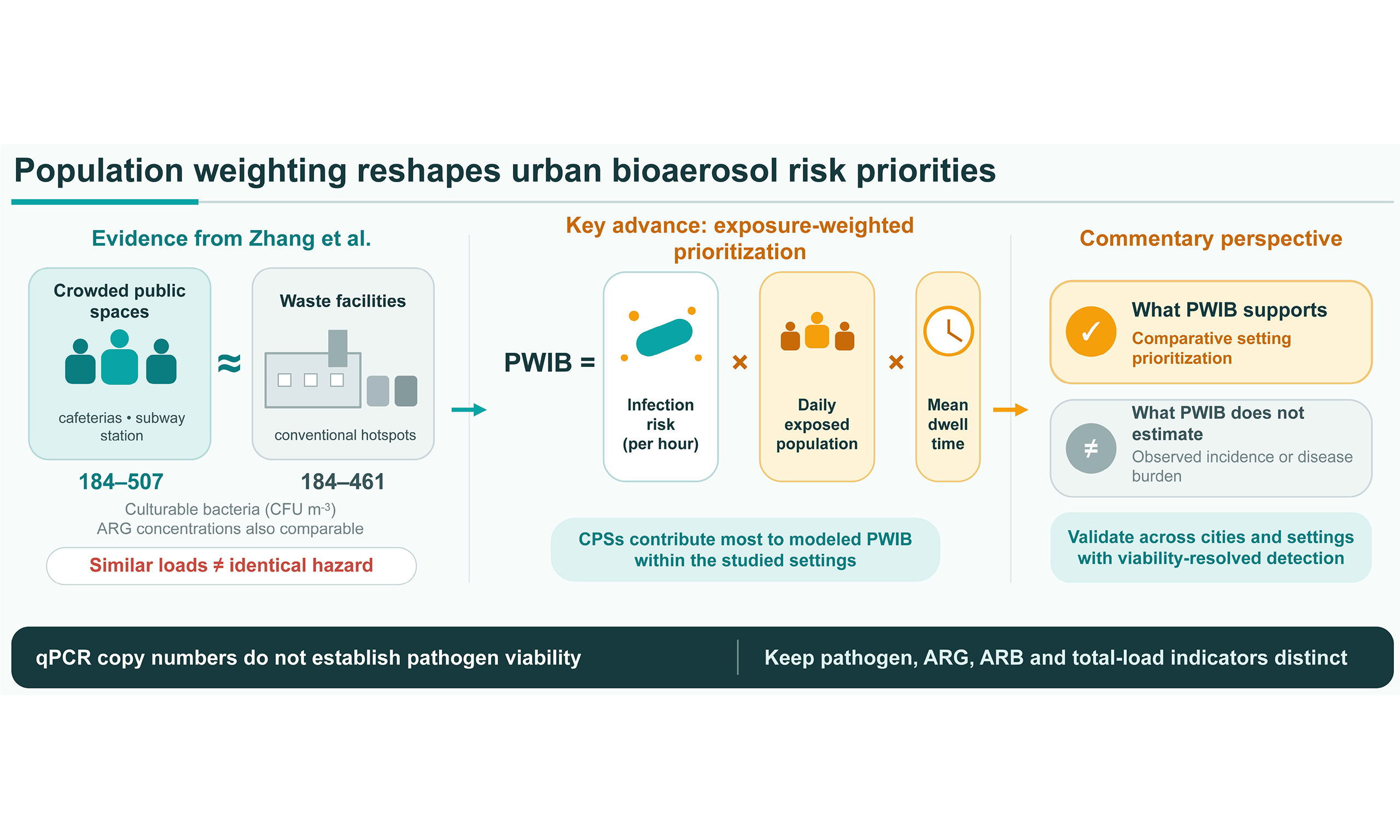
The study by Zhang et al. extends current approaches to urban bioaerosol risk assessment[1]. Using Shanghai as a case study, the authors used culture, quantitative polymerase chain reaction (qPCR), sequencing, source tracking, and risk modeling to analyze 540 air samples from university cafeterias, a subway station, two waste facilities, and an urban reference site. They showed that crowded public spaces (CPSs) harbored culturable bacteria, antibiotic-resistant bacteria, and antibiotic resistance genes at levels comparable to those in waste collection facilities (WCFs), long regarded as microbial hotspots[1]. Culturable bacterial concentration ranged from 184-507 CFU·m-3 in CPSs and 184-461 CFU·m-3 in waste facilities, vs. 25-129 CFU·m-3 at the reference site; corresponding ARG ranges were 2.7 × 10³ - 1.2 × 10⁴ and 2.4 × 10³ - 9.8 × 10³ copies m-3. Human sources contributed about half of airborne bacteria in CPSs; 61% of 131 resistant isolates across all five monitored sites were multidrug-resistant[1]. The advance was integrating modeled pathogen risk with occupant flux and dwell time.
This perspective extends beyond documenting microbial contamination. Measurements of viable bacteria, antimicrobial resistance, predicted pathogenic potential, and source attribution help explain why CPSs differ from conventional source-dominated hotspots in real-world exposure contexts. In CPSs, people function simultaneously as emitters and recipients of airborne microbes through respiration, speech, skin shedding, clothing disturbance, and particle resuspension, consistent with evidence that human occupancy is a major source of indoor airborne bacteria[6]. Thus, the study redirects attention from what is detected in air to how microbial hazards are generated, shared, and repeatedly encountered in urban life. Comparable concentrations do not imply equivalent hazards: human-dominated and waste-derived aerosols may differ in commensal content, viability, virulence, and dose-response characteristics. ARG copies indicate exposure, not infectious units or carriage by viable hosts[7,8].
Perhaps the study’s most important conceptual advance is its population-weighted infection burden (PWIB) framework. PWIB equals IRpathogen × N × T: modeled one-hour pathogen infection risk, daily exposed population, and mean dwell time, respectively[1]. Conventional environmental assessment ranks sites by contamination intensity, an essential measure of hazard but an incomplete indicator of public health risk. Population-weighted risk depends not only on intrinsic microbial hazard, but also on the scale, duration, and frequency of human exposure in specific settings[9]. Consequently, environments with moderate contamination may receive greater public-health priority than traditional microbial hotspots if they are occupied by large numbers of people. For six pathogens, cumulative infection probabilities in CPSs and WCFs were 6.2 × 10⁻² - 1.0 × 10⁻¹; weighting made CPSs the dominant city-scale PWIB contributors[1]. ARGs were not used as infectious doses: PWIB used qPCR-derived pathogen copies with pathogen-specific dose-response parameters, while ARG and antibiotic-resistant-bacteria (ARB) indices remained separate. Because qPCR does not establish viability, these are screening-level, potentially upper-bound estimates[10].
PWIB is a risk-prioritization index, not observed incidence or severity-weighted burden. Occupancy links emissions and exposure without algebraic double counting, but sensitivity analyses should separate these pathways. It also omits susceptibility, inhalation variation, particle deposition, repeated visits, and counterfactual exposure, so it ranks setting contributions rather than marginal risk.
These findings have direct implications for urban environmental management. Routine surveillance should extend beyond occupational or visibly polluted settings to CPSs where high occupancy, inadequate ventilation, prolonged residence, and particle resuspension amplify microbial exposure. Without health-based limits, total bacteria and ARGs are suited to relative comparisons. Either CO2 or rebreathed-air fraction can flag high occupancy relative to ventilation but are only proxies for shared-air conditions[11,12]. Improving ventilation, minimizing particle resuspension, managing crowding during peak periods, and incorporating microbial indicators into healthy-building assessment could reduce population exposure. Where outdoor-air supply is constrained, filtration and upper-room germicidal ultraviolet disinfection may provide complementary controls[12,13], subject to energy use, outdoor pollution, infrastructure, maintenance, and limited outcome evidence. Such measures should form part of routine urban public health infrastructure, rather than being reserved for outbreak response alone.
Microbial modulation is emerging. “Probiotic cities” use microbiome-integrated design and green-blue infrastructure[14]. Daycare biodiversity interventions altered commensal microbiota and immune markers[15], but indoor bioaugmentation still requires defined targets, safety, persistence, and demonstrated health benefits.
Several limitations warrant consideration. qPCR-based risk assessment cannot fully distinguish viable from nonviable microorganisms, and source tracking depends on the completeness and regional representativeness of reference databases. Culture captures a selective fraction; qPCR quantifies gene copies without identifying viable hosts; sequence-based pathogenicity prediction does not measure virulence. Cross-study comparisons remain limited by sampling, particle-size cutoffs, storage, extraction, sequencing, and bioinformatics[16-18]. The proposed PWIB framework also requires further validation across diverse urban settings. Future studies should integrate viability-resolved pathogen detection, improved exposure characterization, standardized multi-season sampling, and longitudinal multi-site studies to strengthen risk assessment.
Overall, Zhang et al. move beyond comparing microbial contamination across urban environments[1]. By framing CPSs as dynamic interfaces of microbial emission and exposure, the study highlights population-weighted assessment as a useful framework for prioritizing urban microbial risks. Its outputs support decisions only when pathogen, ARG, ARB, and total-microbial indicators remain distinct. This perspective provides a stronger foundation for bioaerosol surveillance and urban public health planning.
DECLARATIONS
Authors’ contributions
Made substantial contributions to the conception and writing of the commentary: Jia, S.; Qiu, X.
Availability of data and materials
Not applicable.
AI and AI-assisted tools statement
During the preparation of this manuscript, the AI tool ChatGPT Work (OpenAI; version GPT-5.6, released 2026-07-09) was used solely for language editing. The tool did not influence the study design, data collection, analysis, interpretation, or the scientific content of the work. All authors take full responsibility for the accuracy, integrity, and final content of the manuscript.
Financial support and sponsorship
This work was supported by the Fundamental and Interdisciplinary Disciplines Breakthrough Plan of the MOE of China (JYB2025XDXM906).
Conflicts of interest
Qiu, X. is an Editorial Board Member of the Journal of Environmental Exposure Assessment. Qiu, X. was not involved in any steps of editorial processing, notably including reviewers’ selection, manuscript handling, and decision-making. The other author declared that there are no conflicts of interest.
Ethical approval and consent to participate
Not applicable.
Consent for publication
Not applicable.
Copyright
© The Author(s) 2026.
REFERENCES
1. Zhang, X.; Lu, B.; Jin, L. N.; et al. Crowded public spaces as hotspots of airborne microbial risk: a population-weighted risk assessment in urban environments. Environ. Sci. Technol. 2026, 60, 17996-8010.
2. Prussin, A. J. 2nd.; Marr, L. C. Sources of airborne microorganisms in the built environment. Microbiome 2015, 3, 78.
3. Hanski, I.; von Hertzen, L.; Fyhrquist, N.; et al. Environmental biodiversity, human microbiota, and allergy are interrelated. Proc. Natl. Acad. Sci. U. S. A. 2012, 109, 8334-9.
4. Danko, D.; Bezdan, D.; Afshin, E. E.; et al.; International MetaSUB Consortium. A global metagenomic map of urban microbiomes and antimicrobial resistance. Cell 2021, 184, 3376-93.e17.
5. Leung, M. H.; Wilkins, D.; Li, E. K.; Kong, F. K.; Lee, P. K. Indoor-air microbiome in an urban subway network: diversity and dynamics. Appl. Environ. Microbiol. 2014, 80, 6760-70.
6. Hospodsky, D.; Qian, J.; Nazaroff, W. W.; et al. Human occupancy as a source of indoor airborne bacteria. PLoS. One. 2012, 7, e34867.
7. Larsson, D. G. J.; Flach, C. F. Antibiotic resistance in the environment. Nat. Rev. Microbiol. 2022, 20, 257-69.
8. Li, J.; Cao, J.; Zhu, Y. G.; et al. Global survey of antibiotic resistance genes in air. Environ. Sci. Technol. 2018, 52, 10975-84.
9. Tang, L.; Rhoads, W. J.; Eichelberg, A.; Hamilton, K. A.; Julian, T. R. Applications of quantitative microbial risk assessment to respiratory pathogens and implications for uptake in policy: a state-of-the-science review. Environ. Health. Perspect. 2024, 132, 56001.
10. Emerson, J. B.; Adams, R. I.; Román, C. M. B.; et al. Schrödinger’s microbes: tools for distinguishing the living from the dead in microbial ecosystems. Microbiome 2017, 5, 86.
11. Peng, Z.; Rojas, A. L. P.; Kropff, E.; et al. Practical indicators for risk of airborne transmission in shared indoor environments and their application to COVID-19 outbreaks. Environ. Sci. Technol. 2022, 56, 1125-37.
12. Wang, C. C.; Prather, K. A.; Sznitman, J.; et al. Airborne transmission of respiratory viruses. Science 2021, 373, eabd9149.
13. Linnes, J. C.; Rudnick, S. N.; Hunt, G. M.; McDevitt, J. J.; Nardell, E. A. Eggcrate UV: a whole ceiling upper-room ultraviolet germicidal irradiation system for air disinfection in occupied rooms. Indoor. Air. 2014, 24, 116-24.
14. Robinson, J. M.; Breed, M. F.; Beckett, R. Probiotic cities: microbiome-integrated design for healthy urban ecosystems. Trends. Biotechnol. 2024, 42, 942-5.
15. Roslund, M. I.; Puhakka, R.; Grönroos, M.; et al.; ADELE research group. Biodiversity intervention enhances immune regulation and health-associated commensal microbiota among daycare children. Sci. Adv. 2020, 6, eaba2578.
16. Luhung, I.; Uchida, A.; Lim, S. B. Y.; et al. Experimental parameters defining ultra-low biomass bioaerosol analysis. NPJ. Biofilms. Microbiomes. 2021, 7, 37.
17. Rocha-Melogno, L.; Ginn, O.; Bailey, E. S.; et al. Bioaerosol sampling optimization for community exposure assessment in cities with poor sanitation: a one health cross-sectional study. Sci. Total. Environ. 2020, 738, 139495.
Cite This Article
 Open Access
How to Cite
Download Citation
Export Citation File:
Type of Import
Tips on Downloading Citation
Citation Manager File Format
Type of Import
Direct Import: When the Direct Import option is selected (the default state), a dialogue box will give you the option to Save or Open the downloaded citation data. Choosing Open will either launch your citation manager or give you a choice of applications with which to use the metadata. The Save option saves the file locally for later use.
Indirect Import: When the Indirect Import option is selected, the metadata is displayed and may be copied and pasted as needed.
About This Article
Copyright

Data & Comments
Data
0







Comments
Comments must be written in English. Spam, offensive content, impersonation, and private information will not be permitted. If any comment is reported and identified as inappropriate content by OAE staff, the comment will be removed without notice. If you have any queries or need any help, please contact us at support@oaepublish.com.