

Designing iontronic pressure sensors: a perspective from multiscale mechanics
 0
0 
Abstract
Iontronic pressure sensors (IPSs) have emerged as a promising technology for wearable electronics and electronic skin due to their ultra-high specific capacitance and biomimetic sensing capabilities. However, their performance remains limited by signal drift, hysteresis, and crosstalk that arise from coupled electro-mechanical processes across multiple length scales. Understanding and utilizing multiscale mechanics - from nanoscale ionic transport and interfacial energy to microscale contact deformation and macroscale structural integrity - are therefore essential for rational IPS design. By bridging these scales, mechanics principles enable balanced improvements in sensitivity, linearity, and stability, guiding the creation of high-performance iontronic sensing systems for next-generation electronic skins and healthcare applications.
Keywords
MULTISCALE CHALLENGES IN IONTRONIC SENSING
Iontronic pressure sensors (IPSs) are an emerging class of soft pressure sensors that transduce mechanical stimuli through an electric double layer (EDL) formed at the electrode–ion interface. Enabled by the EDL-based supercapacitive mechanism with exceptionally large areal capacitance, IPSs can convert small, pressure-induced changes in real contact area (and effective interfacial separation) into pronounced signal variations, distinguishing them from traditional piezoresistive and piezoelectric sensors that rely on bulk resistance changes or stress-induced polarization charge. Despite these advantages, the development of IPSs has reached a stage where material innovation and empirical optimization alone cannot resolve the performance limits arising from multiscale interactions [Figure 1][1-4]. The fundamental sensing principle - i.e., the formation of the EDL at the electrode-ion interface - is intrinsically coupled to mechanical conditions[5-7]. At the nanoscale, the sensing mechanism progresses from the rearrangement of ions and electrons at the electrode-electrolyte interface, where Helmholtz and diffusion layers form and collectively give rise to an EDL-based supercapacitive response[8,9]. However, the viscoelastic polymer network often restricts the mobility of ions by chain relaxation and spatial confinement, which induces nonlinear behavior, signal drift, and response delay[10-12]. Meanwhile, the electrochemical effects cannot be overlooked. Interfacial redox reactions of the electrode or electrolyte modify the local electric field and ion distribution via intermediate adsorption[13], and the dynamic evolution of ion concentration gradients affects ion migration and EDL formation[14,15]. The coupled interplay between the electrochemical processes and mechanical relaxation contributes to signal instability. At the microscale, IPSs typically adopt a sandwich structure comprising two electrodes separated by an ionic dielectric. Their transduction is dominated by the evolution of the electrode/ionic-dielectric contact: upon contact, excess electrons on the electrode surface generate an interfacial electric field that attracts counter-ions and repels co-ions, building an EDL and increasing the interfacial capacitance. Consequently, the performance of IPSs is governed by how the ionic dielectric deforms to create and grow effective contact area. Surface microstructures improve sensitivity through contact-area amplification but often exhibit limited linearity and early saturation[16-18]. Moreover, viscoelastic interactions at solid–liquid or solid–solid interfaces induce hysteresis through interfacial energy dissipation from adhesion and friction. At the macroscale, system integration introduces additional coupling: mechanical interaction between neighboring sensing units causes signal crosstalk, while impedance mismatch with soft tissues leads to non-conformal contact and signal degradation[19-21]. Addressing these intertwined issues requires a shift from trial-and-error material design toward a mechanics-guided approach that bridges nanoscale ionic transport, microscale contact behavior, and macroscale structural mechanics to achieve stable, linear, and high-sensitivity iontronic sensing.

Figure 1. EDL formation, microstructure deformation, and system integration introduce nanoscale to macroscale challenges, including nonlinear response, hysteresis, and crosstalk. EDL: Electric double layer.
MOLECULAR MECHANICS AT NANOSCALE: TUNING IONIC DYNAMICS
At the nanoscale, the design priority is to regulate the ionic dynamics to achieve stable and fast response [Figure 2]. This molecular mechanics approach employs molecular dynamics (MD) simulations to reveal how ionic transport couples with polymer deformation[22]. Borodin et al. investigated the interaction between lithium-ion conductivity and polymer chain deformation through MD simulations, highlighting that the efficiency of ion transport is influenced by the microstructural changes of the polymer[23]. The intrinsic viscoelasticity of polymer matrices causes diffusion-limited ion motion, leading to signal lag and drift governed by diffusion kinetics and interfacial binding energy[24]. MD simulations quantify these effects through mean-squared ion displacement, providing a theoretical basis for controlling ion mobility. Wu et al. investigated the ion mobility in high-sensitivity ion sensors through MD simulations, revealing the relationship between relative humidity and ion mobility[25]. Free volume engineering, by adjusting cross-linking density or introducing nanofillers, can reduce confinement and facilitate ion transport[26]. Zhu et al. found that integrating ionic conductive fillers into the polymer matrix enhances ion transport efficiency by modulating the microstructure, concurrently facilitating direct ion conduction through vacancy-mediated pathways within the inorganic phase[27]. Signal drift, often exacerbated by the ion leakage, can be mitigated by tuning interfacial binding strength via functional groups modification guided by binding energy analysis[28]. Li et al. enhanced the interfacial adhesion energy of iontronic sensors by forming covalent crosslinks and topological entanglements via 3D printing, thereby effectively mitigating signal drift induced by ion leakage[29]. Ultimately, the EDL formation is an interfacial electromechanical process, determined by the balance between electrostatic attraction and the elastic restoring force of the polymer network. Regulating these nanoscale interactions enables intrinsic optimization of iontronic behavior, reducing lag and drift in sensor response.
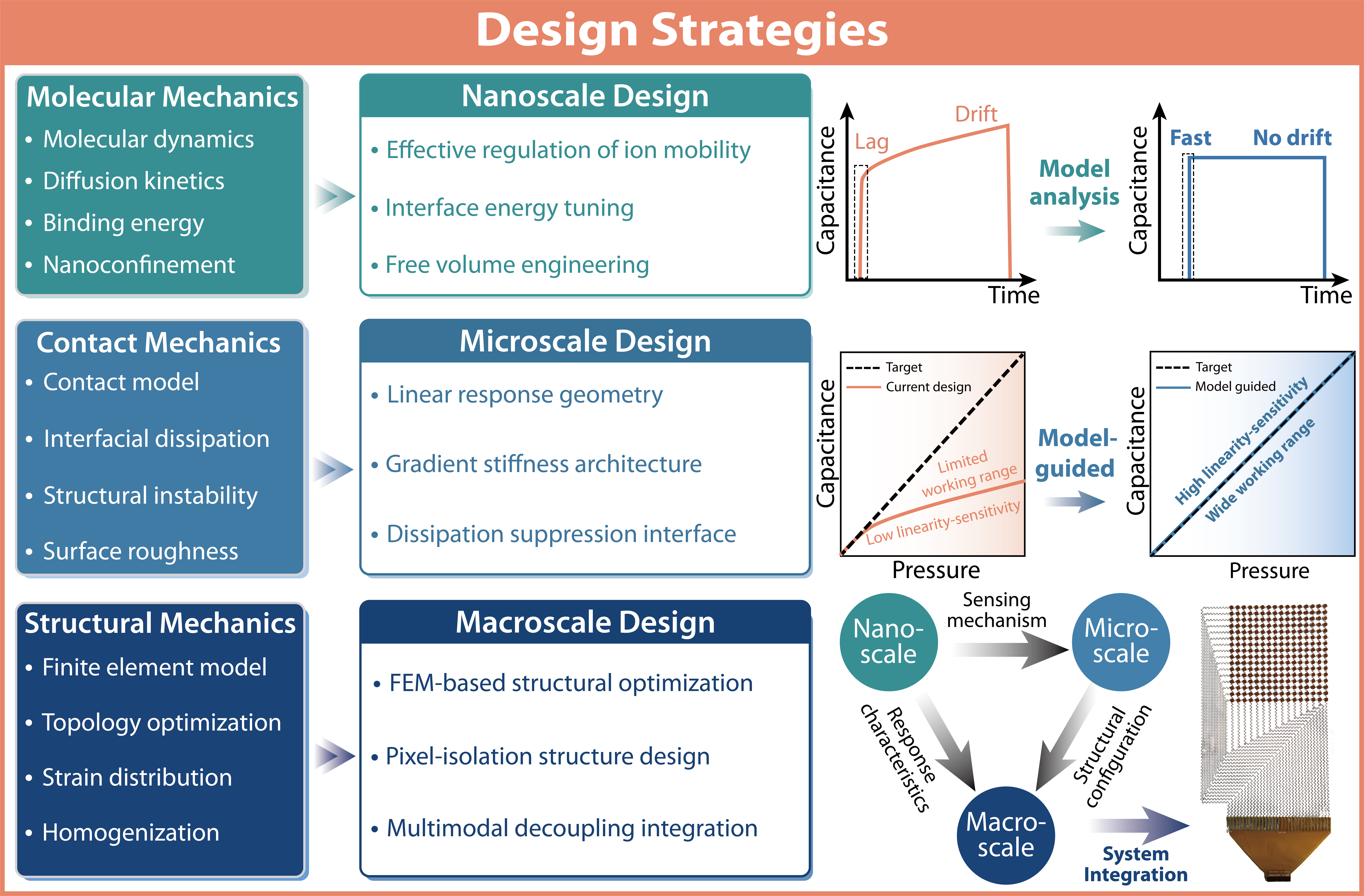
Figure 2. Mechanical principles across molecular, contact, and structural scales guide IPS design. Regulating ion transport, tailoring microstructures, and optimizing system architecture collectively enhance linearity, sensitivity, and stability across scales. IPS: Iontronic pressure sensor.
CONTACT MECHANICS AT MICROSCALE: OPTIMIZING INTERFACIAL INTERACTIONS
At the microscale, design focuses on controlling interfacial deformation and energy dissipation through contact mechanics [Figure 2]. The core challenge is balancing high sensitivity, linearity, and hysteresis. Conventional microstructure designs often rely on empirical optimizations with low efficiency and limited performance[30]. Contact mechanics models provide a mechanics-based route to achieve linear contact geometries, where the effective contact area increases proportionally with pressure, yielding a near-linear capacitive response[31,32]. To mitigate the trade-off between sensitivity and working range, the gradient stiffness architecture can be implemented. To overcome the inherent trade-off between sensitivity and working range, gradient-stiffness architectures can be introduced by combining microstructures of different scales, enabling a progressive contact response that prevents early saturation[33,34]. Addressing hysteresis requires minimizing interfacial energy losses. A dissipation-suppression interface, realized through tailored surface roughness and topological design, can reduce adhesion and friction during contact-separation cycles. Such hysteresis-suppression microstructures ensure that unloading and loading paths nearly coincide, thereby enhancing signal repeatability and stability. These insights highlight how contact mechanics enables rational design beyond empirical geometry selection.
STRUCTURAL MECHANICS AT MACROSCALE: SYSTEM INTEGRATION
At the macroscale, IPSs evolve from single devices into integrated arrays and flexible systems, where mechanical coupling strongly influences overall performance [Figure 2]. Structural mechanics provides the foundation for understanding and controlling these interactions. When adjacent sensing pixels deform collectively, mechanical coupling induces signal crosstalk and reduces spatial resolution[19]. Finite element modeling (FEM) enables quantitative analysis of global stress distributions. It guides the design of pixel-isolation structures, such as island-bridge or serpentine configurations, that mechanically decouple sensing units[35]. Beyond crosstalk mitigation, homogenization theory offers a route to achieve multimodal decoupling, allowing selective response to pressure while suppressing interference from stretching or temperature variations. Achieving conformal contact with complex surfaces further requires tailoring global stiffness and encapsulation geometry to ensure uniform stress transfer and wearability[36]. Finally, topological and gradient-based optimization approaches can identify array architectures that preserve sensitivity while maintaining structural integrity and recyclability. Through these strategies, structural mechanics links device-level architecture with system-level performance, providing the design foundation for reliable, stable, and multifunctional iontronic sensing arrays.
CONCLUSION AND OUTLOOK
IPSs operate through electro-mechanical coupling across multiple scales. This perspective underscores how molecular, contact, and structural mechanics collectively enable rational design beyond empirical optimization. Future progress lies in integrating molecular simulations, contact theories, and finite-element modeling for predictive, data-driven design. Such multiscale coupling will guide inverse optimization of materials and architectures, advancing sensors with balanced sensitivity, linearity, and stability. Extending these principles to soft robotics and biomedical interfaces will transform iontronic sensing from laboratory demonstrations to intelligent, reliable systems driven by mechanics-guided innovation.
DECLARATIONS
Authors’ contributions
Conceptualized, designed, and supervised the study: Wang, L.
Wrote the paper: Zhang, N.; He, Y.; Wang, L.
Availability of data and materials
Not applicable.
Financial support and sponsorship
This work was supported by the National Natural Science Foundation of China under Grants 12388101 and 12272369.
Conflicts of interest
Wang, L. is an Editorial Board Member of the journal lontronics but is not involved in any steps of the editorial process, notably including reviewer selection, manuscript handling, or decision-making. The other authors declare that there are no conflicts of interest.
Ethical approval and consent to participate
Not applicable.
Consent for publication
Not applicable.
Copyright
© The Author(s) 2025.
REFERENCES
1. Gao, L.; Wang, M.; Wang, W.; et al. Highly sensitive pseudocapacitive iontronic pressure sensor with broad sensing range. Nanomicro. Lett. 2021, 13, 140.
2. Liu, Z.; Cai, M.; Hong, S.; et al. Data-driven inverse design of flexible pressure sensors. Proc. Natl. Acad. Sci. U. S. A. 2024, 121, e2320222121.
3. Niu, H.; Li, H.; Gao, S.; et al. Perception-to-cognition tactile sensing based on artificial-intelligence-motivated human full-skin bionic electronic skin. Adv. Mater. 2022, 34, e2202622.
4. Dai, C.; Ye, C.; Ren, J.; et al. Humanoid ionotronic skin for smart object recognition and sorting. ACS. Mater. Lett. 2022, 5, 189-201.
5. Chang, Y.; Wang, L.; Li, R.; et al. First decade of interfacial iontronic sensing: from droplet sensors to artificial skins. Adv. Mater. 2021, 33, e2003464.
6. Niu, H.; Li, H.; Li, N.; et al. Morphological-engineering-based capacitive tactile sensors. Appl. Phys. Rev. 2025, 12, 011319.
7. Li, Y.; Bai, N.; Chang, Y.; et al. Flexible iontronic sensing. Chem. Soc. Rev. 2025, 54, 4651-700.
8. Wu, J. Understanding the electric double-layer structure, capacitance, and charging dynamics. Chem. Rev. 2022, 122, 10821-59.
9. Li, B.; Ge, R.; Du, W.; et al. iWood: an intelligent iontronic device for human-wood interactions. Adv. Funct. Mater. 2024, 34, 2314190.
10. Cao, X.; Cha, S.; Gong, M. Interfacial electrical double layer in electrocatalytic reactions: fundamentals, characterizations and applications. Acta. Physico-Chimica. Sinica. 2025, 41, 100041.
11. He, Y.; Cheng, Y.; Yang, C.; Guo, C. F. Creep-free polyelectrolyte elastomer for drift-free iontronic sensing. Nat. Mater. 2024, 23, 1107-14.
12. Yang, C.; Guo, C. F. Drift-free iontronic sensing enabled by a creep-free polyelectrolyte elastomer. Nat. Mater. 2024, 23, 1025-6.
13. Omura, J.; Yano, H.; Watanabe, M.; Uchida, H. Electrochemical quartz crystal microbalance analysis of the oxygen reduction reaction on Pt-based electrodes. Part 1: Effect of adsorbed anions on the oxygen reduction activities of Pt in HF, HClO4, and H2SO4 solutions. Langmuir 2011, 27, 6464-70.
14. Wang, T.; Zhang, Y.; Huang, B.; et al. Enhancing oxygen reduction electrocatalysis by tuning interfacial hydrogen bonds. Nat. Catal. 2021, 4, 753-62.
15. Li, P.; Jiang, Y.; Hu, Y.; et al. Hydrogen bond network connectivity in the electric double layer dominates the kinetic pH effect in hydrogen electrocatalysis on Pt. Nat. Catal. 2022, 5, 900-11.
16. Wei, D.; Guo, J.; Qiu, Y.; et al. Monitoring the delicate operations of surgical robots via ultra-sensitive ionic electronic skin. Natl. Sci. Rev. 2022, 9, nwac227.
17. Su, Q.; Zou, Q.; Li, Y.; et al. A stretchable and strain-unperturbed pressure sensor for motion interference-free tactile monitoring on skins. Sci. Adv. 2021, 7, eabi4563.
18. Li, N.; Li, H.; Feng, J.; et al. Microstructure-modulated linear-response flexible pressure sensors. Adv. Funct. Mater. 2025, e09776.
19. Shi, J.; Dai, Y.; Cheng, Y.; et al. Embedment of sensing elements for robust, highly sensitive, and cross-talk-free iontronic skins for robotics applications. Sci. Adv. 2023, 9, eadf8831.
20. Sun, C.; Li, S.; Zhou, Z.; et al. Conformal iontronic sensing clear aligner. Adv. Funct. Mater. 2024, 34, 2408376.
21. Wang, H. L.; Guo, Z. H.; Pu, X.; Wang, Z. L. Ultralight iontronic triboelectric mechanoreceptor with high specific outputs for epidermal electronics. Nanomicro. Lett. 2022, 14, 86.
22. Bedrov, D.; Piquemal, J. P.; Borodin, O.; MacKerell AD, J. R.; Roux, B.; Schröder, C. Molecular dynamics simulations of ionic liquids and electrolytes using polarizable force fields. Chem. Rev. 2019, 119, 7940-95.
23. Borodin, O.; Smith, G. D. Mechanism of ion transport in amorphous poly(ethylene oxide)/LiTFSI from molecular dynamics simulations. Macromolecules 2006, 39, 1620-9.
24. Warren, A.; Zhang, D.; Choudhury, S.; Archer, L. A. Electrokinetics in viscoelastic liquid electrolytes above the diffusion limit. Macromolecules 2019, 52, 4666-72.
25. Wu, Z.; Cheng, Y.; Yang, Z.; et al. Ultra-sensitive and high-resolution flexible iontronic humidity sensor for detecting subtle moisture differences. Adv. Funct. Mater. 2025, e17569.
26. Xu, X.; Lu, D.; Huang, S.; Wang, F.; Min, Y.; Xu, Q. Multiscale insights into inorganic filler regulation, ion transport mechanisms, and characterization advances in composite solid-state electrolytes. Processes 2025, 13, 2795.
27. Zhu, P.; Yan, C.; Dirican, M.; et al. Li0.33La0.557TiO3 ceramic nanofiber-enhanced polyethylene oxide-based composite polymer electrolytes for all-solid-state lithium batteries. J. Mater. Chem. A. 2018, 6, 4279-85.
28. Sun, Y.; Cheng, Y.; Shi, L.; Sun, J.; Chen, S.; Wang, R. Dual ion regulated eutectogels with high elasticity and adhesive strength for accurate strain sensors. Adv. Funct. Mater. 2024, 34, 2401808.
29. Li, C.; Cheng, J.; He, Y.; et al. Polyelectrolyte elastomer-based ionotronic sensors with multi-mode sensing capabilities via multi-material 3D printing. Nat. Commun. 2023, 14, 4853.
30. Qiu, Z.; Wan, Y.; Zhou, W.; et al. Ionic skin with biomimetic dielectric layer templated from calathea zebrine leaf. Adv. Funct. Mater. 2018, 28, 1802343.
32. Zheng, Z. J.; Yu, J. A generalized maugis model for adhesive contact of arbitrary axisymmetric elastic objects. Chin. J. Mech. 2007, 23, 382-88.
33. Bai, N.; Wang, L.; Wang, Q.; et al. Graded intrafillable architecture-based iontronic pressure sensor with ultra-broad-range high sensitivity. Nat. Commun. 2020, 11, 209.
34. Bai, N.; Wang, L.; Xue, Y.; et al. Graded interlocks for iontronic pressure sensors with high sensitivity and high linearity over a broad range. ACS. Nano. 2022, 16, 4338-47.
35. Li, P.; Xie, L.; Su, M.; et al. Skin-inspired large area iontronic pressure sensor with ultra-broad range and high sensitivity. Nano. Energy. 2022, 101, 107571.
Cite This Article
 Open Access
How to Cite
Download Citation
Export Citation File:
Type of Import
Tips on Downloading Citation
Citation Manager File Format
Type of Import
Direct Import: When the Direct Import option is selected (the default state), a dialogue box will give you the option to Save or Open the downloaded citation data. Choosing Open will either launch your citation manager or give you a choice of applications with which to use the metadata. The Save option saves the file locally for later use.
Indirect Import: When the Indirect Import option is selected, the metadata is displayed and may be copied and pasted as needed.
About This Article
Copyright

Data & Comments
Data
0




Comments
Comments must be written in English. Spam, offensive content, impersonation, and private information will not be permitted. If any comment is reported and identified as inappropriate content by OAE staff, the comment will be removed without notice. If you have any queries or need any help, please contact us at support@oaepublish.com.