
Promoting effect of hydroxyl groups on the CO-SCR activity of Ir-Mo bimetallic catalysts under O2 and SO2
 0
0 Abstract
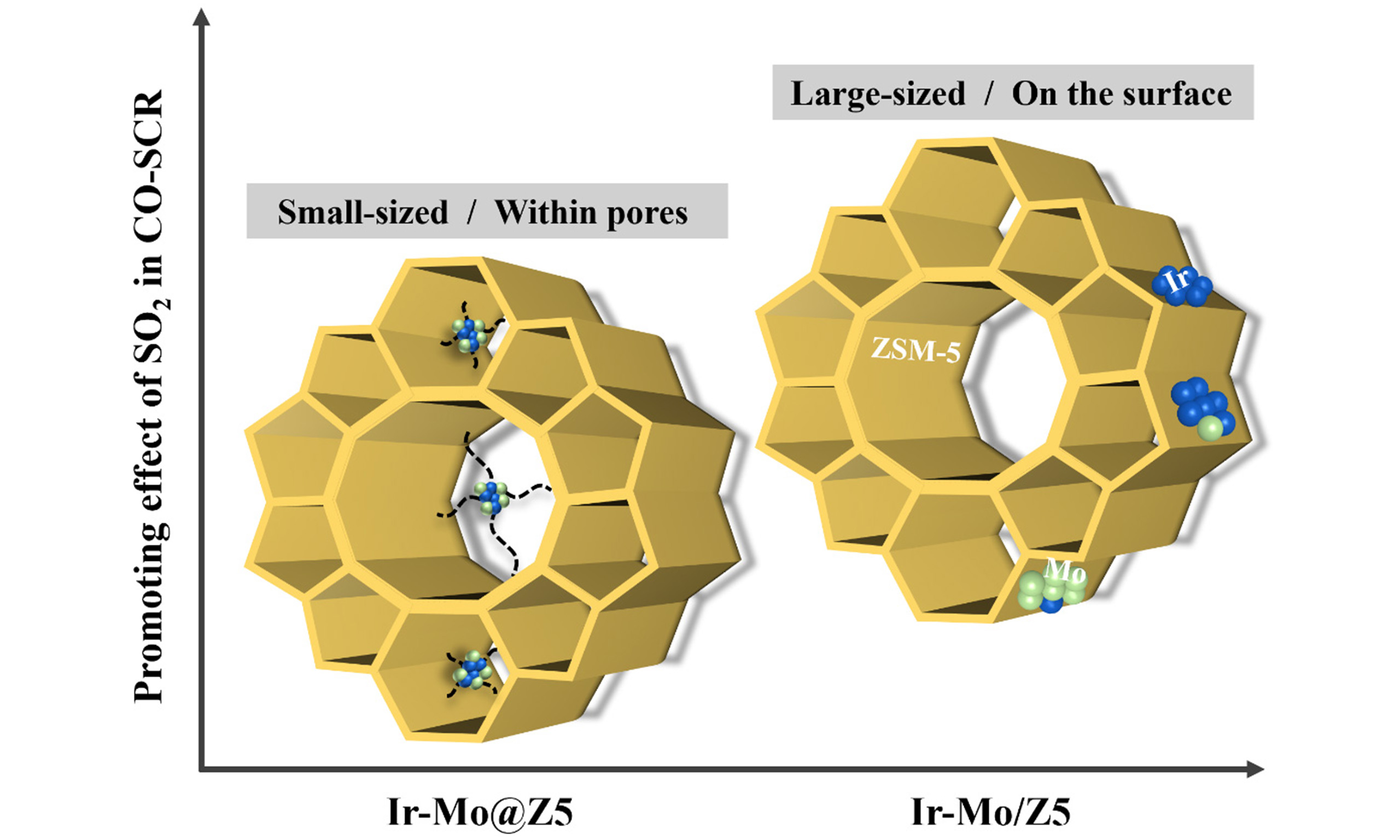
The incorporation of promoters to form bimetallic clusters is a feasible strategy for boosting catalyst performance in the selective catalytic reduction of nitrogen oxides (NOx) by carbon monoxide (CO) (CO-SCR); however, developing bimetallic catalysts suitable for complex flue gas conditions remains challenging. This study reports a highly dispersed, sub-nanometer iridium-molybdenum (Ir-Mo) cluster catalyst predominantly confined within ZSM-5 (MFI-type zeolite) crystals (denoted as Ir-Mo@Z5), in which hydroxyl groups (-OH) serve as active sites, thereby preserving high catalytic performance under oxygen (O2)- and sulfur dioxide (SO2)-containing conditions. Remarkably, this catalyst achieves ∼62.4% NOx conversion at 275 °C in the presence of 5% O2 and 200 ppm SO2. The crucial role of the -OH groups is revealed by comparison with an Ir-Mo/Z5 catalyst prepared by conventional impregnation. On the one hand, the -OH groups are generally occupied by Ir species, thereby reducing the extent of CO oxidation and promoting NO reduction by CO. On the other hand, the oxidation of SO2 on the catalyst and the resulting consumption of -OH groups, especially the bridging silanol-aluminum group (Si-OH-Al), constitute the intrinsic mechanism that reduces the nitrate-mediated “ineffective reaction pathway” in the presence of O2. This work elucidates how the structural state of bimetallic clusters influences the SO2-promoted -OH mechanism, guiding the rational design of high-performance bimetallic CO-SCR catalysts tailored for complex reaction conditions.
Keywords
INTRODUCTION
Nitrogen oxides (NOx), primarily nitric oxide (NO), nitrous oxide (N2O), and nitrogen dioxide (NO2), are major air pollutants that contribute to photochemical smog and acid rain and pose serious threats to human health[1,2]. Although selective catalytic reduction (SCR) technology using ammonia (NH3) as a reducing agent (NH3-SCR) has been widely applied for the removal of stationary-source NOx, it suffers from drawbacks such as NH3 slip and the high cost of NH3 storage and transportation[3]. The CO-SCR technology, using carbon monoxide (CO) instead of NH3 as a reducing agent, has become a research hotspot in recent years, as CO is a byproduct of the incomplete combustion of carbon-based fuels and is present at high concentrations in industrial flue gas[4-6]. This technology is of great significance for the coordinated control of NOx and CO emissions simultaneously.
However, the activity of most CO-SCR catalysts is limited by the presence of oxygen (O2), as CO is more likely to be oxidized than participate in NOx reduction. Compared to other catalysts, iridium (Ir)-based catalysts exhibit superior performance in O2-containing environments and have been widely studied[7,8]. Typically, Ir0 is considered the main active site because the electrons are transferred from Ir0 to the antibonding π orbital of NO, thereby weakening the N–O bond[9]. Furthermore, Irδ+ serves as a charge-transfer bridge, accepting electrons from the carbon (C) atom of CO and facilitating redox cycling[10]. Our previous research has confirmed that an Ir-based catalyst encapsulated in Zeolite Socony Mobil-5 (ZSM; Ir@ZSM-5) is more effective[11], as Ir0 and Irδ+ are more likely to reach dynamic equilibrium in the presence of O2 and SO2 due to the micropore confinement.
Recently, an increasing number of studies have shown that adding promoters to form bimetallic clusters enhances the performance of CO-SCR catalysts. Ji et al.[12] demonstrated that the electronegativity difference between Ir and tungsten (W) promotes electron transfer, thereby improving CO-SCR activity. Isolated Ir single atoms and Ir-W intermetallic nanoparticles coexist on ordered mesoporous SiO2 (KIT-6), enabling complete NO conversion to nitrogen (N2) at 250 °C under 1% O2. Similarly, Wang et al.[13] found that highly dispersed Ir and tungsten oxide (WO3) species facilitated strong Ir-W interactions, resulting in more exposed Ir0 and Ir-WO3-x active sites and enhancing the adsorption and dissociation of NO. Takahashi et al.[14] also proposed that Ir-WOx species (2.92 ≤ x ≤ 3) on Ir/WO3-SiO2 promote NO dissociation. However, these studies remain limited to bimetallic clusters supported on the surface. Research on enhancing the CO-SCR performance of bimetallic clusters via zeolite micropore confinement remains scarce.
Herein, we report that iridium-molybdenum (Ir-Mo) bimetallic clusters encapsulated within ZSM-5 achieve highly efficient CO-SCR in the presence of oxygen (O2) and sulfur dioxide (SO2). Mo, which belongs to the same group as W, is also a commonly used active component for NO adsorption and dissociation in SCR catalysts[15]. Previous studies have shown that smaller molybdenum trioxide (MoO3) particles interact more readily with Brønsted acid sites on the surface of ZSM-5 to form Mo-O-Al species, resulting in a favorable phase structure of the Mo/ZSM-5 catalyst for NO reduction[16,17]. In addition, Xie et al.[18] reported that preferential anchoring of Mo atoms at terminal hydroxyl (-OH) groups on the support promotes the aggregation of other low-loading noble metal atoms into highly concentrated electron-rich species. Similarly, Fu et al.[19] confirmed that the addition of Mo is beneficial for reducing the oxidation state of Ir in the Ir/TiO2 catalyst.
In this work, we employed a one-step synthesis to prepare an Ir-Mo@ZSM-5 catalyst, in which Ir-Mo bimetallic clusters were spatially confined within the ordered ZSM-5 framework. This spatial confinement balances the contents of Ir0 and Irδ+ species, leading to superior NOx conversion performance. The Ir-Mo@ZSM-5 catalyst achieved a NOx conversion of approximately 62.4% at 275 °C under simulated industrial flue gas conditions (400 ppm NO, 8,000 ppm CO, 5% O2, and 200 ppm SO2). This study highlights the effectiveness of zeolite micropore confinement in enhancing the CO-SCR performance of bimetallic clusters. Further, it reveals, through systematic investigation of hydroxyl groups, that the structural state of the bimetallic clusters governs the SO2 promotion mechanism, providing valuable insights for the rational design of highly efficient CO-SCR catalysts.
EXPERIMENT
Catalyst preparation
Tetrapropylammonium bromide (TPABr, 98%), silica sol (20%-40%), sodium aluminate (NaAlO2, analytical reagent), and sodium hydroxide (NaOH, 96%) were purchased from Shanghai Macklin Biochemical Co., Ltd. Hexachloroiridic acid hydrate (H2Cl6Ir·xH2O, 36%), ammonium molybdate [(NH4)6Mo7O24·4H2O], ethylenediamine (EDA, 99.5%), and tetraethylenepentamine (TEPA, technical grade) were purchased from Shanghai Aladdin Biochemical Technology Co., Ltd. Unless otherwise specified, all chemicals were of analytical grade and used as received without further purification.
TPABr, silica sol, NaAlO2, and NaOH were used for preparing ZSM-5 (hereinafter referred to as Z5). An improved ligand-protected one-step synthesis strategy was used to obtain ZSM-5-encaged Ir-Mo bimetallic clusters, denoted as Ir-Mo@Z5. Ir-Mo/Z5 catalysts were prepared by the impregnation method with the same metal loading for comparison. The symbols “@” and “/” are used to distinguish catalysts prepared via encapsulation within zeolite frameworks and surface-supported configurations, respectively. Before evaluating catalytic performance, the synthesized Ir-Mo@Z5 and Ir-Mo/Z5 catalysts were pretreated in 5% hydrogen/argon (H2/Ar) at 200 °C for 30 min. The detailed synthetic method is provided in the Supplementary Materials. A schematic diagram of Ir-Mo@Z5 catalyst preparation is shown in
Catalytic performance evaluation and catalyst characterization
The activity measurements of CO-SCR at atmospheric pressure were conducted in a quartz tubular continuous-flow reactor (inner diameter = 6 mm) using 40-60 mesh catalyst particles. The total flow rate of the simulated reactant gas was 100 mL⋅min-1 with a gas hourly space velocity (GHSV) of 16,000 h-1. The gas composition contained 400 ppm NO, 8,000 ppm CO, 5% O2, 200 ppm SO2, and N2 as the balance gas. Concentrations of CO and NOx were analyzed in real time using an online Fourier transform infrared (FTIR) spectrometer equipped with a deuterated triglycine sulfate (DTGS) detector. The conversion and selectivity were calculated as below[20]:
Detailed information on catalyst characterizations is provided in the Supplementary Materials.
RESULTS AND DISCUSSION
CO-SCR performance
The CO-SCR performance of Ir-Mo@Z5 and Ir-Mo/Z5 catalysts under typical industrial flue gas conditions was evaluated within the temperature range of 150-400 °C. The results are presented in Figure 1. As shown in Figure 1A, the NO conversion of both samples follows a volcano curve, with or without SO2 introduction, consistent with recent reports in the literature[13,21]. It is worth noting that after SO2 injection, the NO conversion of Ir-Mo/Z5 increased significantly, whereas that of Ir-Mo@Z5 decreased slightly. Comparison of the NO conversion of Ir-Mo@Z5 with that of several high-performance bimetallic catalysts reported in the literature [Supplementary Table 1] shows that Ir-Mo@Z5 exhibits superior catalytic performance under comparable reaction conditions, highlighting its advantages and potential applications in CO-SCR systems. To more accurately reflect the actual efficiency of NO reduction to N2 and eliminate the interference from byproducts such as NO2, NOx conversion is presented in Figure 1B. Unlike NO conversion, NOx conversion is synchronously promoted for both samples after SO2 injection. The NOx conversion of Ir-Mo@Z5 was higher than that of Ir-Mo/Z5 across the entire temperature range, reaching a maximum of 62.4%. Subsequently, the long-term catalytic stability of Ir-Mo@Z5 and Ir-Mo/Z5 was further evaluated. As shown in Supplementary Figure 2, both catalysts exhibit excellent durability during continuous reaction, demonstrating their promising potential for practical applications. Figure 1C confirms that CO achieves nearly complete conversion at the temperature where NO or NOx conversion reaches a maximum over both catalysts, indicating that the volcano-shaped NO or NOx conversion profile originates from preferential oxidation of CO by O2 at elevated temperatures. In addition, Figure 1D indicates that the SO2 injection effectively improves N2 selectivity, and Ir-Mo@Z5 exhibits superior N2 selectivity compared to Ir-Mo/Z5. Supplementary Figure 3 illustrates the effect of O2 on CO-SCR performance at 275 °C. Firstly, both catalysts exhibit reduced NOx conversion with increasing O2 concentration. However, Ir-Mo@Z5 maintains higher activity in the absence of the SO2 promotional effect, indicating better O2 tolerance.
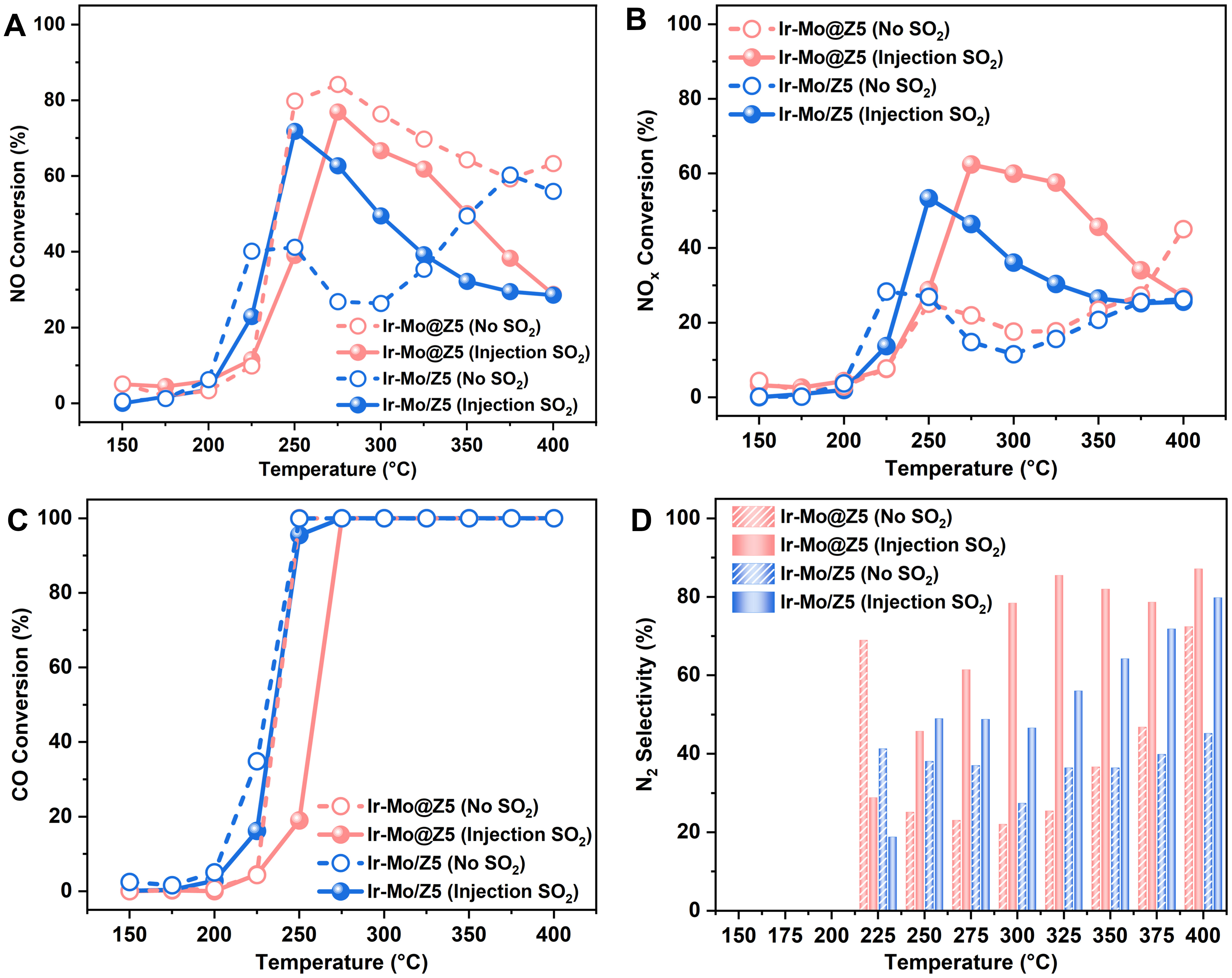
Figure 1. CO-SCR performance of Ir-Mo@Z5 and Ir-Mo/Z5 catalysts: (A) NO conversion, (B) NOx conversion, (C) CO conversion, and (D) N2 selectivity. Reaction conditions: [NO] = 400 ppm, [CO] = 8,000 ppm, [O2] = 5%, [SO2] = 200 ppm (when used), GHSV = 16,000 h-1. SCR: Selective catalytic reduction; GHSV: gas hourly space velocity.
These results indicate that although SO2 exhibits similar promotional effects on NOx conversion over the two catalysts, the underlying mechanisms differ. Undoubtedly, SO2 effectively improves the selective reduction of NO to N2. As we previously reported[22], this is attributed to the regulatory effect of SO2 on the “ineffective reaction pathway” in the presence of O2 with nitrate as an intermediate. More importantly, SO2 also promotes NO adsorption on catalysts prepared by the conventional impregnation method.
Physical and chemical characterizations
Supplementary Figure 4 shows the X-ray diffraction (XRD) patterns of Ir-Mo@Z5 and Ir-Mo/Z5 catalysts. The obtained catalysts exhibited a well-ordered MFI-type zeolite structure of Z5 (PDF#44-0003)[23,24]. No distinct characteristic peaks corresponding to Ir or Mo species were detected due to the low metal loading and high dispersion[25]. The results demonstrate that the addition of EDA, TEPA, and metal precursors into the synthetic gel had a negligible effect on the crystallization of the Z5 support. N2 adsorption-desorption isotherms of both Ir-Mo@Z5 and Ir-Mo/Z5 catalysts exhibit typical Type I behavior [Supplementary Figure 5], indicating a microporous structure with a dominant pore size of ~0.55 nm [Supplementary Figure 6]. As summarized in Supplementary Table 2, both catalysts maintain relatively high specific surface areas (~280 m2g-1), which provide abundant sites for the adsorption of CO and NO molecules. Inductively coupled plasma (ICP) analysis indicates that the Si/Al ratios of both catalysts are approximately 25. The results also reveal that the loadings of Ir and Mo are ~0.4 and 0.85 wt.%, respectively, confirming successful incorporation of Ir and Mo into the Z5 support.
According to the transmission electron microscopy (TEM) images of the catalysts [Figure 2], the well-dispersed Ir species in Ir-Mo@Z5 exhibited an average size of 1.0 nm through the one-step synthesis method. The observation that these clusters are larger than the micropore channels in Z5 (0.55 nm) can be attributed to partial collapse of neighboring micropores during metal growth[26]. In other words, the clusters are likely confined within zeolite crystals rather than within the microporous channels[27]. Combined with energy-dispersive X-ray spectroscopy (EDS) mapping results, the Mo signal completely overlaps with that of Ir, suggesting the formation of Ir-Mo bimetallic clusters[23]. In addition, Ir-Mo bimetallic clusters show clear interplanar lattice fringes of 0.23 nm, which may correspond to the Ir (111) facet, implying the favorable dispersion of Mo species on the Ir surface. Previous studies have found that the fraction of bimetallic clusters in zeolite-supported catalysts gradually increases with prolonged hydrogen (H2) reduction time[12,28], confirming that H2 pretreatment is beneficial for the formation of Ir-Mo bimetallic interactions. In contrast, larger bimetallic clusters (with an average size of ~8.0 nm) were unevenly distributed on the zeolite’s external surface in catalysts prepared by the conventional impregnation method.
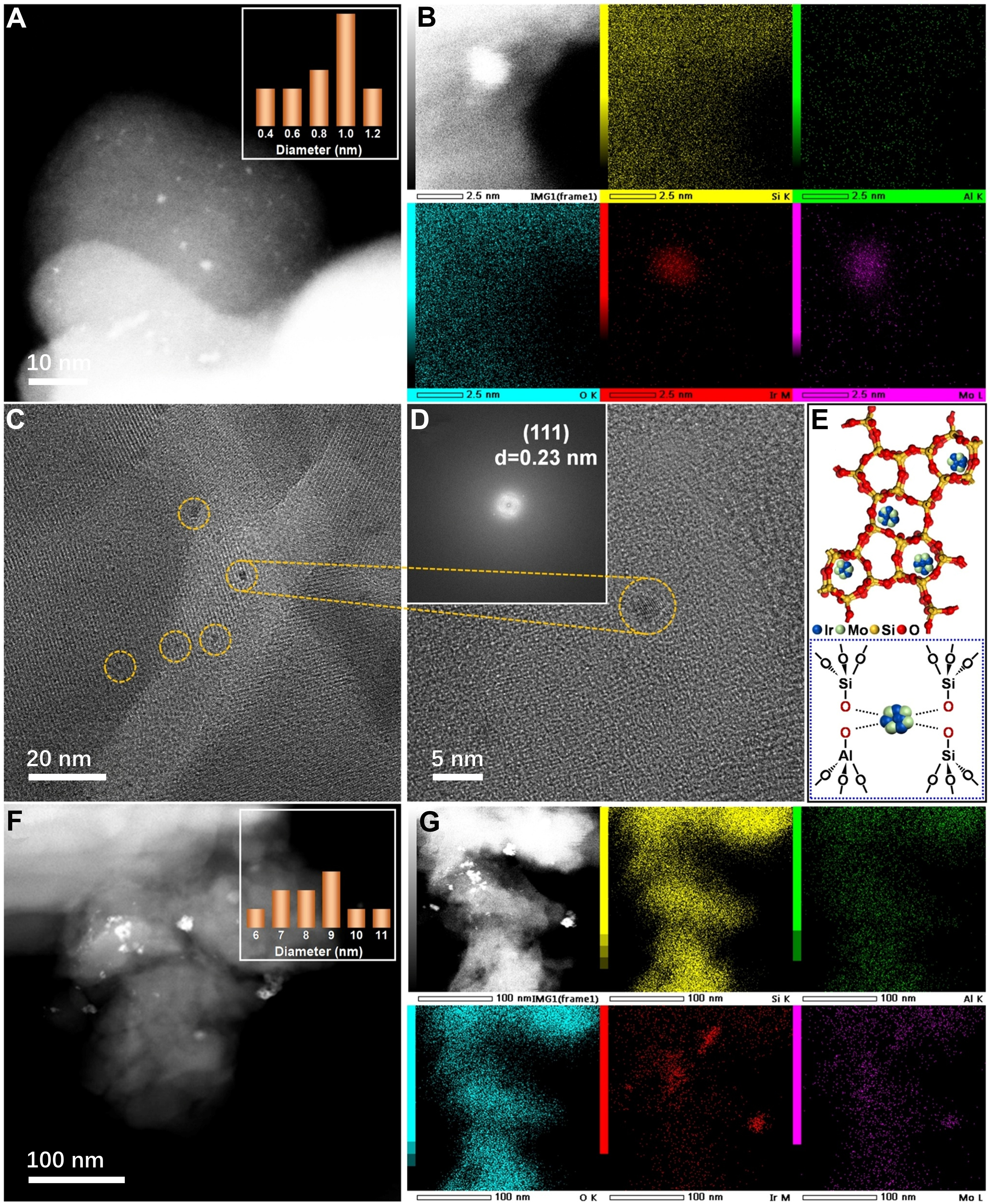
Figure 2. (A and B) TEM image and the corresponding EDS mapping images of Si, Al, O, Ir, Mo in Ir-Mo@Z5, (C and D) AC HAADF-STEM images of Ir-Mo@Z5, (E) structure diagram of Ir-Mo@Z5, and (F and G) TEM image and the corresponding EDS mapping images of Si, Al, O, Ir, Mo of Ir-Mo/Z5. TEM: Transmission electron microscopy; EDS: energy-dispersive X-ray spectroscopy; AC HAADF-STEM: aberration-corrected high-angle annular dark-field scanning transmission electron microscopy.
The Ir 4f X-ray photoelectron spectroscopy (XPS) spectra of Ir-Mo@Z5 and Ir-Mo/Z5 catalysts are shown in Figure 3. In Figure 3A, the Ir 4f7/2 peak centered at 61.20 eV and 62.20 eV observed for Ir-Mo@Z5, which were assigned to metallic Ir0 and oxidized Irδ+, respectively[29,30]. After peak fitting, it was found that the proportion of Ir0 in Ir-Mo@Z5 was 52.77%, which is significantly lower than that in Ir0 on Ir-Mo/Z5 (61.54%) [Figure 3B]. Therefore, we confirm that the ratio of Ir0 to Irδ+ can be tuned by encapsulating bimetallic clusters within the zeolite micropores, thereby effectively regulating their redox properties. This is consistent with our previous finding on Ir clusters encapsulated within zeolite micropores[11]. Furthermore, NO molecule dissociation can be enhanced by electron-rich Ir0 species through the electron donation from the metal center into the empty π* orbital of NO[3], which is crucial for low-temperature catalytic performance. However, oxidized Irδ+ species can promote selective NO adsorption in the presence of O2 and even help maintain a balance between CO oxidation and NO reduction reactions in the presence of SO2[11,31]. Moreover, the Ir 4f XPS signal intensity of Ir-Mo@Z5 is lower than that of Ir-Mo/Z5, indicating fewer metal species are dispersed on the external surface of Ir-Mo@Z5, which confirms that Ir-Mo bimetallic clusters are mainly confined within zeolite crystals via the one-step synthesis method. As shown in Supplementary Figure 7, compared with Ir@Z5, the binding energy of Ir 4f7/2 in Mo-modified Ir-Mo bimetallic cluster catalysts exhibits an obvious redshift of 0.45 eV toward lower binding energy. Given Ir’s higher electronegativity compared to Mo, Mo tends to donate electrons in bimetallic clusters. After H2 pretreatment at 200 °C, Mo species in Ir-Mo@Z5 and Ir-Mo/Z5 serve as electron donors, transferring partial electrons to Ir, thereby increasing the electron density at Ir sites. The electron-rich Ir0 can elongate the N–O bond and facilitate NO dissociation.
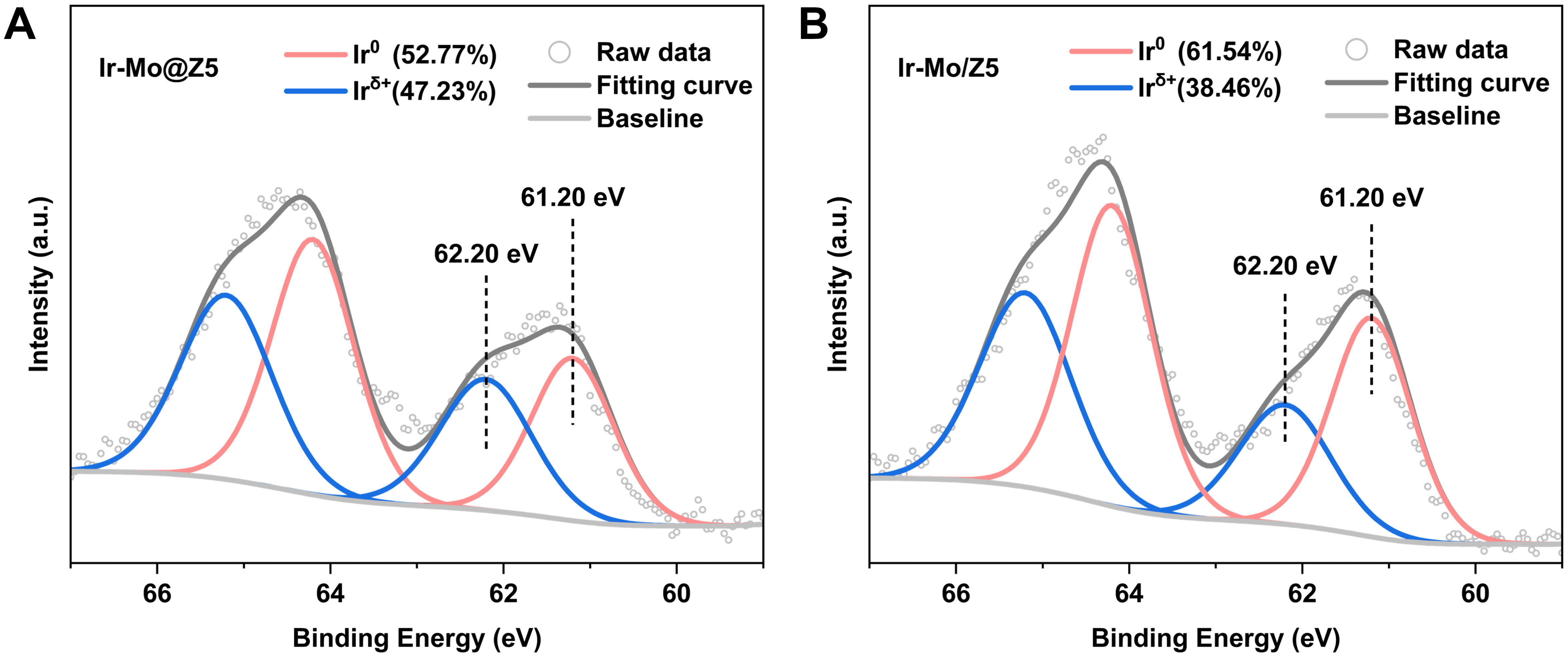
Figure 3. Ir 4f XPS spectra of (A) Ir-Mo@Z5 and (B) Ir-Mo/Z5 catalysts. XPS: X-ray photoelectron spectroscopy.
Mechanistic study
Temperature-programmed experiments were conducted to investigate the adsorption and desorption behaviors of NO and CO on the two catalysts. As shown in Figure 4A and B, two N2O desorption peaks were observed for the Z5 support at 335 and 650 °C in the NO-temperature-programmed desorption (NO-TPD) and N2O-TPD profiles. This indicates that all NO molecules adsorbed on the Z5 support undergo a coupling-dissociation process[4,32]. The ONNO intermediate formed through coupling is prone to N–O bond cleavage, which is completed at temperatures below 335 °C. The NO-TPD results for the Ir-Mo@Z5 and Ir-Mo/Z5 catalysts also show NO desorption peaks. According to previous reports[13], these NO species are likely adsorbed and decomposed into nitrates. Compared with the three N2O desorption peaks observed in the N2O-TPD profiles (175, 335, and 530 °C), only two desorption peaks at 335 and 530 °C were observed in the NO-TPD profile of Ir-Mo/Z5. This indicates that the dissociation temperature of ONNO on Ir-Mo/Z5 is between 175 and 335 °C, whereas that on Ir-Mo@Z5 is between 320 and 385 °C. These results confirm that electron-rich Ir0 species dominate the ONNO dissociation. Increasing the content of metallic Ir0 species in the catalyst is beneficial for intermediate conversion.
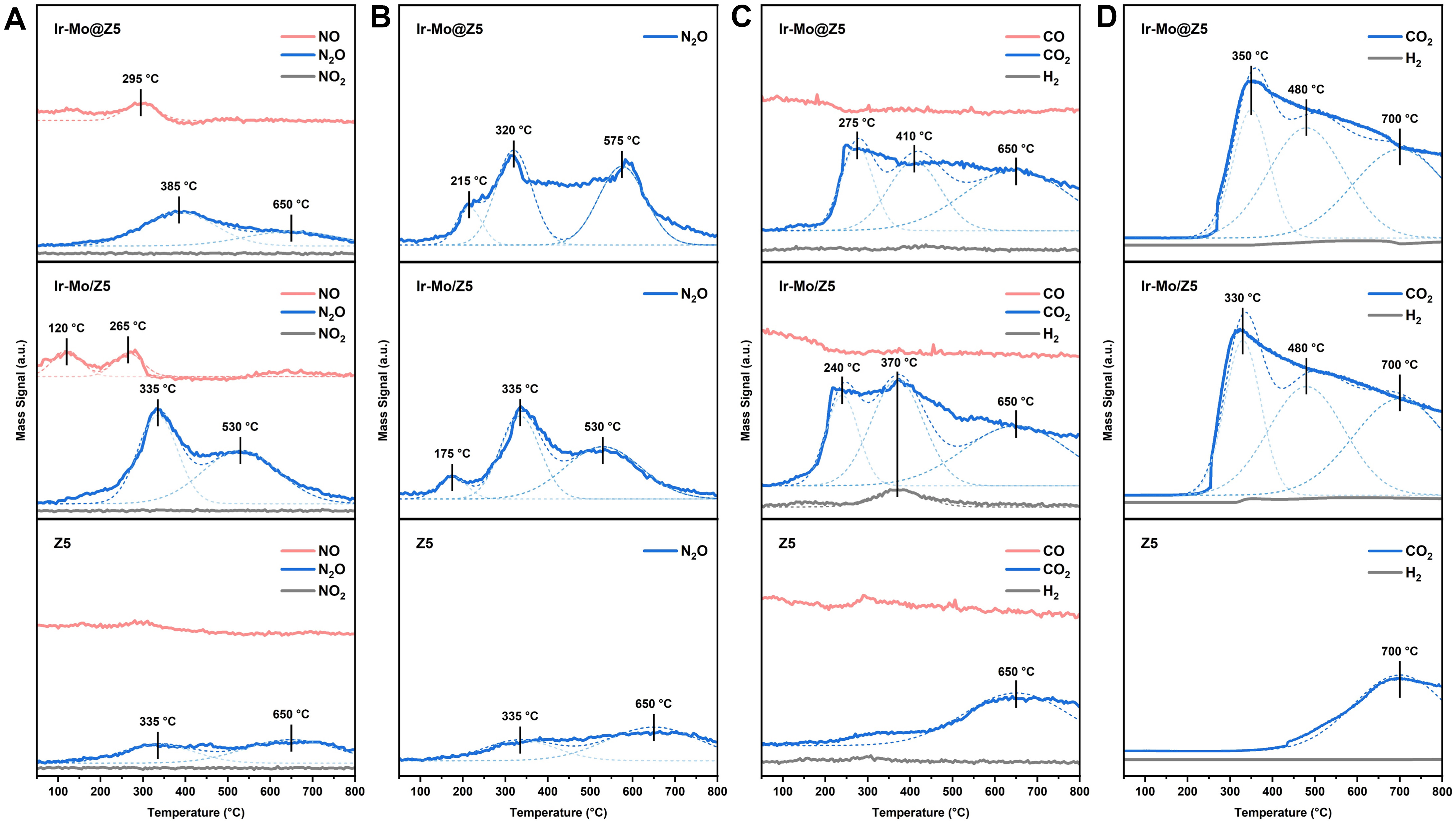
Figure 4. (A) NO-TPD profiles, (B) N2O-TPD profiles, (C) CO-TPD profiles, and (D) CO-TPR profiles of Ir-Mo@Z5, Ir-Mo/Z5 catalysts and Z5 support. TPD: Temperature-programmed desorption; TPR: temperature-programmed reduction.
As shown in Figure 4C, carbon dioxide (CO2) is the only desorption product observed for the two catalysts and the Z5 support during programmed heating (after CO saturation); no significant CO desorption peak is detected, which is typically associated with the reaction between CO and lattice oxygen species. Compared with the CO2 desorption peak observed on the Z5 surface at 650 °C, two additional desorption peaks appeared at lower temperatures for the Ir-Mo@Z5 and Ir-Mo/Z5 catalysts. Among them, the two CO2 desorption peaks of Ir-Mo/Z5 occur at lower temperatures than those of Ir-Mo@Z5, indicating that the lattice oxygen activity of Ir-Mo/Z5 is superior to that of Ir-Mo@Z5. We propose that electrons are transferred from coordinated oxygen species to the Ir species, reducing the oxidized Irδ+ species on Ir-Mo/Z5 to metallic Ir0. This process facilitates oxygen-ion activation and vacancy formation to maintain charge balance[4,33], thereby explaining the lower activation temperature for CO oxidation on Ir-Mo/Z5. In addition, the simultaneous formation of CO2 and H2 at 370 °C on Ir-Mo/Z5 is observed, originating from the reaction between CO and surface -OH species (2CO + 2OH → 2CO2 + H2)[34,35]. According to our previous report[11], Ir species loaded on the surface of Z5 usually occupy surface -OH groups[36], especially bridged silanol-aluminum groups (Si-OH-Al). Therefore, the larger bimetallic clusters on Ir-Mo/Z5 obtained via the conventional impregnation method imply fewer occupied -OH groups, which may be one of the reasons for the enhanced CO oxidation activity. Furthermore, Figure 4D shows the CO-TPR results. In general, the CO2 desorption temperature corresponding to the reaction between gas-phase CO and lattice oxygen species is always higher than that for adsorbed CO on the two catalysts and the Z5 support, indicating that the Langmuir-Hinshelwood (L-H) mechanism occurs more readily at lower temperatures.
To investigate the effects of O2 and SO2 on reaction intermediates, NO, NO + O2, or NO + O2 + SO2 were introduced over various catalysts at 275 °C. According to Wang et al.[37], the promotional effects of O2 and SO2 on the performance of Ir-based CO-SCR catalysts may be related to surface -OH groups. Once NO-adsorbed species occupy a portion of the catalyst surface -OH groups, the intensities of the negative -OH bands would decrease because fewer adsorption sites remain available for further adsorption. Figure 5A and B shows changes in the in situ DRIFTS spectra over the range of 3,100-3,900 cm-1 under different adsorption conditions. The absorption bands observed at 3,678 and 3,587 cm-1 are attributed to the stretching vibrations of isolated silanol groups (Si-OH) and the bridged silanol-aluminum groups (Si-OH-Al), respectively. After NO introduction, the peak areas of Si-OH and Si-OH-Al decrease to different extents. To quantify the variations in the two -OH groups, Gaussian fitting was applied to deconvolute the infrared absorption bands, and the results are summarized in Figure 5C. The peak area of Si-OH-Al decreases more significantly after NO introduction, showing a reduction more than twice that of Si-OH on both Ir-Mo@Z5 and Ir-Mo/Z5 catalysts. This indicates that NO is more readily adsorbed on Si-OH-Al sites. However, once NO and O2 were introduced simultaneously, the extent of Si-OH-Al consumption was significantly reduced, supporting the competitive adsorption between NO and O2. Interestingly, the -OH groups on the two catalysts exhibited distinctly different trends after further SO2 introduction. In general, the two types of -OH groups on the Ir-Mo/Z5 catalyst were significantly consumed, whereas those on the Ir-Mo@Z5 catalyst were largely preserved after SO2 introduction. Wang et al.[37] reported that SO2 is first oxidized to SO3 on the Ir surface and subsequently forms sulfate species on -OH sites, thereby suppressing a series of side reactions in the presence of O2. As shown in the SO2-TPD profiles in Supplementary Figure 8, the SO2 desorption amount is higher on supports with lower Si/Al ratios, providing direct evidence for SO2 adsorption and activation by -OH groups. Our previous studies[22] also showed that SO2 oxidation at Ir (111) sites is beneficial for suppressing the “ineffective reaction pathway” mediated by nitrate species in the presence of O2. As mentioned earlier, more oxidized Irδ+ species on Ir-Mo/Z5 are readily reduced to metallic Ir0, facilitating oxygen ion activation and vacancy formation for charge balance maintenance, thereby resulting in higher lattice oxygen activity on Ir-Mo/Z5 than on Ir-Mo@Z5. Therefore, SO2 is more readily oxidized on the Ir-Mo/Z5 catalyst, leading to greater consumption of -OH groups. These results clearly explain why the promotional effect of SO2 is more pronounced over Ir-Mo/Z5 than over Ir-Mo@Z5, as shown in Figure 1 and Supplementary Figure 3.
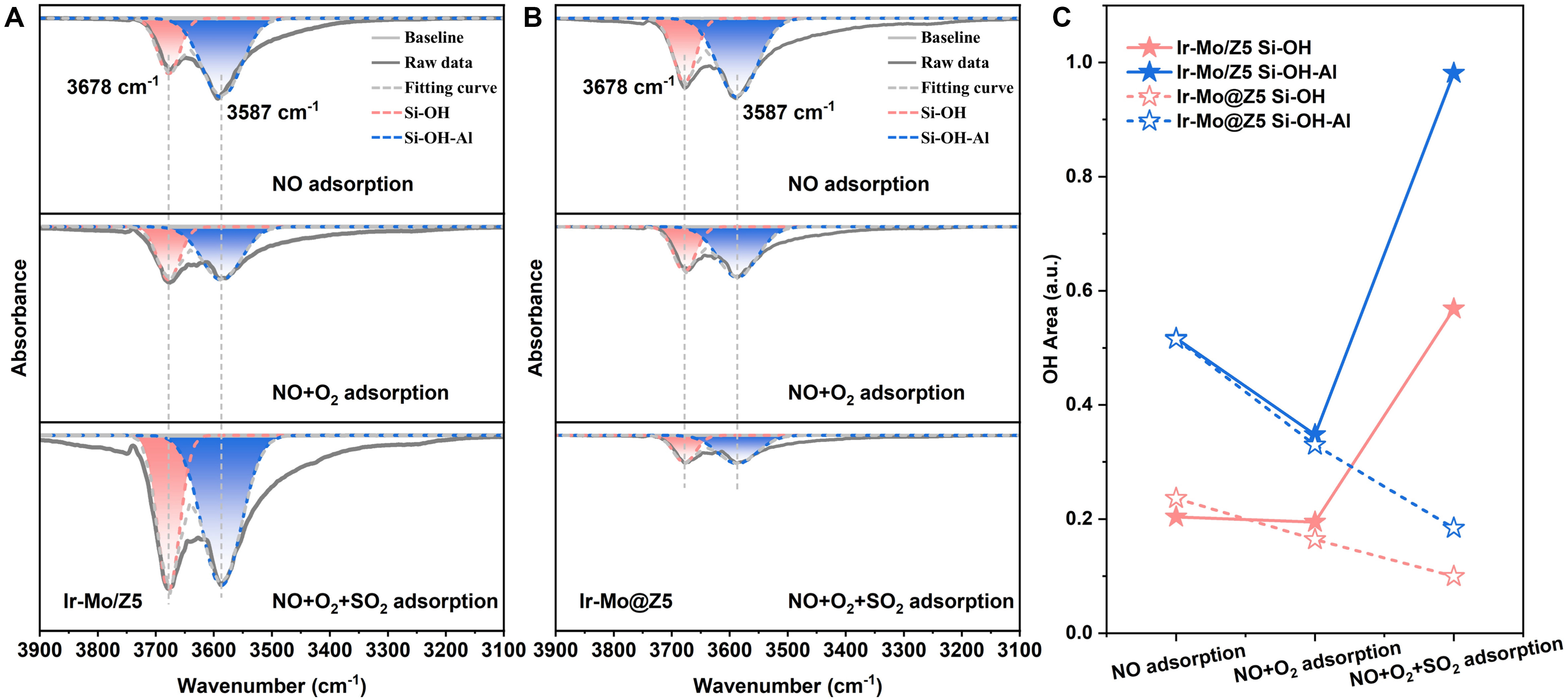
Figure 5. In situ DRIFTS results for pre-adsorbed NO, NO+O2, or NO+O2+SO2 at 275 °C over (A) Ir-Mo/Z5 and (B) Ir-Mo@Z5 catalysts. Reaction conditions: [NO] = 400 ppm, [O2] = 5%, [SO2] = 200 ppm, and Ar balance; (C) Variation of Si-OH and Si-OH-Al peak areas with pre-adsorption on Ir-Mo/Z5 and Ir-Mo@Z5. In situ DRIFTS: In situ diffuse reflectance infrared Fourier transform spectroscopy.
The activity tests revealed that the mechanism by which SO2 influences CO-SCR performance depends on the catalyst preparation method. The NOx conversion over Ir-Mo@Z5 is higher than that over Ir-Mo/Z5 across the entire test temperature range, reaching a maximum of 62.4%. The one-step synthesis method yields small, uniform Ir-Mo bimetallic species confined within the zeolite interior, whereas the conventional impregnation method produces larger, unevenly distributed particles on the external surface. The formation of well-dispersed bimetallic structures is facilitated by appropriate reduction treatment. The confinement effect of zeolite micropores regulates the electronic state of the active sites, which is crucial for the adsorption and dissociation of NO molecules. Meanwhile, particles on the external surface favor surface oxygen activation and reactions with surface hydroxyl groups, thereby enhancing CO oxidation. These results demonstrate that the spatial distribution and electronic properties of the active sites can be rationally regulated through synthetic strategies, thereby governing the adsorption and reaction pathways of NO and CO.
To investigate the dynamic evolution of adsorbed species on the two catalysts, NO was first pre-adsorbed on the catalyst surface until saturation, followed by CO introduction to initiate the transient reaction [Supplementary Figure 9A and B]. Prominent characteristic adsorption peaks corresponding to ONNO (1,720-1,724 cm-1) and N2O4 (1,683 cm-1) were detected on both Ir-Mo@Z5 and Ir-Mo/Z5, with dimeric ONNO species serving as the dominant adsorbed intermediates[11]. After CO introduction, the intensity of the ONNO peak gradually decreased over time on both catalysts, confirming the synergistic catalytic effect of Ir and Mo sites in promoting ONNO dissociation. Notably, distinct adsorption peaks assigned to CO (2,057-2,063 cm-1) and NO (1,830 cm-1) adsorbed on metallic Ir0 were observed over Ir-Mo/Z5, confirming the presence of Ir0 species on this catalyst. In contrast, no obvious adsorption peaks associated with Ir0 were detected on Ir-Mo@Z5. This strongly indicates that the one-step synthesis strategy effectively enhances the interaction between Ir and Mo within sub-nanoclusters and suppresses excessive reduction and aggregation of metallic species. To further explore the effect of O2 on the CO-SCR reaction pathway, in situ DRIFTS experiments were conducted by introducing CO following the pre-adsorption of NO + O2 [Supplementary Figure 9C and D]. Under aerobic conditions, the proportion of N2O4 species on Ir-Mo/Z5 increased markedly, whereas the formation of ONNO, a key low-temperature active intermediate, was significantly inhibited. By contrast, ONNO remained the dominant NO adsorption species on Ir-Mo@Z5. This comparative result reveals that the strong bimetallic interaction within Ir-Mo sub-nanoclusters efficiently modulates the electronic structure of active sites and facilitates the directional conversion of NO into ONNO intermediates in the presence of O2. The superior capability of Ir-Mo@Z5 to stably maintain ONNO formation and accelerate its dissociation and transformation under aerobic conditions accounts for its outstanding catalytic activity in the aerobic CO-SCR reactions. For both catalysts, NO first couples to form ONNO species, which subsequently dissociate. The difference in the ONNO dissociation temperature between the two catalysts is primarily determined by the electron-rich metallic Ir0 species, and a higher Ir0 content facilitates intermediate conversion. For CO activation, it mainly reacts with lattice oxygen species to form CO2. The catalyst prepared via the conventional impregnation method exhibits higher lattice-oxygen activity and, therefore, a lower CO oxidation temperature. This catalyst also provides more available surface hydroxyl groups, which further participate in CO oxidation.
In situ DRIFTS results indicate that although SO2 exhibits similar promotional effects on NOx conversion over the two catalysts, the underlying mechanisms differ. Undoubtedly, SO2 promotes the actual efficiency of NO reduction to N2. As we previously reported[22], this is attributed to the regulatory effect of SO2 on the “ineffective reaction pathway” in the presence of O2 with nitrate species as intermediates. More importantly, SO2 effectively promotes NO adsorption onto catalysts prepared by conventional impregnation.
CONCLUSION
This work investigates a one-step-synthesized Ir-Mo@Z5 bimetallic cluster catalyst and systematically explores the role of surface hydroxyl groups in the SO2-promoted CO-SCR reaction. The zeolite confinement effect enables the formation of highly dispersed Ir-Mo sub-nanoclusters (~1 nm), which preferentially occupy surface hydroxyl sites and suppress non-selective reactions between -OH groups and CO, thereby endowing Ir-Mo@Z5 with significantly enhanced NOx conversion compared with the conventionally impregnated catalyst. In situ characterizations further verify that the consumption of Si-OH-Al by SO2 effectively inhibits the nitrate-mediated non-productive reaction pathway under oxygen-containing conditions, revealing the intrinsic promotional mechanism of SO2. Large-pore materials can be employed to confine the bimetallic clusters, allowing sufficient SO2 diffusion into the pore channels and enabling reactions with surface hydroxyl sites occupied by Ir species, thereby suppressing non-productive reaction pathways and further enhancing CO-SCR catalytic performance. These aspects will be systematically investigated in future work.
DECLARATIONS
Authors’ contributions
Data curation, validation, investigation, formal analysis, writing - original draft, writing - review and editing: Wang, Y.
Writing - review and editing, formal analysis: Ma, X.
Conceptualization, methodology: Liu, H.
Validation, formal analysis: Yuan, Y.
Methodology, formal analysis, writing - review and editing: Yang, Y.
Formal analysis, investigation: Zhang, Y.
Funding acquisition, validation, formal analysis, project administration, resources, writing - review and editing: Xu, W.
Resources, project administration, supervision: Zhu, T.
Availability of data and materials
The original contributions presented in this study are included in the article/Supplementary Materials. Further inquiries can be directed to the corresponding author.
AI and AI-assisted tools statement
Not applicable.
Financial support and sponsorship
This work was financially supported by the National Natural Science Foundation of China (Nos. 52400140 and 52470132).
Conflicts of interest
Xu, W. is an Editorial Board Member of the journal Greenverse Science. Xu, W. was not involved in any step of the editorial process, notably including reviewers’ selection, manuscript handling, or decision-making. The other authors declare no conflicts of interest.
Ethical approval and consent to participate
Not applicable.
Consent for publication
Not applicable.
Copyright
© The Author(s) 2026.
Supplementary Materials
REFERENCES
1. Le Roy, E. J.; Wong, A. Y.; Eastham, S. D.; Fiore, A. M.; Selin, N. E. Impact of climate variability and change on the surface ozone response to NOx emissions reductions. Environ. Sci. Technol. 2025, 59, 10422-33.
2. Zhang, X.; Fung, J. C.; Lau, A. K.; Hossain, M. S.; Louie, P. K.; Huang, W. Air quality and synergistic health effects of ozone and nitrogen oxides in response to China’s integrated air quality control policies during 2015-2019. Chemosphere 2021, 268, 129385.
3. Jabłońska, M.; Palkovits, R. Copper based catalysts for the selective ammonia oxidation into nitrogen and water vapour - recent trends and open challenges. Appl. Catal. B. Environ. 2016, 181, 332-51.
4. Liu, B.; Dai, G.; Wang, R.; et al. Co-based catalysts for the reduction of NOx with CO via the regulation of geometric and electronic structure. Coord. Chem. Rev. 2025, 532, 216502.
5. Li, S.; Chen, X.; Wang, F.; et al. Promotion effect of Ni doping on the oxygen resistance property of Fe/CeO2 catalyst for CO-SCR reaction: activity test and mechanism investigation. J. Hazard. Mater. 2022, 431, 128622.
6. Liu, J.; Burciaga, R.; Tang, S.; et al. Heterogeneous catalysis for the environment. Innov. Mater. 2024, 2, 100090.
7. Li, R.; Liu, Z.; Li, J.; Wang, M.; Liu, Z. Advances in CO-SCR of NOx in the presence of oxygen: strategies, reaction mechanisms, and key influencing factors. Sep. Purif. Technol. 2026, 382, 136086.
8. Bai, Y.; Wu, Y.; Miao, C.; Wang, H.; Peng, Y.; Wu, Z. Sn-mediated regulation of the O2 adsorption and activation capacity of the Ir/SAPO-34 catalyst: a key to boosting CO selective catalytic reduction of NOx in O2-enriched environments. Environ. Sci. Technol. 2025, 59, 26875-85.
9. Haneda, M. Pusparatu, .; Kintaichi, Y.; et al. Promotional effect of SO2 on the activity of Ir/SiO2 for NO reduction with CO under oxygen-rich conditions. J. Catal. 2005, 229, 197-205.
10. Sun, Y.; Wu, Y.; Bai, Y.; Wu, X.; Wang, H.; Wu, Z. High performance iridium loaded on natural halloysite nanotubes for CO-SCR reaction. Fuel 2024, 357, 129938.
11. Chen, W.; Wang, Y.; Xu, W.; Li, C.; Yang, Y.; Zhu, T. Identifying spatially segregated Ir sites within ZSM-5 for enhanced redox cycle in NOx reduction by CO. Angew. Chem. Int. Ed. 2025, 64, e202425312.
12. Ji, Y.; Liu, S.; Zhu, H.; et al. Isolating contiguous Ir atoms and forming Ir-W intermetallics with negatively charged Ir for efficient NO reduction by CO. Adv. Mater. 2022, 34, 2205703.
13. Wang, J.; Gao, F.; Yi, H.; et al. Strong Ir-W interaction boosts CO-SCR denitration over supported Ir-based catalysts and influential mechanism of oxygen. Sep. Purif. Technol. 2023, 325, 124684.
14. Takahashi, A.; Nakamura, I.; Haneda, M.; Fujitani, T.; Hamada, H. Role of tungsten in promoting selective reduction of NO with CO over Ir/WO3-SiO2 catalysts. Catal. Lett. 2006, 112, 133-8.
15. Kwon, D. W.; Park, K. H.; Hong, S. C. Enhancement of SCR activity and SO2 resistance on VOx/TiO2 catalyst by addition of molybdenum. Chem. Eng. J. 2016, 284, 315-24.
16. Li, Z.; Yang, J.; Zhou, Y.; et al. Influence of different preparation methods on the activity of Ce and Mo co-doped ZSM-5 catalysts for the selective catalytic reduction of NOx by NH3. Environ. Sci. Pollut. Res. 2020, 27, 40495-503.
17. Li Z.; Huang W.; Xie K.C. Effect of Mo contents on properties of Mo/ZSM-5 zeolite catalyst for NOx reduction. J. Environ. Sci. 2005, 17, 103-5.
18. Xie, Y.; Yang, X.; Li, Z.; et al. Competitive anchoring of Mo atoms induces Pt atoms agglomeration and enhanced electronic effects: elevated activity and selectivity for carbon disulfide hydrogenation. Adv. Funct. Mater. 2025, 35, 2505879.
19. Fu, J.; Dong, J.; Si, R.; et al. Synergistic effects for enhanced catalysis in a dual single-atom catalyst. ACS. Catal. 2021, 11, 1952-61.
20. Kato, A.; Matsuda, S.; Kamo, T.; Nakajima, F.; Kuroda, H.; Narita, T. Reaction between nitrogen oxide (NOx) and ammonia on iron oxide-titanium oxide catalyst. J. Phys. Chem. 2002, 85, 4099-102.
21. Bai, Y.; Gao, S.; Sun, Y.; et al. Insight into the mechanism of selective catalytic reduction of NO by CO over a bimetallic IrRu/ZSM-5 catalyst in the absence/presence of O2 by isotopic C13O tracing methods. Environ. Sci. Technol. 2023, 57, 9105-14.
22. Wang, Y.; Xu, W.; Liu, Z.; et al. Unveiling the mechanism of CO-SCR reaction over Ir/SiO2 catalyst in the presence of multiple components (CO, O2, SO2). Appl. Catal. B. Environ. Energy. 2025, 366, 125066.
23. He, J.; Chen, D.; Li, N.; et al. Controlled fabrication of mesoporous ZSM-5 zeolite-supported PdCu alloy nanoparticles for complete oxidation of toluene. Appl. Catal. B:. Environ. 2020, 265, 118560.
24. Chen, G.; She, P.; Han, J.; et al. Structurally engineering multi-shell hollow zeolite single crystals via defect-directed oriented-kinetics transformation and their heterostructures for hydrodeoxygenation reaction. Angew. Chem. Int. Ed. 2025, 64, e202424690.
25. Yang, L.; Liu, Q.; Han, R.; et al. Confinement and synergy effect of bimetallic Pt-Mn nanoparticles encapsulated in ZSM-5 zeolite with superior performance for acetone catalytic oxidation. Appl. Catal. B. Environ. 2022, 309, 121224.
26. Cheng, K.; Van Der Wal, L. I.; Yoshida, H.; et al. Impact of the spatial organization of bifunctional metal-zeolite catalysts on the hydroisomerization of light alkanes. Angew. Chem. Int. Ed. 2020, 59, 3592-600.
27. Wei, X.; Cheng, J.; Li, Y.; et al. Bimetallic clusters confined inside silicalite-1 for stable propane dehydrogenation. Nano. Res. 2023, 16, 10881-9.
28. Liu, L.; Lopez-haro, M.; Lopes, C. W.; et al. Structural modulation and direct measurement of subnanometric bimetallic PtSn clusters confined in zeolites. Nat. Catal. 2020, 3, 628-38.
29. Katrib, A.; Stanislaus, A.; Yousef, R. XPS investigations of metal - support interactions in Pt/SiO2, Ir/SiO2 and Ir/Al2O3 systems. J. Mol. Struct. 1985, 129, 151-63.
30. Duan, X.; Sha, Q.; Li, P.; et al. Dynamic chloride ion adsorption on single iridium atom boosts seawater oxidation catalysis. Nat. Commun. 2024, 15, 1973.
31. Mingheng, Y.; Mulan, C.; Siyuan, X.; et al. Metal-support interaction governing Ir active-site properties for SO2 reduction by CO. Appl. Surf. Sci. 2025, 712, 164150.
32. Yan, X.; Liu, J.; Yang, Y.; Wang, Z.; Zheng, Y. A catalytic reaction scheme for NO reduction by CO over Mn-terminated LaMnO3 perovskite: a DFT study. Fuel. Process. Technol. 2021, 216, 106798.
33. Xu, X.; Liu, X.; Ma, L.; et al. Construction of surface synergetic oxygen vacancies on CuMn2O4 spinel for enhancing NO reduction with CO. ACS. Catal. 2024, 14, 3028-40.
34. Sun, X.; Lin, J.; Wang, Y.; et al. Catalytically active Ir0 species supported on Al2O3 for complete oxidation of formaldehyde at ambient temperature. Appl. Catal. B. Environ. Energy. 2020, 268, 118741.
35. Li, Y.; Chen, X.; Wang, C.; Zhang, C.; He, H. Sodium enhances Ir/TiO2 activity for catalytic oxidation of formaldehyde at ambient temperature. ACS. Catal. 2018, 8, 11377-85.
36. Kong, F.; Nie, B.; Jiang, L.; et al. Progress in palladium-based bimetallic catalysts for lean methane combustion: towards harsh industrial applications. Innov. Mater. 2025, 3, 100116.
Cite This Article
 Open Access
How to Cite
Download Citation
Export Citation File:
Type of Import
Tips on Downloading Citation
Citation Manager File Format
Type of Import
Direct Import: When the Direct Import option is selected (the default state), a dialogue box will give you the option to Save or Open the downloaded citation data. Choosing Open will either launch your citation manager or give you a choice of applications with which to use the metadata. The Save option saves the file locally for later use.
Indirect Import: When the Indirect Import option is selected, the metadata is displayed and may be copied and pasted as needed.
About This Article
Copyright

Data & Comments
Data
0




Comments
Comments must be written in English. Spam, offensive content, impersonation, and private information will not be permitted. If any comment is reported and identified as inappropriate content by OAE staff, the comment will be removed without notice. If you have any queries or need any help, please contact us at support@oaepublish.com.