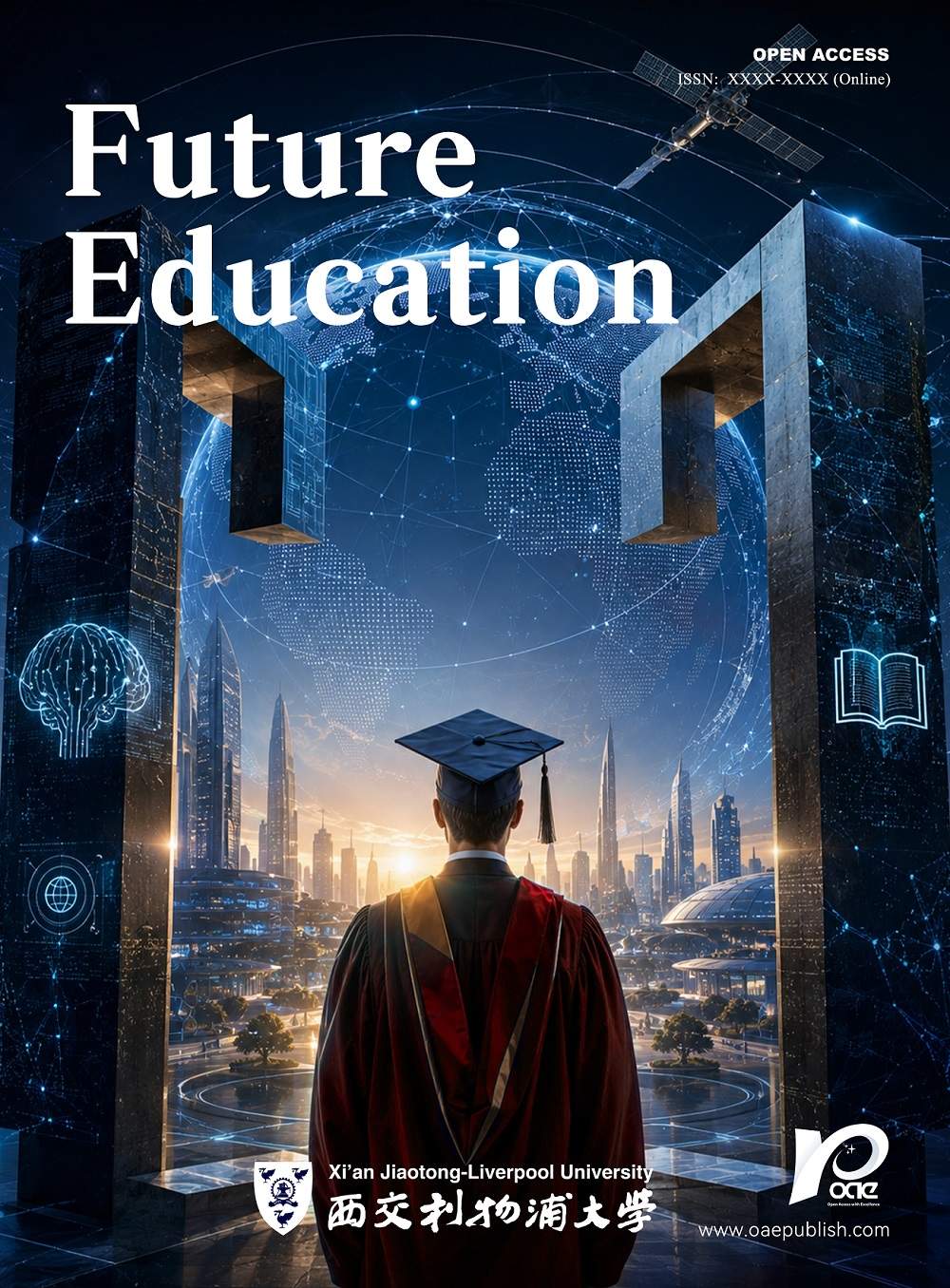
Reshaping education: the ecosystem imperative
 0
0 Welcome to the inaugural issue of the new International Journal “Future Education”.
This journal is born out of a conviction that the current global education system - for all its historical achievements - is reaching its limits. The world has changed fundamentally, but our schools, universities, and assessment systems remain largely anchored in an industrial-age paradigm: standardised, age-based, and knowledge-centric.
As we stand at the intersection of the Fourth Industrial Revolution, the rise of artificial general intelligence, and the accelerating pace of global interconnectedness, we must ask ourselves a difficult question: are we preparing learners for the future, or educating them for a world that is rapidly disappearing?
My own journey, first as a science student, later a scholar studying complex systems and organisational ecosystems, then a vice president of a famous public university in China, now as the founding Executive President of Xi’an Jiaotong-Liverpool University, has convinced me that the answer requires not incremental reform, but a paradigm shift in how we think about the purpose, structure, and delivery of education.
WHY A NEW JOURNAL
Educational research has never been more vibrant, yet many academic conversations remain constrained by disciplinary boundaries, established assumptions, and incremental improvement. We, the editorial board, believe the world now needs a forum that complements rigorous scholarship with intellectual courage, a place where bold ideas can be debated, interdisciplinary perspectives welcomed, and future possibilities explored.
Future Education is therefore not simply another education journal. It is intended as an international platform where researchers, practitioners, policymakers, industry leaders and learners themselves can collectively explore how education may evolve over the coming decades. We welcome scholarship that not only analyses education, but also helps shape and redesign its future.
Recognising that no single institution, country or educational tradition possesses all the answers, we provide an opportunity to develop an ongoing global dialogue that values diversity of perspectives, constructive debate, and collaborative imagination.
THE CENTRAL INSIGHT: EDUCATION MUST BECOME AN ECOSYSTEM
In my research on ecosystem theory and strategic flexibility, I have long argued that successful organisations, and by extension, successful societies, are those that can adapt, self-organise, and co-evolve with their environment. Education must learn from this logic.
Traditional education functions as a linear pipeline in that students enter at one end, receive standardised knowledge, and exit with a credential. The future education ecosystem, I believe, must be more socialised, ecological, and dynamic. It must be personalised, lifelong, globally connected, AI-empowered and deeply integrated with the real world.
Such an ecosystem is not defined primarily by technology; rather, it represents a philosophical reorientation. The core question shifts from “How much do students know?” to “What can students become, and how can they continue to grow?”
Education should awaken curiosity, ignite imagination, enable creativity, nurture responsibility and support lifelong development. Knowledge remains important, but it is no longer sufficient.
A HOLISTIC FRAMEWORK FOR THE FUTURE EDUCATION ECOSYSTEM
To operationalise this ecosystem vision, we can decompose future education into five interdependent dimensions that collectively redefine the learning experience:
1. Content: from data to wisdom
Future learning content transcends standardised knowledge to form a hierarchical continuum: starting with data or raw information, navigating through misinformation and disinformation, constructing structured knowledge, and integrating AI-augmented solutions - while critically interrogating narratives that may obfuscate truth or even conspiracy. The ultimate objective is to cultivate insight and wisdom, equipping learners to navigate complexity with discernment.
2. Context: grounded in authentic challenges
Learning must be anchored in real-world problems and connected to the social, technological, cultural, and environmental contexts in which people live and work. It needs to be supported by platforms that bridge formal instruction and experiential application. This approach ensures education is not abstract or isolated but directly relevant to the multifaceted issues learners will encounter in personal and professional domains.
3. Process: learning as collaborative inquiry
The learning process should adopt an inquiry-based mindset, centred on group activities that integrate experience, deliberation, and action. This active, collaborative model replaces passive knowledge absorption with dynamic, problem-solving engagement that mirrors real-world problem resolution.
4. Atmosphere: cultivating supportive learning environments
A thriving educational ecosystem depends on its atmospheric conditions, encompassing physical infrastructure, inclusive cultural norms, and accessible resources. These elements collectively create a space where learners feel empowered, inspired, and capable of taking intellectual risks.
5. Outcome: beyond competence to holistic flourishing
Educational success should be measured not only by academic proficiency or vocational skills, but by the development of adaptive mindsets, ethical reasoning, creativity, resilience, intercultural understanding and responsible AI literacy. The goal is to nurture learners who can thrive in a rapidly evolving landscape while upholding humanistic values.
FOUR PILLARS FOR THE FUTURE OF EDUCATION
Drawing upon 20 years of leading educational innovation at Xi’an Jiaotong-Liverpool University (XJTLU), a pioneering Sino-foreign university, alongside wider international developments, I believe four foundational pillars or transitions are particularly significant for the future of education.
1. From teaching to facilitating
The role of the educator must evolve from the “sage on the stage” to the “guide on the side.” In an AI-rich environment, where information is abundant and instantly accessible, the teacher’s highest value lies in mentoring, inspiring curiosity, and fostering critical thinking. At XJTLU, we call this the “Syntegrative cocreation” or “symphonic leadership”, where faculty orchestrate learning experiences rather than dispense facts.
2. From degrees to capabilities
Whilst qualifications remain valuable, the credentialing monopoly of the traditional degree is ending. Employers, especially in innovation-driven sectors, increasingly value demonstrated competencies such as problem-solving, collaboration, intercultural fluency, and digital literacy, over a traditional transcript as indicators of success. Our education systems must embrace richer forms of assessment, including micro-credentials, portfolio-based assessment, project-based evaluations and lifelong learning pathways. The university of the future is not a four-year dormitory but a lifelong partnership.
3. From national to global
The challenges we face including climate change, AI governance, public health, and economic inequality are global in nature. Education must prepare students to be global citizens, not just national job seekers. This means cross-cultural competence, multilingual fluency between people and between humans and machines, and the ability to address challenges that transcend national borders are essential. Hybrid and transnational education models, such as those pioneered by XJTLU and its international partners, are a glimpse of this borderless future.
4. From efficiency to well-being
The pandemic exposed a global crisis in student mental health and well-being. The relentless pursuit of grades, rankings, and efficiency has come at a terrible cost. Future education must embed social-emotional learning, mindfulness, and resilience as core elements of the curriculum. Human flourishing, resilience, purpose and social responsibility must become equally central educational outcomes.
ARTIFICIAL INTELLIGENCE AND HUMAN DEVELOPMENT
Artificial intelligence represents perhaps the most significant educational catalyst of our generation. Yet its greatest contribution will not be simply automating existing educational practices. AI challenges many of our traditional assumptions about knowledge, expertise, creativity, assessment and even research itself. Rather than asking how education can adapt AI to existing systems, we should ask how AI enables us to reimagine education while strengthening the uniquely human qualities of curiosity, judgement, ethics, imagination and compassion.
The future belongs neither to humans nor machines working alone, but to thoughtful partnerships between human intelligence and artificial intelligence.
UNIVERSITIES AND RESEARCH IN THE FUTURE
Universities themselves also need to evolve. Their success should not be judged purely by the number of graduates they produce or research papers they publish, but by the knowledge ecosystems they create, the partnerships they sustain, and the positive contributions they make to society.
Similarly, educational research should aspire not only to explain educational practice but to transform it. The most valuable scholarship is that which helps individuals, institutions and societies imagine and build better futures.
THE HEDGEHOG CONCEPT FOR EDUCATION
In my studies of strategic leadership, I frequently return to the Hedgehog Concept, the intersection of what we are deeply passionate about, what we can become best in the world at, and what drives our economic or social engine. For education, this intersection is clear to me in that we should focus on what we are most passionate about, nurturing human potential; what we can be best at, creating learning ecosystems that adapt to individual needs; and what drives our social engine, building a more just, sustainable, and interconnected world.
Together, we can transcend the boundaries of traditional education, challenge the status quo, and co-create an ecosystem where learning becomes a lifelong journey of exploration, growth, and contribution. The road ahead may be filled with uncertainties and obstacles, but with passion, innovation, and collective wisdom, we can shape an education future that empowers every individual to thrive in an interconnected world and make meaningful impacts on society.
A LIVING COMMUNITY OF INQUIRY
This inaugural issue brings together voices from scholars, practitioners, policymakers and innovators across six continents. Perspectives may differ, but all share a common belief that education must continue evolving if it is to serve humanity in the decades ahead.
Our ambition extends beyond publishing excellent research. We hope that this journal becomes a living international community of inquiry, exploration and practice, one that encourages thoughtful disagreement, welcomes diverse perspectives and supports collaborative exploration of education’s future.
The future of education cannot be designed by any single journal, university, nation or discipline. It will emerge through collective imagination, critical reflection and shared experimentation. As we launch this journal, I am reminded of the words of the philosopher Karl Popper: “The future is open. It is not predetermined. It depends on us.” The future of education is not something that happens to us; it is something we create, together.
I invite you to read, to question, to disagree, and most importantly, to act. Welcome to the journey.
Professor Youmin Xi
Editor-in-Chief
DECLARATIONS
Authors’ contributions
The author contributed solely to the article.
Availability of data and materials
Not applicable.
AI and AI-assisted tools statement
Not applicable.
Financial support and sponsorship
Not applicable.
Conflicts of interest
Xi, Y. is the Editor-in-Chief of Future Education. This Editorial was not externally peer reviewed and was accepted directly by the publisher. The Editor-in-Chief was not involved in the handling or decision-making of this manuscript.
Ethical approval and consent to participate
Not applicable.
Consent for publication
Not applicable.
Copyright
© The Author(s) 2026.
Cite This Article
 Open Access
How to Cite
Xi, Y. (2026). Reshaping education: The ecosystem imperative. Future Education, 1(1), 1. https://doi.org/10.20517/futureeduc.2026.06
Download Citation
Export Citation File:
Type of Import
Tips on Downloading Citation
Citation Manager File Format
Type of Import
Direct Import: When the Direct Import option is selected (the default state), a dialogue box will give you the option to Save or Open the downloaded citation data. Choosing Open will either launch your citation manager or give you a choice of applications with which to use the metadata. The Save option saves the file locally for later use.
Indirect Import: When the Indirect Import option is selected, the metadata is displayed and may be copied and pasted as needed.
About This Article
Copyright

Data & Comments
Data
0




Comments
Comments must be written in English. Spam, offensive content, impersonation, and private information will not be permitted. If any comment is reported and identified as inappropriate content by OAE staff, the comment will be removed without notice. If you have any queries or need any help, please contact us at support@oaepublish.com.