


Electrosynthesis in pure aqueous or organic phase
 0
0 
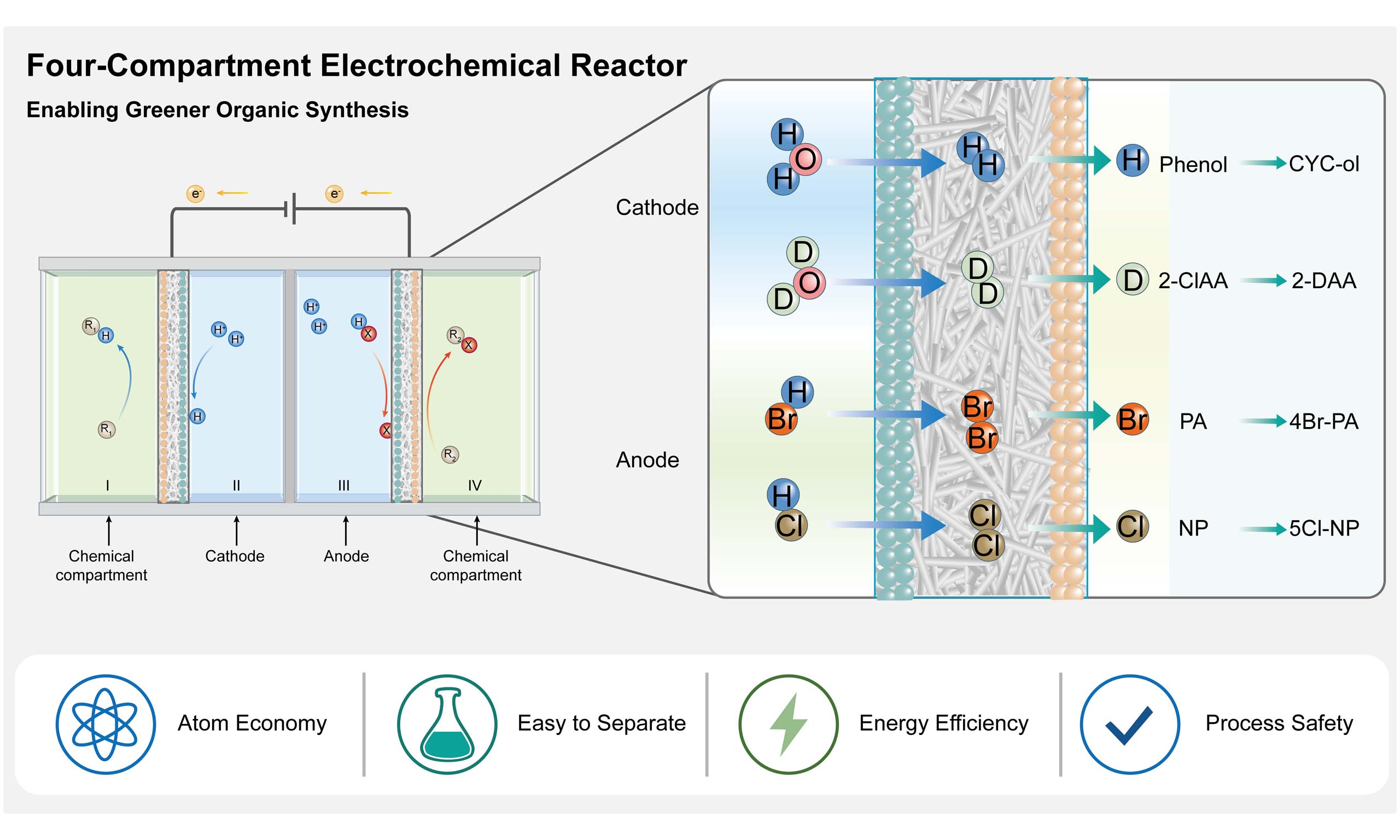
Modern chemical and pharmaceutical industries rely heavily on hydrogenation and halogenation reactions to synthesize key high-value-added chemicals. In traditional chemical synthesis pathways, these reactions often require harsh conditions with the consumption of molecular hydrogen or halogen gases, leading to substantial safety risks and environmental pollution [Figure 1A][1,2]. To find milder alternatives that align with green chemistry principles, researchers have turned their attention to electrocatalytic synthesis. Traditional two-chamber electrochemical reactors offer a highly promising route for green synthesis [Figure 1B][3]. They utilize extremely stable and environmentally friendly aqueous solutions or simple halide salts as raw materials, generating the highly reactive atomic hydrogen or halogens in situ on the electrode surface under an electric field, thereby driving hydrogenation or halogenation reactions at ambient temperature and pressure. However, due to the extremely poor conductivity of solvents, a large amount of supporting electrolyte salts is needed during electrolysis. After the reactions, the clean separation of the target products becomes an extremely cumbersome and costly engineering problem. This complex product separation process and dependence on organic supporting electrolytes greatly limit the competitiveness of electrosynthesis technology in large-scale green manufacturing.
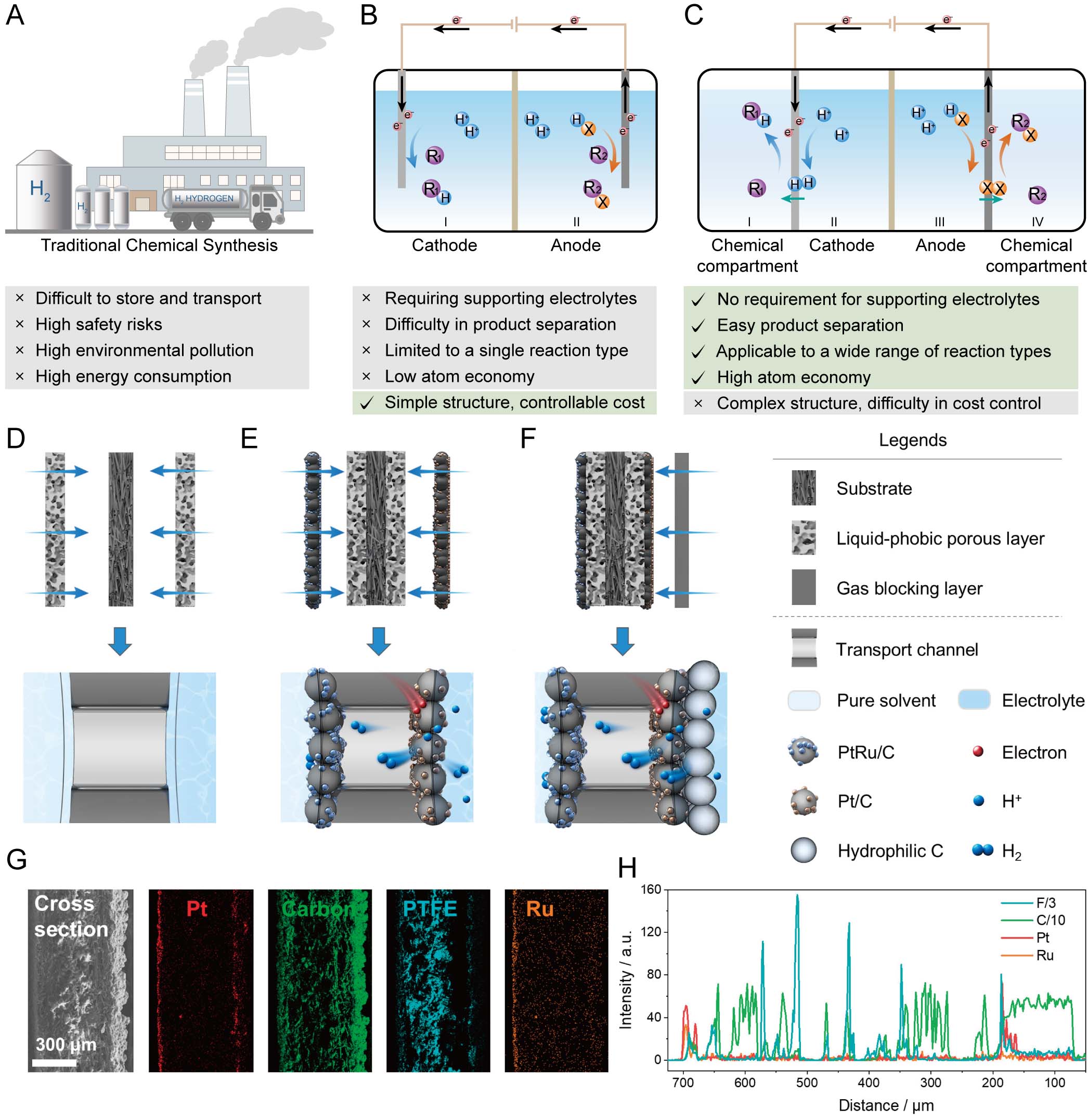
Figure 1. (A) Conceptual diagram of the drawbacks of traditional chemical hydrogenation synthesis. (B) Traditional electrochemical reactor. (C) Four-chamber electrochemical reactor for electrosynthesis without an auxiliary electrolyte. (D) Liquid-phobic interface structure. (E) Catalytic layer structure. (F) Gas barrier layer structure. (G) Cross-sectional SEM image of the membrane used for CYC-ol electrosynthesis and corresponding elemental distribution map and (H) Elemental distribution spectrum[4]. (D-H) is reproduced from[4], under the terms of the CC BY-NC-ND license, without modification.
In a recent study published in the Proceedings of the National Academy of Sciences (PNAS), Wu and colleagues reported a four-chamber electrochemical reactor that spatially decouples the electrochemical generation of active substances from the chemical reaction that produces the product[4]. Similar to early Pd-membrane reactor concepts, active species pass through a specially designed diffusion membrane to interact with organic reagents, thereby optimizing the pathways and processes of electrochemical organic reactions[5]. As shown in [Figure 1C], the reactor is divided into two chemical chambers for reductive and oxidative synthesis and two electrochemical chambers serving as the cathode and anode, respectively; these functionally distinct chambers are separated by a carefully designed membrane electrode that facilitates the diffusion of active species. The central framework of the diffusion membrane consists of a lyophobic gas diffusion layer, primarily composed of modified polytetrafluoroethylene (PTFE) [Figure 1D]. Researchers coated specific catalyst layers onto both sides of this lyophobic framework [Figure 1E]. The side facing the chemical reaction chamber was coated with a catalyst for the synthesis reaction to facilitate hydrogenation, such as a platinum-ruthenium alloy or palladium-on-carbon. The side facing the electrochemical reaction chamber was coated with a RuO2 catalyst to generate oxidizing gases. A critical step involved applying an additional hydrophilic nanocarbon gas-barrier layer over the catalyst layer on the electrochemical side [Figure 1F-H]. This barrier layer allows electrolyte permeation to sustain gas generation while increasing the resistance against gas escaping into the electrochemical chamber. This effectively exerts a localized, directional pressure on the newly generated gases, forcing them through the diffusion membrane and into the chemical chamber, where resistance is lower. This design allows the electrolyte to access the active gas generation zone while directing the gases toward the adjacent synthesis chamber. Consequently, the supporting electrolyte is confined to the electrochemical chamber, whereas the substrates and products remain within the pure solvent chamber.
Based on the experimental data in the paper, this four-chamber structure offers numerous advantages. First, it effectively prevents product contamination from the supporting electrolyte. For example, in the synthesis of the plant hormone 4-bromophenoxyacetic acid, the absence of interfering salts in the chemical chamber allows the pure product to be obtained simply by evaporating the solvent after the reaction. Second, it expands the range of solvents used in organic electrosynthesis. When processing naproxen, a drug that is almost insoluble in water, pure dichloromethane can be used directly as the solvent for the organic phase chlorination reaction, achieving a high yield of 83.1% even at a substrate concentration as high as
Spatial decoupling strategies were explored in early polymer electrolyte and membrane reactor systems[6]. The key advancement made by Wu and colleagues lies in integrating these concepts into a four-chamber configuration that supports both anodic and cathodic transformations[4]. While this integration significantly optimizes reaction pathways, it also introduces profound kinetic considerations and engineering challenges. At the material level, the diffusion membrane must precisely balance amphiphobicity, catalyst loading, and gas-barrier properties. Microscopic defects can trigger electrolyte leakage or compromise gas utilization. At the process level, operating conditions are determined by inherent physicochemical properties. For instance, bromination requires temperatures exceeding 70 °C to ensure Br2 vaporization and membrane penetration, thereby complicating thermal management. Furthermore, operational control in continuous flow mode necessitates a stringent trade-off between throughput and conversion efficiency.
The broader significance of this study is not that it removes every solvent or process constraint. Instead, it presents a thoughtful engineering strategy for selective transport and compartmentalized electrosynthesis. Its most compelling sustainability benefit may be the simplification of product isolation and the cleaner separation between electrolyte and product streams. At the same time, the overall green profile will still depend on the choice of solvent, membrane durability, and the source of electrical power. Even with those caveats, the work marks a meaningful step toward more adaptable electrochemical reactor design for both aqueous and organic-phase synthesis.
DECLARATIONS
Authors’ contributions
Conceptualization and supervision: Zhu, Q. L.
Manuscript preparation and revision: Ruan, K.; Long, Y.; Zhu, Q. L.
Availability of data and materials
Not applicable.
AI and AI-assisted tools statement
Not applicable.
Financial support and sponsorship
This work was financially supported by the financial support of the National Natural Science Foundation of China (22575218, 52332007) and the Natural Science Foundation of Fujian Province (2025J011015).
Conflicts of interest
Zhu, Q. L. is a Guest Editor of the Special Issue "Advanced Catalysts for Green Electrocatalysis and Electrosynthesis" of the journal Energy Materials. Zhu, Q. L. was not involved in any steps of editorial processing, including reviewers' selection, manuscript handling, and decision-making, while the other authors have declared that they have no conflicts of interest.
Ethical approval and consent to participate
Not applicable.
Consent for publication
Not applicable.
Copyright
© The Author(s) 2026.
REFERENCES
1. Gunathilake, C.; Soliman, I.; Panthi, D.; et al. A comprehensive review on hydrogen production, storage, and applications. Chem. Soc. Rev. 2024, 53, 10900-69.
2. Saikia, I.; Borah, A. J.; Phukan, P. Use of bromine and bromo-organic compounds in organic synthesis. Chem. Rev. 2016, 116, 6837-7042.
3. Liu, C.; Chen, F.; Zhao, B.; Wu, Y.; Zhang, B. Electrochemical hydrogenation and oxidation of organic species involving water. Nat. Rev. Chem. 2024, 8, 277-93.
4. Wu, H.; Liu, B.; Su, C.; et al. A supporting-electrolyte-free four-compartment electrochemical reactor for aqueous and organic phase electrosynthesis. Proc. Natl. Acad. Sci. USA. 2025, 122, e2514240122.
5. Inoue, H.; Abe, T.; Iwakura, C. Successive hydrogenation of styrene at a palladium sheet electrode combined with electrochemical supply of hydrogen. Chem. Commun. 1996, 32, 55-6.
Cite This Article
 Open Access
How to Cite
Download Citation
Export Citation File:
Type of Import
Tips on Downloading Citation
Citation Manager File Format
Type of Import
Direct Import: When the Direct Import option is selected (the default state), a dialogue box will give you the option to Save or Open the downloaded citation data. Choosing Open will either launch your citation manager or give you a choice of applications with which to use the metadata. The Save option saves the file locally for later use.
Indirect Import: When the Indirect Import option is selected, the metadata is displayed and may be copied and pasted as needed.
About This Article
Special Topic
Copyright

Data & Comments
Data
0








Comments
Comments must be written in English. Spam, offensive content, impersonation, and private information will not be permitted. If any comment is reported and identified as inappropriate content by OAE staff, the comment will be removed without notice. If you have any queries or need any help, please contact us at support@oaepublish.com.