


Amorphous nanomaterials for energy catalysis: a review
 0
0 Abstract
Amorphous nanomaterials - defined by short-range atomic order coupled with long-range structural disorder - exhibit a high density of intrinsic defects, coordinatively unsaturated active sites, and highly tunable electronic configurations. These structural and electronic characteristics collectively confer exceptional catalytic activity and selectivity in energy-related catalytic applications, often surpassing those of their crystalline counterparts. This review comprehensively outlines controllable synthetic strategies for three archetypal classes of amorphous-based catalytic materials: (i) purely amorphous materials, (ii) amorphous/crystalline heterojunction, and (iii) amorphous/single-atom composites. Building upon this synthetic foundation, we critically analyze the structure-activity relationships, performance advantages, and mechanistic underpinnings governing their efficacy in electrocatalysis and photocatalysis. We identify rational amorphous structural design, precise interface engineering, and atomic-level dispersion as three pivotal levers for simultaneously enhancing catalytic activity, selectivity, and stability. Finally, we propose forward-looking perspectives on advancing amorphous nanomaterials toward scalable manufacturing, fundamental mechanistic elucidation - particularly through operando characterization and multiscale modeling - and integration into next-generation energy conversion and storage devices. Collectively, this review furnishes a conceptual framework and actionable guidance for the rational design and practical deployment of high-performance amorphous-based catalysts in energy applications.
Keywords
INTRODUCTION
The dual imperatives of global energy security and environmental sustainability are driving the advancement of renewable energy conversion and carbon resource utilization technologies as foundational pillars of sustainable development[1-5]. Amid accelerating global commitments to carbon neutrality and rising industrial energy demands, the environmental and resource challenges associated with fossil fuel dependence, including climate change, air pollution, and nonrenewable resource depletion have intensified significantly. Consequently, the developing of zero-carbon, high-efficiency, and long-term stable energy conversion technologies has become a globally prioritized strategic objective for scientific and technological advancement[6,7]. Energy catalysis, serving as the cornerstone for critical technologies such as green hydrogen production, CO2 conversion, and water electrolysis, is fundamentally governed by the intrinsic activity, structural stability, and electronic transport capabilities of catalytic materials[8-11]. Core reactions like electrocatalytic water splitting and electrochemical/photocatalytic CO2 reduction represent vital pathways for clean energy production and carbon cycling[12-15]. Moreover, these processes underpin critical technological enablers for scalable green hydrogen production, industrial tail gas carbon capture and utilization, and efficient storage and conversion of renewable electricity, thereby playing a decisive role in advancing clean, resilient, and intelligent energy system architectures[16-19]. However, traditional crystalline catalysts are inherently constrained by their long-range periodic atomic arrangements, typically exhibiting critical performance bottlenecks including insufficient active site density, restricted electronic structure tunability, and structural instability under high-current-density operation due to crystallization-driven sintering or phase segregation[20,21]. Industrial-scale conditions are demanding. They feature high current densities, high-concentration electrolytes, and complex operational environments. Under these conditions, crystalline materials are prone to lattice reconstruction, loss of active components, and particle agglomeration. This leads to rapid performance degradation[22,23]. Consequently, meeting long-term stable operation requirements becomes difficult. Noble metal catalysts face challenges of high cost and scarce reserves, while non-noble metal crystalline materials struggle to balance activity and stability, failing to meet the stringent demands for scalable applications. Therefore, the development of novel catalytic systems - featuring rationally engineered architectures and breakthrough performance - is an urgent priority in energy catalysis[24].
Amorphous materials, characterized by their unique atomic arrangement of short-range order and long-range disorder, transcend the lattice constraints of crystalline materials. Their surfaces are feature a high density of defect and coordinatively unsaturated centers, and their electronic structure exhibits exceptional tunability, collectively establishing a distinctive structural platform for catalytic performance breakthroughs[25,26]. Unlike the fixed lattices and limited active facets of crystalline materials, the disordered atomic arrangement in amorphous structures gives rise to a high density of low-coordination, catalytically active sites. Furthermore, their flexible coordination environments are well-suited for the adsorption and activation of various reaction intermediates, offering a new structural paradigm to surpass the performance limits of traditional catalytic materials[27-29]. Early applications of bulk amorphous materials in catalysis were severely limited by issues such as poor electrical conductivity, low specific surface area, and inefficient mass transport. Advances in nanoscale fabrication, porous structuring, and interface engineering, have enabled nano-amorphous materials to overcome the intrinsic performance limitations of traditional bulk amorphous counterparts. By simultaneously enhancing specific surface area and charge transport kinetics, these strategies accentuate the intrinsic advantages of the amorphous structure, propelling its rapid development and application breakthroughs in the field of energy catalysis[30-33]. Furthermore, the introduction of nanoscale dimensions and porous structures significantly enhances the specific surface area and mass transport capabilities of the materials. When combined with interface engineering and atomic-level regulation strategies, this advancement is progressively transitioning amorphous materials from fundamental catalytic research toward practical and industrial application applications[34].
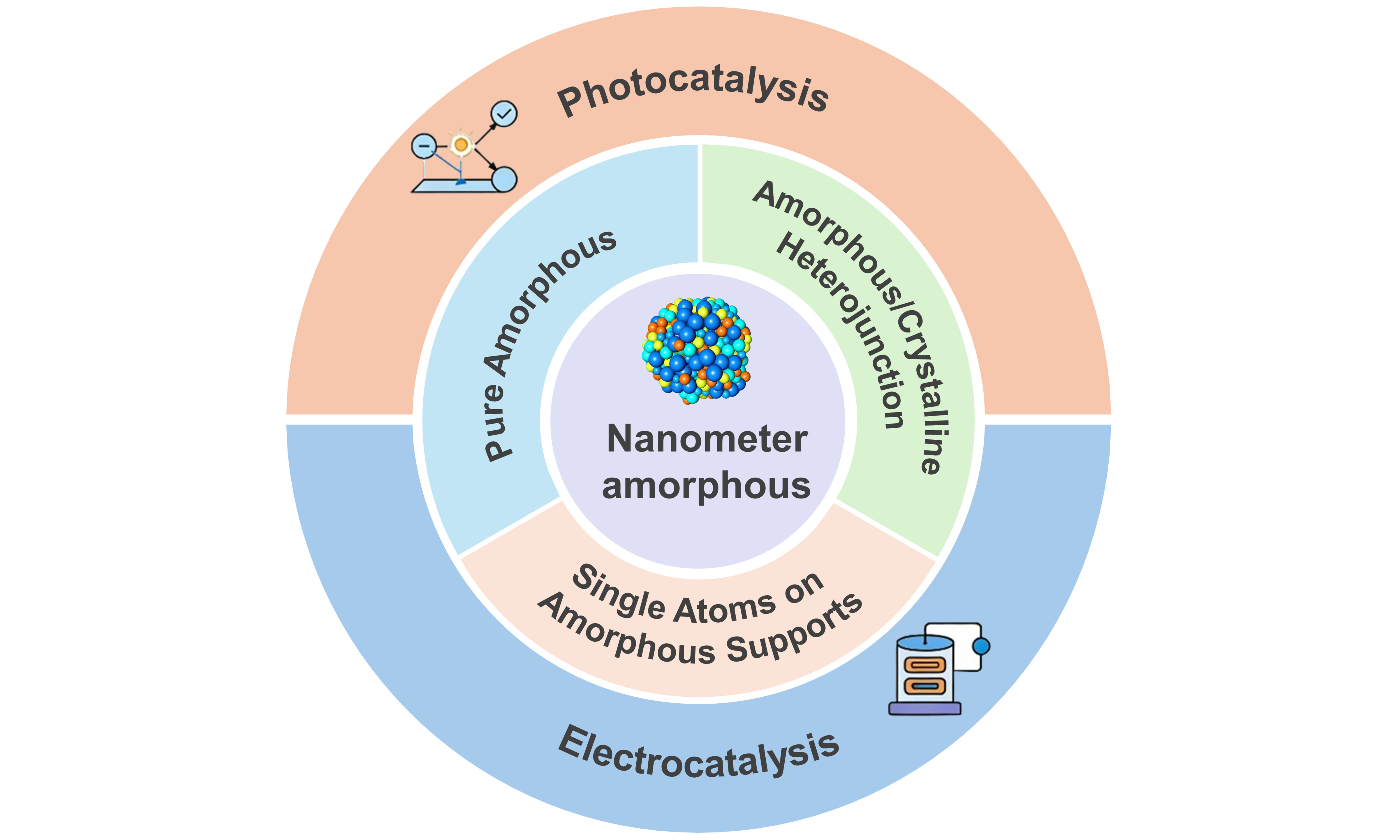
Compared with crystalline and bulk amorphous counterparts, nano-amorphous materials offer four distinct advantages: (i) their topologically disordered atomic structure enables the construction of high-density active sites, thereby effectively reducing reaction energy barriers; (ii) their homogeneous, isotropic structure free of grain boundaries significantly enhances structural stability under complex operating conditions; (iii) their flexible atomic coordination environment facilitates the optimization of electronic states and intermediate adsorption behaviors through compositional regulation, heteroatom doping, and other strategies; and (iv) they simultaneously possess favorable mechanical robustness with corrosion resistance, rendering them suitable for long-term, industrial catalytic applications[35-40]. These advantages enable amorphous nanomaterials to achieve superior activity, selectivity, and cycling stability in key energy reactions such as electrocatalysis and photocatalysis, outperforming traditional crystalline materials and positioning them as a vital direction for the next-generation high-performance catalytic materials[41,42]. Leveraging the aforementioned unique advantages of nano-amorphous materials, researchers have developed several targeted catalytic design strategies. Among these, three strategies - pure amorphous materials, amorphous/crystalline heterojunction, and amorphous/single-atom cooperative systems - have become current research hotspots due to their structural uniqueness and demonstrated potential for performance breakthroughs[43-54]. Early studies were dominated by pure amorphous nanomaterials. Thereafter, composite design strategies including amorphous/crystalline heterojunction and amorphous/single-atoms have garnered widespread attention, which have advanced the evolution of amorphous catalysts from single-phase configurations to multi-scale functional structures [Figure 1]. This review focuses on three archetypal amorphous-based catalytic systems: pure amorphous phases, amorphous/crystalline heterojunctions, and amorphous/single-atom hybrids. It systematically outlines the mild and controllable synthesis strategies for pure amorphous materials - including reducing agent regulation and low-temperature annealing induction; fabrication strategies for heterojunction - spanning top-down phase transformation and bottom-up interface construction; and robust single-atom anchoring methodologies - such as supersaturated co-precipitation, thermal driving, and electrochemical deposition. This review aims to provide an in-depth analysis of the structure-performance relationships, interfacial synergistic mechanisms, and atomic-level electronic regulation principles of these three material classes in electrocatalytic hydrogen evolution/oxygen evolution and photocatalytic CO2 reduction.

Figure 1. Schematic diagram of various amorphous-based catalyst categories applied in energy catalysis. Top inset: Reprinted with permission from[43]. Copyright 2018, John Wiley and Sons; Reprinted with permission from[44]. Copyright 2023, American Chemical Society; Reprinted with permission from[45]. Copyright 2025, John Wiley and Sons; Reprinted with permission from[46]. Copyright 2025, John Wiley and Sons. Middle inset: Reprinted with permission from[47]. Copyright 2023, American Chemical Society; Reprinted with permission from[48]. Copyright 2023, John Wiley and Sons; Reprinted with permission from[49]. Copyright 2024, John Wiley and Sons; Reprinted with permission from[50]. Copyright 2025, American Chemical Society. Bottom inset: Reprinted with permission from[51]. Copyright 2022, American Chemical Society; Reprinted from[52], under CC BY 4.0 license; Reprinted with permission from[53]. Copyright 2025, Springer Nature; Reprinted with permission from[54]. Copyright 2026, John Wiley and Sons. GO: Graphene oxide.
It further summarizes the key challenges currently facing for amorphous-based catalytic materials, including structural instability arising from metastability, insufficient intrinsic conductivity and structural heterogeneity, difficulty in identifying active sites, and bottlenecks in scalable fabrication. In response to these challenges, future research directions are envisioned, such as high-entropy stabilization strategies, deep integration of multi-dimensional characterization and theoretical simulations, as well as green and scalable synthesis technologies. Collectively, these efforts aim to provide theoretical foundation and technical support for the rational design and practical application of high-performance, long-life amorphous-based catalysts for energy conversion applications.
DESIGN STRATEGIES FOR AMORPHOUS CATALYTIC MATERIALS
The design and development of amorphous catalytic materials represent an important research direction that leverages the intrinsic disordered structure of materials to achieve precise regulation of catalytic performance, and is of critical significance for advancing theoretical innovation and practical applications of new catalytic systems. With the advancement of research, the development trajectory of amorphous catalytic materials has progressed from initial exploration of single-phase pure amorphous materials to sophisticated, multi-scale and multi-phase composite architectures featuring precise structural regulation. This evolution has crystallized into three three mainstream design strategies: (i) pure amorphous materials, (ii) amorphous/crystalline heterojunctions, and (iii) amorphous/single-atom composites. Each design concept is derived from the core structural characteristics of amorphous materials - short-range order coupled with long-range disorder - and exhibits unique catalytic advantages while concurrently facing distinct scientific challenges. The Table 1 systematically compares the key differences among these three types of amorphous catalytic materials in terms of synthesis strategies, structural features, catalytic advantages, and inherent limitation. This comparison clearly reveals the evolutionary principles and development context of their structure-performance relationships.
Comparative summary of core strengths, inherent limitations, and key design principles for the three amorphous-based catalytic systems
| Pure amorphous materials | Amorphous/crystalline heterojunction | Amorphous/single-atom composites | |
| Synthesis strategies | Reducing Agent Regulation Method[43,46]; Heat Treatment[44,45] | Top-down approaches[49]; Bottom-up approaches[47,48] | Supersaturated co-coprecipitation method[53]; Thermal-Driven Method[51]; Electrochemical deposition[52,54] |
| Structural features | Short-range ordered, long-range disordered; Fully amorphous with no grain boundaries; High density of intrinsic defects[37,43] | Coexistence of amorphous and crystalline phases; Presence of clear heterogeneous interfaces; Accompanied by charge redistribution and atomic distortion at the interface[47,50] | Isolated metal single atoms are uniformly dispersed on the surface of the amorphous support and bound to the support via coordination bonds[51,52] |
| Catalytic advantages | High density of active sites; Simple synthesis[41,43] | Interfacial synergy optimization; Crystalline phases provide structural rigidity and fast electron transport pathways; Excellent electrical conductivity and structural stability; Multi-dimensional performance modulation[40,47,48] | Maximized atomic utilization efficiency; Electronic states of active centers can be precisely regulated; High product selectivity[51,53] |
| Inherent Limitations | Poor electrical conductivity; Thermodynamic metastability leads to easy crystallization; Heterogeneous distribution of active sites[25,37] | Difficult precise regulation of the interface; Complex synthesis procedures; Ambiguous identification of active sites due to phase mixing at the interface[37] | Low single-atom loading capacity[37]; High synthesis cost; Insufficient local coordination stability under dynamic reaction conditions[51] |
Pure amorphous materials
Amorphous catalytic materials represent a novel class of catalytic materials characterized by short-range order and long-range disorder in their microstructure. They lack long-range crystalline periodicity, feature surfaces abundant in structural defect and coordinatively unsaturated active centers, and possess electronically tunable architectures. Demonstrating superior performance compared to traditional crystalline catalytic materials in various fields such as electrocatalysis, photocatalysis, and thermocatalysis, they have become a research hotspot in the catalysis community. The formation of amorphous structures fundamentally relies on external manipulation to disrupt the thermodynamic tendency toward long-range ordered atomic arrangements, stabilizing the system in a metastable amorphous state. Achieving mild and controllable construction of amorphous structures remains a core challenge in the field of materials synthesis[55-58]. Current mainstream synthesis strategies can be categorized into two approaches: (i) controlling reduction kinetics via reducing agents to suppress ordered atomic crystallization in the liquid phase, enabling the direct growth of amorphous structures; (ii) employing heat treatment to limit atomic migration, thereby blocking crystal nucleation and growth processes and stabilizing the material in an amorphous metastable state.
Reducing agent regulation method
The reducing agent regulation method represents a core strategy for amorphous synthesis based on wet-chemical systems. Its underlying formation mechanism involves selecting an appropriate reducing agent to precisely control the reduction rate of precursor ions. The kinetic imbalance between the rate of atom generation and the combined rates of atomic diffusion and ordered arrangement, suppressed long-range crystalline periodicity while promoting the assembly of atoms into a short-range ordered, long-range disordered configurations, ultimately yielding an amorphous structure. This approach does not require extreme reaction conditions and enables precise control over the phase, morphology, and size of amorphous materials through regulation of the type and amount of reducing agent, as well as the reaction environment. It is a commonly employed synthesis route for metal-based and metal oxide-based amorphous catalytic materials[59,60]. Duan et al.[43] achieved the facile synthesis of both amorphous and crystalline copper nanoparticles in an aqueous solution system at room temperature using copper chloride as the copper source [Figure 2A]. Using deionized water as a green liquid-phase medium without the addition of surfactants, templating agents, or dispersants, and employing tannic acid as a mild reducing agent to create a gentle reduction environment, Cu2+ was slowly reduced to Cu0 atoms. Under these conditions, the reduction rate was significantly lower than the atomic diffusion rate, preventing copper atoms from spontaneously arranging in an ordered manner to form a crystalline lattice under thermodynamic driving forces. Instead, they nucleated and grew in a short-range ordered, long-range disordered fashion, ultimately forming amorphous copper nanoparticles with an average particle size of 3.33 nm with excellent dispersion [Figure 2B]. Conversely, when the reducing agent was replaced by sodium borohydride, its strong reducing properties led to the rapid reduction of Cu2+, generating a large number of Cu0 atoms instantaneously[61]. These atoms quickly aggregated and spontaneously crystallized under thermodynamic stabilization tendencies, forming well-crystallized crystalline copper nanoparticles. This entire process was conducted at room temperature and atmospheric pressure, requiring no specialized equipment or harsh reaction conditions. The as-prepared amorphous copper nanoparticles exhibited a large electrochemical active surface area and enhanced CO2 adsorption capacity. When employed as electrocatalysts for CO2 reduction, the amorphous copper nanoparticles demonstrated significantly superior electrocatalytic performance compared to their crystalline counterparts, achieving Faradaic efficiencies of 37% for formate and 22% for ethanol at -1.4 V, a maximum total Faradaic efficiency of 59% for liquid products, along with good catalytic stability over 12 h. This synthetic strategy is also applicable for preparing amorphous metal oxide catalytic materials. In the synthesis of boron-doped amorphous CeO2/GO composite materials[46], the researchers utilized sodium borohydride as both a boron source, reducing agent, and precipitant. Through a wet-chemical method[11], boron was uniformly doped into the CeO2 lattice. The introduction of boron atoms formed planar triangular BO33+ structural units, disrupting the intrinsic Fm-3m high-symmetry crystal structure of CeO2, inducing symmetry breaking and amorphization [Figure 2C]. Simultaneously, the additional electrons introduced by the boron atoms effectively promoted the reduction of Ce4+ to Ce3+, ultimately enabling the controllable preparation of an amorphous CeO2/GO composite material with a high Ce3+ content (85.7%) [Figure 2D]. To elucidate the influence of the amorphous structure on material properties, the study also synthesized a purely crystalline CeO2/GO control sample using a glycine-sodium hydroxide buffer solution instead of NaBH4 [Figure 2E], directly confirming the crucial role of the pure amorphous structure in enhancing CO2 photoreduction performance. The amorphous CeO2/GO composite exhibited excellent CO production performance in dilute CO2 feed streams through photoreduction, fully demonstrating the efficacy of the reduction regulation strategy in constructing amorphous metal oxide phases and investigating structure-property relationships.
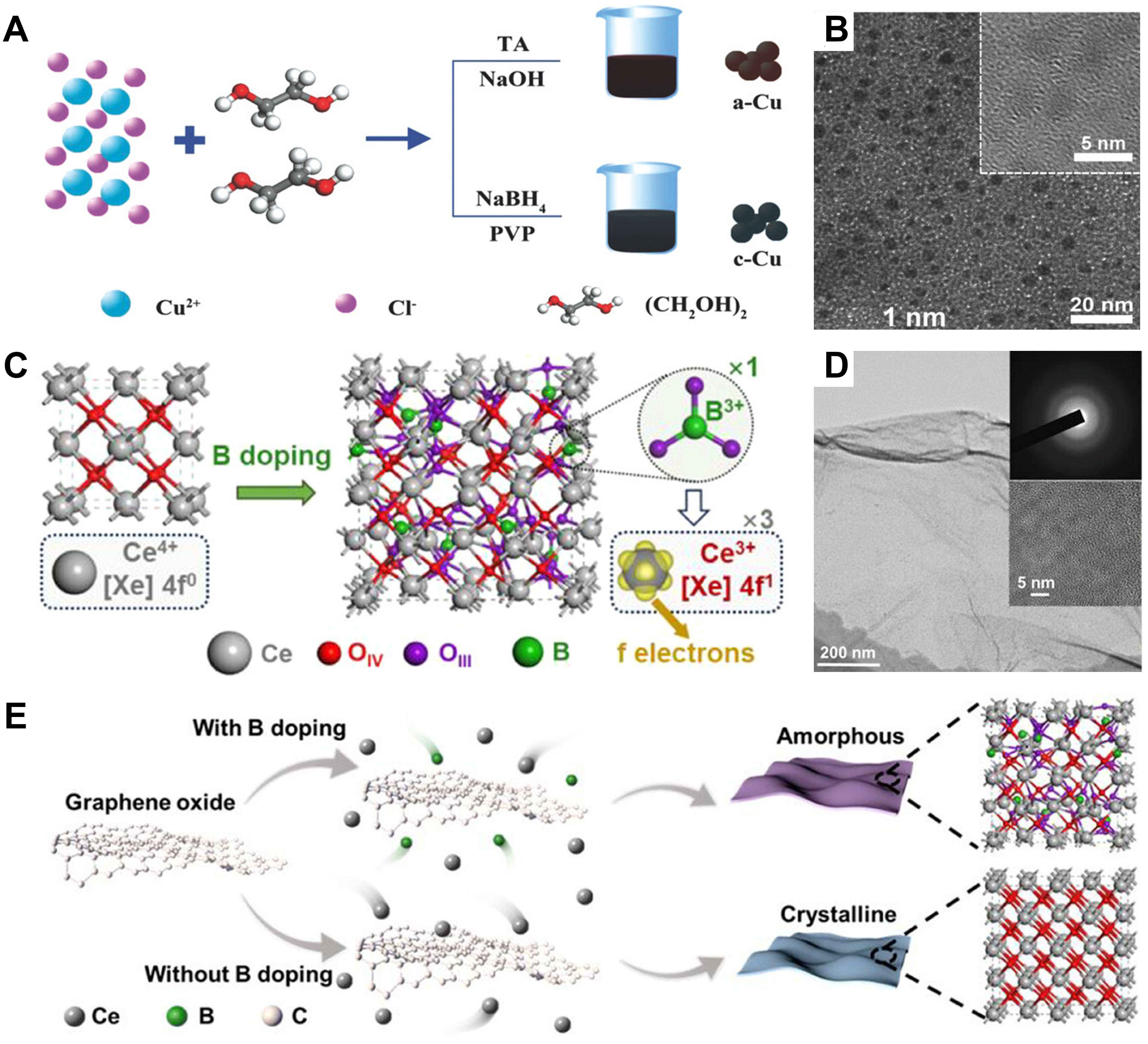
Figure 2. (A) Schematic representation of a-Cu and c-Cu formation; (B) TEM image of a-Cu. Figure 2A and B is reprinted with permission from[43]. Copyright 2018, John Wiley and Sons; (C) Structural evolution from pristine CeO2 to B-doped CeO2 (B-7.69%) upon boron incorporation; (D) TEM image of the B-doped CeO2/GO nanosheet, with the insets displaying the selected area electron diffraction (SAED) pattern and high-resolution transmission electron microscopy (HRTEM) image; (E) Schematic of the synthesis procedure for B-doped CeO2/GO nanosheet. Figure 2C-E is reprinted with permission from[46]. Copyright 2025, John Wiley and Sons. PVP: Polyvinyl pyrrolidone; TEM: transmission electron microscopy; GO: graphene oxide.
Heat treatment
The low-temperature annealing induction method is currently the most widely employed post-treatment strategy for crystal phase regulation in amorphous inorganic catalytic materials. As an important branch of solid-state amorphization techniques, it is often combined with classical precursor preparation routes such as liquid-phase impregnation, sol-gel processing, hydrothermal synthesis, and chemical precipitation. Its core design principal leverages annealing temperature as the key regulation parameter, strictly controlling the thermal treatment temperature below the critical crystallization temperature of the target material. By leveraging the kinetic inhibition effects of low-temperature environments on atomic migration, rearrangement, and crystalline phase evolution, this method suppresses crystal nucleation and grain growth, stabilizing the system in a short-range ordered, long-range disordered amorphous state. Simultaneously, it achieves uniform dispersion and surface anchoring of active components, establishing itself as a versatile and reliable technical pathway for efficiently constructing amorphous-based composite catalytic materials. For the vast majority of inorganic catalytic materials, transitioning from an amorphous precursor to a crystalline phase requires overcoming a specific energy barrier. Only upon reaching the critical crystallization temperature do atoms acquire sufficient thermal kinetic energy to undergo long-range diffusion and ordered lattice assembly, thereby enabling nucleation and crystal growth. Under low-temperature annealing conditions, the system facilitates precursor compositional transformations - such as the conversion of hydroxides, chlorides, or nitrates into catalytically oxides or sulfides - while remaining energetically insufficient to induce long-range ordered atomic arrangements, thus stabilizing the material in an amorphous metastable state[62]. Conversely, when the temperature exceeds the critical crystallization temperature, atomic thermal motion intensifies significantly, leading to directed arrangement, and the material gradually crystallizes, forming a complete lattice structure[63,64]. Based precisely on this temperature-dependent phase transformation behavior, the low-temperature annealing induction method enables controllable switching between amorphous and crystalline phases using the same chemical composition and precursor system, providing an ideal research paradigm for establishing structure-property relationships in catalytic materials. For example, Gao et al.[44] used hydrothermally synthesized flower-like anatase TiO2 nanosheets as a support. After loading a RuCl3·xH2O precursor via liquid-phase impregnation, they subjected the material to low-temperature annealing at 100 °C. Utilizing the kinetic inhibition of RuO2 crystallization at low temperatures, they obtained an a-RuO2/TiO2 composite catalyst with uniformly loaded amorphous RuO2. By increasing the annealing temperature to 600 °C, they obtained a crystalline c-RuO2/TiO2 control sample using the same precursor and support system, achieving precise and controllable regulation of the RuO2 crystal phase through different annealing temperatures [Figure 3A]. Characterization techniques such as electron diffraction [Figures 3B and C] clearly revealed the absence of RuO2-related diffraction rings or spots in a-RuO2/TiO2, confirming the amorphous nature of RuO2. In contrast, distinct RuO2 characteristic diffraction rings or spots were observed in c-RuO2/TiO2, confirming its crystalline structure. Electrochemical tests demonstrated that the a-RuO2/TiO2 prepared by low-temperature annealing exhibited superior cathode catalytic performance in lithium-oxygen batteries, achieving a discharge specific capacity of 2.3 mAh cm-2 at a current density of 0.04 mA and maintaining stable cycling for over 160 cycles, far outperforming c-RuO2/TiO2 [Figure 3D]. This performance advantage originates from the unique structural characteristics engineered by low-temperature annealing: suppressing of crystallization concurrent with retention of a high specific surface area (131 m2 g-1), a high density of surface defects and abundant surface functional groups, providing ample active sites for oxygen reduction and evolution reactions. Furthermore, the amorphous catalyst induced the formation of 100-300 nm amorphous Li2-xO2 discharge products [Figures 3E and F], which could be completely decomposed during the charging process, significantly enhancing the reversibility of the oxygen electrode reaction and charge transfer kinetics. Concurrently, Shi et al.[45] applied the low-temperature annealing induction method to prepare ultrathin amorphous CoO nanosheets (a-CoO) for photocatalytic CO2 reduction. Using Co(acac)2 and NaNO3 as precursors, they directly synthesized amorphous CoO nanosheets via low-temperature annealing at 230 °C under an argon atmosphere. Upon further increasing the annealing temperature to 400 °C under identical atmosphere conditions, a crystalline CoO (c-CoO) reference sample was obtained [Figure 3G]. Photocatalytic CO2 reduction performance tests revealed that the a-CoO prepared by low-temperature annealing exhibited significantly higher catalytic activity than the crystalline sample and maintained essentially unchanged catalytic performance over five cycles. The origin of this performance advantage is attributed to the amorphous structure formed by low-temperature crystallization inhibition, which induced a transition in the local coordination environment of Co atoms from quasi-octahedral to quasi-tetrahedral. This regulation altered the energy level distribution of Co 3d orbitals and increased the number of unpaired electrons in the frontier d orbitals, significantly enhancing d-p orbital hybridization between Co 3d and CO2 2p orbitals, thereby lowering the CO2 activation energy barrier [Figure 3H]. In contrast, the high-temperature crystallized cubic CoO exhibits significantly weakened adsorption and activation capabilities toward CO2, resulting in a substantial decline in photocatalytic performance. Characterized by its distinct temperature dependence, method compatibility, structural retention, and comparative structure-property analysis capabilities, the low-temperature annealing induction method transcends the limitations of traditional amorphous preparation methods that rely on extreme conditions. It simplifies crystal phase regulation from complex synthetic design to a quantifiable and reproducible temperature control, establishing itself as a representative and widely adopted standard synthesis strategies in the field of amorphous catalytic materials.
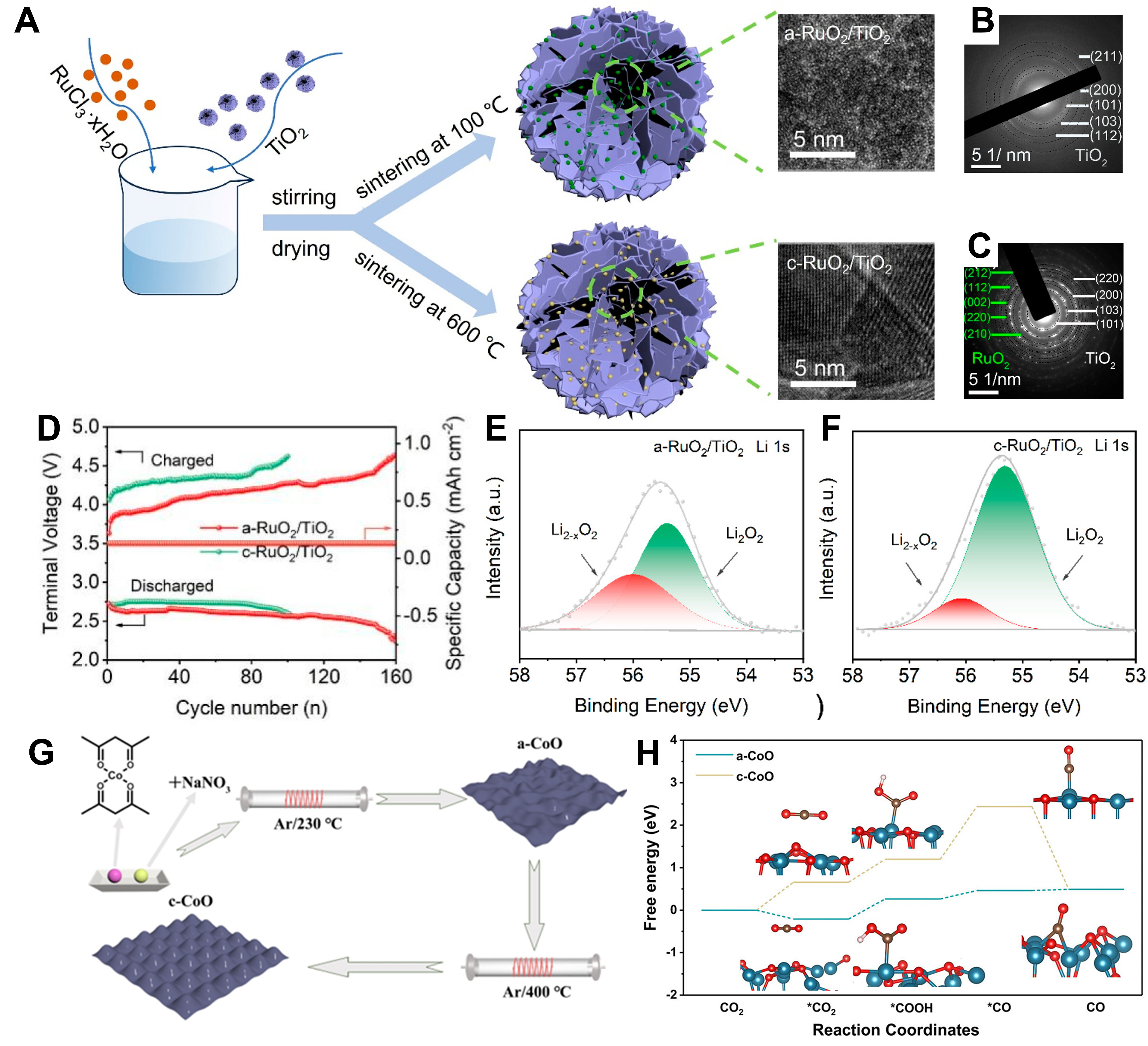
Figure 3. (A) Schematic depiction of the synthesis procedure for a-RuO2/TiO2 and c-RuO2/TiO2 catalysts. Electron diffraction pattern of (B) a-RuO2/TiO2 and (C) c-RuO2/TiO2; (D) Terminal voltage profiles of a-RuO2/TiO2 and c-RuO2/TiO2 electrodes at 0.04mA. Li 1s XPS spectra of (E) a-RuO2/TiO2 and (f) c-RuO2/TiO2 electrode in the fully discharged state. Figure 3A-F is reprinted with permission from[44]. Copyright 2023, American Chemical Society; (G) Synthetic schematic of a-CoO and c-CoO; (H) Free energy diagrams and corresponding configurations for CO2 photoreduction processes (color code: Co blue, O red, H white, C brown). Figure 3G and H is reprinted with permission from[45]. Copyright 2025, John Wiley and Sons. XPS: X-ray photoelectron spectroscopy.
Despite the remarkable intrinsic activity offered by pure amorphous phases, their practical application is often hindered by insufficient electronic conductivity and structural instability under harsh operating conditions. To address these limitations, researchers have advanced beyond single-phase architectures to develop amorphous/crystalline heterojunction catalysts, specifically engineered to synergistically integrate the complementary functional advantages of both structural motifs.
Amorphous/crystalline heterojunction
The efficiency enhancement of catalytic reactions is highly correlated with the structural characteristics of catalysts, the number of active sites, and electron transport capabilities. Amorphous/crystalline (a/c) Heterojunction catalytic materials, by precisely integrating the structural advantages of amorphous and crystalline phases, have become a central direction for breaking through the performance bottlenecks of traditional single-phase catalytic materials[65-69]. The amorphous phase, owing to its disordered atomic arrangement, possesses abundant unsaturated coordination sites, defect structures, and a flexible surface, enabling effective adsorption and activation of reaction intermediates and significantly enhancing intrinsic catalytic activity. The crystalline phase, with its regular atomic arrangement, high electronic conductivity, and structural rigidity, provides stable electron transport pathways and mechanical support for catalytic reactions while inhibiting structural collapse and loss of active sites during catalysis[70,71]. Furthermore, the coupling of these two phases at the heterointerface creates synergistic effects. Lattice mismatch at the interface induces dangling bonds, atomic distortions, and charge redistribution, which optimize the adsorption energy of reaction intermediates, lower the catalytic reaction energy barrier, and achieve simultaneous improvements in catalytic activity, stability, and selectivity[72-74]. Currently, researchers have developed numerous mature synthesis methods for the controllable construction of amorphous/crystalline heterojunction catalytic materials. These synthesis strategies are primarily categorized into two main types: bottom-up construction” and “top-down transformation”.
Top-down approaches
The fundamental principle of top-down strategies lies in utilizing external stimuli to disrupt the single-phase equilibrium of a precursor, inducing a phase transformation in localized regions while preserving portions of the original phase, thereby forming an amorphous/crystalline heterojunction. Based on the type of stimulus, these strategies can be further subdivided into chemical reduction-induced and physical annealing-induced processing routes. Chemical reduction-induced strategies have garnered widespread attention due to their ability to precisely control the degree of phase transformation and interfacial characteristics under mild conditions. The core mechanism of this approach involves selective reactions between reducing agents and precursors, which disrupt the long-range ordered structure in specific regions or induce crystallization of particular components, while simultaneously introducing defects (such as oxygen vacancies) and reconstructing electronic structures, ultimately forming heterointerfaces that combine the advantages of both phases. The success of this method hinges on precise control of reducing agent dosage, reaction temperature, and duration. Only an appropriate degree of reduction yields heterointerfaces with both high interfacial density and structural stability.
Wang et al.[49] used NiCo-metal–organic framework (NiCo-MOF) grown in situ on carbon cloth as a precursor, which was calcined in air to obtain crystalline NiCo2O4 nanosheet arrays. Subsequently, the crystalline NiCo2O4 was reduced using a NaBH4 solution at room temperature, ultimately yielding an amorphous/crystalline heterojunction NiCo2O4-B-CC electrode supported on carbon cloth [Figure 4A]. The strongly reducing H- ions provided by NaBH4 acted as oxygen scavengers, not only reducing the crystallinity of NiCo2O4 and inducing a partial transformation to an amorphous phase, but also successfully introducing a large number of oxygen vacancies, forming a well-defined amorphous/crystalline heterointerface [Figure 4B]. This gradual amorphization from the exterior inward preserved the high conductivity of the crystalline core while significantly increasing the density of active sites for both the oxygen evolution reaction (OER) and hydrogen evolution reaction (HER) through the oxygen vacancy defects in the amorphous shell. Consequently, NiCo2O4-B-CC exhibited excellent performance in electrocatalytic water splitting. Density functional theory (DFT) calculations revealed that the incorporation of oxygen vacancies induces a pronounced rearrangement of the local coordination environment surrounding the catalytically active centers. Such structural modulation significantly attenuates the free energy barriers corresponding to the potential-determining steps for both the OER and HER processes. In contrast, Fan et al.[75] developed another reduction-induced pathway. They first synthesized amorphous Ni0.5Fe0.5Mo1.5Ox ternary oxide nanosheets via a solvothermal method. Subsequently, they added varying amounts of borane tert-butylamine complex in a triethylene glycol system at 250 °C for reduction treatment [Figure 4C]. With an optimal amount of reducing agent, partial Ni and Fe ions were reduced and precipitated in situ, forming crystalline Ni and FeNi3 nanoparticles with a mean dimension of 3.9 nm [Figure 4D-F], uniformly anchored onto the residual amorphous oxide matrix. This inward precipitation mechanism resulted in the formation of numerous intimately contacted heterointerfaces between the crystalline metal nanodomains and the amorphous oxide. X-ray photoelectron spectroscopy (XPS) revealed a clear electronic coupling effect. The resulting material exhibited a low OER overpotential of 278 mV and operated via a lattice oxygen-mediated reaction mechanism. This study systematically demonstrates that the degree of crystalline phase precipitation and interface structure can be precisely regulated through controlled modulation of the reducing agent dosage. Insufficient reducing agent promotes selective Ni precipitation only, whereas excess dosage resulted in extensive alloying or even structural collapse, highlighting the critical importance of moderate chemical reduction in constructing high-performance heterointerfaces.
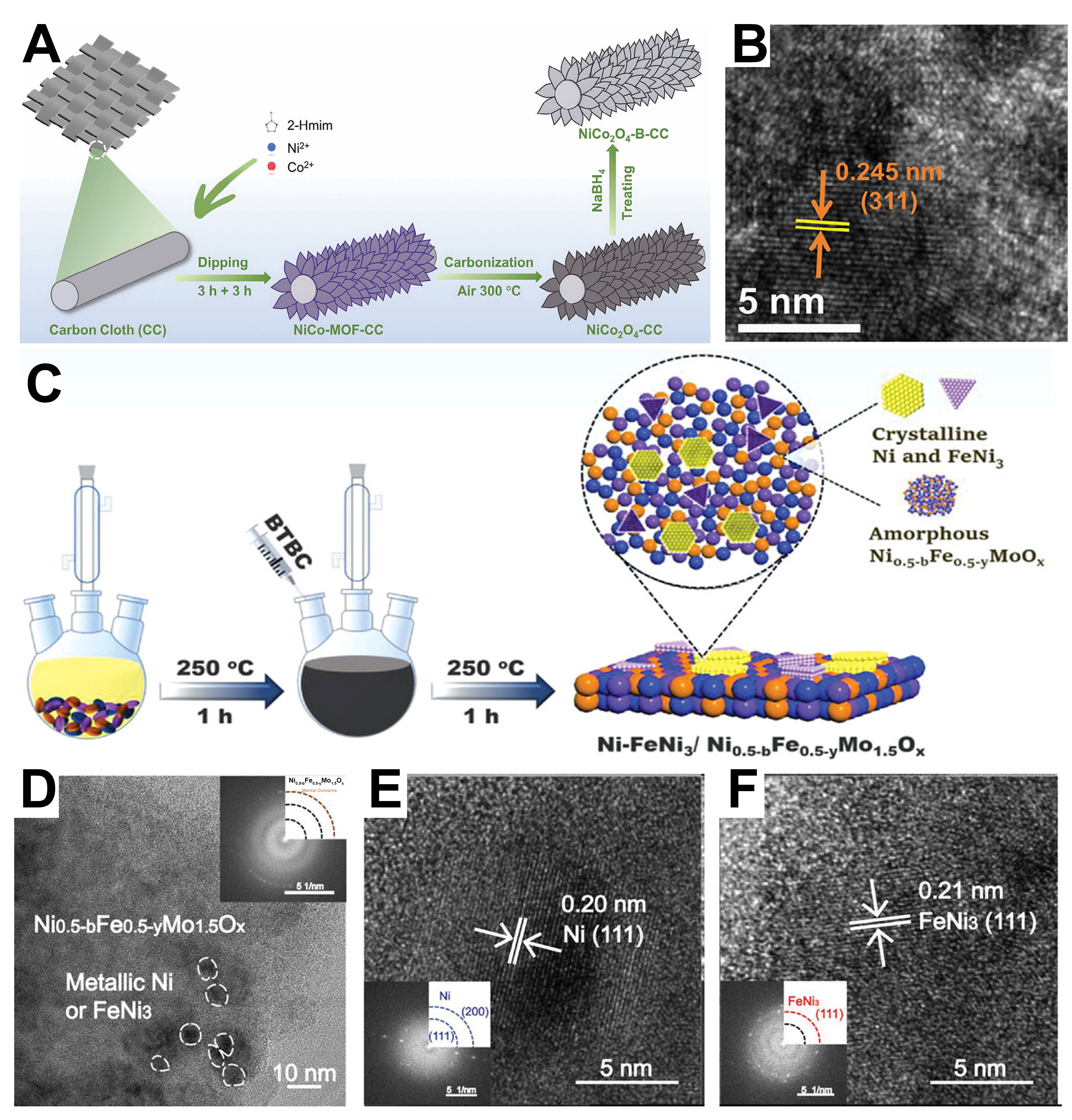
Figure 4. (A) Schematic illustration of the synthesis process of the NiCo2O4-B-CC; (B) HRTEM images of NiCo2O4-CC. Figure 4A and B is reprinted with permission from[49]. Copyright 2024, John Wiley and Sons; (C) Schematic illustration showing the synthesis of typical Ni-FeNi3/Ni0.5-bFe0.5-yMo1.5Ox nanohybrids; (D) High-magnification TEM image; (E and F) HRTEM images of Ni-FeNi3/Ni0.5-bFe0.5-yMo1.5Ox. Figure 4C-F is reprinted with permission from[75]. Copyright 2023, John Wiley and Sons. BTBC: Borane-tert-butylamine complex; CC: carbon cloth; HRTEM: high-resolution transmission electron microscopy.
The annealing-induced strategy constitutes a core implementation approach for top-down in situ partial crystallization. It is grounded in the use of an amorphous material as the single precursor. Through precisely controlled thermal energy input, this strategy disrupts the thermodynamic equilibrium associated with the disordered atomic arrangement, thereby exploiting differences in crystallization energy barriers among different structural regions or chemical components. As a result, selective crystallization is achieved locally, while retaining a portion of the original amorphous phase. This enables the in-situ construction of structurally dense amorphous/crystalline heterojunction with significant synergistic effects. Compared to other top-down strategies, this method does not require the introduction of additional chemical reagents; phase transformation control is achieved solely through thermodynamic regulation, simultaneously optimizing interfacial bonding strength, defect density, and electronic structure within the heterojunction. Key process control parameters include annealing temperature, holding time, heating rate, and atmospheric environment, with annealing temperature serves as the predominant factor determining the degree of phase transformation[76]. However, excessively high temperatures can result in complete crystallization of the amorphous phase or collapse of the heterojunction. Therefore, precise temperature control is essential for optimizing the ratio and synergistic coexistence of amorphous and crystalline phases. For instance, Zhao et al.[77] first synthesized amorphous RuSe2 nanoparticles with a porous structure using F127 as a soft template via a simple hydrothermal method, followed by annealing treatments at different temperatures under an argon atmosphere [Figure 5A]. Structural characterization revealed that the as-prepared pristine sample was completely amorphous. After annealing at 300 °C, the material remained predominantly amorphous. However, upon increasing the annealing temperature to 400 °C, distinct RuSe2 lattice fringes began to appear, alternating with amorphous regions, forming abundant amorphous/crystalline interfaces [Figure 5B]. Further increasing the temperature above 500 °C led to complete crystallization and the disappearance of amorphous regions. Electrochemical tests showed that RuSe2 annealed at 400 °C (RuSe2-400), featuring coexisting amorphous and crystalline phases, required an overpotential of only 27 mV to achieve a current density of 10 mA cm-2 in the alkaline HER, significantly outperforming the fully amorphous or fully crystalline counterparts. DFT calculations revealed that the amorphous structure facilitates the adsorption and activation of water molecules (adsorption energy -2.84 eV), while the crystalline structure optimizes the adsorption free energy of hydrogen intermediates (-0.19 eV). The synergistic effect of these two phases makes the amorphous/crystalline interface an ideal active center for the HER. Similarly, Zhang et al.[78] adopted a facile Pechini method combined with gradient annealing in an air atmosphere to precisely regulate the crystallization degree by tuning the annealing temperature. An optimal amorphous/crystalline heterojunction was constructed at 300-350 °C, while complete crystallization occurred when the temperature exceeded 400 °C [Figure 5C]. The MnRuOx-300 sample obtained by heat treatment at 300 °C presents a solid-solution structure with RuO2 microcrystals embedded in an amorphous MnRuOx matrix [Figure 5D]. The amorphous/crystalline heterointerface can induce abundant oxygen vacancies [Figure 5E], enlarge the electrochemically active surface area, and accelerate the interfacial charge transfer kinetics. DFT calculations further verify that the amorphous/crystalline heterojunction can effectively regulate the d-band center, reduce the energy barrier of the OER [Figure 5F], and strengthen the interfacial charge transfer behavior [Figure 5G]. Benefiting from the interfacial synergistic effect between RuO2 microcrystals and amorphous MnRuOx, the catalyst achieves simultaneous enhancement of acidic OER catalytic activity and structural stability. It delivers an extremely low overpotential and Tafel slope, and exhibits outstanding long-term operational stability under high current densities in both acidic electrolytes and proton exchange membrane water electrolyzer.
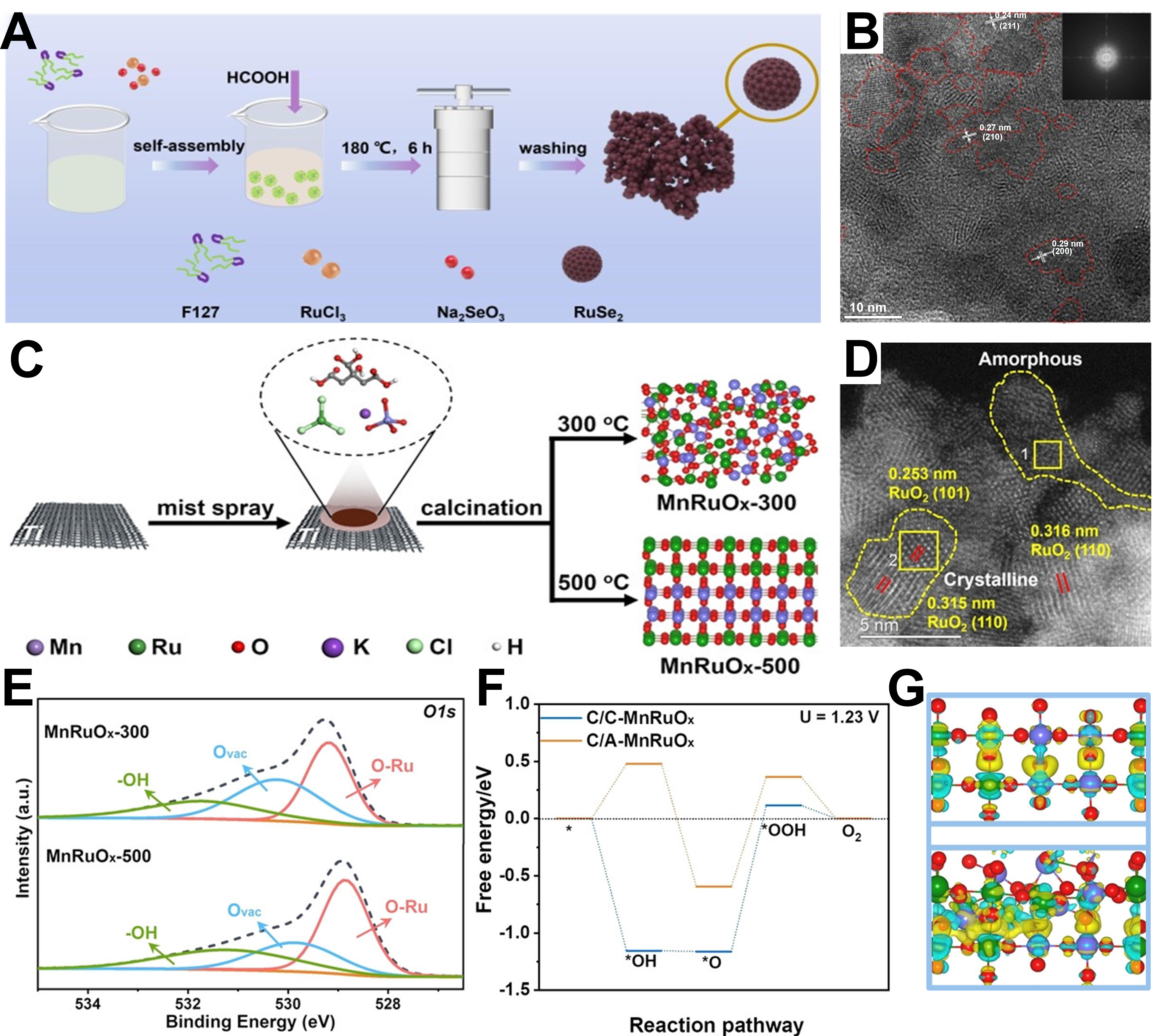
Figure 5. (A) Schematic diagram of the synthetic procedure for amorphous porous RuSe2; (B) HRTEM image of RuSe2-400 ℃. The inset (B) shows its corresponding FFT pattern. Figure 5A and B is reprinted with permission from[77]. Copyright 2024, Elsevier; (C) The schematic illustration of MnRuOx catalyst preparation; (D) HAADF-STEM image of MnRuOx-300; (E) The O 1s XPS spectra of MnRuOx-300 and MnRuOx-500 catalysts; (F) The OER energy profile at an applied potential of 1.23 V. (G) Charge density difference of C/C-MnRuOx and C/A-MnRuOx. Figure 5C-G is reprinted with permission from[78]. Copyright 2024, John Wiley and Sons. HRTEM: High-resolution transmission electron microscopy; XPS: X-ray photoelectron spectroscopy; OER: oxygen evolution reaction; HAADF-STEM: high-angle annular dark-field scanning transmission electron microscopy.
Bottom-up approaches
Within the synthetic methodology for amorphous/crystalline heterojunction, the bottom-up construction approach constitutes a fundamental strategy. In contrast to top-down partial crystallization, the construction approach follows the logic of “pre-fabricating the substrate, then loading the secondary phase”. This approach entails the prior synthesis of a substrate material with a well-defined crystalline or amorphous structure, followed by the controlled introduction of the complementary phase onto its surface through epitaxial growth, solvothermal deposition, or electrochemical assembly, thereby forming an amorphous/crystalline heterojunction at the interface. The core merit of this strategy stems from the programmability of interface design. By independently controlling the structure, composition, and morphology of both the substrate and the loaded phase, it enables precise tailoring of interface density, interface energy level alignment, and electronic interactions. Based on the combination mode of the substrate and the loaded phase, the stepwise construction method can be further subdivided into several models, including loading an amorphous phase onto a crystalline substrate, loading a crystalline phase onto an amorphous substrate, and polymorphic epitaxy.
As a representative example of loading an amorphous phase onto a crystalline substrate. Li et al.[47] first grew Ni(OH)2 nanosheet arrays on nickel foam via a hydrothermal method, which were subsequently converted to crystalline NiO nanosheets by annealing at 300 °C under argon. This crystalline substrate was then immersed in a RuCl3 solution for room-temperature etching, allowing Ru3+ ions to adsorb onto the NiO surface via electrostatic interactions and partially substitute Ni sites. Finally, a secondary annealing step at 300 °C under argon thermally converted the adsorbed Ru species into amorphous RuO2, thereby establishing a core-shell heterojunction comprising an amorphous RuO2 shell encapsulating a crystalline NiO core (a-RuO2/NiO) [Figure 6A]. High-resolution transmission electron microscopy (HRTEM) clearly showed well-defined NiO lattice fringes uniformly coated by an amorphous RuO2 layer, with a tightly bonded interface and no apparent lattice mismatch. Electron paramagnetic resonance (EPR) and XPS revealed that the introduction of amorphous RuO2 significantly increased the oxygen vacancy concentration, thereby enhancing the spin-polarized electron density of the material. This catalyst required an overpotential of only 25 mV to achieve a current density of 10 mA cm-2 in the alkaline HER and exhibited excellent bifunctional catalytic performance for both the HER and the urea oxidation reaction (UOR). DFT calculations revealed that the electron redistribution at the amorphous/crystalline interface optimized the d-band center position, significantly reducing the adsorption energies of H2O and CO intermediates, thereby accelerating the reaction kinetics. In contrast to the above model, Qian et al.[79] used nickel-iron bimetallic foam (NIF) as a substrate. First, amorphous NixFeyS microspheres assembled from nanosheets were grown on the NIF surface via a two-step solvothermal method. Subsequently, a second solvothermal treatment in a solution containing Co2+ and phosphotungstic acid led to the uniform growth of crystalline CoWO4 nanoparticles on the surface of the amorphous NixFeyS microspheres, forming an amorphous/crystalline heterojunction microsphere [Figure 6B]. X-ray diffraction (XRD) and selected area electron diffraction (SAED) confirmed the good crystallinity of CoWO4, while NixFeyS remained amorphous, with a clear interface between them. XPS showed shifts in the Co 2p and Fe 2p peak positions after the formation of the heterointerface, indicating electronic interactions at the interface. The amorphous NixFeyS shell effectively protected the internal sulfur components from excessive dissolution, while the crystalline CoWO4 partially transformed into highly active cobalt oxyhydroxides during the reaction, synergistically maintaining catalytic activity and structural stability. This catalyst required an overpotential of only 322.8 mV to drive a high current density of 500 mA cm-2 for the OER and 306.5 mV for the HER, demonstrating excellent bifunctional water-splitting performance. Notably, the electrode operated stably for over 48 hours under industrial conditions using 30 wt% KOH electrolyte. The stepwise construction method can also achieve polymorphic epitaxial growth of amorphous and crystalline phases. Li et al.[48] used nickel foam as a substrate to first synthesize Pt-doped amorphous (Co, Ni)11(HPO3)8(OH)6 nanowires (Pt-a-CoNiHPi) via a two-step solvothermal method. Subsequently, during a second solvothermal process, the remaining reactive sites on the amorphous surface induced the epitaxial growth of crystalline (Co, Ni)11(HPO3)8(OH)6 nanocones (Pt-c-CoNiHPi), ultimately forming a polymorphic Heterojunction with amorphous nanowires encapsulating crystalline nanocones [Figure 6C]. Inductively coupled plasma optical emission spectrometry (ICP-OES) determined a Pt doping content of only 0.21 wt% (3.31 μg cm-2). DFT calculations showed that the substitution energy for Pt in the amorphous phase (0.558 eV) was significantly lower than that in the crystalline phase (0.924 eV), confirming that the flexible nature of the amorphous structure is more favorable for noble metal doping. After the formation of the heterogeneous interface, electrons transfer from Ni/Co to Pt, rendering Pt in a partial zero-valent state and increasing the binding energies of Ni and Co. This catalyst exhibited an exceptionally low overpotential of 19 mV for the alkaline HER at 10 mA cm-2 and an outstanding mass activity of 39.1 mA μg-1, significantly surpassing that of commercial Pt/C. Theoretical calculations further revealed that the electron redistribution at the amorphous/crystalline interface optimized the d-band center position of Pt, bringing the hydrogen adsorption free energy close to zero (0.12 eV), while simultaneously significantly reducing the adsorption energy of water molecules at Ni sites. These synergistic effects collectively accelerated the kinetics of the Volmer-Tafel reaction pathway.
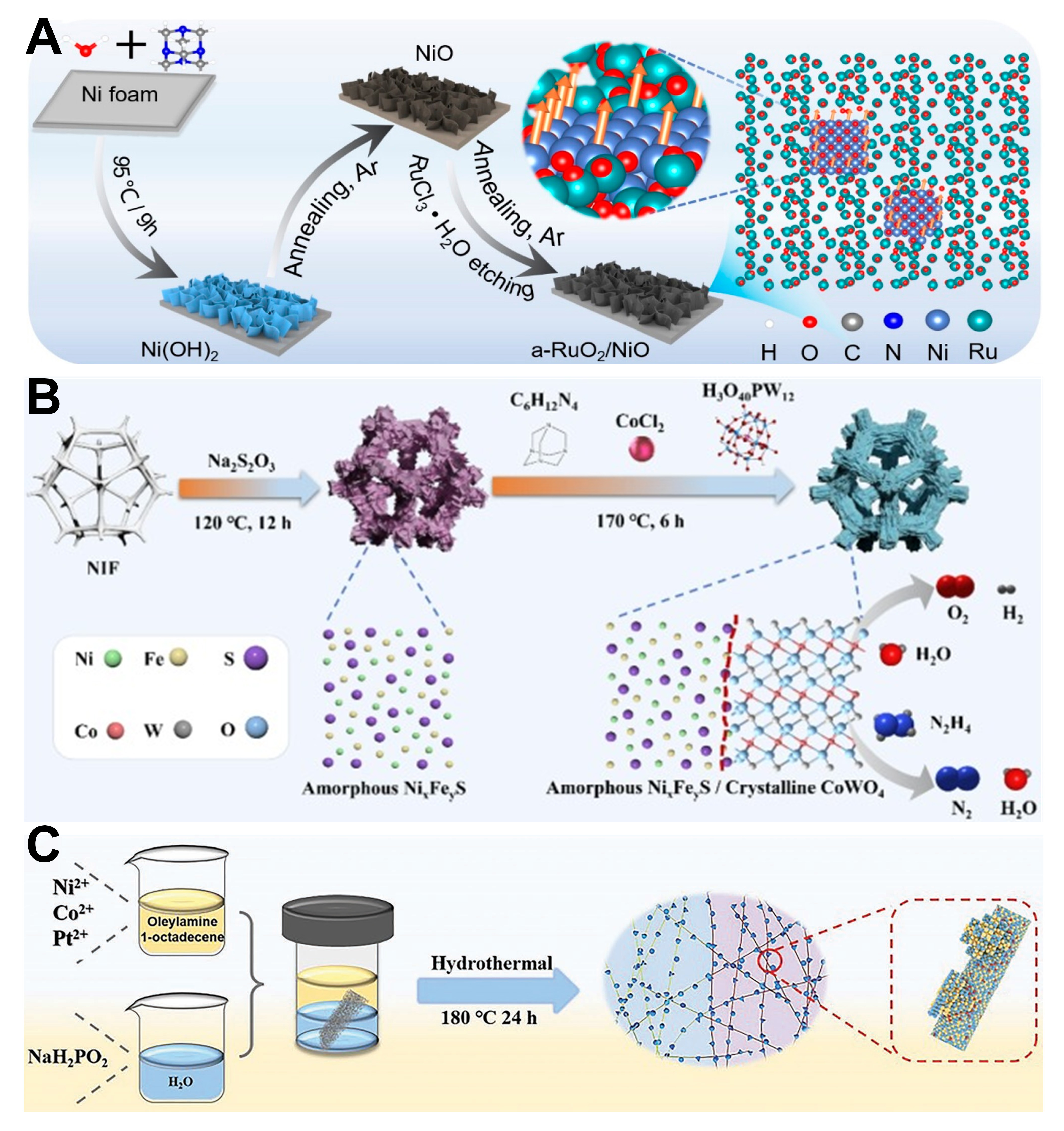
Figure 6. (A) Schematic illustration of the synthesis of a-RuO2/NiO nanosheets supported on nickel foam. Reprinted with permission from[47]. Copyright 2023, American Chemical Society; (B) Schematic diagram of the formation process of CoWO4/NixFeyS/NIF via two-step solvothermal method. Reprinted with permission from[79]. Copyright 2024, Elsevier; (C) Schematic diagram of synthesis and structure of Pt-a/c-NiCoHPi. Reprinted with permission from[48]. Copyright 2023, John Wiley and Sons. NIF: Nickel-iron bimetallic foam.
Amorphous/single-atom composites
In recent years, amorphous materials, characterized by their long-range structur disordered and abundant metastable defects, have emerged as a highly suitable platform for single-atom catalysts. Amorphous supports not only efficiently anchor metal single atoms through surface defects such as dangling bonds and oxygen vacancies, but their structural flexibility also enables strong electronic interactions with guest metal atoms, allowing for deep regulation of the coordination environment and electronic structure of single atoms[80-82]. This synergistic effect enables amorphous/single-atom composite catalysts to exhibit catalytic activity and stability surpassing those of traditional crystalline supports while maintaining high atom utilization efficiency. In the research of amorphous/single-atom composite catalysts, the selection of synthesis methodology directly determines the dispersion state, atomic loading, and interaction mode of single atoms with the amorphous support[83-85]. Currently, researchers have developed various effective synthesis strategies, among which the one-step supersaturated co-precipitation method, thermal-driven method, and electrochemical deposition method are the most representative.
Supersaturated co-precipitation method
The supersaturated co-precipitation method combines the synthesis of the amorphous support with the loading of single atoms into a single step. Unlike traditional multi-step syntheses, this method utilizes fast reaction kinetics to disrupt the thermodynamic equilibrium state of atomic ordering, allowing guest metal atoms to be directly encapsulated into the framework of the amorphous matrix at the moment of its formation. This not only simplifies the synthesis procedure but, more importantly, achieves uniform doping with high single-atom loadings, overcoming the limitation of crystalline supports regarding guest metal atom loading. Li et al.[53] successfully synthesized a Ru single-atom anchored amorphous NiMoOx catalyst using a one-step supersaturated co-precipitation method. They rapidly mixed high-concentration precursor solutions of Ni2+, MoO42-, and Ru3+, inducing instantaneous co-precipitation with the assistance of ultrasonication. Due to the extremely fast precipitation rate, atoms did not have time to undergo long-range ordering, directly forming a structure with Ru atoms uniformly dispersed within the amorphous NiMoOx network [Figure 7A]. During this process, Ru atoms were directly “frozen” into the amorphous framework, achieving uniform doping at the atomic scale [Figure 7B]. Structural characterization revealed that the M-O bond lengths in amorphous NiMoOx were longer than those in crystalline NiMoO4, indicating a looser amorphous structure conducive to exposing more active sites. Meanwhile, X-ray absorption spectroscopy confirmed electronic interactions between Ru and Ni, and this optimized electronic structure endowed the catalyst with excellent activity and stability in the OER.
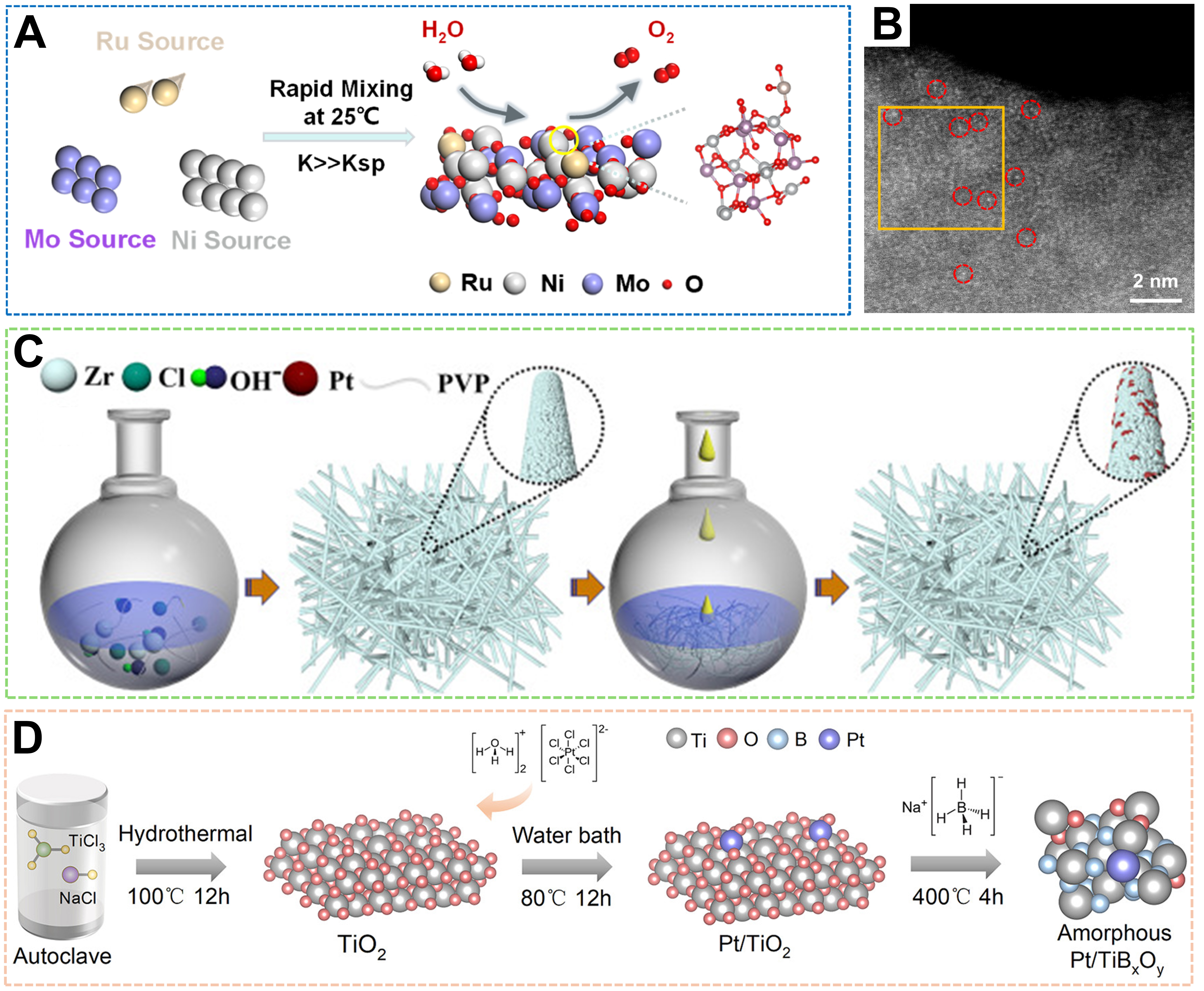
Figure 7. (A) Schematic view for preparing amorphous catalysts by one-step co-precipitation strategy; (B) AC-HAADF-STEM image of the a-RNMO sample. Figure 7A and B is Reprinted with permission from[53]. Copyright 2025, Springer Nature; (C) Schematic depiction of the fabrication of AeZrO2 and the subsequent loading of Pt single atoms. Reprinted with permission from[86]. Copyright 2022, Elsevier; (D) Schematic diagram of the synthetic procedure for Pt/TiBxOy. Reprinted with permission from[51]. Copyright 2022, American Chemical Society. PVP: Polyvinyl pyrrolidone; AC-HAADF-STEM: aberration-corrected high-angle annular dark-field scanning transmission electron microscopy; a-RNMO: Ru single atoms onto amorphous NiMoO.
Thermal-driven method
The thermal-driven method represents another important synthesis strategy. Its core principle involves leveraging thermal annealing to either activate pre-existing intrinsic defects within the amorphous support or create new defects and coordination sites in situ during the amorphization process, thereby providing the driving force and stable environment for single-atom anchoring. Dong et al.[86] successfully anchored Pt single atoms onto amorphous ZrO2 nanowires via an impregnation-reduction method. They first synthesized amorphous ZrO2 nanowires rich in oxygen vacancies using a wet-chemical method. Subsequently, the support was immersed in an H2PtCl6 solution, allowing Pt ions to adsorb near the oxygen vacancies. Finally, thermal reduction was performed at 200 °C under an H2/Ar atmosphere [Figure 7C]. During this process, thermal annealing not only reduced Pt ions to the single-atom state but, more importantly, activated the oxygen vacancy defects on the surface of the amorphous ZrO2, enabling them to act as “chemical traps” to form stable Pt-O-Zr bridging bonds with Pt atoms. X-ray absorption fine structure (XAFS) spectroscopy confirmed that Pt atoms were dispersed as single atoms and formed Pt-O coordination with the support. This strategy fully leveraged the intrinsic defects inherent to amorphous materials, activating them as anchoring sites for single atoms through mild heat treatment. In contrast to the above strategy, Cheng et al.[51] developed a more proactive thermal-driven strategy involving high-temperature reduction treatment to introduce heteroatom defects in situ concurrently with the amorphization of the support, thereby creating a novel coordination environment for single atoms. Using crystalline Pt/TiO2 as a precursor, they subjected it to reduction treatment with NaBH4 at high temperature [Figure 7D]. During this process, B atoms generated from the decomposition of NaBH4 were incorporated into the TiO2 lattice, disrupting its long-range ordered structure and transforming it into amorphous TiBxOy. Simultaneously, the thermal annealing drove the structural reorganization of the support and the re-coordination of Pt atoms. Pt atoms were released from the original Ti-O-Pt coordination environment and preferentially coordinated with the newly generated, near-neutral B atoms within the support, forming Pt-B bonds rather than the Pt-O bonds commonly found in traditional oxide supports. XPS and Extended X-ray Absorption Fine Structure (EXAFS) analyses confirmed that Pt atoms existed as single atoms with a Pt-B coordination environment. This thermal-driven strategy, which accomplishes amorphization, heteroatom doping, and single-atom anchoring simultaneously, enabled the active design of the chemical composition of the amorphous support, thereby tuning the electronic state of Pt to a quasi-zero-valent state and optimizing its hydrogen adsorption free energy.
Electrochemical deposition
Electrochemical deposition constitutes a widely method for preparing amorphous single-atom catalysts. This approach utilizes a pre-synthesized amorphous support as the working electrode, immersed in an electrolyte containing noble metal ions. By precisely controlling the potential, metal ions are selectively reduced and deposited onto the most active sites on the support surface, such as defects, edges, or oxygen vacancies. The advantage of this method lies in its high precision and controllability: by adjusting the deposition potential and time, the loading and dispersion state of single atoms can be precisely controlled. Additionally, the electrochemical environment can induce dynamic reconstruction of the amorphous support surface, thereby constructing unique coordination structures that are difficult to achieve with traditional thermochemical methods. Zhang et al.[54] employed a cyclic voltammetry-assisted electrochemical deposition method to deposit adjacent Pt single atoms with an interatomic distance of approximately 3.0 Å onto an amorphous FeNiWPB alloy support [Figure 8A]. They first synthesized the amorphous FeNiWPB alloy via a chemical reduction method. Transmission electron microscopy images showed no obvious lattice fringes in the alloy particles, and selected area electron diffraction exhibited diffuse ring patterns [Figure 8B]. Subsequently, this alloy was used as the working electrode, and cyclic voltammetry scans were applied in a solution containing a Pt precursor. During this process, Pt atoms were precisely reduced and deposited onto defect sites on the alloy surface [Figure 8C]. Notably, the introduction of tungsten not only significantly enhanced the structural stability of the catalyst over a wide pH range by forming stable M-W bonds (M = Fe, Pt, Ni) but also induced an electron-rich state at the Pt sites via charge transfer from W to Pt. This regulation optimized the hydrogen adsorption free energy of adjacent Pt atoms from -0.25 eV for PtASSA@FeNiPB to 0.05 eV, closer to the thermoneutral state [Figure 8D]. This W-mediated electronic regulation, combined with the metal-metal synergy between adjacent Pt atoms, collectively endowed the catalyst with excellent hydrogen evolution activity and exceptional stability for up to 600 h in both acidic and alkaline media. Liu et al.[52] successfully constructed a Pt single-atom catalyst on amorphous Ni(OH)2 nanosheets using an electrochemical reduction strategy. They first grew amorphous Ni(OH)2 nanosheet arrays rich in oxygen vacancies on carbon paper via electrochemical transformation. Subsequently, this electrode was subjected to constant potential electrolysis at a specific reduction potential in an alkaline electrolyte containing PtCl62- [Figure 8E]. Due to the presence of numerous coordinatively unsaturated Ni sites on the surface of the amorphous Ni(OH)2, the reduced Pt ions were not coordinated with oxygen atoms but were instead captured by these exposed Ni atoms, forming unique Pt-Ni metal bonds. Combined results from XAFS and AC-TEM verified that Pt exists in the form of single atoms and forms coordination bonds with Ni sites. This unique coordination environment rendered the Pt single atoms in a negatively charged state, significantly optimizing their adsorption capacity for hydrogen intermediates and promoting the hydrogen spillover process between the amorphous Ni(OH)2 and Pt sites, thereby substantially enhancing their hydrogen evolution performance under alkaline conditions.
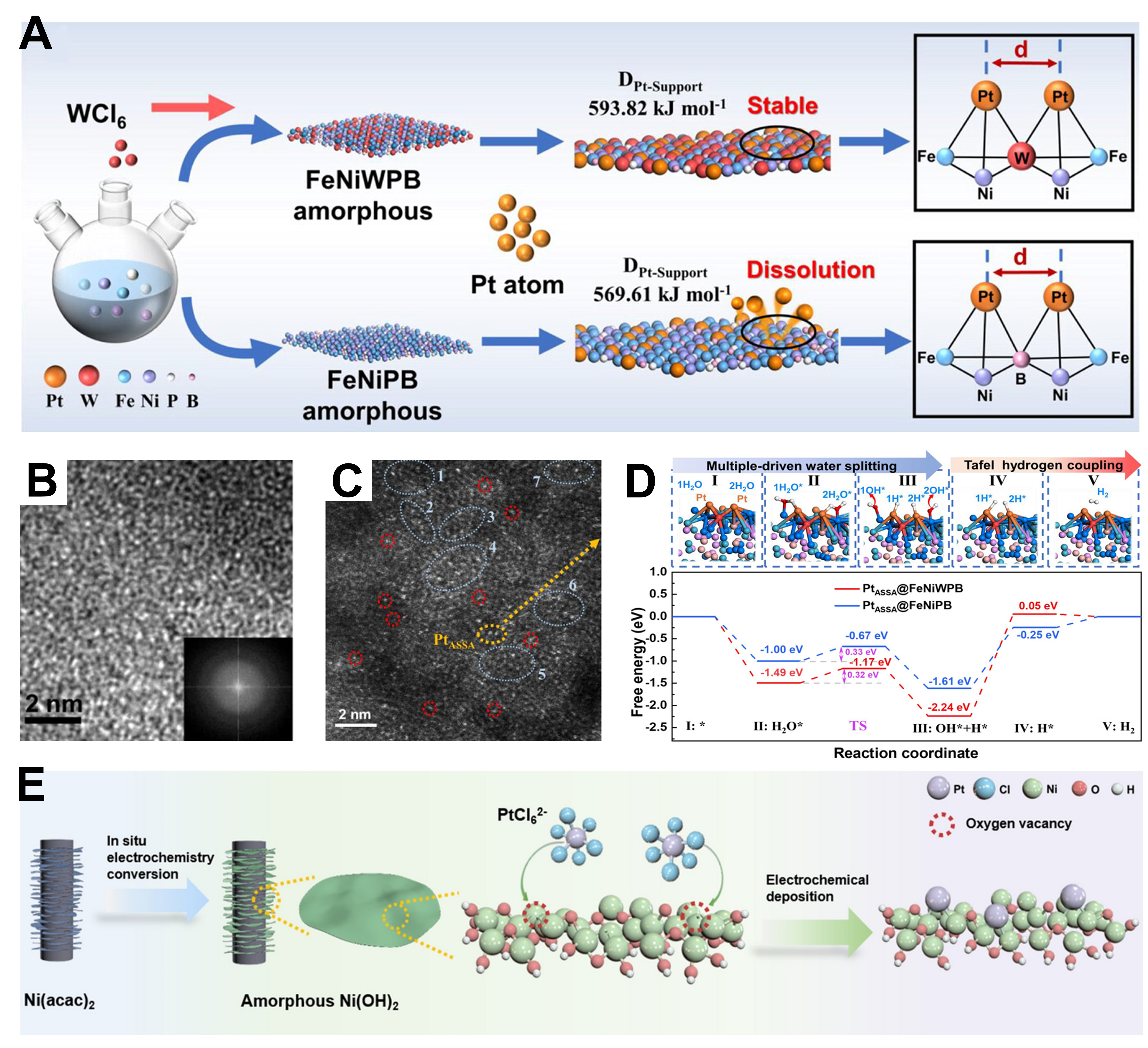
Figure 8. (A) Schematic diagram of the synthesis process; (B) The TEM image and (C) HAADF-STEM image of PtASSA@FeNiWPB; (D) Free energy evolution of PtASSA@FeNiWPB and PtASSA@FeNiPB during the processes of dual H2O dissociation and two H* adsorption steps. Figure 8A-D is reprinted with permission from[54]. Copyright 2026, John Wiley and Sons; (E) Schematic illustration of Pt-SA/a-Ni(OH)2 growth. Reprinted from[52], under CC BY 4.0 license. ASSA: Atomic-spaced single-atom; TEM: transmission electron microscopy; HAADF-STEM: high-angle annular dark-field scanning transmission electron microscopy; SA: single atom.
APPLICATIONS IN CATALYSIS
Owing to their unique structural characteristics, amorphous materials exhibit significant advantages over traditional crystalline counterparts in the fields of electrocatalysis and photocatalysis. The abundance of coordinatively unsaturated sites, combined with tunable electronic structures and flexible atomic coordination environments, renders these materials an ideal platform for optimizing the adsorption behavior of reaction intermediates and regulating charge carrier transport pathways[87,88]. In recent years, the design of amorphous catalytic materials has evolved significantly, from single phases amorphous systems and amorphous/crystalline heterojunction to amorphous-supported single-atom catalysts, yielding substantial advances in key reactions such as the HER, OER, and photocatalytic CO2 reduction. Table 2 summarizes the representative research advances in amorphous catalytic materials for electrocatalytic and photocatalytic applications.
Performance of amorphous catalysts in electrocatalysis and photocatalysis
| Application | Catalyst | Type of reaction | Performance | Refs. |
| Electrocatalytic | Ru-a-CoNi | HER | Overpotential of 15 mV at 10 mA cm-2 (1M KOH) | [89] |
| a-MoSx | HER | Overpotential of 126 mV at 10 mA cm-2 (0.5 M H2SO4) | [90] | |
| Pt-SA/a-MoOx | HER | Overpotential of 19 mV at 10 mA cm-2 (0.5 M H2SO4, acidic HER) | [91] | |
| PBN-300-Ir | HER | Overpotential of 17 mV at 10 mA cm-2 (0.5 M H2SO4) | [92] | |
| IrCoOx ANSs | OER | Overpotential of 152 mV at 10 mA cm-2 (1 M KOH) | [93] | |
| Ru SAs-MoO3-x /NF | OER | Overpotential of 209 mV at 10 mA cm-2 (1 M KOH) | [94] | |
| Ti/TiOxNy -Ir | OER | Overpotential of 370 mV at 10 mA cm-2 (0.1 M HClO4) | [95] | |
| NiFeIr0.03/Ni NW@NSs | OER | Overpotential of 200 mV at 10 mA cm-2 (1 M KOH) | [96] | |
| Ga SA/a-TiO2 | NRR | NH₃ yield rate: 24.47 μg h-1 mg-1 (-0.1 V vs. RHE); Faradaic efficiency (FE): 48.64% (0.1 M Na2SO4) | [97] | |
| h-Pt1-CuSx | ORR | 92%-96% for H2O2 over a wide potential window (0.05-0.7 V vs. RHE) | [98] | |
| a-Mo/C3N4 | CO2RR | CO production rate: 18 μmol g-1 h-1 | [99] | |
| Photocatalytic | Ag-N2C2/CN | HER | Remains nearly full initial activity after 15 cycles; | [100] |
| Ru1/2DAF | NRR | NH3 yield rate: 213 μmol g-1 h-1 | [101] | |
| NiSx/ZnCdS | HER | maximum H2 evolution rate of 67.75 mmol g-1 h-1 under visible-light irradiation | [102] | |
| SA Ni/Y2O3 | CO2 methanation | CO2 conversion efficiency: Up to 90% under 1 sun irradiation | [103] | |
| MA-2 | visible-light photocatalytic degradation | Pseudo-first-order rate constant of 1.92 × 10⁻¹ min-1 | [104] | |
| Amorphous MoO3-x nanosheets | Photothermal conversion | PCE reaches 61.79% under 808 nm NIR laser irradiation | [105] | |
| Pt SA/ZrO2 | CO2RR | CO production rate of 16.61 mmol g-1 h-1 | [86] | |
| B-doped amorphous CeO2/GO | CO2RR | CO production rate of 249.33 μmol gv-1 h-1 | [46] | |
| a-CoO | CO2RR | CO production rate of 12.6 mmol g-1 h-1 | [45] |
Electrocatalysis
Amorphous catalytic materials, characterized by short-range order and long-range disorder, demonstrate enormous potential in the field of electrocatalysis, often surpassing that of traditional crystalline counterparts. Compared to regular crystalline structures, the surfaces of amorphous materials are rich in coordinatively unsaturated sites, dangling bonds, and structural defects. These features not only provide a high density of intrinsic active centers but also endow the materials with unique electronic structure tunability and interfacial flexibility[106,107]. The application of amorphous catalytic materials in electrocatalytic processes including the HER and OER has advanced progressively: from single-phases amorphous systems to amorphous/crystalline heterojunction engineered for interfacial synergy, and further to amorphous-supported single-atom catalysts[108,109]. Consequently, structure-performance relationships have become increasingly well-defined.
Electrocatalytic hydrogen evolution reaction
The electrocatalytic HER, as the core cathodic reaction in water electrolysis for hydrogen production, exhibits catalytic efficiency that is critically governed by the catalyst’s atomic arrangement, electronic structure, and active site characteristics. Amorphous catalytic materials, defined by long-range disorder and short-range order, overcome the lattice constraints of traditional crystalline materials, thereby emerging as a key material system for enhancing both the intrinsic activity and stability of HER. Single-phase amorphous electrocatalytic materials represent the fundamental research system in the HER field. Their core advantages originate from the intrinsic structure and electronic properties conferred by the disordered atomic arrangement[110,111]. Amorphous materials lack long-range crystalline order, and their surfaces are abundant in dangling bonds, coordinatively unsaturated sites, and structural defects. Compared to the regular crystal facets of crystalline materials, these sites are more prone to serve as active centers for H adsorption and activation. Concurrently, the flexible atomic network can adaptively adjust the H adsorption configuration, overcoming the inherent bottleneck of crystalline materials in balancing adsorption and desorption. Taking amorphous PtNiP nanoparticles prepared by the flash Joule heating method[112] as an example, their disordered atomic arrangement reduces the average coordination number of Pt/Ni to 11.5, lower than the coordination number of 12 in crystalline close-packed structures, exposing a large number of low-coordination metal sites [Figure 9A]. This material achieves an overpotential of only 14 mV at a current density of 10 mA cm-2 in acidic electrolyte, with a Tafel slope as low as 18 mV dec-1, and a mass activity five times higher than that of commercial Pt/C [Figure 9B]. Furthermore, the isotropic structure of amorphous materials can alleviate lattice stress during the HER process, inhibit aggregation of active sites and structural collapse, demonstrating superior cycling stability compared to crystalline materials.
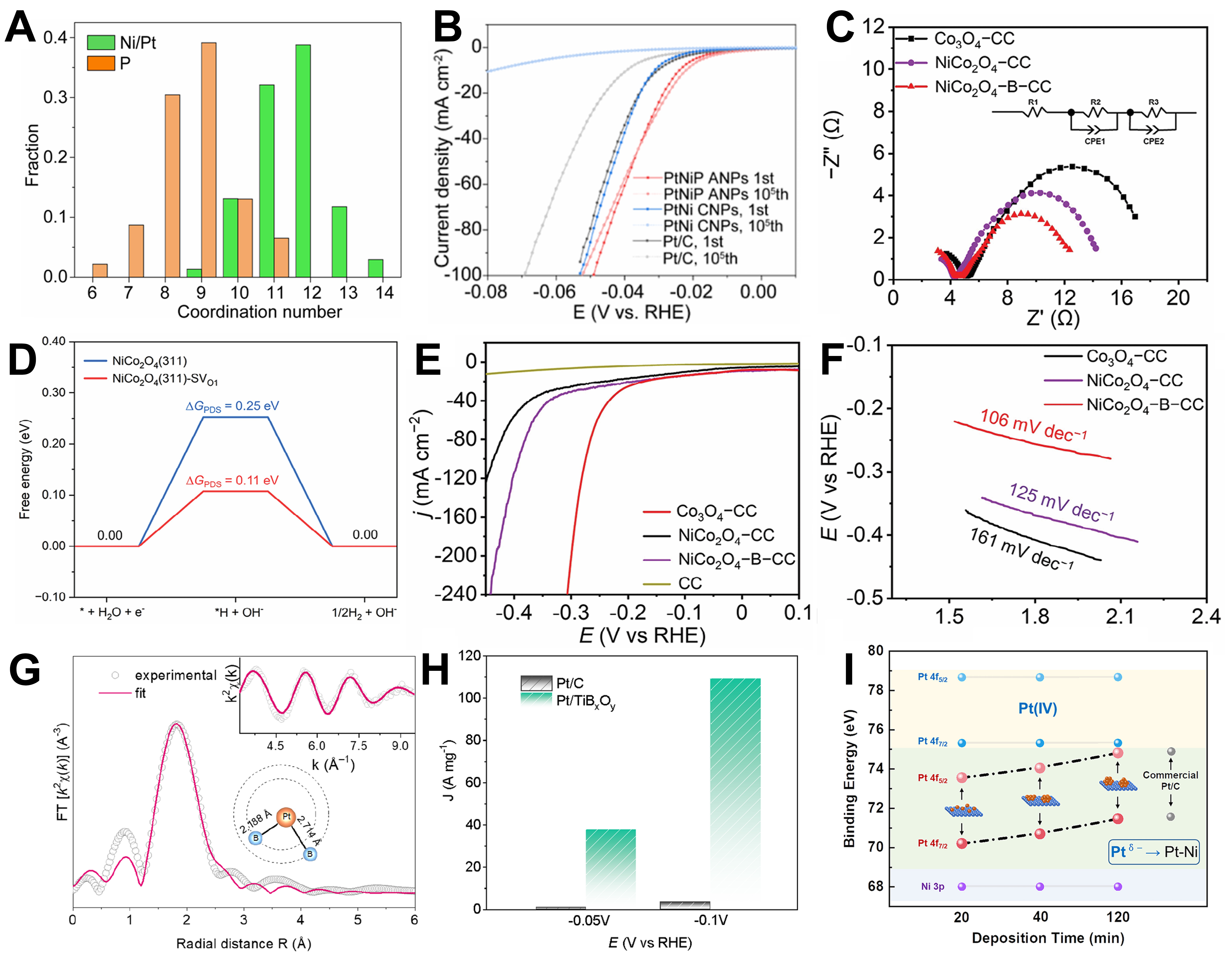
Figure 9. (A) Coordination number (CN) distribution of Ni/Pt and P within amorphous PtNiP. The average CN values for Ni/Pt and P are determined to be 11.5 and 8.7, respectively; (B) Polarization curves comparing PtNiP ANPs, PtNi CNPs, and commercial Pt/C recorded at the first cycle and after the 10,000th CV cycle. Figure 9A and B is reprinted with permission[112]. Copyright 2025, American Chemical Society. (C) Nyquist plots of the electrodes; (D) HER performance on pristine NiCo2O4 (311) and defective NiCo2O4 (311)-SVO1; (E) LSV curves recorded for Co3O4-CC, NiCo2O4-CC, and NiCo2O4-B-CC for HER in 1 m KOH; (F) Tafel plots of Co3O4-CC, NiCo2O4-CC and NiCo2O4-B-CC toward HER in 1 m KOH. Figure 9C-F is reprinted with permission[49]. Copyright 2024, John Wiley and Sons; (G) First-shell fitting result derived from the Pt L3-edge EXAFS spectra and the corresponding Re[k2χ(k)] oscillations of Pt/TiBxOy; (H) Mass activity of Pt/TiBxOy and Pt/C evaluated at various potentials. Figure 9G and H is reprinted with permission[51]. Copyright 2022, American Chemical Society; (I) Binding energie variations for Pt/a-Ni(OH)2 catalysts as a function of electrodeposition time. Reprinted from[52], under CC BY 4.0 license. RHE: Reversible hydrogen electrode; ANP: amorphous nanoparticle; CNP: crystalline nanoparticles; CC: carbon cloth; HER: hydrogen evolution reaction; LSV: linear sweep voltammetry; EXAFS: extended X-ray absorption fine structure.
Single amorphous systems suffer from issues such as insufficient intrinsic conductivity, uneven distribution of active sites, and limited thermodynamic stability of the structure, restricting their application under high current densities. To overcome the performance bottlenecks of pure amorphous materials, amorphous/crystalline heterojunction emerged. Through strong coupling between the crystalline and amorphous phases, they achieve a “1 + 1 > 2” synergistic effect, becoming a mainstream design direction for HER electrocatalysts. This system perfectly integrates the high conductivity and structural stability of the crystalline phase with the high-density active sites and flexible electronic structure of the amorphous phase. Charge redistribution, lattice distortion, and local electronic state regulation at the interface between the two phases further optimize reaction kinetics and intermediate adsorption behavior. A typical representative is the spinel-type NiCo2O4 amorphous/crystalline heterojunction constructed via NaBH4 reduction[49]. This system precisely regulates the proportion of crystalline phases through mild reduction treatment, simultaneously introducing high-density oxygen vacancies and heterointerfaces, achieving synergistic optimization of electronic structure, active sites, and charge transport capability. In this heterojunction, the crystalline NiCo2O4 framework provides continuous electron transport channels, significantly enhancing the intrinsic conductivity of the material [Figure 9C], addressing the issue of slow carrier mobility in the amorphous phase. The amorphous surface layer retains the characteristics of a long-range disordered structure, generating a large number of coordinatively unsaturated sites and oxygen vacancies, serving as efficient active centers for H2O dissociation and H adsorption, while also enhancing the material's corrosion resistance and catalytic stability. Significant interface charge redistribution occurs between the amorphous and crystalline phases, driving electrons transfer from the amorphous to the crystalline phase. his modulation optimizes the d-band center of active metal sites, tunes the hydrogen adsorption-desorption energy toward thermodynamically neutrality, and significantly lowers the energy barrier of the HER rate-determining step [Figure 9D]. This amorphous/crystalline heterojunction exhibits excellent HER performance in alkaline electrolyte, with an overpotential of only 26 mV at 10 mA cm-2 [Figure 9E], a Tafel slope as low as 106 mV dec-1 [Figure 9F], and stable operation for 20 h at 10 mA cm-2, far outperforming the pure crystalline NiCo2O4 catalyst.
Driven by the pursuit of ultimate atomic utilization and enhanced intrinsic activity in electrocatalysis, amorphous-supported single-atom catalysts have emerged as a frontier hotspot research focus for the HER. Leveraging the distinctive coordination environment of amorphous supports and the maximal atomic utilization of single atoms, a synergistic “amorphous substrate-single atom” architecture is constructed, surpassing the performance limitations of traditional catalysts. The disordered structure, abundant defects, and dangling bonds of amorphous supports provide numerous anchoring sites for single atoms, inhibiting their agglomeration. Simultaneously, the electronic state and coordination structure of single atoms can be precisely regulated through the coordination environment, endowing single atoms with special electronic properties unattainable with traditional crystalline supports. Taking the amorphous TiBxOy-supported Pt single atoms[51] as an example, the near-neutral B atoms in the amorphous support preferentially coordinate with Pt, avoiding Pt oxidation caused by Pt-O bonds [Figure 9G]. Through charge transfer balance between B-O and B-Pt, the nucleophilicity of Pt is regulated to an optimal state, achieving an ideal H adsorption energy, with a mass activity of 37.8 A mg-1 Pt in acidic HER, 34 times higher than that of commercial Pt/C [Figure 9H]. In the amorphous Ni(OH)2 supported negatively charged Pt single-atom system[52], the oxygen vacancies and low-coordination Ni sites of the amorphous substrate anchor Pt and form Pt-Ni bonds, rendering Pt in a negatively charged state (Ptδ⁻) [Figure 9I]. The amorphous Ni(OH) 2 efficiently dissociates H2O and transfers hydrogen to the Pt sites via hydrogen spillover, substantially increasing the hydrogen coverage on the Pt surface. In alkaline HER, this catalyst achieves an overpotential of only 48 mV at a current density of 1000 mA cm-2 mg-1, far exceeding the performance of commercial Pt/C.
Electrocatalytic oxygen evolution reaction
Similar to the HER, amorphous materials also exhibit significant structural and performance advantages in the electrocatalytic OER. As a four-electron transfer anodic reaction, the OER has slow kinetics and a higher energy barrier, imposing more stringent requirements on the active sites, conductivity, and structural stability of the catalyst. Single-phase amorphous oxide materials, characterized by long-range structure disordered, are rich in oxygen vacancies, coordinatively unsaturated sites, and tunable metal valence states. They can effectively optimize the adsorption energies of intermediates such as *OH, *O, and *OOH, promote surface reconstruction, and enhance intrinsic activity, generally outperforming their corresponding crystalline catalysts. In amorphous cobalt oxide (CoOx) materials[113], the disordered atomic arrangement breaks the regular lattice restrictions of crystalline Co3O4, exposing more mixed-valence Co2+/Co3+ active sites on the surface. Meanwhile, the reducing effect of VS₂ can induce the formation of an amorphous phase with coexisting multiple species, including metallic Co, CoO, Co(OH)2, and Co3O4, significantly increasing the active site density and charge transport capability. In 0.1 M KOH electrolyte, the amorphous CoOx/VS2/CP exhibits a significantly lower overpotential at 10 mA cm-2 and a smaller charge transfer resistance compared to crystalline Co3O4/CP [Figure 10A], demonstrating faster adsorption/desorption kinetics for OER intermediates, and a higher current density retention after 100 cycles [Figure 10B], with overall stability comprehensively superior to the crystalline control sample.
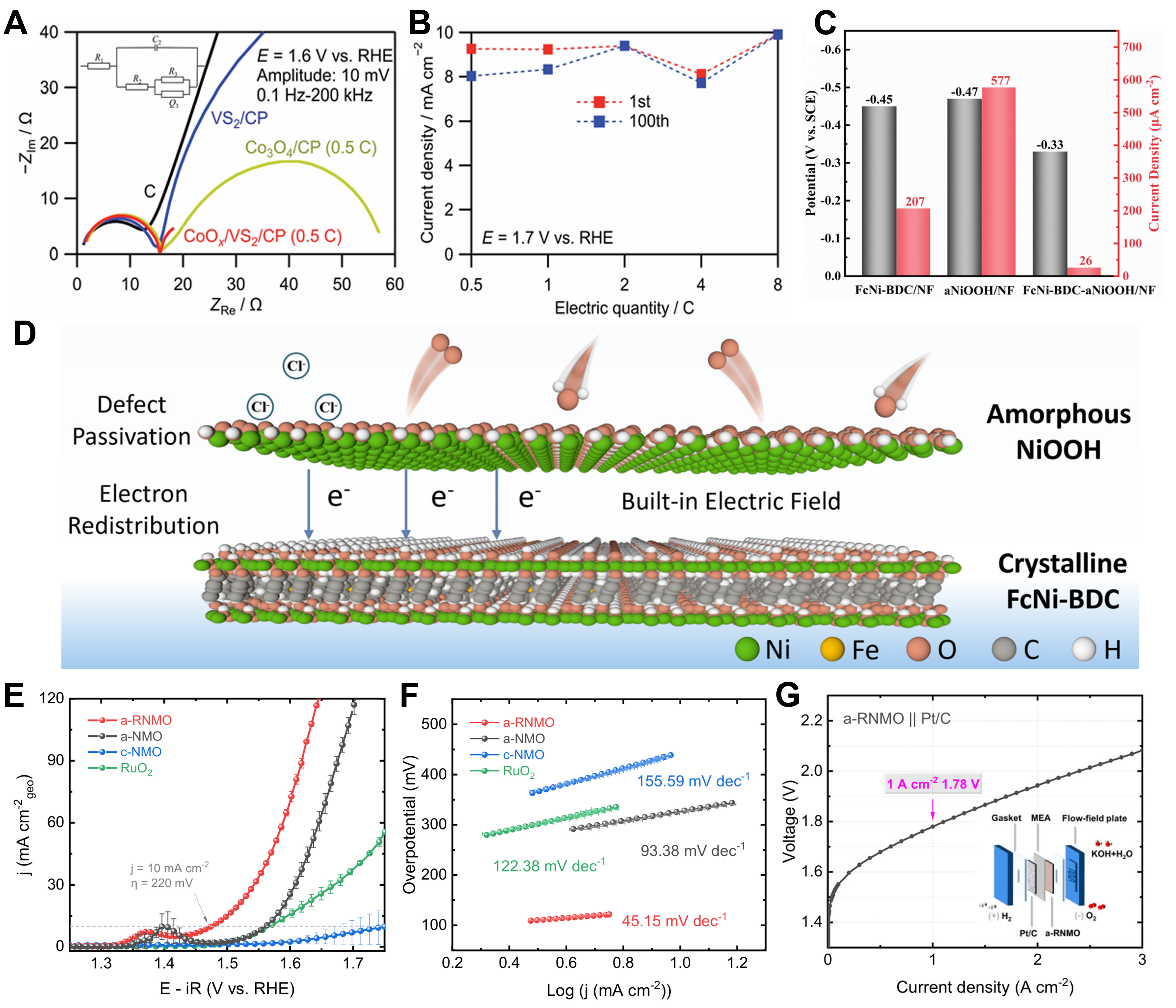
Figure 10. (A) Nyquist plots of EIS spectra recorded for CoOx/VS2/CP (0.5C), Co3O4/CP (0.5C), VS2/CP, and CP at an applied potential of 1.6 V vs. RHE with a voltage amplitude of 10 mV over a frequency range of 0.1 Hz to 100 kHz; (B) Current densities of CoOx/VS2/CP samples with varying Co deposition amounts, measured at 1.6 V during the 1st and 100th cycles. Data were acquired via CV-averaged linear sweep voltammetry over 100 cycles within a potential range of 1.23 to 1.83 V vs. RHE. Reprinted from[113], under CC BY 4.0 license; (C) Schematic diagram of the OER mechanism governed by synergistic coupling at the crystalline/amorphous interface; (D) Corrosion current densities and corresponding potentials for three catalysts in natural seawater. Figure 10C and D is reprinted with permission[114]. Copyright 2026, Elsevier; (E) LSV measurements with in-situ iR compensation were performed for a-NMO, a-RNMO, c-NMO and RuO2 catalysts; (F) Tafel curves fitted from the LSV data in panel (E); (G) Polarization curve recorded for the electrolyzer operated without iR-compensation, where a-RNMO served as the anode and Pt/C as the cathode, in flowing 1 M KOH at 80 °C. Inset: schematic of AEMWE cell. Figure 10e-g is reprinted with permission[53]. Copyright 2025, Springer Nature. SCE: Saturated calomel electrode; FcNi-BDC: two-dimensional ferrocene-based metal-organic frameworks; a-RNMO: Ru single atoms onto amorphous NiMoOx; c-NMO: crystalline NiMoO4; RNMO: rare-earth nickel mixed oxide; RHE: reversible hydrogen electrode; MEA: membrane electrode assembly; EIS: electrochemical impedance spectroscopy; CP: carbon paper; OER: oxygen evolution reaction; LSV: linear sweep voltammetry; iR: iR compensation; CV: cyclic voltammetry; AEMWE: anion exchange membrane water electrolyzer.
Amorphous/crystalline heterojunction achieve synergistic enhancement through interfacial coupling between the two phases. The crystalline component provides efficient electron transport pathways, while the amorphous component offers high-density active sites. Interfacial charge redistribution further modulates the d-band center, significantly reducing the OER overpotential and enhancing cycle life, demonstrating outstanding performance in both alkaline and seawater systems. Taking the heterojunction constructed from crystalline ferrocene-based MOF [FcNi-terephthalic acid (FcNi-BDC)] and amorphous NiOOH[114] as an example, the crystalline MOF framework provides continuous electron transport channels and structural support, enhancing material conductivity and mechanical stability. The amorphous NiOOH retains a large number of coordinatively unsaturated sites and oxygen vacancies, providing ample OER active centers. A Type-II heterojunction and built-in electric field are formed at the interface between the two phases, driving directional charge transfer, increasing the proportion of Ni3+ active species, and optimizing the adsorption free energy of *OOH intermediates [Figure 10C]. In an alkaline seawater system, this heterojunction catalyst achieves an overpotential of only 329 mV at an industrial current density of 1000 mA cm-2, operates stably for 400 h at 500 mA cm-2, and has a corrosion current density as low as 26 μA cm-2 [Figure 10D], exhibiting excellent Cl- corrosion resistance, making it ideally suited for the harsh conditions of seawater electrolysis.
Building on this foundation, amorphous-supported single-atom catalysts have emerged as a cutting-edge direction in the OER field. The abundant defects and flexible coordination environment of amorphous materials enable efficient anchoring and electronic modulation of single atoms, thereby achieving ultra-high intrinsic activity and atomic utilization at extremely low noble metal loadings. This configuration simultaneously lowers the reaction energy barriers while maintaining excellent stability, providing a novel design concept for high-efficiency, low-cost, and long-life OER electrocatalysis. Taking the amorphous NiMoOx-anchored Ru single-atom catalyst (a-RNMO)[53] as an example, the numerous dangling bonds, oxygen vacancies, and disordered coordination environment of the amorphous NiMoOx support enable highly dispersed and uniform anchoring of Ru single atoms, preventing agglomeration and deactivation, with a Ru loading of only 2.28 at.%. In 1 M KOH electrolyte, this catalyst achieves a low overpotential of 220 mV at a current density of 10 mA cm-2 [Figure 10E], a Tafel slope of only 45.15 mV dec-1 [Figure 10F], and a mass activity over 140 times higher than that of commercial RuO2. In an anion exchange membrane water electrolyzer (AEMWE), it req G uires only 1.78 V cell voltage at a high industrial current density of 1 A cm-2 [Figure 10] and operates stably for 100 h without significant decay. Through the synergistic electronic regulation of the amorphous structure and single atoms, a combined breakthrough in activity, stability, and economy has been achieved.
The structural advantages of amorphous materials - including abundant coordinatively unsaturated sites, flexible atomic coordination environments, and tunable electronic structures - extend well beyond electrocatalysis into photocatalysis. Specifically, for CO2 photoreduction, a multi-electron process heavily reliant on efficient charge separation and intermediate activation, these features offer a fundamentally new design paradigm.
Photocatalysis
In the field of photocatalysis, amorphous materials characterized by long-range structural disorder and short-range order, have emerged as a pivotal platform for constructing efficient CO2 reduction catalysts. In contrast to the regular periodic lattice of crystalline counterparts, amorphous structures feature abundant coordinatively unsaturated active sites, intrinsic defects, and highly flexible atomic coordination environments. These features can effectively break crystal field symmetry, enabling precise reconstruction of the electronic orbitals of metal centers. Simultaneously, their disordered atomic arrangement can significantly suppress photogenerated carrier recombination, prolong carrier lifetime, and shorten charge diffusion distances, providing efficient charge transport pathways for photocatalytic reactions. Furthermore, amorphous materials exhibit widely tunable band structures and isotropic surface characteristics - features that collectively enhance CO2 chemisorption strength, lower the activation energy barrier for CO2 activation, and synergistically improve the photocatalytic conversion efficiency from both thermodynamic and kinetic perspectives[115-117]. These attributes provide a rational foundation for designing efficient photocatalytic systems.
For the ultrathin amorphous CoO nanosheets prepared via a low-temperature annealing strategy[45], amorphization induces a partial transition in the local crystal field around Co centers from quasi-octahedral to quasi-tetrahedral coordination. This triggers a rearrangement of Co 3d orbitals, significantly increasing the number of unpaired electrons in the frontier d orbitals, strengthening the d-p orbital hybridization between Co 3dᵧz orbitals and C 2px orbitals of CO2 molecules. This accelerates the injection of photogenerated electrons from the Co active centers into the antibonding orbitals of CO2, efficiently activating the inert CO2 molecules and breaking C=O bonds. Concurrently, the ultrathin two-dimensional amorphous structure further optimizes the separation and transport kinetics of photogenerated carriers [Figure 11A]. Under visible light irradiation, this amorphous CoO catalyst achieves a total syngas evolution rate of 23.7 mmol g-1 h-1, with an apparent quantum efficiency of 1.28% at 450 nm wavelength, and a catalytic activity 8.7 times higher than that of crystalline CoO [Figure 11B], directly confirming the crucial role of amorphization in orbital regulation, charge transport, and CO₂ activation. The amorphous B-CeO2/GO nanosheets constructed via boron doping-induced symmetry breaking[46] further expand the functional boundaries of amorphous photocatalytic materials. The planar triangular BO3 units introduced by boron doping disrupt the crystalline Fm-3m structure of CeO2 and induce amorphization, while also providing excess electrons to the system, promoting the efficient conversion of Ce4+ to Ce3+, achieving a Ce3+ ratio as high as 85.7%. The amorphous disordered structure effectively narrows the bandgap of the material [Figure 11C], prolongs carrier lifetime, and establishes a built-in electric field that suppresses electron-hole recombination, endowing the material with excellent low-concentration CO2 catalytic adaptability and cycling stability. Under a 15% CO2 atmosphere, the CO production rate reaches 249.33 μmol g-1 h-1 [Figure 11D]; even under a dilute 1% CO2 atmosphere, it maintains an activity of 103.4 μmol g-1 h-1 [Figure 11E], achieving 100% CO product selectivity [Figure 11F], with no significant degradation in catalytic activity after five cycles [Figure 11G]. This unequivocally demonstrates the unique functional advantages of amorphous structures in stabilizing metal valence states, regulating charge carriers dynamics, and enabling low-concentration substrate conversion.
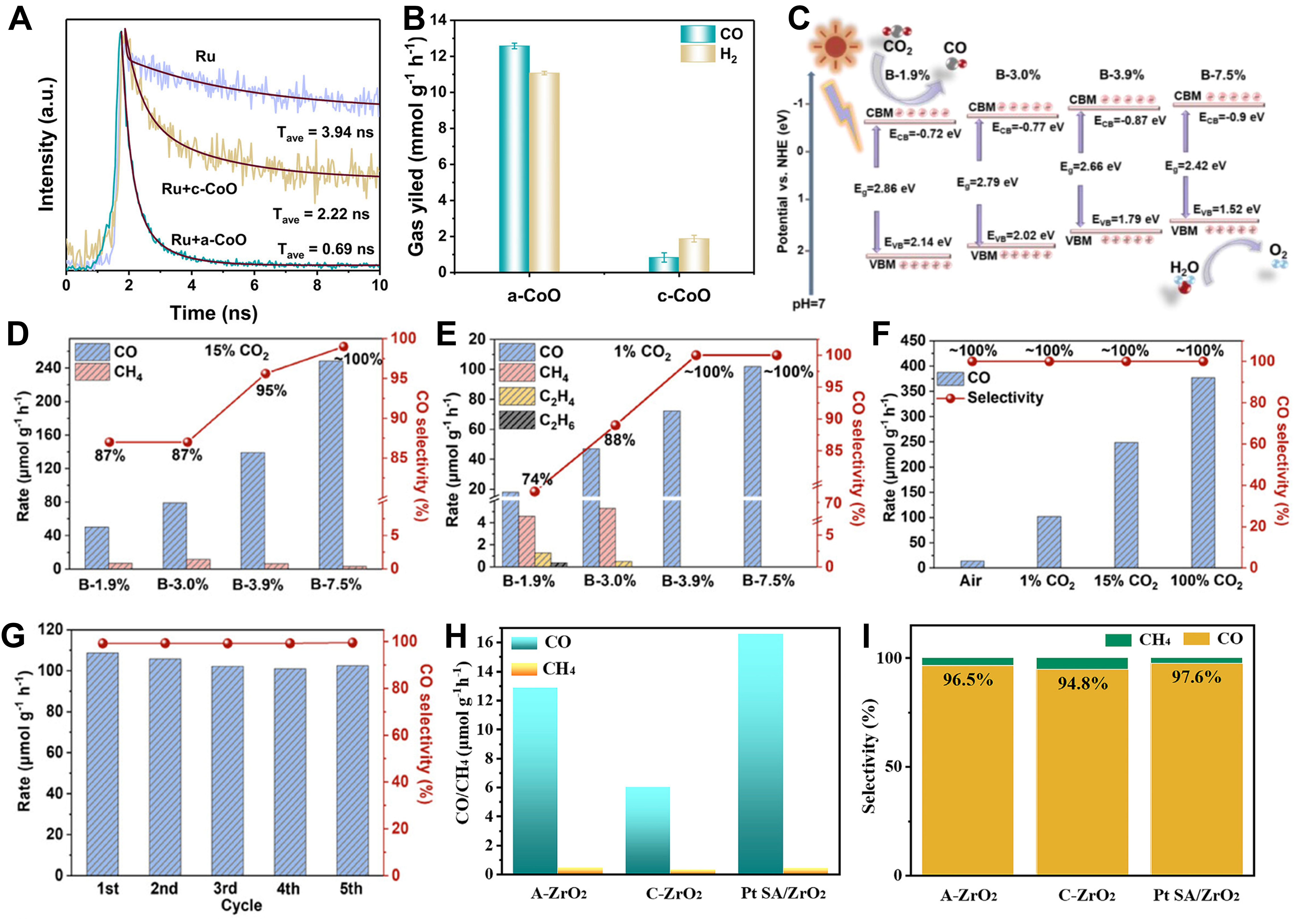
Figure 11. (A) TRPL decay spectra were measured for an aqueous system composed of 0.5 mM Ru with 1 mg mL-1 photocatalyst present; (B) A comparison of CO and H2 yields is presented across a range of different catalysts. Figure 11A and B is reprinted with permission[45]. Copyright 2025, John Wiley and Sons; (C) Presented is the band structure of B-doped CeO2/GO. Comparison of CO production rate under CO2 concentration of (D) 15% and (E) 1%, respectively; (F) CO production rate of B-7.5% measured under four different CO2 concentrations. (G) Cycling stability of amorphous CeO2/GO tested under 1% CO2. Figure 11C-G is reprinted with permission[46]. Copyright 2025, John Wiley and Sons; (H) Photocatalytic CO2 reduction products obtained over AeZrO2, CeZrO2, and Pt SA/ZrO2 after 2 h of visible light illumination; (I) Selectivity of AeZrO2, CeZrO2, and Pt SA/ZrO2 toward CO and CH4. Figure 11H and I is reprinted with permission[86]. Copyright 2022, Elsevier. VBM: Valence band maximum; CBM: conduction band minimum; SA: single atom; TRPL: time-resolved photoluminescence; GO: graphene oxide.
By capitalizing on the structural advantages of amorphous bulk materials, amorphous-supported single-atom catalysts have emerged as an advanced photocatalytic system - enabling functional synergy between the amorphous matrix and single-atom active sites, and elevating the structural regulation of amorphous catalysis to atomic-level precision. The defect structures inherent to amorphous supports serve as natural anchoring sites for single atoms, effectively preventing their agglomeration during both preparation and catalysis, while stabilizing the coordination structure and chemical valence state. Concurrently, a charge-transfer bridge forms between the amorphous matrix and the anchored single atoms, enabling directional acceleration of photogenerated electrons transfer from the support to active centers. This facilitates precise regulation of both the electronic structure of the metal centers and the adsorption energy of intermediates, thereby enhancing catalytic activity while significantly improving reaction selectivity. This composite structure retains the advantages of amorphous materials, such as high charge carrier separation efficiency and strong CO2 adsorption capability, while maximizing atomic utilization through the single-atom sites, representing an important development direction for amorphous photocatalytic materials[118-123]. Taking the Pt SA/ZrO2 catalyst with Pt single atoms supported on amorphous ZrO2 nanowires[86] as an example, the abundant oxygen vacancies in the amorphous ZrO2 matrix not only provide stable anchoring sites for Pt single atoms but also form Zr-O-Pt charge bridges, significantly reducing interfacial charge transport resistance and enhancing the utilization efficiency of photogenerated electrons. Pt single atoms, serving as efficient active centers, precisely catalyze the directional conversion of CO2 to CO, effectively suppressing the occurrence of side reactions such as hydrogen evolution. This catalyst exhibits excellent performance in photocatalytic CO2 reduction, with a CO production rate of 16.61 mmol g-1 h-1 [Figure 11H] and a CO selectivity as high as 97.6% [Figure 11I], far surpassing pure amorphous ZrO2 and crystalline ZrO2-based catalysts. This systematically validates the synergistic mechanism of the amorphous single-atom architectures: “defects anchor single atoms, charge-transfer bridges mediate directional electron transport, and single atoms govern reaction selectivity”. It establishes a representative paradigm for advancing amorphous catalytic materials from bulk structural design toward atomic-precision regulation, and offering a new strategy for constructing efficient and highly selective photocatalytic CO2 reduction systems.
CONCLUSION AND OUTLOOK
Nano-amorphous materials, characterized by short-range structural order and long-range disorder, possess abundant defect sites, coordinatively unsaturated active centers, and tunable electronic structures. These features effectively compensate for the inherent shortcomings of traditional crystalline energy catalysts, establishing them as a central research direction in the field of energy catalysis. This review has focused on three core systems - pure amorphous materials, amorphous/crystalline heterojunction, and amorphous/single-atom composite materials - and comprehensively summarized their controllable synthesis strategies and advances in energy catalysis applications. Pure amorphous materials, prepared via mild and controllable methods such as reducing agent regulation and low-temperature annealing induction, leverage the intrinsic advantages of their disordered structure to exhibit outstanding intrinsic activity in electrocatalytic and photocatalytic reactions. Amorphous/crystalline heterojunctions, constructed via top-down phase transformation and bottom-up stepwise assembly strategies, integrate the high activity of the amorphous phase with the high conductivity and stability of the crystalline phase, achieving significant enhancements in catalytic performance through interfacial synergistic effects. Amorphous/single-atom composite materials, synthesized by methods such as supersaturated co-precipitation, thermal driving, and electrochemical deposition, utilize defect sites on the amorphous support to achieve efficient single-atom anchoring and precise regulation of electronic states, thereby maximizing atomic utilization and optimizing reaction kinetics. Both types of materials demonstrate superior activity, selectivity, and stability compared to conventional crystalline materials in key energy conversion reactions, including electrocatalytic hydrogen evolution, oxygen evolution, and photocatalytic CO2 reduction. These findings clarify the structure-performance relationships involving amorphous structural design, interfacial coupling, and atomic-level regulation, providing important theoretical and experimental foundations for the development of high-performance energy catalytic materials.
Research on nano-amorphous catalytic materials has advanced from fundamental preparation to precise functional regulation. Nevertheless, a prominent gap persists between basic research and industrial application, accompanied by a series of fundamental challenges and scientific bottlenecks that demand urgent resolution. First, structural instability induced by thermodynamic metastability represents a core bottleneck limiting the practical deployment of amorphous catalysts. Amorphization is inherently a product of thermodynamic non-equilibrium, and the intrinsic tendency to transform into a more stable crystalline phase leads to inevitable performance degradation rather than occasional attenuation[124,125]. Extreme conditions in practical industrial operations-including high current density, elevated temperature, strong acid/alkali electrolytes, and high potential-markedly accelerate atomic rearrangement, bulk recrystallization, and active component leaching. This triggers irreversible structural damage and rapid performance decay, severely restricting the long-term operational stability of amorphous catalysts under industrial conditions. Second, dual constraints of insufficient intrinsic conductivity and structural heterogeneity in certain systems significantly impede the optimization and regulation of catalytic performance. Most pure amorphous metal oxides exhibit low intrinsic electrical conductivity, which substantially increases charge transfer resistance under high current density and fails to meet the kinetic requirements of industrial-scale catalytic reactions[126]. Meanwhile, amorphous structures are inherently inhomogeneous: their long-range disorder gives rise to distinct local heterogeneity in atomic arrangement, defect distribution, and chemical composition[22], resulting in regional structural and compositional variations. Achieving atomic-level homogeneous controllable synthesis remains challenging, leading to significant batch-to-batch performance fluctuations and hindering the precise optimization of catalytic activity. Third, uncertainty in identifying genuine active sites undermines the establishment of reliable structure–activity relationships. Conventional characterization techniques tailored for crystalline materials are poorly suited to the short-range ordered nature of amorphous structures, precluding precise resolution of local coordination environments, defect types, and electronic state distributions. Unlike crystalline catalysts, accurately identifying intrinsic active sites in amorphous materials-and distinguishing them from active phases derived from in-situ structural reconstruction during reactions-remains elusive[127]. This absence of atomic-level structural insight impedes the establishment of quantitative structure–activity relationships, thereby hindering mechanism-guided catalyst design and targeted performance optimization. Finally, poor experimental reproducibility and inadequate scalability pose major barriers to industrial translation. The formation of amorphous materials is highly sensitive to reaction parameters (e.g. temperature, concentration, reaction time, and precursor ratio); slight process fluctuations can induce significant variations in amorphization degree, defect concentration, and microstructure. Consequently, the excellent performance achieved via laboratory-scale small-batch synthesis is difficult to stably reproduce in large-scale production, with poor reproducibility emerging as a critical industrialization challenge. Furthermore, current synthetic protocols predominantly rely on costly noble metal precursors, highly toxic reductants, and low-yield batch operations, further hindering the industrial application of amorphous catalytic materials[128].
To break through the aforementioned fundamental bottlenecks and advance amorphous nanocatalytic materials from fundamental research to practical application, future research should focus on the following directions:
(1) High-entropy stabilization strategy
High-entropy amorphous catalysts have demonstrated unique advantages in addressing the long-term stability challenges of electrocatalysts. By incorporating five or more principal elements, the synergistic effect of sluggish diffusion and high configurational entropy significantly elevates the crystallization activation energy barrier, thereby effectively suppressing the thermodynamic driving force for atomic rearrangement into long-range ordered structures under high-temperature operation or high-current-density conditions. Studies have shown that high-entropy amorphous catalysts can achieve exceptional catalytic activity and durability in water electrolysis, and their disorder-driven intrinsic structural properties offer irreplaceable advantages over traditional crystalline materials[129,130]. This strategy not only markedly enhances the thermal stability of catalysts but also effectively mitigates the dissolution and leaching of active components during prolonged electrolysis. The excellent compositional tunability of high-entropy amorphous systems enables simultaneous optimization of electronic structure and active site density, providing a highly promising multifunctional platform for the design and development of next-generation high-performance electrocatalysts. Future research should systematically explore the intrinsic correlations between principal element number and composition, configurational entropy, crystallization temperature, and catalytic performance in high-entropy amorphous systems to achieve synergistic optimization of entropy-driven stabilization effects and intrinsic catalytic activity.
(2) Deep coupling of multi-dimensional characterization and theoretical simulation
Traditional characterization techniques struggle to accurately capture the short-to-medium range ordered structural features of amorphous materials and their dynamic evolution under reaction conditions. Therefore, it is imperative to integrate and promote advanced characterization techniques highly sensitive to local coordination environments and electronic structures, including Pair Distribution Function (PDF) analysis, XAFS, in-situ Raman spectroscopy, and in-situ XPS. These techniques enable real-time tracking of the dynamic structural evolution, surface reconstruction processes, and adsorption behavior of reaction intermediates on amorphous catalysts under realistic operating conditions, revealing the dynamic evolution rules of active sites[131]. Combined with the atomic-resolution capability of spherical aberration-corrected electron microscopy, a complete spatiotemporal picture of the dynamic structural evolution of amorphous catalysts under reaction conditions can be constructed. On this basis, theoretical calculation methods such as DFT and molecular dynamics simulations are employed to analyze the energy distribution, intermediate adsorption energies, and dynamic changes in chemical bonding states during catalysis at the atomic and electronic levels[132,133]. This will establish a dynamic structure-activity relationship model centered on real active sites, driving the design of amorphous catalysts from “trial-and-error” experimental exploration to “mechanism-guided” rational design.
(3) Scalable green synthesis technologies
The translation of amorphous nanocatalysts from laboratory fundamental research to large-scale applications in industrial electrolyzers and CO2 electroreduction reactors urgently requires the development of low-cost, environmentally friendly, and scalable synthesis technologies[134]. Traditional synthesis methods rely on noble metal precursors and highly toxic reducing agents, making them unsuitable for large-scale industrial production. Future research should prioritize the development of continuous-flow microreactor synthesis technologies to achieve reproducible, high-throughput preparation of amorphous nanoparticles and significantly enhance their large-scale production capacity[135]. Concurrently, active exploration of green chemical reduction systems based on biomass-derived reducing agents (e.g. plant polyphenols) is warranted. The development of scalable synthesis methods must extend beyond catalytic performance benchmarking against laboratory-scale protocols to encompass rigorous techno-economic and environmental feasibility assessments, including comprehensive life cycle cost analysis and quantitative environmental footprint evaluation.
DECLARATIONS
Authors’ contributions
Made substantial contributions to conception and design of the study and performed the whole work writing: Chen, W.; Shang, H.; Ma, X.
Revised and directed parts of the writing manuscript: Chen, W.; Shang, H.; Ma, X.; Li, R.; Bai, Q.; Jiang, S.
Availability of data and materials
Not applicable.
Al and Al-assisted tools statement
Not applicable.
Financial support and sponsorship
This work was supported by the National Natural Science Foundation of China (Grant Nos. 92580136 to Shang, H. and 22375019 to Chen, W.), Natural Science Foundation of Henan (252300421175 to Shang, H.).
Conflicts of interest
All authors declared that there are no conflicts of interest.
Ethical approval and consent to participate
Not applicable.
Consent for publication
Not applicable.
Copyright
© The Author(s) 2026.
REFERENCES
1. Menezes, P. W.; Indra, A.; Das, C.; et al. Uncovering the nature of active species of nickel phosphide catalysts in high-performance electrochemical overall water splitting. ACS. Catal. 2016, 7, 103-9.
2. Yang, X.; Wang, Y.; Tong, X.; Yang, N. Strain engineering in electrocatalysts: fundamentals, progress, and perspectives. Adv. Energy. Mater. 2021, 12, 2102261.
3. Kwon, H. R.; Park, H.; Jun, S. E.; Choi, S.; Jang, H. W. High performance transition metal-based electrocatalysts for green hydrogen production. Chem. Commun. 2022, 58, 7874-89.
4. Xie, H.; Zhao, Z.; Liu, T.; et al. A membrane-based seawater electrolyser for hydrogen generation. Nature 2022, 612, 673-8.
5. Mohtadi, R.; Orimo, S. The renaissance of hydrides as energy materials. Nat. Rev. Mater. 2016, 2, 16091.
6. Yu, S.; Li, Q.; Zhang, Y.; Yan, J.; Zhou, H. Enhancing carbon-negative emission technologies through biomass integration. The. Innovation. 2025, 6, 101079.
7. Wang, Z.; Sun, Y.; Kong, H.; Xia-Bauer, C. An in-depth review of key technologies and pathways to carbon neutrality: classification and assessment of decarbonization technologies. Carb. Neutrality. 2025, 4, 15.
8. Georgakilas, V.; Tiwari, J. N.; Kemp, K. C.; et al. Noncovalent functionalization of graphene and graphene oxide for energy materials, biosensing, catalytic, and biomedical applications. Chem. Rev. 2016, 116, 5464-519.
9. Trogadas, P.; Coppens, M. Nature-inspired electrocatalysts and devices for energy conversion. Chem. Soc. Rev. 2020, 49, 3107-41.
10. Ahmad, A. A.; Ulusoy Ghobadi, T. G.; Ozbay, E.; Karadas, F. 2D Network overtakes 3D for photocatalytic hydrogen evolution. Chem. Commun. 2022, 58, 9341-4.
11. Asadi, M.; Sayahpour, B.; Abbasi, P.; et al. A lithium-oxygen battery with a long cycle life in an air-like atmosphere. Nature 2018, 555, 502-6.
12. Song, F.; Li, W.; Yang, J.; et al. Interfacial sites between cobalt nitride and cobalt act as bifunctional catalysts for hydrogen electrochemistry. ACS. Energy. Lett. 2019, 4, 1594-601.
13. Song, F.; Zhang, T.; Zhou, D.; et al. Charge transfer of interfacial catalysts for hydrogen energy. ACS. Materials. Lett. 2022, 4, 967-77.
14. Attia, P. M.; Grover, A.; Jin, N.; et al. Closed-loop optimization of fast-charging protocols for batteries with machine learning. Nature 2020, 578, 397-402.
15. Hammes-Schiffer, S.; Galli, G. Integration of theory and experiment in the modelling of heterogeneous electrocatalysis. Nat. Energy. 2021, 6, 700-5.
16. Swain, R.; Ramarao, S. D. Review on advancements in catalyst development for hydrogen generation and fuel cells: strategies, challenges, and future prospects. ECS. Adv. 2026, 5, 014501.
17. Hussain, I.; Amna, R.; Kalidasan, B.; et al. MXenes for various applications: recent trends and future aspects. SmartMat 2025, 6, e70012.
18. Yao, Z.; Cheng, H.; Xu, Y.; et al. Hydrogen radical-boosted electrocatalytic CO2 reduction using Ni-partnered heteroatomic pairs. Nat. Commun. 2024, 15, 9881.
19. Jiang, X.; Ke, L.; Zhao, K.; et al. Integrating hydrogen utilization in CO2 electrolysis with reduced energy loss. Nat. Commun. 2024, 15, 1427.
20. Strasser, P.; Koh, S.; Anniyev, T.; et al. Lattice-strain control of the activity in dealloyed core-shell fuel cell catalysts. Nature. Chem. 2010, 2, 454-60.
21. Wu, J.; Chong, R.; Li, Z.; et al. Tailoring active sites in amorphous NiFe-MOFs through pyridine ligand coordination for enhanced oxygen evolution performance. ACS. Appl. Mater. Interfaces. 2025, 17, 52297-306.
22. Guo, C.; Fan, X. Y.; Liu, M.; et al. Amorphous protective layers to reshape inorganic-rich interphases for high-voltage sodium-ion batteries. Carbon. Energy. 2025, e70037.
23. Liao, Y.; Li, L.; Zhang, J.; et al. Colloid-mediated synthesis of hierarchically porous amorphous catalyst for durable industrial-scale water electrolysis. Adv. Mater. 2025, 38, e16751.
24. Liu, Y.; Er, X.; Wang, X.; et al. Core-shell IrPt nanoalloy on La/Ni-Co3O4 for high-performance bifunctional PEM electrolysis with ultralow noble metal loading. Nano-Micro. Lett. 2025, 17, 329.
25. Yao, Q.; Yu, Z.; Li, L.; Huang, X. Strain and surface engineering of multicomponent metallic nanomaterials with unconventional phases. Chem. Rev. 2023, 123, 9676-717.
26. Jia, B.; Yang, J.; Hao, R.; Li, L.; Guo, L. Confined synthesis of ultrathin amorphous metal-oxide nanosheets. ACS. Materials. Lett. 2020, 2, 610-5.
27. Duan, S. B.; Wang, Y. Q.; Cao, R.; Sun, Y. F.; Zhang, W.; Wang, R. M. The amorphization strategies of two-dimensional transition metal oxide/(oxy)hydroxide nanomaterials for enhanced electrocatalytic water splitting. Rare. Metals. 2025, 44, 822-40.
28. Wang, G.; Chen, Z.; Zhu, J.; et al. High-entropy amorphous catalysts for water electrolysis: a new frontier. Nano-Micro. Lett. 2025, 18, 77.
29. Fan, X.; Yin, K.; Wang, H.; et al. The advances in innovative amorphous noble-metal-based electrocatalysts. Chem. Catalysis. 2025, 5, 101324.
30. Ding, L.; Li, K.; Wang, W.; et al. Amorphous iridium oxide-integrated anode electrodes with ultrahigh material utilization for hydrogen production at industrial current densities. Nano-Micro. Lett. 2024, 16, 203.
31. He, T.; Wang, W.; Shi, F.; et al. Mastering the surface strain of platinum catalysts for efficient electrocatalysis. Nature 2021, 598, 76-81.
32. Cao, L.; Liu, W.; Luo, Q.; et al. Atomically dispersed iron hydroxide anchored on Pt for preferential oxidation of CO in H2. Nature 2019, 565, 631-5.
33. Shi, X.; Zhou, C.; Gao, Y.; et al. Pore structure and oxygen content design of amorphous carbon toward a durable anode for potassium/sodium-ion batteries. Carbon. Energy. 2024, 6, e534.
34. Yuan, F. H.; Mohammadi, M. R.; Ma, L. L.; et al. Electrodeposition of self-supported NiMo amorphous coating as an efficient and stable catalyst for hydrogen evolution reaction. Rare. Metals. 2022, 41, 2624-32.
35. Wu, G.; Zheng, X.; Cui, P.; et al. A general synthesis approach for amorphous noble metal nanosheets. Nat. Commun. 2019, 10, 4855.
36. Bu, F.; Wang, Z.; Wajid, A.; et al. Solid-state hydrogen storage materials with excellent selective hydrogen adsorption in the presence of alkanes, oxygen, and carbon dioxide by atomic layer amorphous Al2O3 encapsulation. Nano-Micro. Lett. 2025, 18, 78.
37. Kang, J.; Yang, X.; Hu, Q.; Cai, Z.; Liu, L.; Guo, L. Recent progress of amorphous nanomaterials. Chem. Rev. 2023, 123, 8859-941.
38. Zhang, Z.; Sun, Z.; Wei, Z.; et al. Rational design of nano and atomically dispersed catalysts for electrocatalytic ammonia synthesis from nitrate. eChem 2025, 1, 2.
39. Lee, G.; Kang, D.; Hong, S.; et al. Keggin-type aluminum polyoxometalate-mediated oxidation of amorphous carbon for engineered electrochemical interfaces. Carbon. Energy. 2025, e70120.
40. Kou, T.; Wang, S.; Yang, S.; et al. Amorphous CeO2-Cu heterostructure enhances CO2 electroreduction to multicarbon alcohols. ACS. Materials. Lett. 2022, 4, 1999-2008.
41. Liu, G.; He, D.; Yao, R.; Zhao, Y.; Li, J. Amorphous NiFeB nanoparticles realizing highly active and stable oxygen evolving reaction for water splitting. Nano. Res. 2018, 11, 1664-75.
42. He, J. C.; Duan, D. C.; Du, Y. C.; et al. Three-dimensional amorphous N-doped cobalt-copper sulfide nanostructures for efficient full water splitting. Rare. Metals. 2025, 44, 3080-93.
43. Duan, Y. X.; Meng, F. L.; Liu, K. H.; et al. Amorphizing of Cu nanoparticles toward highly efficient and robust electrocatalyst for CO2 reduction to liquid fuels with high faradaic efficiencies. Adv. Mater. 2018, 30, 1706194.
44. Gao, J.; Zhu, Y.; Wang, L.; et al. Catalytic performance of amorphous and crystalline RuO2 loading on TiO2 nanosheets in lithium-oxygen batteries. ACS. Appl. Nano. Mater. 2023, 7, 27837-45.
45. Shi, X.; Su, Z.; Deng, C.; et al. Amorphization-induced d-orbital rearrangement in ultrathin CoO nanosheets with strong d-p interactions for efficient CO2 photoreduction. Adv. Mater. 2025, 37, 2508492.
46. Li, Y.; Yin, Q.; Jia, B.; et al. Boron doping-induced ultrahigh Ce3+ ratio in amorphous CeO2/GO catalyst for low-concentration CO2 photoreduction. Angew. Chem. Int. Ed. 2025, 64, e202505668.
47. Li, L.; Zhang, X.; Humayun, M.; et al. Manipulation of electron spins with oxygen vacancy on amorphous/crystalline composite-type catalyst. ACS. Nano. 2023, 18, 1214-25.
48. Li, Y.; Zhang, X.; Liu, L.; et al. Ultra-low Pt doping and Pt-Ni pair sites in amorphous/crystalline interfacial electrocatalyst enable efficient alkaline hydrogen evolution. Small 2023, 19, 2300368.
49. Wang, M.; Feng, X.; Li, S.; et al. Spinel-type metal oxides with tailored amorphous/crystalline heterointerfaces for enhanced electrocatalytic water splitting. Adv. Funct. Mater. 2024, 34, 2410439.
50. Zhang, Z.; Tang, F.; Liu, P. A cobalt sulfide-based amorphous/crystalline heterostructure with enhanced interface charge polarization for efficient hydrogenation of N-heteroarenes. ACS. Sustainable. Chem. Eng. 2025, 13, 8128-39.
51. Cheng, X.; Xiao, B.; Chen, Y.; et al. Ligand charge donation-acquisition balance: a unique strategy to boost single pt atom catalyst mass activity toward the hydrogen evolution reaction. ACS. Catal. 2022, 12, 5970-8.
52. Liu, Y.; Liu, G.; Chen, X.; et al. Achieving negatively charged Pt single atoms on amorphous Ni(OH)2 nanosheets with promoted hydrogen absorption in hydrogen evolution. Nano-Micro. Lett. 2024, 16, 202.
53. Li, J.; Zhu, Y.; Li, C.; et al. Boosting and stabilizing oxygen evolution reaction through Ru single atoms anchored amorphous NiMoOx electrocatalyst. Nat. Commun. 2025, 16, 8827.
54. Zhang, J.; Zhou, K. L.; Zhang, Y.; Wang, H. All-round enhancement of wide pH hydrogen evolution enabled by tungsten-based amorphous alloy-mediated adjacent platinum atoms. Adv. Mater. 2025, 38, e11276.
55. Fan, X. R.; Xie, L.; Li, Q.; Gao, Y. H.; Chang, C. T.; Gao, M. Effects of the melt temperature on cluster structures and mechanical properties of FeCoNi-based high-entropy bulk metallic glasses. cMat 2025, 2, e70012.
56. He, Y.; Liu, L.; Zhu, C.; et al. Amorphizing noble metal chalcogenide catalysts at the single-layer limit towards hydrogen production. Nat. Catal. 2022, 5, 212-21.
57. Tian, H.; Ma, Y.; Li, Z.; et al. Disorder-tuned conductivity in amorphous monolayer carbon. Nature 2023, 615, 56-61.
58. Jin, Y.; Zhang, M.; Song, L.; Zhang, M. Research advances in amorphous-crystalline heterostructures toward efficient electrochemical applications. Small 2022, 19, 2206081.
59. Kang, Y.; Jiang, B.; Yang, J.; et al. Amorphous alloy architectures in pore walls: mesoporous amorphous NiCoB alloy spheres with controlled compositions via a chemical reduction. ACS. Nano. 2020, 14, 17224-32.
60. Jiang, B.; Xue, H.; Wang, P.; et al. Noble-metal-metalloid alloy architectures: mesoporous amorphous iridium-tellurium alloy for electrochemical N2 reduction. J. Am. Chem. Soc. 2023, 145, 6079-86.
61. Xie, Z.; Wang, Q.; Yang, H.; et al. Surface facets reconstruction in copper-based materials for enhanced electrochemical CO2 reduction. Small 2024, 20, 2401530.
62. Sun, H.; Xu, X.; Chen, G.; Shao, Z. Perovskite oxides as electrocatalysts for water electrolysis: From crystalline to amorphous. Carbon. Energy. 2024, 6, e595.
63. Singh, M.; Cha, D. C.; Singh, T. I.; et al. A critical review on amorphous-crystalline heterostructured electrocatalysts for efficient water splitting. Mater. Chem. Front. 2023, 7, 6254-80.
64. Yang, L.; Wang, X.; Zou, L.; Ruan, F.; Ni, Q. Effect of heat treatment on microstructures of magnetron sputtered amorphous carbon films. Diamond. Relat. Mater. 2019, 100, 107572.
65. Zhang, Y.; Zheng, L.; Yang, X.; et al. Deconstructing amorphous MoS2-crystalline Ni3S2 heterostructures toward high-performance alkaline water splitting. Carbon. Energy. 2025, 7, e70066.
66. Xing, Z.; Zhao, Y.; Wang, Y.; Liu, X.; Guo, Z.; Chen, Q. Boosting charge transfer via interface charge reconstruction between amorphous NiFe-LDH and crystalline NiCo2O4 for efficient alkaline water/seawater oxidation. Nano. Res. 2024, 17, 4856-63.
67. Yoon, H.; Song, H. J.; Ju, B.; Kim, D. Cobalt phosphide nanoarrays with crystalline-amorphous hybrid phase for hydrogen production in universal-pH. Nano. Res. 2020, 13, 2469-77.
68. Yuan, X.; Shen, X.; Li, Y.; et al. Cu-Fe crystalline/amorphous interface enables efficient electrocatalytic nitrate-to-ammonia conversion. Nano. Research. 2026, 19, 94908139.
69. Wang, C.; Geng, Q.; Fan, L.; Li, J.; Ma, L.; Li, C. Phase engineering oriented defect-rich amorphous/crystalline RuO2 nanoporous particles for boosting oxygen evolution reaction in acid media. Nano. Res. Energy. 2023, 2, e9120070.
70. Wang, C. C. X.; Xu, D.; Sun, X. Q.; et al. Amorphous/crystalline interface-triggered electron redistribution on Rh(OH)3/NiMoO4 for high-efficient overall water and urea electrolysis at industrial current densities. Rare. Metals. 2025, 44, 8577-92.
71. Dutta, S. Amorphous crystalline heterostructure in electrocatalytic 2D platinum group metals. Curr. Opin. Electroche. 2025, 50, 101653.
72. Chen, G.; Zheng, H.; Dai, Z.; et al. Interface-driven synergy in NiSe-NiP@NF: A crystal-amorphous heterostructure for superior bifunctional catalysis. Surf. Interf. 2025, 62, 106287.
73. Li, T.; Sun, H.; Dan, Z.; Zhou, L. Recent progress on transition metal-based amorphous ribbons as electrocatalysts for water splitting. Int. J. Miner. Metall. Mater. 2025, 32, 757-77.
74. Liu, M.; Su, H.; Liu, X.; et al. Dynamic modulation of electron redistribution at the heterogeneous interface nickel hydroxides/platinum boosts acidic oxygen reduction reaction. Nat. Commun. 2025, 16, 2826.
75. Fan, J.; Zhang, X.; Han, M.; et al. Amorphous Ni-Fe-Mo oxides coupled with crystalline metallic domains for enhanced electrocatalytic oxygen evolution by promoted lattice-oxygen participation. Small 2023, 20, 2303927.
76. Zheng, R.; Ueda, J.; Li, J.; et al. Self-straining nanocrystals strategy: temperature and pressure co-induced phase transitions of CsPbBr3 in amorphous matrices. Adv. Opt. Mater. 2022, 10, 2200818.
77. Zhao, J.; Guo, Y.; Li, S.; et al. Amorphous-crystalline porous ruthenium selenide as highly efficient electrocatalysts for alkaline hydrogen evolution. Chem. Eng. J. 2024, 485, 150074.
78. Zhang, J.; Xu, L.; Yang, X.; et al. Amorphous MnRuOx containing microcrystalline for enhanced acidic oxygen-evolution activity and stability. Angew. Chem. Int. Ed. 2024, 63, e202405641.
79. Qian, Q.; Chen, C.; Zheng, X.; Wang, Q.; Gao, F.; Zou, Z. Hierarchical CoWO4/NixFeyS microspheres bearing crystalline-amorphous interface as a multifunctional platform for outperformed water splitting and sensitive hydrazine sensing. J. Colloid. Interface. Sci. 2024, 664, 756-65.
80. Zhan, Z.; Wei, Z.; Zhang, Z.; et al. Precisely designing atomically dispersed catalysts for C-N coupling reactions. Nano. Res. Energy. 2025, 4, e9120197.
81. Liu, K.; Wang, L.; Chen, W.; et al. The roadmap of carbon-based single-atom catalysts: rational design and electrochemical applications. Rare. Metals. 2025, 44, 7987-8132.
82. Sun, B.; Xu, M.; Li, X.; et al. Unlocking single-atom catalysts via amorphous substrates. Nano. Res. 2023, 17, 3533-46.
83. Wang, L.; Wang, L.; Zhang, L.; Liu, H.; Yang, J. Perspective of p-block single-atom catalysts for electrocatalysis. Trends. Chem. 2022, 4, 1135-48.
84. Kang, Y.; Li, S.; Cretu, O.; et al. Mesoporous amorphous non-noble metals as versatile substrates for high loading and uniform dispersion of Pt-group single atoms. Sci. Adv. 2024, 10, eado2442.
85. Chu, M.; Zhou, H.; Hu, H.; et al. Mineral-based amorphous single-atom functional materials for efficient overall water splitting. J. Mater. Sci. Technol. 2026, 262, 97-108.
86. Dong, S.; Liu, W.; Liu, S.; et al. Single atomic Pt on amorphous ZrO2 nanowires for advanced photocatalytic CO2 reduction. Mater. Today. Nano. 2022, 17, 100157.
87. Meng, H.; Chen, Z.; Zhu, J.; et al. In situ amorphization of electrocatalysts. Adv. Funct. Mater. 2024, 34, 2405270.
88. Yu, M.; Ye, Q.; Xiao, L.; et al. Copper phosphide coupled with amorphous ruthenium on scaffold surfaces synergistically enhances hydrogen production. Nano. Research. 2026, 19, 94908527.
89. Liu, Y.; Liu, X.; Jadhav, A. R.; et al. Unraveling the function of metal-amorphous support interactions in single-atom electrocatalytic hydrogen evolution. Angew. Chem. 2022, 134, e202114160.
90. Giuffredi, G.; Mezzetti, A.; Perego, A.; et al. non-equilibrium synthesis of highly active nanostructured, oxygen-incorporated amorphous molybdenum sulfide HER electrocatalyst. Small 2020, 16, 2004047.
91. Xu, J.; Zhang, C.; Liu, H.; et al. Amorphous MoOX-stabilized single platinum atoms with ultrahigh mass activity for acidic hydrogen evolution. Nano. Energy. 2020, 70, 104529.
92. Liu, C.; Pan, G.; Liang, N.; Hong, S.; Ma, J.; Liu, Y. Ir single atom catalyst loaded on amorphous carbon materials with high HER activity. Advanced. Science. 2022, 9, 2105392.
93. Cai, C.; Wang, M.; Han, S.; et al. Ultrahigh Oxygen evolution reaction activity achieved using Ir single atoms on amorphous CoOx nanosheets. ACS. Catal. 2020, 11, 123-30.
94. Feng, D.; Wang, P.; Qin, R.; et al. Flower-like amorphous MoO3-x stabilized Ru Single atoms for efficient overall water/seawater splitting. Adv. Sci. 2023, 10, 2300342.
95. Suhadolnik, L.; Bele, M.; Čekada, M.; et al. Nanotubular TiOxNy-supported Ir single atoms and clusters as thin-film electrocatalysts for oxygen evolution in acid media. Chem. Mater. 2023, 35, 2612-23.
96. Luo, X.; Wei, X.; Zhong, H.; et al. Single-atom Ir-anchored 3D amorphous NiFe nanowire@nanosheets for boosted oxygen evolution reaction. ACS. Appl. Mater. Interfaces. 2019, 12, 3539-46.
97. Zhang, M.; Xu, W.; Ma, C.; Yu, J.; Liu, Y.; Ding, B. Highly active and selective electroreduction of N2 by the catalysis of Ga single atoms stabilized on amorphous TiO2 nanofibers. ACS. Nano. 2022, 16, 4186-96.
98. Shen, R.; Chen, W.; Peng, Q.; et al. High-concentration single atomic Pt sites on hollow CuSx for selective O2 reduction to H2O2 in acid solution. Chem 2019, 5, 2099-110.
99. Zhang, R.; Li, P.; Wang, F.; et al. Atomically dispersed Mo atoms on amorphous g-C3N4 promotes visible-light absorption and charge carriers transfer. App. Catal. B:. Environ. 2019, 250, 273-9.
100. Jiang, X. H.; Zhang, L. S.; Liu, H. Y.; et al. Silver single atom in carbon nitride catalyst for highly efficient photocatalytic hydrogen evolution. Angew. Chem. 2020, 132, 23312-6.
101. Liu, P.; Huang, Z.; Yang, S.; et al. Support amorphization engineering regulates single-atom ru as an electron pump for nitrogen photofixation. ACS. Catal. 2022, 12, 8139-46.
102. Gan, S.; Deng, M.; Hou, D.; Huang, L.; Qiao, X.; Li, D. An amorphous NiSx film as a robust cocatalyst for boosting photocatalytic hydrogen generation over ultrafine ZnCdS nanoparticles. Mater. Adv. 2021, 2, 3881-91.
103. Li, Y.; Hao, J.; Song, H.; et al. Selective light absorber-assisted single nickel atom catalysts for ambient sunlight-driven CO2 methanation. Nat. Commun. 2019, 10, 2359.
104. Zhao, Z.; Zhang, W.; Liu, W.; et al. Single-atom silver induced amorphization of hollow tubular g-C3N4 for enhanced visible light-driven photocatalytic degradation of naproxen. Sci. Total. Environ. 2020, 742, 140642.
105. Guo, C.; Yan, P.; Zhu, C.; et al. Amorphous MoO3-x nanosheets prepared by the reduction of crystalline MoO3 by Mo metal for LSPR and photothermal conversion. Chem. Commun. 2019, 55, 12527-30.
106. Ji, Y.; Chen, X.; Liu, S.; et al. Engineering oxygen vacancies and localized amorphous regions in CuO-ZnO separately boost catalytic reactivity and selectivity. Nano. Res. 2022, 16, 2126-32.
107. Li, Z.; Han, M.; Yu, P.; Lin, J.; Yu, J. Macroporous directed and interconnected carbon architectures endow amorphous silicon nanodots as low-strain and fast-charging anode for lithium-ion batteries. Nano-Micro. Lett. 2024, 16, 98.
108. Kuang, L. F.; Zhang, L.; Li, H.; et al. Recent progress in high-entropy nanocatalysts. cMat 2024, 1, e26.
109. Lin, F. X.; Guo, S. J. Band structure regulation for Ni anti-electrooxidation. cMat 2024, 1, e27.
110. Lyu, C.; Dai, C.; Tan, Y. Amorphous hybrid tungsten oxide-nickel hydroxide nanosheets used as a highly efficient electrocatalyst for hydrogen evolution reaction. Nano. Res. 2023, 17, 2499-508.
111. Peng, J.; Zhang, Z.; Wang, H.; et al. Amorphization of MXenes: boosting electrocatalytic hydrogen evolution. Small 2023, 20, 2308528.
112. Deng, B.; Wu, Z.; Feng, E.; et al. Coupling amorphization and compositional optimization of ternary metal phosphides toward high-performance electrocatalytic hydrogen production. J. Am. Chem. Soc. 2025, 147, 16129-40.
113. Liu, W.; Kamiko, M.; Yamada, I.; Yagi, S. Electrochemical deposition of amorphous cobalt oxides for oxygen evolution catalysis. RSC. Adv. 2022, 12, 8731-6.
114. Liu, H.; Fu, P.; Cui, D.; et al. Durable alkaline seawater electrolysis through the synergistic effect of crystalline-amorphous interface coupling of ferrocene-based MOF/NiOOH. J. Colloid. Interface. Sci. 2026, 703, 139234.
115. Di, J.; Liu, Y. L.; Zhang, Y.; et al. In situ N-doped Bi3O4Br/(BiO)2CO3 ultrathin nanojunctions with matched energy band structure for nonselective photocatalysis pollutant removal. cMat 2024, 1, e23.
116. Tan, X. G.; Jeyakkumar, P.; Zhang, Y. X.; et al. Self-assembled supramolecular materials for photocatalytic reactions. cMat 2024, 1, e31.
117. Wang, S.; Li, Y.; Li, Z.; et al. Amorphous/crystalline interface of Bi/Bi4NbO8 Cl heterostructure for improved piezo-photocatalysis. Small 2025, 21, 2500758.
118. Lee, H.; Park, D. G.; Park, J.; Kim, Y. H.; Kang, J. K. Amorphized defective fullerene with a single-atom platinum for room-temperature hydrogen storage. Adv. Energy. Mater. 2023, 13, 2300041.
119. Zheng, X.; Ahmed, S.; Zhang, Y.; et al. Differentiating the 2D passivation from amorphous passivation in perovskite solar cells. Nano-Micro. Lett. 2025, 18, 62.
120. Luo, G.; Song, M.; Zhang, Q.; et al. Advances of synergistic electrocatalysis between single atoms and nanoparticles/clusters. Nano-Micro. Lett. 2024, 16, 241.
121. Lei, Z.; Ali, S.; Sathish, C.; et al. Transition metal carbonitride MXenes anchored with Pt sub-nanometer clusters to achieve high-performance hydrogen evolution reaction at All pH range. Nano-Micro. Lett. 2025, 17, 123.
122. Zhang, A.; Cai, Y.; Guo, L.; et al. Recent progress in CO2 conversion: an overview of catalytic strategies for sustainable fuel and chemical synthesis. SmartMat 2026, 6, e70058.
123. Wang, M.; Chen, G.; Tian, Z.; et al. Photocathode design in photo-assisted Li-O2 batteries: status and perspectives. SmartMat 2025, 6, e70004.
124. Cao, S.; Gao, L.; Tao, H.; et al. Partially amorphous pearl-chain-shaped PtTe nanowires for robust fuel cell catalysis. Nano. Lett. 2025, 25, 8732-9.
125. Li, Z.; Yang, H.; Sun, M.; et al. Unconventional-phase 1T′-transition metal dichalcogenide monolayers grown on amorphous templates for highly efficient hydrogen evolution. J. Am. Chem. Soc. 2026, 148, 7342-54.
126. Li, Z.; Jin, Y.; Ji, Z.; et al. Local electronic environment regulation of crystalline/amorphous NiSe/NiFe(OH)x heterostructure enhancing catalytic activity of alkaline oxygen evolution reaction. Small 2026, 22, e14445.
127. Zhao, Y.; Gao, S.; Chen, X.; et al. In situ identification of dynamic active sites in the electrocatalytic nitrate reduction reaction. J. Am. Chem. Soc. 2025, 147, 31722-30.
128. Guo, Z.; Lai, F.; Song, B.; et al. Scalable synthesis of amorphous NiFe oxide hollow microspheres via glucose-mediated spray pyrolysis for industrial hydrogen production. Energy. Environ. Sci. 2025, 18, 8549-63.
129. Lei, Z.; Huang, Y.; Zhu, Y.; et al. Automatic discovery and optimal generation of amorphous high-entropy electrocatalysts. J. Am. Chem. Soc. 2025, 147, 21743-53.
130. Lu, Z.; Huang, J.; Chen, K.; et al. Amorphous-crystalline high-entropy electrocatalysts for H2 evolution in high-power aluminum-based fuel cells. J. Am. Chem. Soc. 2026, 148, 4317-28.
131. Zhang, X.; Cheng, L.; Tian, Y.; Zhang, Y.; Wang, S. Improving the charge separation efficiencies of ternary metal sulfides for photocatalytic hydrogen production. Chem. Commun. 2025, 61, 11330-52.
132. Hinsch, J. J.; Hu, J.; Wang, L.; et al. Emerging p-block metal-based electrocatalysts for energy conversion. Small 2026, 22, e14932.
133. Wang, S.; Wan, K.; Feng, J.; Yang, Y.; Wang, S. BiVO4 photoanodes with enhanced photoelectrochemical performance: preparation, modification and emerging applications. J. Mater. Sci. Technol. 2025, 217, 182-220.
134. Wang, X.; Liu, B.; Ma, S.; et al. Induced dipole moments in amorphous ZnCdS catalysts facilitate photocatalytic H2 evolution. Nat. Commun. 2024, 15, 2600.
Cite This Article
 Open Access
How to Cite
Download Citation
Export Citation File:
Type of Import
Tips on Downloading Citation
Citation Manager File Format
Type of Import
Direct Import: When the Direct Import option is selected (the default state), a dialogue box will give you the option to Save or Open the downloaded citation data. Choosing Open will either launch your citation manager or give you a choice of applications with which to use the metadata. The Save option saves the file locally for later use.
Indirect Import: When the Indirect Import option is selected, the metadata is displayed and may be copied and pasted as needed.
About This Article
Special Topic
Copyright

Data & Comments
Data
0








Comments
Comments must be written in English. Spam, offensive content, impersonation, and private information will not be permitted. If any comment is reported and identified as inappropriate content by OAE staff, the comment will be removed without notice. If you have any queries or need any help, please contact us at support@oaepublish.com.