


A solid-state all-PbSe platform for thermoelectric cooling
 0
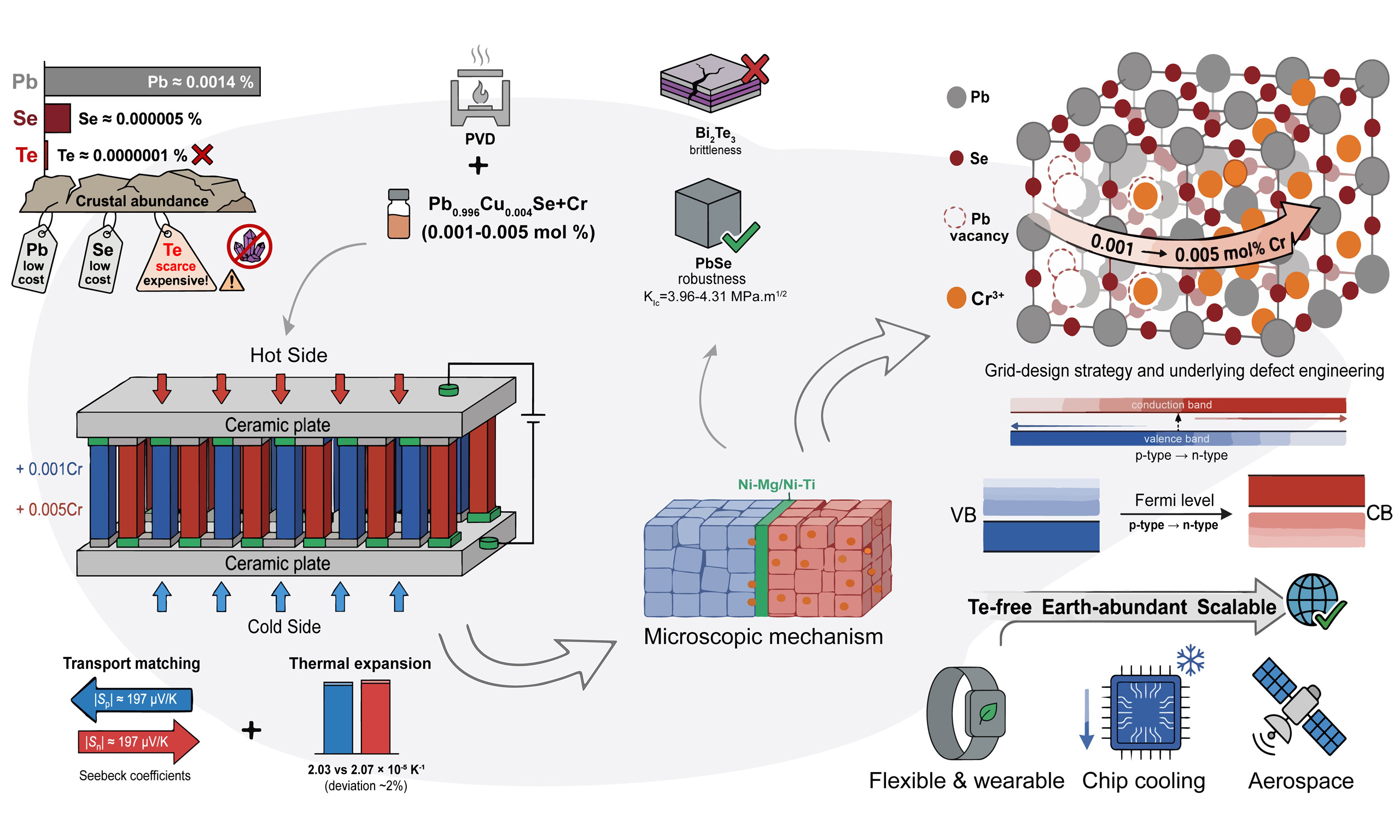
Solid-state cooling based on the Peltier effect is essential for thermal management in the modern electronic information industry. Most cooling thermoelectrics rely on elements such as Ge, Ga and Ag, all of which are scarce and expensive. Bi2Te3-based alloys perform considerably better and thus remain the commercial standard[1]. However, their widespread application is constrained by the limited availability of tellurium, thus motivating the search for tellurium-free alternatives. In addition, conventional thermoelectric modules, including commercial Bi2Te3-based coolers, typically employ dissimilar p-type and n-type leg compositions (p-type BixSbxTex and n-type BixTexSex), which differ in crystal structure, thermal expansion coefficient, and mechanical properties. Consequently, homogeneous thermoelectric integration based on a single material platform has attracted increasing interest because it can eliminate interfacial incompatibility while simplifying device fabrication. Hence, simultaneously achieving homogeneous p-n integration within a tellurium-free material platform is a promising yet challenging route for future development. In 2024, Qin et al. enhanced the performance of n-type PbSe through a grid-plainification strategy. However, their device architectures still relied on heterogeneous p-n integration (n-PbSe/p-PbSe, p-SnSe, or p-BiSbTe), leaving the issues associated with dissimilar material interfaces unresolved[2]. In 2025, Xu et al. employed Cu doping to tune crystal symmetry and carrier polarity within a tellurium-free material system. Although homogeneous p-n integration was demonstrated, the narrow doping window prevented simultaneous optimization of both carrier types, resulting in a maximum temperature difference of only 32.8 K[3]. To address this challenge, Liu and co-workers reported a significant advance in Science[4]. By introducing ultralow chromium (Cr) doping into a single PbSe matrix, they realized both p-type and n-type transport while maintaining excellent thermoelectric performance. Structurally, PbSe forms a uniform three-dimensional rock-salt network (Pb-Se bond energy ~2.7 eV) rather than a layered lattice held together by van der Waals forces. Being isotropic and tolerant to substitutional doping, it allows Cr to occupy Pb sites and reverse the carrier sign without disrupting the host framework[5], thereby providing a promising strategy for homogeneous thermoelectric integration and high-performance solid-state cooling.
Rather than relying on conventional multi-element doping, this work adopted an ultralow chromium-doping strategy in the PbSe lattice. Defect engineering is used to modulate the p-n conduction transition while largely retaining the intrinsic crystal framework. Using physical vapor deposition, this work introduces only 0.001-0.005 mol% Cr into PbSe. In the PbSe lattice, Pb vacancies normally give rise to p-type conduction. Ultralow Cr atoms preferentially occupy a portion of these vacancies, effectively compensating the native defects, suppressing vacancy-induced carrier scattering, and simultaneously driving the transition from p-type to n-type conduction. As a result, the Fermi level shifts smoothly from the valence-band edge to the conduction-band edge. This enables a controllable switch from p-type to n-type conduction without changing the Pb content [Figure 1A]. Density functional theory calculations reveal that the ionic radius of Cr3+ (0.61 Å) is considerably smaller than that of the Pb2+ ionic radius (1.12 Å) that originally occupies the lattice site. Given this size disparity, along with the comparable electronegativity between the two species, the incorporation of Cr3+ into the PbSe lattice induces only marginal lattice distortion, thus effectively preserving the crystalline integrity[6]. As experimental evidence supporting these theoretical forecasts, Annular bright-field scanning transmission electron microscopy (ABF-STEM)/annular dark-field scanning transmission electron microscopy (ADF-STEM) images clearly exhibit a steady decrease in the density of Pb vacancies upon elevated Cr doping levels [Figure 1B]. This vacancy filling strategy not only suppresses the intrinsic p-type carrier contribution but also introduces n-type conductive channels, realizing reversible modulation of carrier type within the original PbSe matrix. On a broader scale, it underscores the efficacy of defect engineering for carrier-type modulation while retaining the intrinsic lattice structure of the host material.
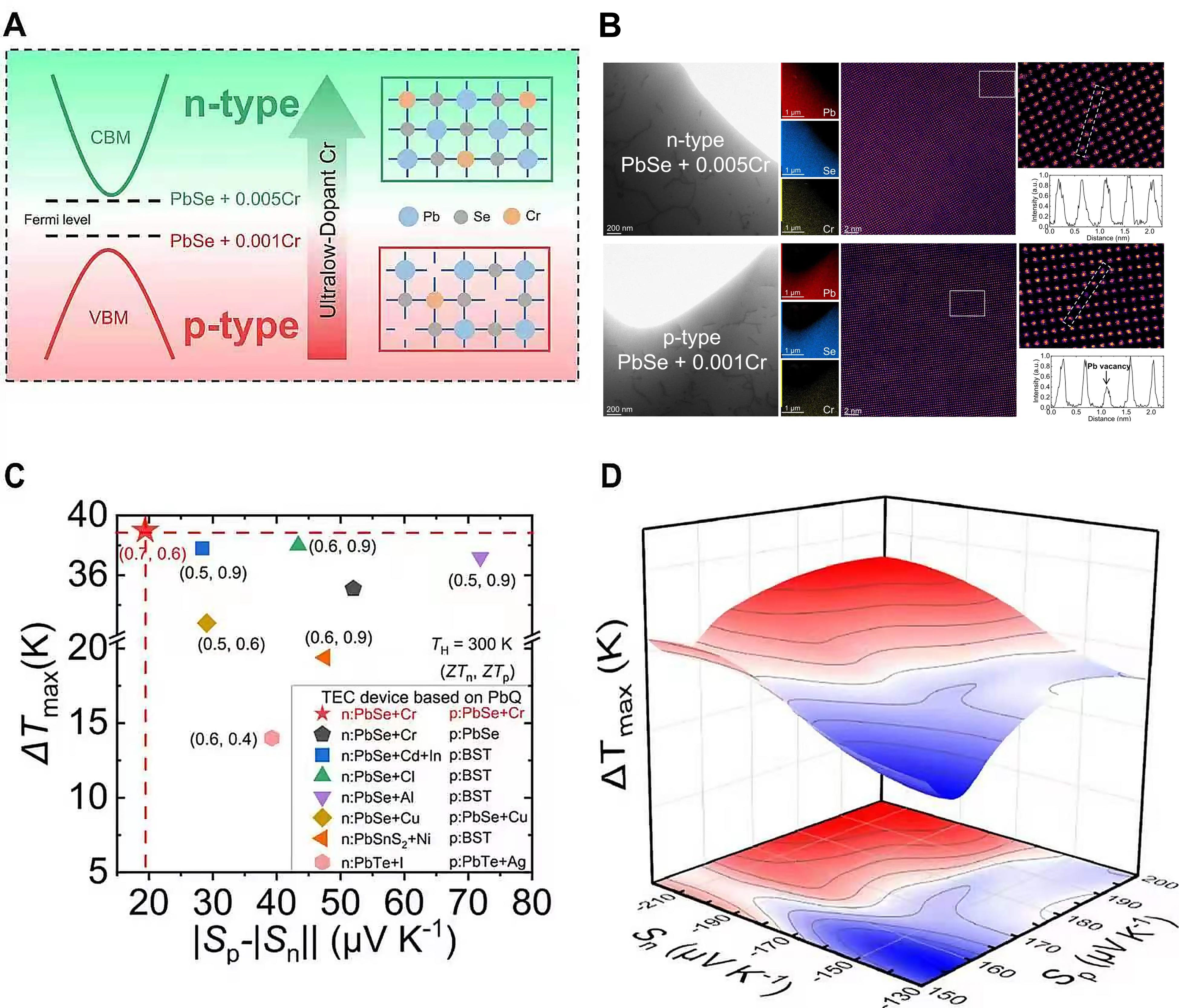
Figure 1. (A) Schematic illustration of the ultralow-doping lattice design strategy for the preparation of high-performance p-type and n-type PbSe; (B) Annular bright-field (ABF) scanning transmission electron microscopy and a comparative analysis of the magnified annular dark-field (ADF) characterization of PbSe + xCr crystals; (C) Maximum cooling temperature difference (ΔTmax) versus the difference in the absolute Seebeck coefficients (|Sp| - |Sn|) for PbSe-based thermoelectric coolers in this work and previously reported lead chalcogenide devices at a hot-side temperature of 300 K; (D). Simulated maximum cooling temperature difference (ΔTmax) as a function of the Seebeck coefficients of p-type and n-type PbSe, obtained by COMSOL Multiphysics based on the experimentally measured properties of the n-type and p-type PbSe legs. This figure is reprinted with permission from[4]. Copyright © 2026, AAAS. CBM: Conduction band minimum; VBM: valence band maximum; TEC: thermoelectric cooling.
Conventional thermoelectric cooling devices typically employ heterogeneous configurations combining different material systems, such as n-Bi2Te3/p-Bi2Te3 or n-PbSe/p-SnSe heterojunctions[2,3]. This work fundamentally eliminates tellurium reliance by substituting traditional BiSbTe and SnSe-based heterojunction configurations with an all-PbSe homojunction architecture[4]. Notably, slight toxicity is common to virtually all advanced thermoelectric materials, whereas tellurium scarcity remains the key obstacle to large-scale deployment; Se-related health and regulatory concerns are well managed under established occupational standards, and the hermetically encapsulated modules prevent direct exposure. Cr doping effectively sustains the inherent cubic rock-salt lattice framework of PbSe, achieving nearly identical thermal expansion coefficients between p-type (2.03 × 10⁻⁵ K-1) and n-type (2.07 × 10⁻⁵ K-1) legs with a marginal deviation of merely 2%. Beyond structural compatibility, the fabricated system possesses superior mechanical durability, with a fracture toughness as high as 4.31 MPa·m1/2. These structural and mechanical merits substantially mitigate interfacial fracture induced by thermal stress, a critical failure issue commonly observed in conventional hybrid thermoelectric devices. To further validate this concept, this work combines experimental verification [Figure 1C] and multiphysics simulations [Figure 1D] to propose a universal design principle for thermoelectric cooling devices. Specifically, the symmetric Seebeck coefficients of n-type and p-type legs contribute comparably to the overall cooling performance, which is equivalent to the optimization effect of the conventional figure of merit (ZT). Guided by this design strategy, optimized Ni-Mg/Ni-Ti interfacial engineering is implemented to lower the contact resistivity to 3-26 μΩ·cm2. The fabricated seven-pair thermoelectric prototype achieves a maximum temperature difference (ΔTmax) of 53 K (hot-side temperature of 363 K, leg dimensions of 2 mm × 2 mm × 6 mm). Furthermore, the ultrathin device variant delivers an ultrahigh cooling power density of 6 W·cm-2 (leg dimensions of 2 mm × 2 mm × 0.4 mm) and a peak coefficient of performance of 21 (I = 0.5 A at ΔT = 0.1 K), with its core performance metrics closely approaching those of commercial Bi2Te3-based cooling devices.
In summary, this work shifts the focus beyond the conventional pursuit of high thermoelectric ZT by addressing two key challenges in thermoelectric cooling: the development of tellurium-free materials as alternatives to Bi2Te3 and the realization of homogeneous p-n integration to overcome the interfacial incompatibility and thermal expansion mismatch associated with conventional heterogeneous devices. Furthermore, the tellurium-free composition combined with symmetric p-n junction integration makes this system particularly suitable for high heat flux electronic devices. Further exploration into its reliability will pave the way for addressing the persistent challenges of localized active cooling and precision temperature regulation in advanced microprocessors, power devices, laser systems, and wearable electronics. Beyond electronic cooling, the isotropic cubic rock-salt structure of PbSe offers superior mechanical robustness compared with the layered Bi2Te3 lattice, suggesting additional potential for thermal management under harsh operating conditions, including aerospace electronics and spacecraft payloads[7]. Nevertheless, before practical deployment, further studies are needed to understand the long-term stability of ultralow Cr dopants and defect evolution under repeated thermal cycling, high-current operation, and irradiation environments. Overall, this all-PbSe platform with advantages of simple composition, robust structure, and interfacial compatibility makes it a highly promising candidate for the future of sustainable and reliable solid-state cooling.
DECLARATIONS
Authors’ contributions
Proposed the topic: Xu, W.; Suwardi, A.
Conducted the literature survey: Li, R.; Xu, D.; Ge, C.
Prepared the manuscript, discussed and revised the manuscript: Li, R.; Ge, C.
Review, conceptualization, and supervision: Xu, W.; Xu, D.; Suwardi, A.
Availability of data and materials
Not applicable.
AI and AI-assisted tools statement
Not applicable.
Financial support and sponsorship
This work was supported by the Advanced Materials National Science and Technology Major Project (2025ZD0613501, 2025ZD0613602), the National Natural Science Foundation of China (52533017, 52573368), Hubei Provincial Natural Science Foundation of China (No. 2026AFC0173), the funding of State Key Laboratory of New Textile Materials and Advanced Processing (Wuhan Textile University, No. FZ2025045), Key Laboratory of Functional Textile Material and Product (Xi'an Polytechnic University, Ministry of Education, No. 2025FTMP003), and the funding by project #RNE-p3-24 of the Shun Hing Institute of Advanced Engineering, the Chinese University of Hong Kong.
Conflicts of interest
All authors declared that there are no conflicts of interest.
Ethical approval and consent to participate
Not applicable.
Consent for publication
Not applicable.
Copyright
© The Author(s) 2026.
REFERENCES
1. Liu, D.; Bai, S.; Wen, Y.; et al. Lattice plainification and band engineering lead to high thermoelectric cooling and power generation in n-type Bi2Te3 with mass production. Natl. Sci. Rev. 2025, 12, nwae448.
2. Qin, Y.; Qin, B.; Hong, T.; et al. Grid-plainification enables medium-temperature PbSe thermoelectrics to cool better than Bi2Te3. Science 2024, 383, 1204-9.
3. Xu, L.; Hong, T.; Liu, S.; et al. Cost-effective symmetric PbSe-based device for thermoelectric cooling. Adv. Mater. 2025, 37, 2502705.
4. Liu, S.; Tian, Y.; Wen, Y.; et al. Ultralow chromium doping enables all-PbSe thermoelectric cooling. Science 2026, 392, 1056-60.
5. Zheng, Y.; Tan, X. Y.; Wan, X.; Cheng, X.; Liu, Z.; Yan, Q. Thermal stability and mechanical response of Bi2Te3-based materials for thermoelectric applications. ACS. Appl. Energy. Mater. 2020, 3, 2078-89.
6. Shannon, R. D. Revised effective ionic radii and systematic studies of interatomic distances in halides and chalcogenides. Acta. Cryst. A. 1976, 32, 751-67.
Cite This Article
 Open Access
How to Cite
Li, R.; Xu, D.; Suwardi, A.; Ge, C.; Xu, W. A solid-state all-PbSe platform for thermoelectric cooling. Energy Mater. 2026, 6, 600142. https://dx.doi.org/10.20517/energymater.2026.260
Download Citation
Export Citation File:
Type of Import
Tips on Downloading Citation
Citation Manager File Format
Type of Import
Direct Import: When the Direct Import option is selected (the default state), a dialogue box will give you the option to Save or Open the downloaded citation data. Choosing Open will either launch your citation manager or give you a choice of applications with which to use the metadata. The Save option saves the file locally for later use.
Indirect Import: When the Indirect Import option is selected, the metadata is displayed and may be copied and pasted as needed.
About This Article
Copyright

Data & Comments
Data
0







Comments
Comments must be written in English. Spam, offensive content, impersonation, and private information will not be permitted. If any comment is reported and identified as inappropriate content by OAE staff, the comment will be removed without notice. If you have any queries or need any help, please contact us at support@oaepublish.com.