


Regulating Na+ vacancies and stabilizing lattice structure via Al3+/O2- doping for low-cost dry-air-stable NaCl-based solid electrolytes
 0
0 Abstract
Sodium chloride (NaCl) is attractive as a solid electrolyte because of its wide electrochemical stability window, excellent dry-air stability, favorable cathode compatibility, and low cost; however, its intrinsically low ionic conductivity has severely limited practical application. Here, we report an Al3+/O2- co-doping strategy that introduces Na+ vacancies and mixed Cl-/O2- anion environments into the NaCl lattice, thereby converting NaCl from a poor ionic conductor into a fast-ion-conducting solid electrolyte. The optimized composition, Na0.4625Al0.25Cl0.7875O0.2125, exhibits an ionic conductivity of
Keywords
INTRODUCTION
Solid-state electrolytes (SSEs) are the key component to realize advanced all-solid-state batteries (ASSBs), as they not only offer intrinsic safety but also effectively eliminate flammability hazards[1-6]. Sodium-based SSEs have attracted increasing interest because sodium is abundant and inexpensive, offering a potentially cost-effective platform for large-scale energy storage[7-9].
Drawing on the design principles established for liquid electrolytes, high-performance Na-based SSEs should combine high ionic conductivity, low activation barriers for ion migration, robust chemical and electrochemical stability, and favorable interfacial compatibility. From a commercialization perspective, low materials and processing costs are also essential[10-12]. Oxide-based SSEs (e.g., Na3Zr2Si2PO12 and Na-β-Al2O3)[13-16] can provide acceptable ionic conductivity and robust chemical stability, but they are limited by brittleness and high interfacial impedance[13,14]. Sulfide-based SSEs (e.g., Na3PS4, Na3SbS4, and Na11Sn2PS12)[17-19] can achieve high ionic conductivity; however, they are hindered by a narrow electrochemical window and poor air stability[7]. Recently, crystalline halide-based SSEs are highly attractive due to superior ionic conductivity (10-4 to 10-3 S cm-1 at room temperature) and excellent cold-pressing deformability[20-23]. These advantages can balance the performance of sulfide- and oxide-based SSEs. However, previous studies on halide-based SSEs have primarily focused on low-symmetry crystal structures, such as trigonal and orthorhombic systems[24-27]. These halide-based SSEs usually suffer from insufficient air stability and high cost[28-33]. Meanwhile, these halide-based SSEs are still insufficient for applications due to limited cathode compatibility with oxidation potential below 4.0 V[34-37]. In this regard, novel sodium chloride (NaCl) based halide-based SSEs are highly competitive because of their wide electrochemical stability window, excellent dry air stability, favorable cathode compatibility (above 4.1 V) and extremely low cost[38,39]. Their practical development is nevertheless constrained by the intrinsically low ionic conductivity of the NaCl lattice.
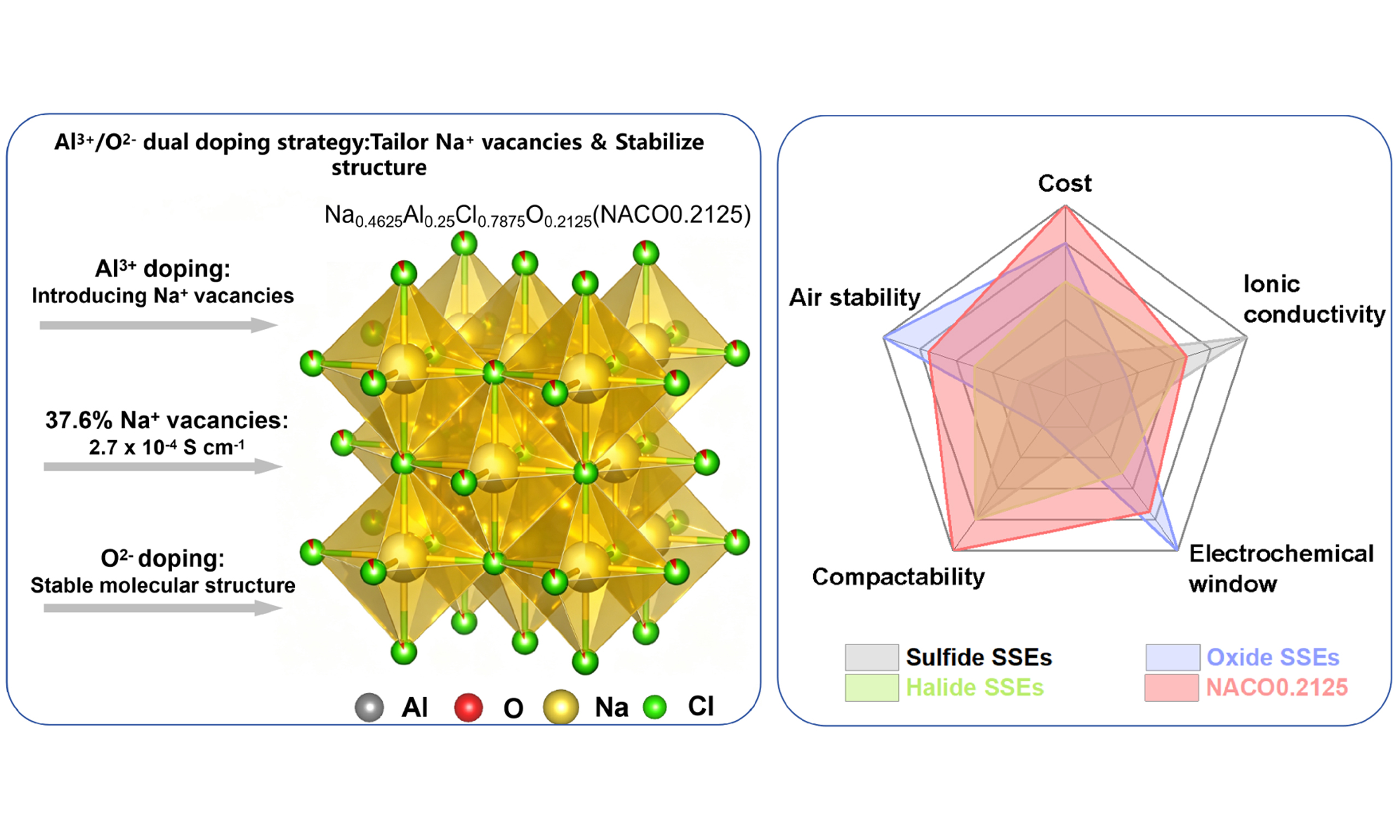
In this work, we developed NaCl-based SSEs (Na0.25+xAl0.25Cl1-xOx, denoted as NACOx, 0 ≤ x ≤ 0.225) through an Al3+/O2- dual-ion doping strategy. The optimized Na0.4625Al0.25Cl0.7875O0.2125 (NACO0.2125) SSEs present a single-phase face-centered cubic structure (space group Fm-3m). Specifically, the doping of Al3+ in the lattice can introduce abundant Na+ vacancies (37.6%) at the 4a sites, which provide fast transport channels for Na+ migration. Meanwhile, O2-, with a smaller ionic radius, can balance the cation-anion radius ratio in NACO0.2125, stabilize the crystal structure of NaCl, and further enhance its dry air stability. Attractively, NACO0.2125 exhibits an ionic conductivity of 2.7 × 10⁻⁴ S cm-1 at 30 °C and an electrochemical window of
EXPERIMENTAL
Material synthesis
NaCl, AlCl3, and NaOH were purchased from Sinopharm and used without further purification. Na0.25+xAl0.25Cl1-xOx and Na1-3yAlyCl were prepared by the same synthesis method. NaCl and AlCl3 or NaCl,AlCl3 and NaOH were milled with a NaCl:AlCl3 molar ratio of (1-3y):y or with a NaCl:AlCl3:NaOH molar ratio of 0.25:0.25:x for 30 min. The pre-blended powder mixtures were sintered at 200 °C in a muffle furnace (Kejing, KSL-1400X-A1, China) for 2 h under a high-purity argon (Ar) atmosphere. The sintered products were subsequently subjected to high-energy ball milling in a 100 mL zirconia (ZrO2) jar under vacuum at 550 rpm for 10 h using a planetary ball mill (Nanda Instruments, QM-3SP2, China). All sample handling and processing operations were conducted in an Ar-filled glovebox (Mikrouna, Super 750, China), where the contents of H2O and O2 were strictly controlled below 0.1 ppm to avoid contamination.
The Na3PS4 solid electrolyte was fabricated via a conventional solid-state synthesis route. Specifically, sodium sulfide (Na2S, Sigma-Aldrich) and phosphorus pentasulfide (P2S5, 99% purity, Sigma-Aldrich) were weighed according to the stoichiometric ratio and homogeneously mixed by ball milling at 500 rpm for 12 h. The fully mixed powders were vacuum-sealed in a quartz tube and thermally annealed at 280 °C for 3 h to obtain the target electrolyte material.
The Na2Sn anode material was synthesized through mechanical ball milling of metallic sodium (Na) and tin (Sn) powders (Sinopharm). Initially, the stoichiometric Na and Sn metal mixture was pre-rolled for preliminary blending, then transferred into a stainless-steel milling jar and hermetically sealed under Ar protection. The sealed mixture was ball-milled at 300 rpm for 10 h to yield a uniform Na2Sn product. An additional 10 h of ball milling was performed if the obtained product exhibited an inhomogeneous morphology and composition.
Characterization
X-ray diffraction (XRD) experiments were performed using a Philips X’Pert powder diffractometer (Rigaku, D/MAX2500VL/PC, Japan) at 45 kV and 40 mA with Cu-Kα radiation (λ = 1.5406 Å). The samples were placed in a zero-background holder and sealed with a Kapton film to avoid air exposure. The data were collected at room temperature with 2θ from 10° to 80°. Rietveld refinement was carried out from XRD data with strong intensity. The following parameters were refined stepwise: (1) scale factor, (2) background using linear interpolation function with 10 coefficients, (3) peak shape using the pseudo-Voigt function, (4) unit cell parameters and fractional atomic coordinates, (5) fractional occupancy and thermal displacement parameters (Uiso). High-resolution synchrotron XRD and total scattering measurements were performed at beamline ID31 of the European Synchrotron Radiation Facility. NIST SRM 660b (NIST, LaB6, America) was used for geometry calibration. Scanning electron microscopy (SEM) images were conducted on a high-resolution field-emission scanning electron microscope (Hitachi, Regulus 8230, Japan). X-ray photoelectron spectroscopy (XPS) measurements were conducted on a Thermo Scientific K-Alpha instrument (Thermo Scientific, ESCALAB Qxi, China).
The ionic conductivity of all solid electrolytes was measured at 30 °C using electrochemical impedance spectroscopy (EIS) in the frequency range from 7 MHz to 1 Hz with a potential perturbation of 50 mV (Bio-Logic, SP-200, France). The activation energy was calculated based on variable-temperature impedance from room temperature up to 70 °C in a microclimate chamber. The as-synthesized solid electrolyte powders were pressed into pellets with a diameter of 12 mm, under a pressure of 370 MPa and then sandwiched between two steel rods for all measurements. The Young's modulus test was carried out on an Atomic Force Microscope (Bruker, Dimension ICON, Germany).
Linear sweep voltammetry (LSV) was employed to evaluate the electrochemical stability of the prepared SSEs. The working cathode was fabricated by blending the SSE powder with 10 wt% vapor-grown carbon fibers (VGCF). The assembled battery configuration adopted NACO0.2125 as catholyte, the as-prepared Na3PS4 as anolyte and Na2Sn as the anode material. The NACO0.2125-VGCF cathode (10 mg), NACO0.2125 (70 mg), Na3PS4 (70 mg), and Na2Sn anode (50 mg) were separately compacted at a pressure of 300 MPa to construct a 12 mm-diameter cylindrical cell. The LSV measurements were performed on a Biologic SP-200 electrochemical workstation at a constant scan rate of 0.1 mV/s, with a voltage testing window ranging from 0 to 5 V.
All-solid-state NaNi1/3Mn1/3Ti1/3O2||Na0.4625Al0.25Cl0.7875O0.2125||Na3PS4||Na2Sn battery was fabricated using the following procedure. The composite cathode was made by ball milling the mixture of NaNi1/3Mn1/3Ti1/3O2, Na0.4625Al0.25Cl0.7875O0.2125 and VGCF (50:50:5 in weight ratio) at 300 rpm for 30 min. The ASSB was made by co-pressing Na2Sn anode (50 mg), Na3PS4 (70 mg) anolyte, Na0.4625Al0.25Cl0.7875O0.2125 (70 mg) catholyte and NaNi1/3Mn1/3Ti1/3O2 composite cathode (12 mg) together in order, and under 300 MPa. Battery tests were carried out on a Neware battery test system (Neware, CT-4008Q-100mA, China).
RESULTS AND DISCUSSION
Synthesis and characterization of Na0.25+xAl0.25Cl1-xOx
To generate Na+ vacancies in the NaCl lattice, partial Na+ substitution with high-valence cations was implemented. Considering the economic factor, Al3+ was chosen as the dopant, which is the most abundant metal element in nature (Na1-3yAlyCl, 0 < y ≤ 0.2). As shown in Supplementary Figure 1, XRD revealed that as the Al content increased, well-resolved diffraction peaks characteristic of the NaAlCl4 phase appeared and gradually intensified[24]. This observation demonstrated that Al3+ ions could not fit into the NaCl structure. Instead, AlCl3 reacted with the NaCl matrix and formed NaAlCl4. This situation can be explained by Pauling's first rule, which states that the cation-to-anion radius ratio (rc/ra) is the primary determinant of the cation coordination geometry and polyhedron stability[40]. For NaCl-type structures belonging to the Fm-3m space group, Na+ ions (102 pm) sit in the 4a octahedral sites where a cation is coordinated by six Cl- anions (181 pm) in a highly symmetrical packing scheme. The mismatch in ionic radius, especially between Al3+ (53.5 pm) and Na+ (102 pm), hinders effective Na+ vacancy creation, leading to low ionic conductivity, which is critical for understanding material limitations. This imbalance induces excessive lattice strain and disrupts the original coordination frameworks. The ionic conductivity of Na1-3yAlyCl with impurities was hardly improved, as shown in Supplementary Figure 2.
It is important to note that Al3+ can achieve stable sixfold coordination in α-Al2O3 primarily due to the influence of O2- size and electronegativity. The small ionic radius of O2- (140 pm) and its high electronegativity work together to optimize the cation-to-anion radius ratio for Al3+, making this coordination thermodynamically favorable[41]. The high electronegativity of O2- exerts a strong polarizing effect, distorting the electron cloud of Al3+ and slightly increasing its effective ionic radius, which further stabilizes the sixfold coordination. Based on the theoretical insight, we proposed a dual-anion modification strategy that involves the simultaneous incorporation of Al3+ and O2- into the NaCl lattice. The introduction of O2- reduces the average ionic radius of the anionic sublattice, which tailors the cation-to-anion radius ratio to the critical range required for producing six-coordinate configurations and stabilizing the doping of Al3+ at the 4a site. The dual-anion approach overcame issues inherent with the traditional aliovalent doping method and led to a novel NaCl-type halide SSE, denoted as Na0.25+xAl0.25Cl1-xOx (NACOx) (0 ≤ x ≤ 0.225).
Upon the doping of O2-, NACOx retains the FCC architecture with the Fm-3m space group, which is isostructural to the parent NaCl lattice [Figure 1A]. XRD characterization
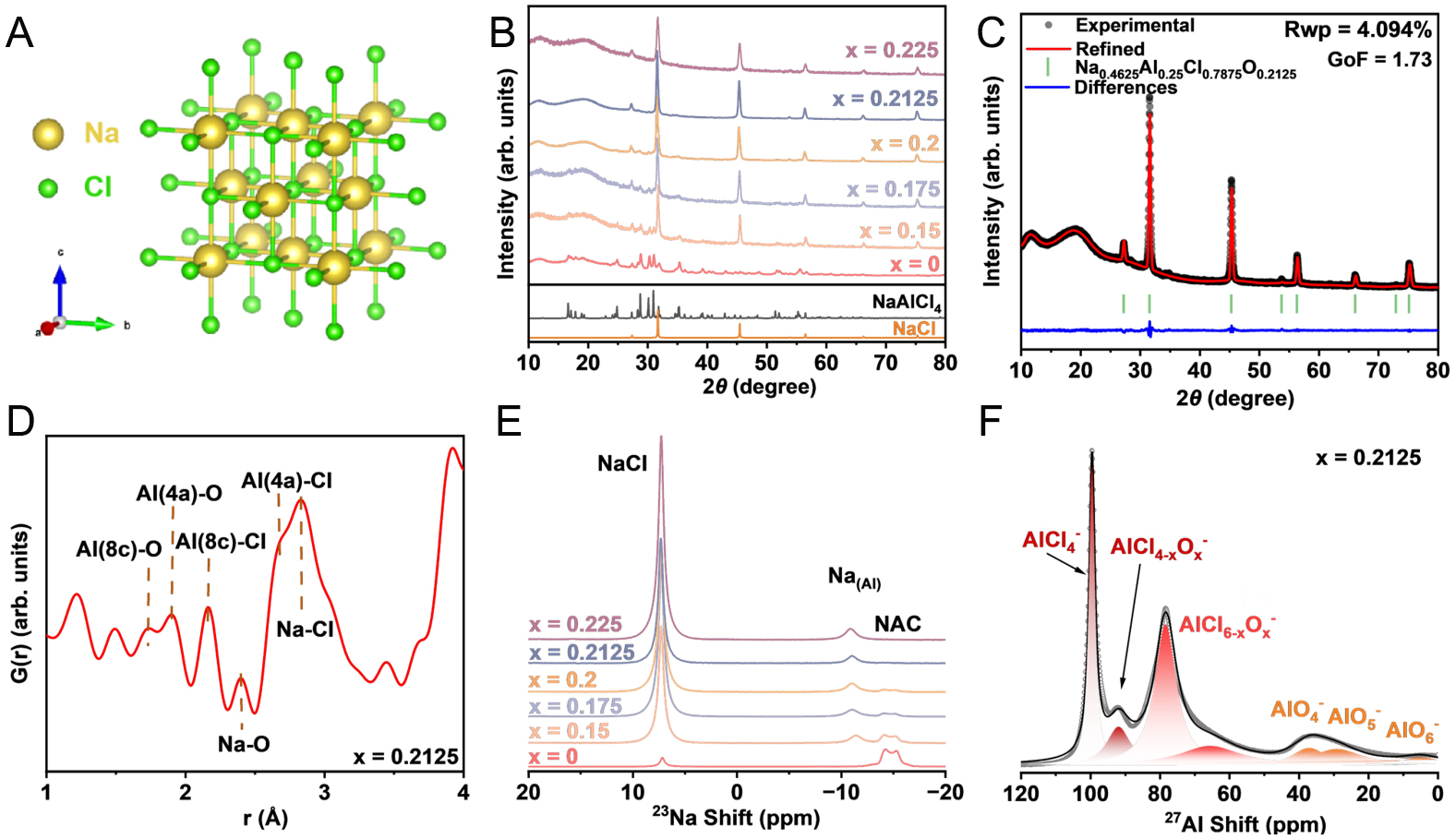
Figure 1. Structural characterization. (A) Crystal structure of NaCl; (B) XRD patterns of Na0.25+xAl0.25Cl1-xOx (0 ≤ x ≤ 0.225); (C) Rietveld refinements of Na0.4625Al0.25Cl0.7875O0.2125; (D) PDF profiles of Na0.4625Al0.25Cl0.7875O0.2125; (E) 23Na NMR of Na0.25+xAl0.25Cl1-xOx (0 ≤ x ≤ 0.225). (F) 27Al NMR of Na0.4625Al0.25Cl0.7875O0.2125.
XPS was first used to probe the local bonding environment of the phase-pure Na0.4625Al0.25Cl0.7875O0.2125 (NACO0.2125) sample [Supplementary Figure 3]. Distinct Na-O and Al-O features were observed, indicating mixed Cl-/O2- coordination around Na and Al species[29,38]. When coupled with complementary XRD data
To further resolve the local structure of NACO0.2125, X-ray pair distribution function (PDF) analysis was performed [Figure 1D and Supplementary Figure 4]. The PDF spectrum of NACO0.2125 in the high-r region
Solid-state nuclear magnetic resonance (ssNMR) spectroscopy provided insights into the chemical coordination environments of Na+ and Al3+ species[46], thereby delineating the structural evolution induced by the co-doping of Al3+ and O2-. As illustrated in Figure 1E, the 23Na NMR spectrum of the oxygen-free counterpart (x = 0) was dominated by a broad resonance spanning from -13 to -17 ppm, a characteristic chemical shift of Na+ ions residing in the NaAlCl4 phase. By contrast, only a faint signal at 7 ppm could be discerned, corresponding to Na+ in the pristine NaCl lattice. This spectral feature confirmed the thermodynamic metastability of Al3+-doped pristine NaCl, aligning with the XRD results [Figure 1B]. Upon the introduction of O2- anions, the resonance intensity associated with the NaCl lattice was pronouncedly enhanced, demonstrating the positive impact of oxygen doping on lattice stability. Concomitantly, the signal attributable to the NaAlCl4 phase gradually diminished until it was completely suppressed at the optimal doping stoichiometry of x = 0.2125. This spectral evolution provided unambiguous evidence for the formation of a single-phase NaCl-type solid solution, in excellent agreement with the phase identification results from XRD [Figure 1B]. Moreover, a distinct new resonance emerged at -11 ppm in the O2--doped samples, indicative of the formation of a novel Na+ coordination environment within the SSE. This signal was attributed to the local environment of Na+ adjacent to Al3+. With the gradual increase in O2- content, the higher electronegativity of O2- relative to Cl- exerted a stronger electrostatic effect, which induced a progressive downfield shift of the chemical shift[47,48].
The 27Al NMR spectra further resolved the local coordination environments of Al3+ ions
To resolve the Na+ transport mechanism within NaCl-type crystalline framework, we constructed Li||NACO0.2125||Li symmetric cells and subjected them to a constant polarization bias [Figure 2A][53]. This experimental design capitalizes on the Li+/Na+ cation exchange reaction driven by Li+ diffusion across the electrolyte. Specifically, the displacement of Na+ from its original lattice sites under an external bias directly reveals the spatial distribution of active Na+ migration channels. Incoming Li+ can replace only Na+ ions residing in transport-accessible sites. Notably, 23Na NMR spectroscopy characterization of the polarized electrolyte [Figure 2B] revealed a pronounced decrease in the resonance intensities corresponding to the NaCl host lattice (7 ppm) and the Na(Al) local environment (-11 ppm), with the reduction ratio of the Na(Al) peak (59%) being markedly higher than that of the NaCl peak (18.1%). Such spectral evolution furnished unambiguous evidence for the construction of continuous Na+ conduction channels within the electrolyte: Na+ ions form a three-dimensional continuous ion transport network across the bulk lattice and exhibit a distinct tendency to migrate via the Na+ vacancies adjacent to Al3+ sites. This result directly verified the efficacy of the defect engineering strategy proposed in this work.
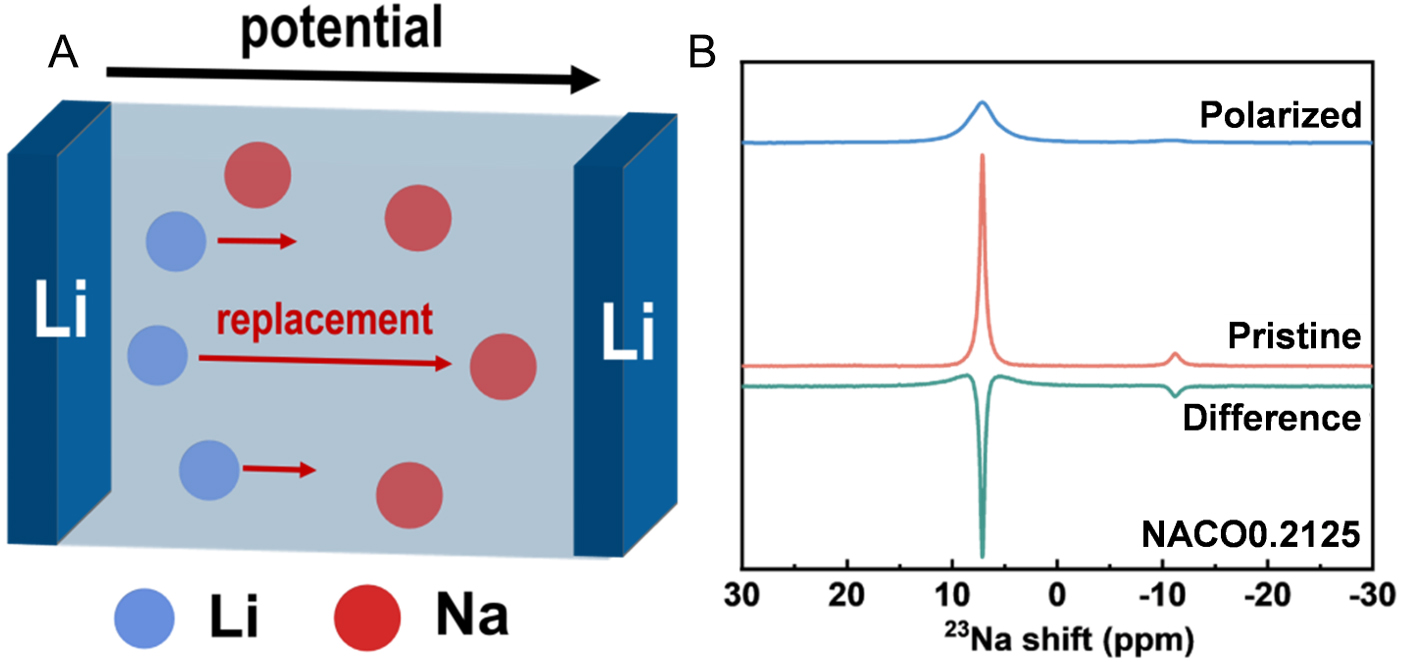
Figure 2. Transport mechanism analysis. (A) Li||NACO0.2125||Li cell; (B) 23Na MAS NMR of polarized and pristine
Electrochemical performance and cost of Na0.25+xAl0.25Cl1-xOx
The optimized structural features of NACO0.2125 (high Na+ vacancy concentration and continuous 3D migration network) directly determine its electrochemical performance. Herein, we systematically evaluated the ionic conductivity, electrochemical stability window, and electronic conductivity of the NACOx series. Both ionic conductivity and phase purity showed a positive correlation with oxygen doping content over a specific range. This trend arose primarily from the progressive suppression of the NaAlCl4 impurity phase.
At the optimal doping stoichiometry of x = 0.2125, the composition achieved a maximum ionic conductivity of 2.7 × 10⁻⁴ S cm-1 at 30 °C [Figure 3A and B, Supplementary Figure 5]. This performance peak coincided with the high Na+ vacancy concentration of 37.6% at the 4a sites, confirming that the vacancy-mediated diffusion mechanism affects ion transport in this system. In contrast, excessive oxygen doping (x = 0.225) triggered a decline in ionic conductivity to 1.7 × 10⁻⁴ S cm-1 at 30 °C [Supplementary Figure 5]. This deterioration could be ascribed to structural factors: the Na+ vacancy concentration at the 4a sites decreased to 36.3%, thereby reducing the density of mobile charge carriers and raising the migration energy barrier[54,55]. On the other hand, increasing O2- doping effectively reduces the content of NaAlCl4 impurities, thereby improving the ionic conductivity of the NACOx samples [Supplementary Figure 5]. The optimal electrochemical performance is achieved at x = 0.2125, at which point impurity phases are completely eliminated. Further increasing the O2- content causes a right shift of the XRD diffraction peaks for NACO0.225 [Supplementary Figure 6]. Since O2- possesses a smaller ionic radius than Cl-, continuous oxygen substitution reduces the unit cell volume. This structural contraction distorts the Na+ fast-migration pathways and ultimately deteriorates the ionic conductivity.
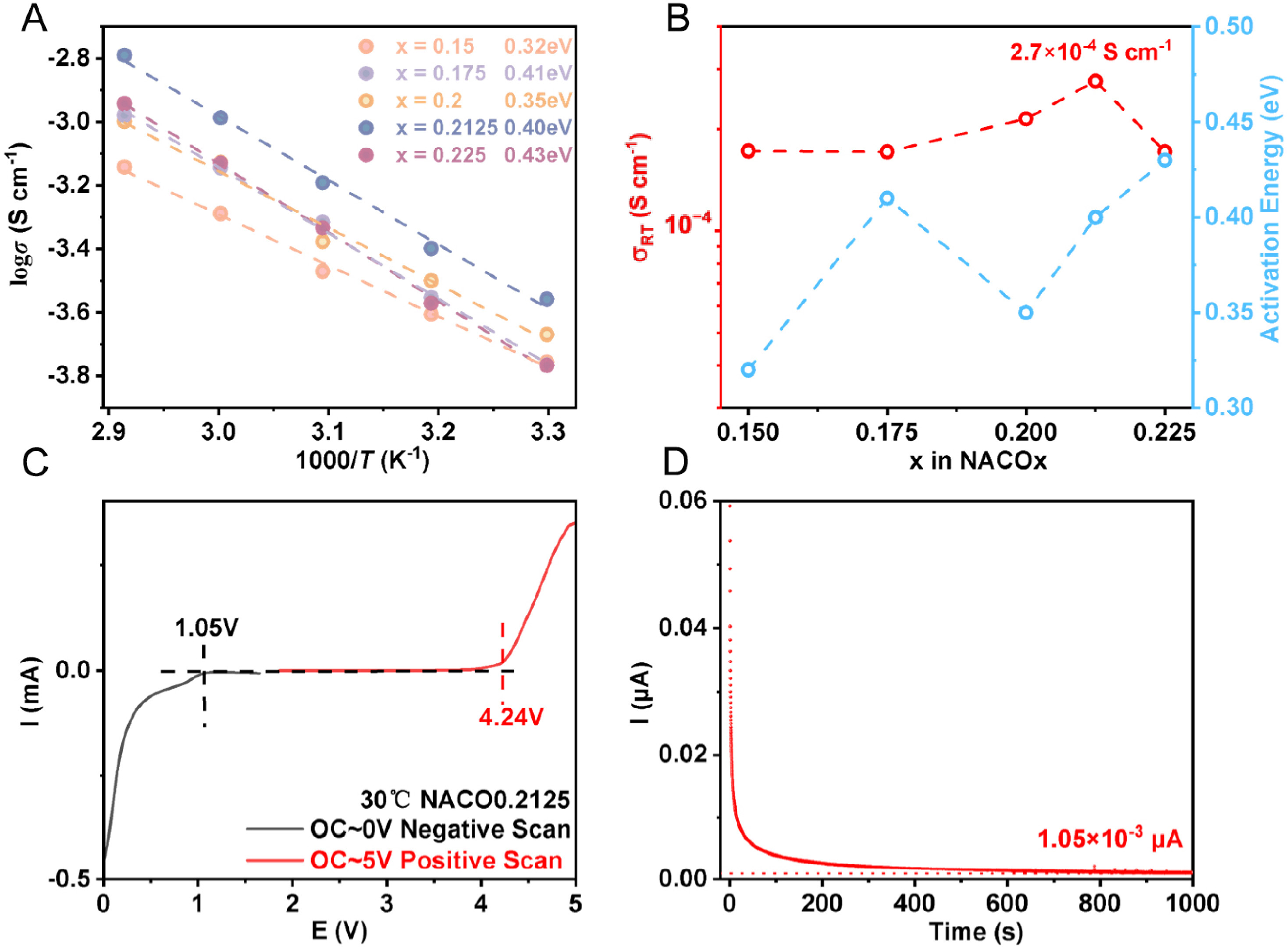
Figure 3. Electrochemical performance of NACOx. (A) Arrhenius conductivity plots of Na0.25+xAl0.25Cl1-xOx (0.15 ≤ x ≤ 0.225); (B) Ionic conductivities and activation energies of Na0.25+xAl0.25Cl1-xOx (0.15 ≤ x ≤ 0.225); (C) Linear scanning voltammetry of NACO0.2125 at
Electrochemical stability represents a pivotal metric for SSEs. To evaluate the electrochemical stability of NACO0.2125, LSV measurements were performed on a tailored cell configuration:
Another remarkable advantage of NACO0.2125 lies in its extremely low cost. It can be synthesized via a simple preparation process using low-cost raw materials, namely NaCl, AlCl3, and NaOH. Among these starting materials, AlCl3 stands out for its exceptional economic viability, with a market price of merely
Mechanical properties and dry air stability
Mechanical factors play a crucial role in the industrial fabrication and practical implementation of SSEs. These factors directly affect interfacial contact with electrodes, and long-term cycling durability in ASSBs. For NACO0.2125, primary particle size analysis reveals a size distribution ranging from approximately 7 to
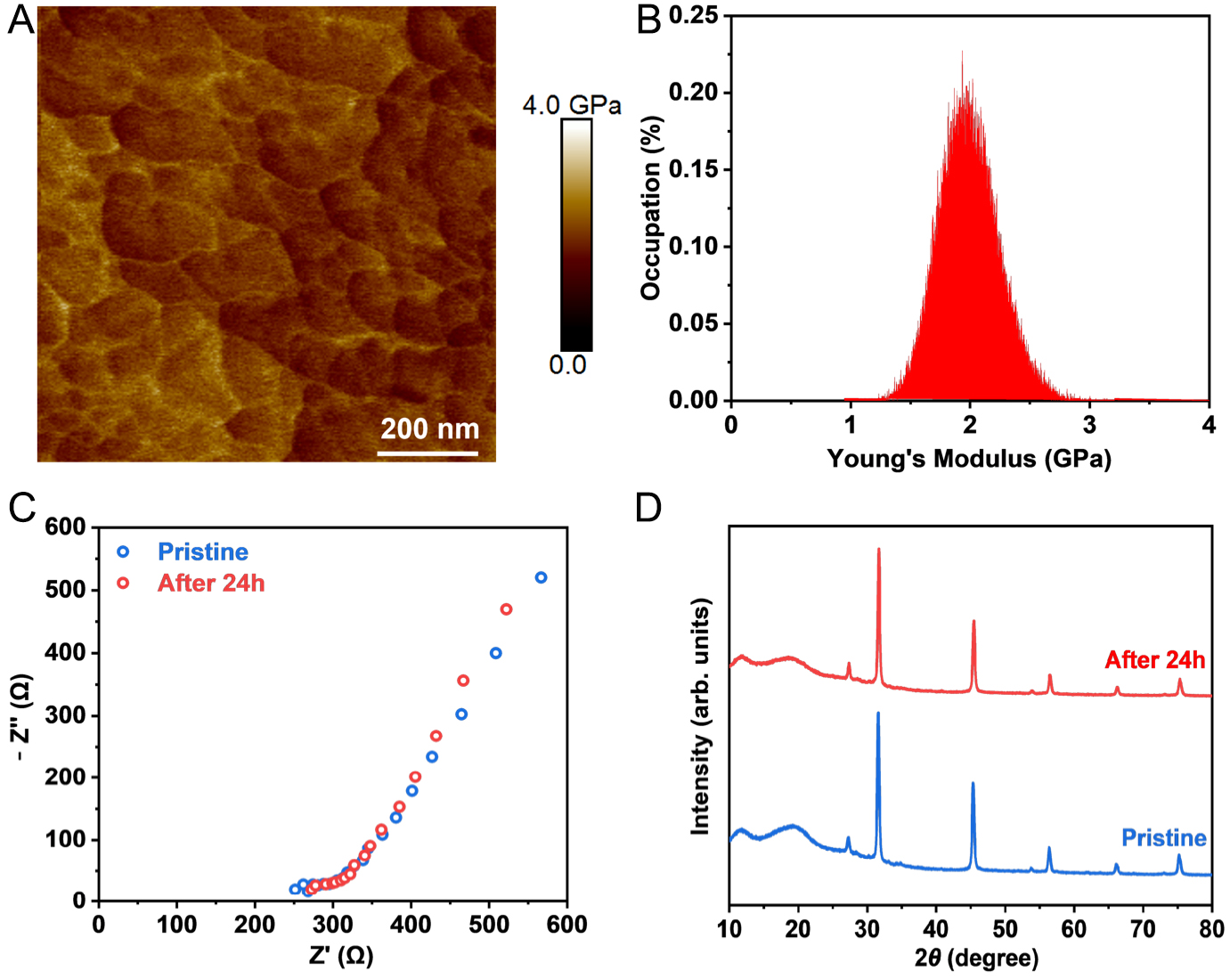
Figure 4. Chemical stability and mechanical properties. (A) AFM topography image of NACO0.2125 pellet; (B) Young’s modulus distribution of NACO0.2125 pellet; (C) Nyquist plots of exposed NACO0.2125; (D) XRD patterns of NACO0.2125 and exposed NACO0.2125 in dry air for 24 h.
Dry air stability is another important factor affecting the practical generation and application of SSEs. It is critical to clarify that the air stability characterization herein is performed under standardized industrial dry-room conditions with a dew point of -40 °C, rather than uncontrolled humid ambient air at room temperature. Mass production of all-solid-state sodium batteries uniformly adopts -40~-60 °C dew dry rooms for electrolyte storage, powder transfer and pellet assembly, making this test condition practically relevant for industrial processing. After 24 h of exposure to an environment with a dew point of
ASSBs using NACO0.2125
Benefiting from the high ionic conductivity, wide stability window, and excellent mechanical compatibility, NACO0.2125 is expected to serve as a practical SSE for ASSBs. Full cells with a high-voltage cathode NaNi1/3Mn1/3Ti1/3O2 and a Na2Sn anode were assembled and evaluated. The composite cathode formulation consists of NACO0.2125, NaNi1/3Mn1/3Ti1/3O2, and VGCF. After thorough mechanical mixing, the active material particles were uniformly dispersed together with NACO0.2125 and VGCF in the composite cathode matrix [Supplementary Figures 11C and 15]. For the ASSB assembly, Na3PS4 (10-4 S cm-1,
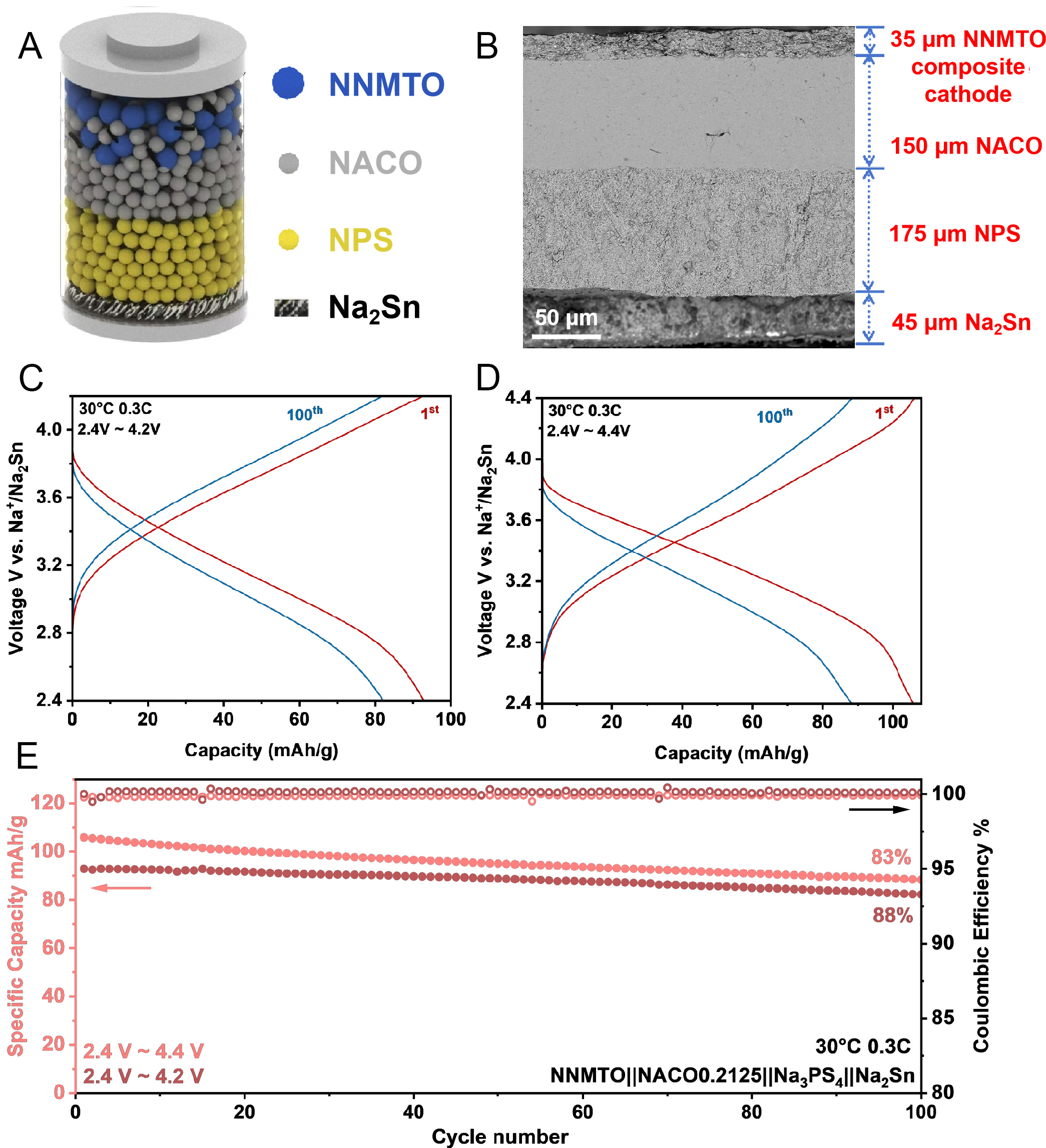
Figure 5. All-solid-state battery. (A) Configuration of ASSB with NACO0.2125 as SSEs; (B) Cross-section SEM for different layers in the ASSB; (C) Charge-discharge profiles at different cycles (2.4~4.2 V); (D) Charge-discharge profiles at different cycles (2.4 V~4.4 V). (E) Cycle performance.
NaNi1/3Mn1/3Ti1/3O2||NACO0.2125||Na3PS4||Na2Sn cell delivers stable cycling performance within a voltage window of 2.4~4.2 V, with an initial discharge capacity of 92.9 mAh·g-1 at 30 °C [Figure 5C]. Even after 100 cycles at 0.3 C, the battery retains a discharge capacity of 82.8 mAh g-1, corresponding to a capacity retention rate of 89%. EIS measurements reveal that the initial impedance of the fresh full cell is 503 Ω, whereas the impedance surges to 1,100 Ω after 100 cycles [Supplementary Figure 18]. This impedance escalation induces electrochemical polarization, which is primarily responsible for the gradual capacity decay observed during long-term cycling. To elucidate the origin of this impedance growth, a compatibility study was conducted on the NACO0.2125/Na3PS4 bilayer system: 100 mg pellets of NACO0.2125 and Na3PS4 were fabricated separately under a pressure of 400 MPa and then stacked and aged for 72 h in an argon atmosphere. Post-aging impedance characterization shows an increase in the total interfacial impedance of the bilayer, providing direct evidence of chemical incompatibility between NACO0.2125 and Na3PS4
CONCLUSIONS
In summary, a novel NaCl-type halide solid electrolyte, Na0.25+xAl0.25Cl1-xOx, was designed and synthesized using an Al3+/O2- co-doping strategy. This approach effectively addresses the phase segregation issue commonly observed in traditional Al3+-doped NaCl systems. Structural characterization techniques, including XRD, ssNMR, and PDF, confirmed that the optimal NACO0.2125 composition forms a single-phase FCC structure, with Al3+ ions occupying both octahedral 4a and tetrahedral 8c sites. The incorporation of O2- reduces the average anion radius, which facilitates the incorporation of Al3+ into the NaCl lattice. This optimization improves the distribution of sodium vacancies and enables the formation of a continuous three-dimensional ion transport network. Electrochemical characterization demonstrated that NACO0.2125 exhibits high ionic conductivity (2.7 × 10⁻⁴ S cm-1 at 30 °C), ultra-low electronic conductivity, and a wide electrochemical stability window compatible with high-voltage cathode materials. Additionally, this material offers practical benefits, including a low Young’s modulus (~ 2 GPa) for excellent compactibility, outstanding dry air stability, and a low raw-material cost (25.5 USD/kg). ASSBs based on NACO0.2125 demonstrated stable cycling performance, with 89% capacity retention after 100 cycles in 2.4~4.2 V and 83% capacity retention in 2.4~4.4 V, validating the material’s potential for practical battery applications. This study provides a promising paradigm for the rational design of low-cost, high-performance halide SSEs, thereby advancing the development of next-generation ASSBs.
DECLARATIONS
Acknowledgment
The analysis work of this article was partially carried out at the Instrumental Analysis Center, Hefei University of Technology.
Authors’ contributions
Performed all experiments, analyzed the data, and wrote the original draft of the manuscript with input from all authors: Fu, C.; Shi, P.; Zhang, L.
Conducted XRD measurements and performed the rietveld refinements: Li, L.
Conducted the NMR measurements: Lou, C.
The manuscript was revised and edited: Fu, C.; Shi, P.; Feng, X.; Li, B.; Sun, Y.; Tang, M.
Conceived the study, provided the resources, and supervised the work: Feng, X.; Xiang, H.
All authors approved the final version of the manuscript.
Availability of data and materials
The data supporting the findings of this study are available within the article and its Supplementary Materials. The raw datasets generated and analyzed during the current study are available from the corresponding authors upon reasonable request.
AI and AI-assisted tools statement
Not applicable.
Financial support and sponsorship
This study was supported by the National Natural Science Foundation of China (U2330101 and 52302085), Taishan Industrial Leadership Talent Project (tscx202312052), the Major Science and Technology Projects in Anhui Province (2022e03020004 and 202423i08050026), the Key R&D Program of Anhui Province (2023t07020007), and the Fundamental Research Funds for the Central Universities (JZ2024HGTG0292), the innovation R&D Program of Anhui Province (202423i08050014), and the Major Science and Technology Projects in Anhui Province (2023z020003).
Conflicts of interest
Li, B. is affiliated with Huacai New Energy Technology Corp., while the other authors have declared that they have no conflicts of interest.
Ethical approval and consent to participate
Not applicable.
Consent for publication
Not applicable.
Copyright
© The Author(s) 2026.
Supplementary Materials
REFERENCES
1. Pan, H.; Hu, Y.; Chen, L. Room-temperature stationary sodium-ion batteries for large-scale electric energy storage. Energy. Environ. Sci. 2013, 6, 2338.
2. Bates, A. M.; Preger, Y.; Torres-Castro, L.; Harrison, K. L.; Harris, S. J.; Hewson, J. Are solid-state batteries safer than lithium-ion batteries? Joule 2022, 6, 742-55.
3. Hirsh, H. S.; Li, Y.; Tan, D. H. S.; Zhang, M.; Zhao, E.; Meng, Y. S. Sodium-ion batteries paving the way for grid energy storage. Adv. Energy. Mater. 2020, 10, 2001274.
4. Deysher, G.; Chen, Y.; Sayahpour, B.; et al. Evaluating electrolyte-anode interface stability in sodium all-solid-state batteries. ACS. Appl. Mater. Interfaces. 2022, 14, 47706-15.
5. Albertus, P.; Anandan, V.; Ban, C.; et al. Challenges for and pathways toward Li-metal-based all-solid-state batteries. ACS. Energy. Lett. 2021, 6, 1399-404.
6. Li, C.; Li, R.; Liu, K.; Si, R.; Zhang, Z.; Hu, Y. S. NaSICON: a promising solid electrolyte for solid-state sodium batteries. Interdiscip. Mater. 2022, 1, 396-416.
7. Kim, J. J.; Yoon, K.; Park, I.; Kang, K. Progress in the development of sodium-ion solid electrolytes. Small. Methods. 2017, 1, 1700219.
8. Gao, H.; Xin, S.; Xue, L.; Goodenough, J. B. Stabilizing a high-energy-density rechargeable sodium battery with a solid electrolyte. Chem 2018, 4, 833-44.
9. Razali A, Norazli SN, Sum WS, Yeo SY, Dolfi A, Srinivasan G. State-of-the-art of solid-state electrolytes on the road map of solid-state lithium metal batteries for E-mobility. ACS. Sustain. Chem. Eng. 2023, 11, 7927-64.
10. Zhang, B.; Tan, R.; Yang, L.; et al. Mechanisms and properties of ion-transport in inorganic solid electrolytes. Energy. Storage. Mater. 2018, 10, 139-59.
11. Banerjee, A.; Wang, X.; Fang, C.; Wu, E. A.; Meng, Y. S. Interfaces and interphases in all-solid-state batteries with inorganic solid electrolytes. Chem. Rev. 2020, 120, 6878-933.
12. Su, H.; Jiang, Z.; Liu, Y.; et al. Recent progress of sulfide electrolytes for all-solid-state lithium batteries. Energy. Mater. 2022, 2, 200005.
13. Rizvi, S.; Aladhyani, I.; Ding, Y.; Zhang, Q. Recent advances in doping N Na3Zr2Si2PO12 (NASICON) solid-state electrolyte for sodium-ion batteries. Nano. Energy. 2024, 129, 110009.
14. Wang, J.; He, T.; Yang, X.; et al. Design principles for NASICON super-ionic conductors. Nat. Commun. 2023, 14, 5210.
15. Lu, X.; Xia, G.; Lemmon, J. P.; Yang, Z. Advanced materials for sodium-beta alumina batteries: status, challenges and perspectives. J. Power. Sources. 2010, 195, 2431-42.
16. Wang, A.; Zhang, Q.; Li, W.; et al. Electrochemical-mechanical evolution of dendrites and cracks in Na3Zr2Si2PO12 ceramic solid electrolytes. Adv. Energy. Mater. 2025, 15, e02156.
17. Hayashi, A.; Noi, K.; Sakuda, A.; Tatsumisago, M. Superionic glass-ceramic electrolytes for room-temperature rechargeable sodium batteries. Nat. Commun. 2012, 3, 856.
18. Zhang, Z.; Ramos, E.; Lalère, F.; et al. Na11Sn2PS12: a new solid state sodium superionic conductor. Energy. Environ. Sci. 2018, 11, 87-93.
19. Zhang, L.; Zhang, D.; Yang, K.; et al. Vacancy-contained tetragonal Na3SbS4 superionic conductor. Adv. Sci. 2016, 3, 1600089.
20. Tan, Y.; Gatts, J.; Fu, C.; et al. Dual-anion sodium halide-based solid electrolytes with high ionic conductivity and high-voltage stability. Small 2025, 21, 2504677.
21. Li, L.; Liu, S.; Li, S.; et al. Low-temperature heat recovery: an economic approach to renovate air-impaired LiNbOCl4 electrolyte for boosted stability in high-performance all-solid-state batteries. Chem. Eng. J. 2025, 526, 171209.
22. Zhou, L.; Bazak, J. D.; Li, C.; Nazar, L. F. 4 V Na solid state batteries enabled by a scalable sodium metal oxyhalide solid electrolyte. ACS. Energy. Lett. 2024, 9, 4093-101.
23. Dai, T.; Wu, S.; Lu, Y.; et al. Inorganic glass electrolytes with polymer-like viscoelasticity. Nat. Energy. 2023, 8, 1221-8.
24. Park, J.; Son, J. P.; Ko, W.; et al. NaAlCl4: new halide solid electrolyte for 3 V stable cost-effective all-solid-state Na-ion batteries. ACS. Energy. Lett. 2022, 7, 3293-301.
25. Kwak, H.; Lyoo, J.; Park, J.; et al. Na2ZrCl6 enabling highly stable 3 V all-solid-state Na-ion batteries. Energy. Storage. Mater. 2021, 37, 47-54.
26. Schlem, R.; Banik, A.; Eckardt, M.; Zobel, M.; Zeier, W. G. Na3–xEr1–xZrxCl6 - a halide-based fast sodium-ion conductor with vacancy-driven ionic transport. ACS. Appl. Energy. Mater. 2020, 3, 10164-73.
27. Wu, E. A.; Banerjee, S.; Tang, H.; et al. A stable cathode-solid electrolyte composite for high-voltage, long-cycle-life solid-state sodium-ion batteries. Nat. Commun. 2021, 12, 1256.
28. Wang, L.; Song, Z.; Lou, X.; et al. Na2.5Cr0.5Zr0.5Cl6: a new halide-based fast sodium-ion conductor. Small 2024, 20, 2400195.
29. Ridley, P.; Duong, G.; Ko, S. L.; et al. Tailoring chloride solid electrolytes for reversible redox. J. Am. Chem. Soc. 2025, 147, 19508-19.
30. Park, K.; Kaup, K.; Assoud, A.; Zhang, Q.; Wu, X.; Nazar, L. F. High-voltage superionic halide solid electrolytes for all-solid-state Li-ion batteries. ACS. Energy. Lett. 2020, 5, 533-9.
31. Kwak, H.; Han, D.; Lyoo, J.; et al. New cost-effective halide solid electrolytes for all-solid-state batteries: mechanochemically prepared Fe3+-substituted Li2ZrCl6. Adv. Energy. Mater. 2021, 11, 2003190.
32. Li, X.; Liang, J.; Adair, K. R.; et al. Origin of superionic Li3Y1-xInxCl6 halide solid electrolytes with high humidity tolerance. Nano. Lett. 2020, 20, 4384-92.
33. Gomes, B. M.; Baptista, M. C.; Orue, A.; et al. All-solid-state lithium batteries with NMC955 cathodes: PVDF-free formulation with SBR and capacity recovery insights. Energy. Mater. 2025, 5, 500091.
34. Wang, J.; Chen, F.; Hu, L.; Ma, C. Alternate crystal structure achieving ionic conductivity above 1 mS cm-1 in cost-effective Zr-based chloride solid electrolytes. Nano. Lett. 2023, 23, 6081-7.
35. Hu, L.; Wang, J.; Wang, K.; et al. A cost-effective, ionically conductive and compressible oxychloride solid-state electrolyte for stable all-solid-state lithium-based batteries. Nat. Commun. 2023, 14, 3807.
36. Duan, H.; Wang, C.; Zhang, X.; et al. Amorphous AlOCl compounds enabling nanocrystalline LiCl with abnormally high ionic conductivity. J. Am. Chem. Soc. 2024, 146, 29335-43.
37. Li, Z.; Mu, Y.; Lü, K.; et al. Cation-anion-engineering modified oxychloride Zr-based lithium superionic conductors for all-solid-state lithium batteries. Angew. Chem. Int. Ed. 2025, 64, e202501749.
38. Moeez, I.; Susanto, D.; Park, J. H.; Kim, J. Y.; Lim, H. D.; Chung, K. Y. Enhanced cycle stability of low-cost Na-rich metallic NaCl electrode for advanced Na-ion batteries. Adv. Funct. Mater. 2022, 33, 2210370.
39. Yu, Q.; Hu, J.; Xu, Y.; Cao, R.; Chen, S.; Li, C. Mesoporous enhanced heterostructured halide solid electrolytes with high air stability and high abundance for sustainable sodium metal batteries. Angew. Chem. Int. Ed. 2025, 64, e202425503.
40. Wei, Z.; Nazar, L. F.; Janek, J. Emerging halide solid electrolytes for sodium solid-state batteries: structure, conductivity, paradigm of applications. Batteries. Supercaps. 2024, 7, e202400005.
41. Gibbs, G. V.; Ross, N. L.; Cox, D. F.; Rosso, K. M. Insights into the crystal chemistry of earth materials rendered by electron density distributions: pauling's rules revisited. Am. Miner. 2014, 99, 1071-84.
42. Tian, H.; Dai, L.; Wang, L.; Liu, S. Interface stability control by an electron-blocking interlayer for dendrite-free and long-cycle solid sodium-ion batteries. ACS. Sustain. Chem. Eng. 2022, 10, 7500-7.
43. Ma, C.; Yu, Z.; Fang, J.; et al. Coupled engineering of short-/long-range disorder in oxyhalides unlocks benchmark sodium superionic conductor. Angew. Chem. Int. Ed. 2025, 65, e18183.
44. Yang, A.; Yao, K.; Schaller, M.; et al. Enhanced room-temperature Na+ ionic conductivity in Na4.92Y0.92Zr0.08Si4O12. eScience 2023, 3, 100175.
45. Gao, K.; Bai, F.; Sun, Z.; Zhang, T. Aliovalent substitution of Al3+ in Li2ZrCl6 solid electrolyte towards large-scale application. Energy. Storage. Mater. 2024, 70, 103444.
46. Rettenwander, D.; Blaha, P.; Laskowski, R.; et al. DFT study of the role of Al3+ in the fast ion-conductor Li7–3xAl3+xLa3Zr2O12 garnet. Chem. Mater. 2014, 26, 2617-23.
47. Ridley, P.; Nguyen, L. H. B.; Sebti, E.; et al. Amorphous and nanocrystalline halide solid electrolytes with enhanced sodium-ion conductivity. Matter 2024, 7, 485-99.
48. Ruoff, E.; Kmiec, S.; Manthiram, A. Enhanced interfacial conduction in low-cost NaAlCl4 composite solid electrolyte for solid-state sodium batteries. Adv. Energy. Mater. 2024, 14, 2402091.
49. Düvel, A.; Romanova, E.; Sharifi, M.; et al. Mechanically induced phase transformation of γ-Al2O3 into α-Al2O3. Access to structurally disordered γ-Al2O3 with a controllable amount of pentacoordinated Al sites. J. Phys. Chem. C. 2011, 115, 22770-80.
50. Wohlmuth, D.; Epp, V.; Bottke, P.; et al. Ordervs disorder—a huge increase in ionic conductivity of nanocrystalline LiAlO2 embedded in an amorphous-like matrix of lithium aluminate. J. Mater. Chem. A. 2014, 2, 20295-306.
51. Zettl, R.; Gombotz, M.; Clarkson, D.; et al. Li-ion diffusion in nanoconfined LiBH4-LiI/Al2O3: from 2D bulk transport to 3D long-range interfacial dynamics. ACS. Appl. Mater. Interfaces. 2020, 12, 38570-83.
52. Zhao, Z.; Xiao, D.; Chen, K.; et al. Nature of five-coordinated Al in γ-Al2O3 revealed by ultra-high-field solid-state NMR. ACS. Cent. Sci. 2022, 8, 795-803.
53. Feng, X.; Chien, P. H.; Zhu, Z.; et al. Studies of functional defects for fast na‐ion conduction in Na3-yPS4-xClx with a combined experimental and computational approach. Adv. Funct. Mater. 2019, 29, 1807951.
54. Pivarníková, I.; Seidlmayer, S.; Finsterbusch, M.; et al. Understanding the structure and mechanism of Na+ diffusion in NASICON solid-state electrolytes and the effect of Sc- and Al/Y-substitution. J. Mater. Chem. A. 2025, 13, 14353-71.
55. Kraft, M. A.; Gronych, L. M.; Famprikis, T.; Zeier, W. G. Influence of reduced na vacancy concentrations in the sodium superionic conductors Na11+xSn2P1–xMxS12 (M = Sn, Ge). ACS. Appl. Energy. Mater. 2021, 4, 7250-8.
56. Zhang, L.; Lou, C.; Liang, S.; et al. Boosting ionic conductivity in LixAlCl3-xOx solid electrolytes through anion-mixing-engineered ion diffusion channels. Chin. Chem. Lett. 2026, 37, 111558.
57. Chi, X.; Zhang, Y.; Hao, F.; et al. An electrochemically stable homogeneous glassy electrolyte formed at room temperature for all-solid-state sodium batteries. Nat. Commun. 2022, 13, 2854.
58. Nose, M.; Kato, A.; Sakuda, A.; Hayashi, A.; Tatsumisago, M. Evaluation of mechanical properties of Na2S-P2S5 sulfide glass electrolytes. J. Mater. Chem. A. 2015, 3, 22061-5.
Cite This Article
 Open Access
How to Cite
Fu, C.; Lou, C.; Zhang, L.; Li, L.; Li, B.; Sun, Y.; Tang, M.; Shi, P.; Feng, X.; Xiang, H. Regulating Na+ vacancies and stabilizing lattice structure via Al3+/O2- doping for low-cost dry-air-stable NaCl-based solid electrolytes. Energy Mater. 2026, 6, 600127. https://dx.doi.org/10.20517/energymater.2026.211
Download Citation
Export Citation File:
Type of Import
Tips on Downloading Citation
Citation Manager File Format
Type of Import
Direct Import: When the Direct Import option is selected (the default state), a dialogue box will give you the option to Save or Open the downloaded citation data. Choosing Open will either launch your citation manager or give you a choice of applications with which to use the metadata. The Save option saves the file locally for later use.
Indirect Import: When the Indirect Import option is selected, the metadata is displayed and may be copied and pasted as needed.
About This Article
Special Topic
Copyright

Data & Comments
Data
0








Comments
Comments must be written in English. Spam, offensive content, impersonation, and private information will not be permitted. If any comment is reported and identified as inappropriate content by OAE staff, the comment will be removed without notice. If you have any queries or need any help, please contact us at support@oaepublish.com.