


Urea electrosynthesis at industrially viable level on Cd-Fe2O3 via a functional design
 0
0 
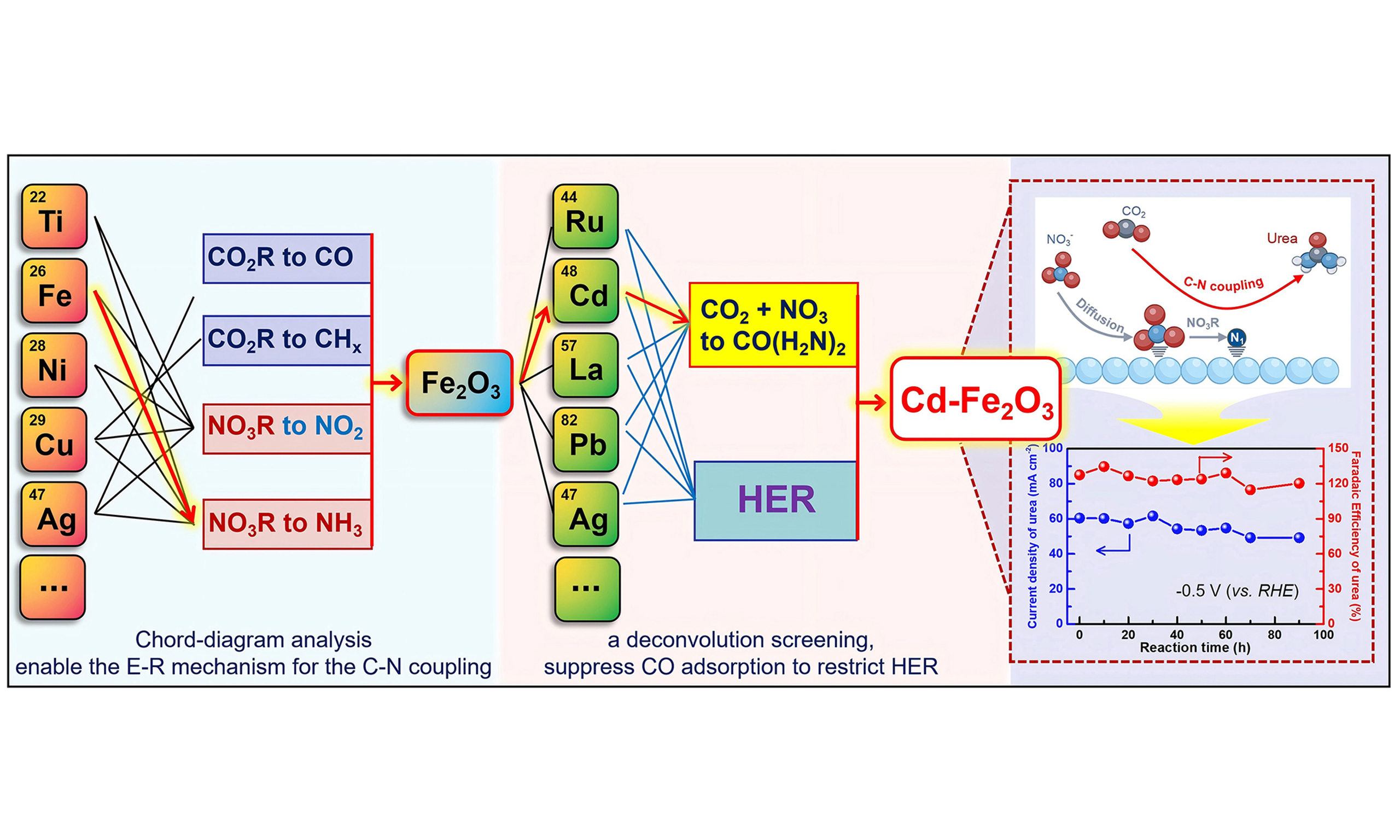
Urea is one of the most important feedstocks in the field of agriculture, chemical industry, etc., with a global market above 115 billion by 2031[1]. It is industrially produced by a chemical reaction between liquid NH3 and liquid CO2 in a vertical reactor under harsh conditions (e.g., > 10 MPa, > 350 oC[2]), causing > 2% of global annual energy consumption and over 200 million tons of CO2 releases every year. Developing alternative strategies for the industrial synthesis of urea with low energy consumption and negligible CO2 emission is a pressing demand.
Electrocatalysis for the synthesis of urea with NOx- ions as nitrogen sources is a highly desired strategy[3], owing to its an easily accessible nitrogen source (e.g., waste water[4]), a facile electroreducibility of NOx-, a green and sustainable catalytic process at ambient condition, etc. It performs a co-reduction of CO2 and NOx- species on the cathode catalyst for the formation of C-N coupling, which is the critical step in urea electrosynthesis [(H2N)2-CO][5]. However, plenty of inevitable side-reactions occur on the surface of the catalyst with a variation of the cathodic potential, e.g., the hydrogen evolution reaction (HER), the CO2 electrocatalytic reduction (CO2R), the over electroreduction of NOx-. Such competitive side-reactions strongly limit the activity and selectivity of the catalyst toward urea (i.e., FEurea < 30%[6]), revealing the significance of designing suitable catalysts for urea electrosynthesis. Although extensive research has been focused on developing efficient catalysts[7] and some of them could achieve ~50% FEurea[8], but the partial current densities for urea electrosynthesis were merely below a few tens of mA·cm-2, indicating a very low urea productivity. Seriously, elevating the current density by an increase of overpotential was found to cause intensive side-reactions, rather than promoting the urea productivity[9]. Currently, figuring out the threshold (i.e., the urea partial current density, the FEurea and the long-term stability) of urea electrosynthesis for the industrialization, with developing an efficient electrocatalyst to reach such a level, has not yet been achieved, hindering the industrial accessibility of urea electrosynthesis.
Hu et al. recently solved some of these puzzles[10]. Briefly, they clarified that the threshold of urea electrosynthesis for reaching the industrial large-scale urea productivity is ~95 mA·cm-2 at a 50% FEurea by a techno-economic calculation. Importantly, they proposed a rational principle for designing efficient catalyst to achieve the industrial threshold, i.e., a suitable catalyst should have both a high nitrate reduction activity and a negligible CO2 reduction, promoting the urea electrosynthesis via the Eley-Rideal mechanism. Following this principle, a potential cadmium-modified iron oxide (Cd-Fe2O3) catalyst was discovered. The Cd-Fe2O3 catalyst shows an excellent urea electrosynthesis performance, with the urea partial current density of 140 mA·cm-2 at an appreciable FEurea of 52% for a long-term stability above 100 h at -0.5 V [vs. reversible hydrogen electrode (RHE)]. It allows the urea electrosynthesis to reach the industrially viable production rate. Moreover, according to the techno-economic calculation, the cost of electrosynthetic urea is ~550 dollars per ton, which is much lower than that of urea market price (i.e., 616.24 dollars per ton[11]), indicating a profitable urea from the electrosynthesis.
A key innovation of this work is to propose an alternative way for exploring desired catalysts, rather than the classic prediction by a theoretical calculation[12]. In detail, they proposed a four-step design strategy under the guidance of functional requirement [Figure 1]: (1) a techno-economic analysis figures out the industrially promising threshold of urea electrosynthesis and confirms the targeted performance (i.e., 96 mA·cm-2 at a 50% FEurea) of desired catalysts [Figure 1A and B]; (2) a reaction procedure analysis proposes a suitable reaction mechanism (i.e., the C-N coupling via the Eley-Rideal mechanism) and determines the critical characteristic of ideal catalysts for the followed catalyst design (i.e., a high nitrate reduction activity and a negligible CO2R in Figure 1C); (3) a chord-diagram analysis of representative candidates (i.e., Ti, Fe, Cu, etc.) for screening out the potential catalyst (i.e., Fe2O3) [Figure 1D]; (4) an experimental verification with a precise optimization, which finally confirms Cd-modified Fe2O3 as the desired catalyst [Figure 1E and F]. Compared to the theoretical prediction that is performed based on an ideal situation (i.e., ideal crystal surface, ideal coordination number of active sites, etc.)[12], this function oriented strategy strongly relies on the existing database from relevant studies, indicating its high reliability for developing catalysts, but with a potential risk of database shortage and additional catalyst optimization on both the catalytic selectivity and stability.
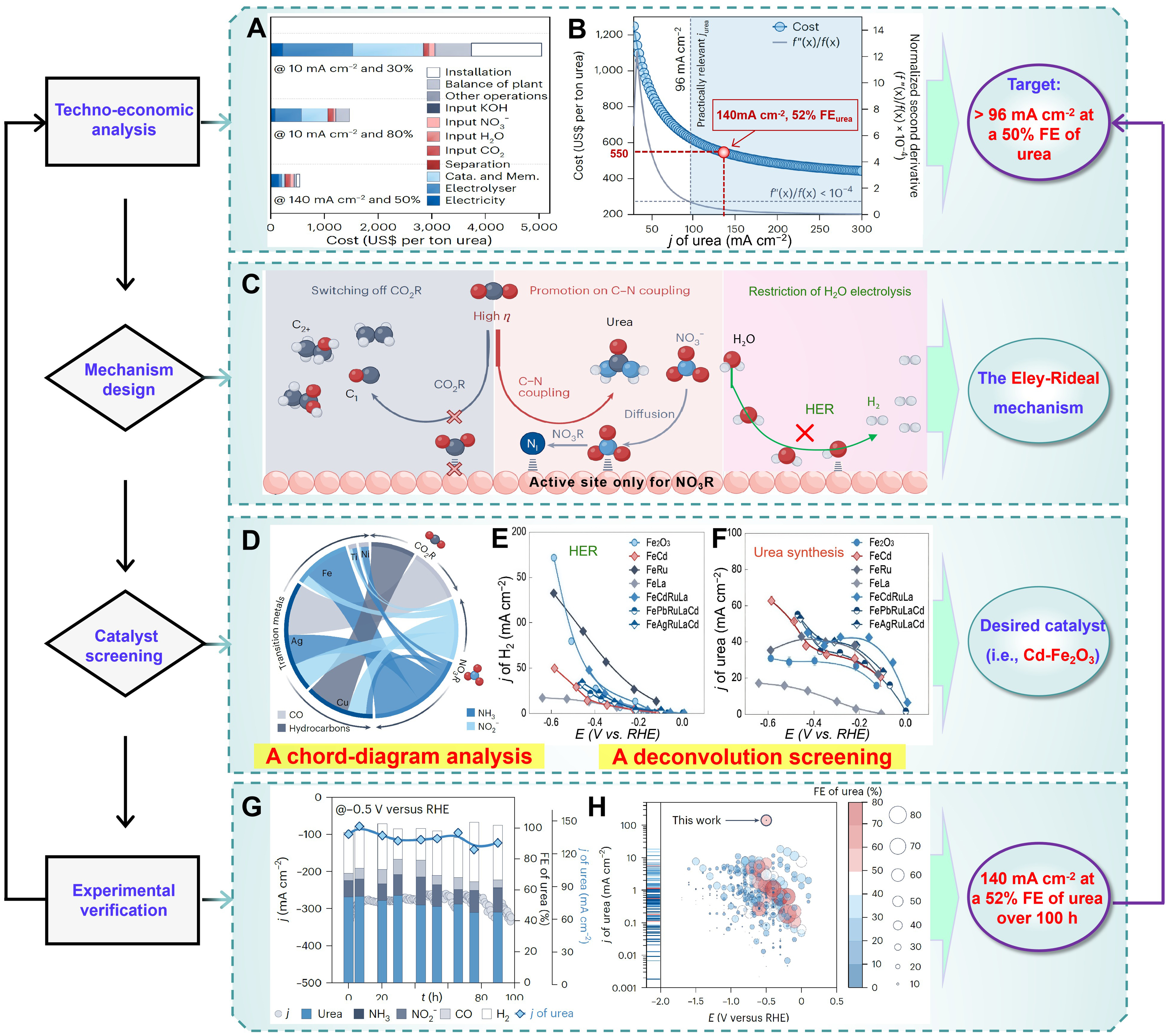
Figure 1. (A) The levelized cost of urea by various electrosynthesis methods; (B) Correlation of urea cost on urea partial current density at 50% urea FE; (C) Reaction pathway of CO2R, HER and C-N coupling; (D) Chord diagram describing the selectivity of typical transition metals towards CO2R and NO3R; Partial current densities of (E) H2 and (F) urea on Fe-based catalyst; (G) Stability test of urea electrosynthesis on Cd-Fe2O3; (H) Summary of the reported urea electrosynthesis performance. (A-H) Adapted with permission from Ref.[10]. Copyright 2026 Spring Nature. FE: Faradaic efficiency; CO2R: CO2 electrocatalytic reduction; HER: hydrogen evolution reaction; RHE: reversible hydrogen electrode.
In addition, an efficient Cd-modified Fe2O3 catalyst was developed to allow urea electrosynthesis reach the industrial productivity level. Specifically, a preliminary investigation on the Fe2O3 candidate shows a superior urea electrocatalytic selectivity (i.e., 71.5% FEurea) and an excellent CO2R limitation (i.e., < 1% FECO2R) at 0 V (vs. RHE), verifying the effectiveness of the design principle. However, with an increase of cathodic potential to -0.5 V (vs. RHE), even though the FECO2R remains below 1%, the dramatic decline of FEurea to ~20% with an intensive HER (i.e., ~70%) indicates the inferior urea selectivity of Fe2O3 at high cathodic potential, as the *CO-species from CO2 strongly covers the Fe2O3 surface and restricts the NOx- activation. The shortage of Fe2O3 was then optimized by introducing cadmium additives, which is selected by a rapid deconvolution screening method. The obtained Cd-Fe2O3 catalyst shows a urea partial current density of 140 mA·cm-2 and an appreciable FEurea of 52% at -0.5 V (vs. RHE), much higher than that of unmodified Fe2O3 (i.e., ~20% FEurea) and superior to the industrial threshold (i.e., ~95 mA·cm-2 at a 50% FEurea). A long-term stability on Cd-Fe2O3 for over 100 h was performed [Figure 1G and H]. The relatively high catalytic stability of Cd-Fe2O3 in laboratory indicates its promise for the industrial exploration. An in-situ monitor by the attenuated total reflectance Fourier-transform infrared spectroscopy (ATR-FTIR) measurement identifies that the protonation of *CO2NH2 is the rate-determining step, which is enhanced by the Cd incorporation that alters the electronic structure of Fe2O3 for a weak CO adsorption and a suppressed HER.
As a conclusion and perspective, Hu et al. developed an efficient Cd-Fe2O3 catalyst by following an innovative catalyst-design strategy[10]. The catalyst enables urea electrosynthesis to reach an industrially accessible level. Besides that, several questions remain open: (1) A slight deactivation of catalyst can be clearly observed in Figure 1G (i.e., the urea partial current density decreases from 140 to ~120 mA·cm-2 during 100 h of reaction). The long-term stability issue has to be solved before reaching an industrialization; (2) Cd is a poisonous metal. Exploration on the Cd-alternative catalytic additives is desired, but with a great challenge as Cd is already the optimized choice; (3) The unclear state of Cd additives on Fe2O3, the practical active site for the *CO2NH2 protonation, the missing threshold of stability, etc.; (4) Only the electric energy at the cathode is utilized (i.e., the urea electrosynthesis), resulting in a waste of energy at the anode. Further oxidation reaction could be explored on the anode; (5) Optimizing the mass transfer efficiency within reactor components (e.g., membrane electrodes) may promote the catalytic system to meet industrial application standards. All these questions are required to be addressed in future studies in order to realize the industrial synthesis of urea by the electrocatalytic way.
DECLARATIONS
Authors’ contributions
Made substantial contributions to conception and design of the study and performed data analysis and interpretation: Li, W. X.; Wang, Z.; Su, B. L.
Performed data acquisition and provided administrative, technical, and material support: Wang, Z.; Li, Y. C.; Li, Z. D.
Availability of data and materials
Not applicable.
AI and AI-assisted tools statement
Not applicable.
Financial support and sponsorship
This work was supported by the National Natural Science Foundation of China (Nos. 22293020, 22293022). Wang, Z. acknowledges the Hubei Provincial Department of Education for the “Chutian Scholar” program and the “Wuhan Yingcai” program.
Conflicts of interest
Su, B. L. is Editor-in-Chief of the journal Chemical Synthesis. Su, B. L. was not involved in any steps of the editorial process, notably including reviewers’ selection, manuscript handling, or decision-making. The other authors declare that there are no conflicts of interest.
Ethical approval and consent to participate
Not applicable.
Consent for publication
Not applicable.
Copyright
© The Author(s) 2026.
REFERENCES
1. Mordor Intelligence. Urea market size & Share analysis - Growth trends and forecast (2026-2031). https://www.mordorintelligence.com/industry-reports/global-urea-market. (accessed 2026-05-29).
2. Wang, Z.; Guan, Z. L.; Su, B. L. Proton shuttle: a key for efficient ammonia electrosynthesis. Chem. Synth. 2025, 5, 20.
3. Pei, C.; Chen, S.; Fu, D.; Zhao, Z. J.; Gong, J. Structured catalysts and catalytic processes: transport and reaction perspectives. Chem. Rev. 2024, 124, 2955-3012.
4. Muhyuddin, M.; Zuccante, G.; Mustarelli, P.; et al. Electrochemical urea production using carbon dioxide and nitrate: state of the art and perspectives. Energy. Environ. Sci. 2024, 17, 3739-52.
5. Chen, X.; Hao, S.; Wang, J.; et al. Ce(IV)-MOF supported bimetallic NiPt nanoparticles for efficient hydrogen generation from ammonia borane hydrolysis. Chem. Synth. 2025, 5, 51.
6. Xiong, H.; Yu, P.; Chen, K.; et al. Urea synthesis via electrocatalytic oxidative coupling of CO with NH3 on Pt. Nat. Catal. 2024, 7, 785-95.
7. Mohajer, M. A.; Basuri, P.; Evdokimov, A.; et al. Spontaneous formation of urea from carbon dioxide and ammonia in aqueous droplets. Science 2025, 388, 1426-30.
8. Verpoort, P. C.; Gast, L.; Hofmann, A.; Ueckerdt, F. Impact of global heterogeneity of renewable energy supply on heavy industrial production and green value chains. Nat. Energy. 2024, 9, 491-503.
9. Khan, D.; Ong, W. J. Tailoring hydrogen storage materials kinetics and thermodynamics through nanostructuring, and nanoconfinement with in-situ catalysis. Interdiscip. Mater. 2025, 4, 249-83.
10. Hu, B.; Liu, Y.; Zhou, Y. F.; et al. Electrosynthesis of urea on cadmium-modified iron oxide. Nat. Synth. 2026.
11. Urea. Price-Chart-Historical Data-News. https://tradingeconomics.com/commodity/urea. (accessed 2026-05-29).
Cite This Article
 Open Access
How to Cite
Download Citation
Export Citation File:
Type of Import
Tips on Downloading Citation
Citation Manager File Format
Type of Import
Direct Import: When the Direct Import option is selected (the default state), a dialogue box will give you the option to Save or Open the downloaded citation data. Choosing Open will either launch your citation manager or give you a choice of applications with which to use the metadata. The Save option saves the file locally for later use.
Indirect Import: When the Indirect Import option is selected, the metadata is displayed and may be copied and pasted as needed.
About This Article
Copyright

Data & Comments
Data
0








Comments
Comments must be written in English. Spam, offensive content, impersonation, and private information will not be permitted. If any comment is reported and identified as inappropriate content by OAE staff, the comment will be removed without notice. If you have any queries or need any help, please contact us at support@oaepublish.com.