


fig4
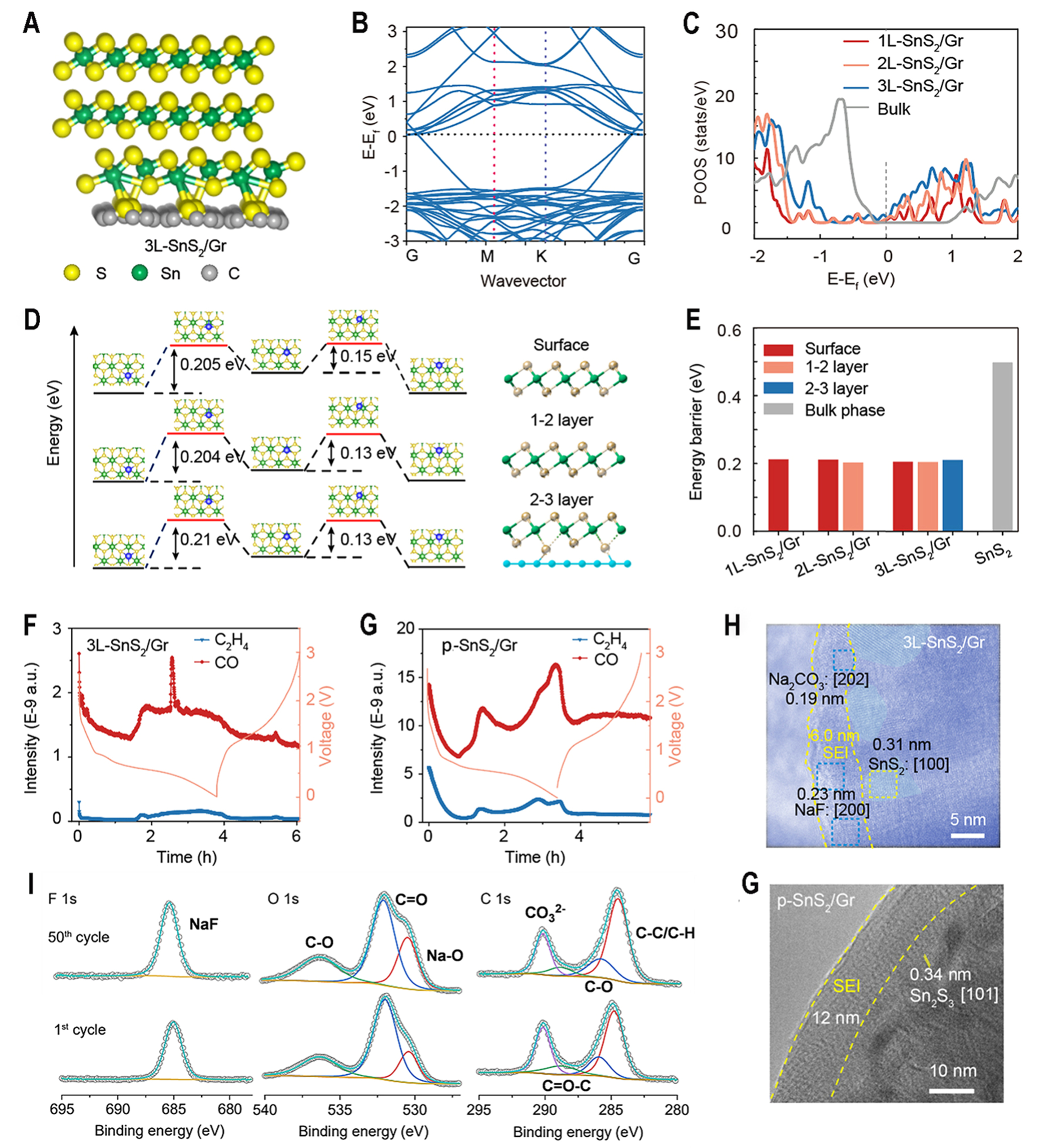
Figure 4. SEI characterization and relative theoretical calculation. (A) Structural model and (B) band structure for 3L-SnS2/Gr; (C) Density of states of as-obtained 1L-SnS2/Gr, 2L-SnS2/Gr, 3L-SnS2/Gr and bulk SnS2. The Fermi level is set at zero; (D) Transition paths of sodium atom diffusion for 3L-SnS2/Gr through surface, 1-2 layer and 2-3 layer path, as shown in right model; (E) Energy barrier of 1L-SnS2/Gr, 2L-SnS2/Gr,3L-SnS2/Gr and bulk SnS2 through different Na+ diffusion paths; (F and G) In situ DEMS of 3L-SnS2/Gr and p-SnS2/Gr; (H) Cyro-TEM image of 3L-SnS2/Gr after one cycle; (I) F 1 s, O 1 s and C 1 s XPS spectra of SEI on the 3L-SnS2/Gr after one cycle and 50 cycles; (J) Cyro-TEM image of p-SnS2/Gr after one cycle. SEI: Solid-electrolyte interphase; DEMS: differential electrochemical mass spectrometry; TEM: transmission electron microscopy; XPS: X-ray photoelectron spectroscopy.