



Is soil carbon sequestration overestimated in carbon footprint accounting?
 0
0 
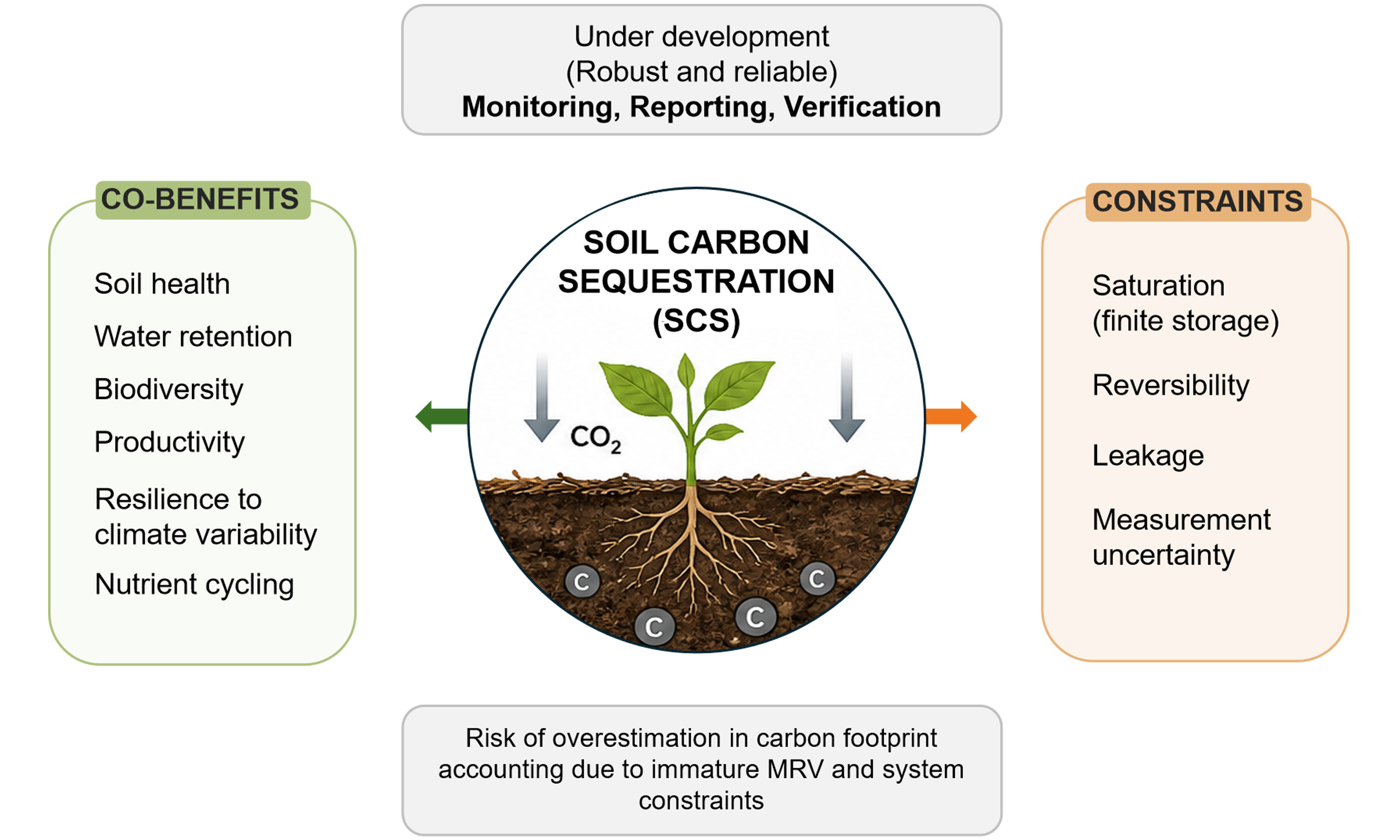
INTRODUCTION
Agriculture and land-use change (LUC) account for about 25% of anthropogenic greenhouse gas (GHG) emissions[1]. Between 1855 and 2022, these emissions contributed an estimated 0.55 °C of global warming[2], driven primarily by methane (CH4), nitrous oxide (N2O), and carbon dioxide (CO2) generated through livestock production, manure management, paddy rice production, fertiliser application, soil disturbance, land-use change, and on-farm energy use[3,4]. Reducing this sector’s impact on climate change is therefore central to achieving net-zero targets. In addition to mitigation options that reduce non-CO2 GHG emissions, agricultural soils have the potential to contribute significantly to atmospheric carbon dioxide removal through soil carbon sequestration (SCS).
Soils store nearly twice as much carbon as the atmosphere (~1,500 Pg C to 1 m depth) and are the largest terrestrial carbon pool[5] with the potential to increase depleted carbon stocks. Therefore, they have been widely framed as a scalable sink for atmospheric CO2[4]. Increasing soil organic carbon (SOC) is not only a mitigation strategy, but can also improve soil health and support food security[6,7].
However, the potential for soil carbon sequestration remains limited by different challenges. Soil carbon sequestration can vary across soil types, climates, and management practices, and can be constrained by saturation effects over time[7]. A further challenge for carbon footprint accounting is quantifying SOC change. The effects of climate, land use, management practices, and soil properties on SOC dynamics remain incompletely understood, while the development of robust monitoring, reporting and verification (MRV) frameworks remains complex and subject to uncertainty[8].
In this article, “overestimation” refers to situations where the climate mitigation benefits attributed to SCS exceed those that can be reliably measured and sustained in practice because important biophysical constraints and accounting uncertainties are not fully incorporated[9]. Such overestimation may contribute to inflated mitigation claims and carbon credits that do not fully reflect long-term carbon storage, potentially undermining the credibility of carbon markets and carbon farming schemes, particularly where additionality, permanence, leakage, and MRV requirements are insufficiently addressed[10,11].
Recent literature has highlighted limitations, uncertainties, and methodological challenges associated with accounting for SCS, including saturation, permanence, additionality, leakage, and measurement uncertainty. These challenges have led several authors to argue that accounting and crediting approaches may overstate the magnitude or durability of climate mitigation benefits when these constraints are not fully incorporated into accounting frameworks[7,12-14].
Here we examine the key biophysical constraints and accounting challenges that may lead to overestimation of SCS in carbon footprint accounting and discuss their implications for the credibility of mitigation claims associated with soil carbon sequestration.
WHAT IS SOIL CARBON SEQUESTRATION, AND HOW CAN IT HELP MITIGATE CLIMATE CHANGE?
SOC refers to the carbon stored in the organic material in soil, and it is a fraction of soil organic matter (SOM), which includes all the organic material present in the soil[15]. SCS is the process by which carbon dioxide (CO2) from the atmosphere is absorbed and stored in the soil in both organic and inorganic forms[16]. By transferring atmospheric CO2 into relatively stable soil carbon pools, SCS can reduce atmospheric GHG concentrations and contribute to climate change mitigation[17]. This occurs when inputs of organic carbon are greater than losses. SCS is fundamentally driven by the photosynthetic process of converting atmospheric CO2 into plant biomass and subsequently entering the soil system as organic inputs such as leaf litter, root biomass, and rhizodeposition[16]. A portion of this carbon is stabilised in the soil in forms that are not immediately re-emitted to the atmosphere, contributing to long-term carbon storage[18,19].
Soils, therefore, function as a dynamic component of the global carbon cycle and are continuously exchanging carbon with the atmosphere through biologically mediated processes[16]. Carbon inputs to soil are primarily plant-derived and supported by microbial processes, which transform organic residues into more stable forms of SOM[20]. Stabilisation mechanisms include physical protection within soil aggregates and chemical association with mineral surfaces, both of which can allow carbon to persist in soils for decades to millennia. However, a significant fraction of carbon is also rapidly returned to the atmosphere through microbial respiration and decomposition processes, such as the breakdown of litter by fungi and bacteria, as well as through erosion and leaching[18]. The dynamic balance between carbon inputs through photosynthesis and deposition and losses via respiration, erosion, and leaching determines whether soils act as a net carbon sink or source[21]. This balance is strongly influenced by environmental factors, including climate, soil texture, drainage, and vegetation type, as well as land management practices[21].
Native ecosystems such as forests and grasslands typically store greater amounts of SOC due to a larger proportion of carbon allocated belowground, combined with minimal soil disturbance. In contrast, the conversion of these systems to cropland disrupts soil structure and accelerates decomposition, often resulting in carbon losses on the order of 0.5 Mg C ha-1 yr-1 to > 2 Mg C ha-1 yr-1[22,23]. Preventing such land-use change is therefore a critical climate mitigation strategy. Conversely, the restoration of degraded lands to perennial vegetation, such as forests or grasslands, can rebuild SOC stocks, although recovery generally occurs more slowly than the initial losses[4].
Beyond land-use change, management practices can directly contribute to regulating soil carbon dynamics[24]. Practices that increase plant biomass such as the use of cover crops, crop residue retention, application of manure or compost, reduced/not-till, and the integration of agroforestry systems, can increase SOC accumulation by supplying organic material to the soil and supporting microbial activity[19]. At the same time, intensive soil disturbance, particularly through conventional tillage, disrupts soil aggregates, exposes protected organic matter, and accelerates microbial decomposition, leading to increased CO2 emissions[25].
At a global scale, improved cropland management represents a significant mitigation opportunity, with estimated sequestration potentials ranging from approximately 1.5 to 5.3 Pg CO2-equivalent per year, including both SCS and changes in non- CO2 greenhouse gas emissions (GHGE)[4]. In addition to sequestration potential, increases in SOC are associated with a range of co-benefits that enhance soil function. SOC plays a central role in maintaining soil structure, regulating water dynamics, supporting nutrient cycling, and sustaining biological activity, thereby contributing to yield stability, drought resilience, and long-term soil fertility, thus enhancing soil health[26-28]. These functions are fundamental to ecosystem functioning and persist regardless of whether increases in SOC are permanent[29]. Consequently, management practices that enhance SOC, such as those that increase organic inputs or reduce losses, can improve water retention, reduce erosion, enhance nutrient-use efficiency, and support soil biodiversity, and are consistently associated with increased crop productivity and greater resilience under climatic stress[16,28].
Additional co-benefits include suppression of some soilborne diseases (though pathogen dynamics remain uncertain), regulating hydrological processes, particularly in peatlands, where SCS improves water retention and moderates peak flows following heavy rainfall and reducing risks of erosion, degradation, and landslides. Water quality regulation is further improved through increased filtering capacity, which buffers pollutants and protects aquatic systems[30].
BIOPHYSICAL CONSTRAINTS ON SOIL CARBON SEQUESTRATION - CHALLENGES FOR CARBON FOOTPRINT ACCOUNTING
Soil carbon sequestration is subject to biophysical constraints that limit its effectiveness as a climate mitigation strategy. Soil carbon dynamics are highly variable and context-dependent, with responses to management that are often uncertain in both magnitude and direction[31]. In mitigation contexts, these constraints interact with additionality, as mitigation requires that carbon gains are additional and achievable in practice, as such, only SOC gains beyond a credible baseline represent a genuine climate benefit. The following subsections examine key constraints, including saturation, permanence, and leakage.
Saturation
Soils do not accumulate carbon indefinitely, but approach a saturation state determined by mineralogy, aggregation, and microbial processing[32]. As soils near carbon saturation, their capacity to stabilise additional SOC decreases. This occurs because a smaller fraction of incoming carbon is retained through physicochemical mechanisms, and thus a smaller fraction of new carbon inputs can be retained[19,21]. This results in diminishing stabilisation efficiency with increasing carbon inputs, ultimately leading to a new steady-state SOC level as inputs and losses come into balance[21]. Consequently, sequestration rates decrease over time, with most gains occurring in the initial decades following changes in management, and additional inputs yielding only limited increases as saturation is approached[33,34].
The capacity of soils to stabilise additional carbon also differs among soil types. Fine-textured soils with higher clay and silt contents generally have a greater capacity to protect and stabilise organic matter through mineral associations and aggregate formation than coarse-textured sandy soils. As a result, sequestration potential and the saturation threshold are not uniform across soils, but depend in part on inherent soil properties and mineralogy[19,21].
Accounting for saturation substantially reduces estimates of long-term mitigation potential, lowering projected SOC sequestration by 53%-81% compared with estimates that assume linear or indefinite accumulation[7]. Global syntheses indicate that sequestration can be sustained only over limited timescales, typically on the order of decades (approximately 20-50 years), after which additional accumulation becomes minimal[36]. Sequestration efficiency is highest in soils that are further from their carbon saturation capacity[21]. This implies that sequestration potential is baseline-dependent, with degraded or carbon-depleted soils generally offering greater potential than soils already near saturation. In managed agroecosystems, disturbance processes such as tillage can reduce the attainable SOC equilibrium by accelerating decomposition, although SOC dynamics within specific management systems still tend to follow asymptotic patterns[37].
Permanence
SOC is inherently dynamic and reversible. It reflects a balance between organic inputs and microbial decomposition rather than permanent storage[10]. Carbon stored in soils can be rapidly released through management reversal, land-use change, or climatic disturbance[13]. Warming and drought accelerate microbial respiration and decomposition, increasing the risk of carbon loss even where management remains unchanged[38,39]. This reversibility represents a major challenge for Land Use, Land Use Change and Forestry (LULUCF) mitigation efforts. Carbon stocks in terrestrial ecosystems remain vulnerable to both natural disturbances (e.g. fire, pests) and anthropogenic interventions, potentially leading to partial or complete loss of previously sequestered carbon[31].
Leakage
Leakage in the context of SCS and carbon footprint accounting can be defined as the net change in GHGEs occurring outside the spatial or system boundary as a direct or indirect consequence of sequestration activities within that boundary[31]. Leakage can be further distinguished into direct leakage, where emissions arise immediately and can be directly attributed to the sequestration activity (e.g., displacement of land use), and indirect leakage, where emissions occur due to broader market responses such as changes in supply, demand, or land-use dynamics across regions or countries[40]. This perspective captures the core idea that local carbon gains can be undermined by emissions generated beyond the project boundary. For instance, converting land to forest that would otherwise have remained in agricultural use can push farming activities beyond the project boundary. This displacement may lead farmers to clear or degrade land elsewhere, generating additional carbon emissions that offset the benefits of the original intervention and are therefore considered leakage[31].
In addition to these off-site effects, SCS practices can also generate on-site GHG trade-offs that complicate their climate benefit[13]. Practices that increase SOC can influence emissions of other GHGs, particularly N2O and CH4[41]. In some cases, increases in N2O emissions associated with nitrogen inputs or residue management can partially or fully offset carbon gains, as even small increases in N2O may outweigh the climatic benefit of SOC accumulation[42]. Consequently, SOC gains should be evaluated alongside other farm GHG emissions, as increases in soil carbon may be partially or fully offset by CH4 and N2O emissions[13,41,42]. Leakage effects, including lateral carbon fluxes such as dissolved organic carbon losses and harvested biomass removal, further complicate net climate outcomes[43].
SOIL CARBON SEQUESTRATION IN CARBON FOOTPRINT ACCOUNTING AND MRV
Soil organic carbon sequestration is incorporated into climate mitigation accounting as a form of net CO2 removal (i.e. carbon stock increase) across multiple scales and frameworks, including national GHG accounting, product-level assessments, and farm-level carbon markets. At the national level, SOC stock changes are accounted for within national GHG inventories reported to the United Nations Framework Convention on Climate Change (UNFCCC), under the Agriculture, Forestry and other Land Use (AFOLU) sector using methodologies developed by the Intergovernmental Panel on Climate Change (IPCC)[44,45]. In this context, SCS contributes to national GHG balances and mitigation reporting but does not generate tradable carbon credits, as national inventories function primarily as accounting frameworks rather than market mechanisms. The Kyoto Protocol, on the other hand, introduced the potential for crediting GHG emissions reductions resulting from activities in the LULUCF sector, including those related to soil carbon under specific rules and eligible activities rather than establishing broad soil carbon markets, with limited and methodologically constrained inclusion of soil carbon[31,46].
At the product level, life cycle assessment (LCA) incorporates SCS as a carbon removal that can offset GHGEs associated with agricultural production[47]. However, estimates are highly sensitive to methodological choices. Studies apply either stock-change approaches derived from inventory data or net carbon flux balances across soil-plant systems and adopt varying temporal allocation periods (typically 20-100 years). As a result, the same agricultural product can receive substantially different carbon footprint estimates depending on how SOC changes are quantified and allocated[47].
At the farm-level, changes in SOC associated with SCS may be incorporated into farm carbon footprints and inventories, used to generate carbon credits, or serve as a basis for results-based payments under carbon farming schemes[14]. Because financial incentives and mitigation claims are often linked directly to estimated SOC gains, these applications depend on robust MRV systems to demonstrate additionality, quantify changes relative to a defined baseline, and verify outcomes[31].
MRV systems require the systematic quantification of SOC stocks and their changes over time through a combination of field measurements, data standardisation and independent validation[8]. Direct measurement of SOC stock changes relies on soil sampling and laboratory analysis to determine organic carbon concentrations and bulk density, which together are used to estimate SOC stocks and their change over time[48]. Accurate stock estimation also requires correction for changes in bulk density over time (e.g., equivalent soil mass approaches) and explicit quantification of measurement uncertainty, typically reported as confidence intervals[49]. Due to high spatial variability, reliable estimation depends on appropriate study designs and sampling protocols[8], a sufficiently large number of soil samples and adequate sampling depth, IPCC guidelines typically recommend measurements to at least 30 cm[50]. Although deeper sampling may be required where management affects subsoil carbon or full-profile accounting is intended[51].
Accurately quantifying SOC remains a major challenge due to the inherent complexity and spatial variability of soils. Developing robust and credible MRV systems is essential to support both national GHG accounting and carbon market mechanisms[8]. Direct measurement approaches are costly and difficult to scale due to the high costs of sampling, laboratory analysis, and repeated measurements. As a result, many approaches combine plot-level measurements with modelling to estimate SOC changes across larger spatial scales. This integration of empirical data and modelling is widely used in national GHG inventories[8], and forms the basis of hybrid MRV systems that balance accuracy and scalability. However, these approaches also introduce additional sources of uncertainty. Process-based models are sensitive to assumptions regarding climate, management practices, and soil processes, while errors associated with model structure, parameterisation, and calibration can propagate into estimates of SOC change[8,52]. Similarly, spatial approaches such as remote sensing generally rely on indirect indicators and require calibration with field observations, creating further challenges for accurately quantifying SOC stocks and changes over time[53].
Credible MRV is central to the functioning of soil carbon markets, because without accurate, standardised, and scientifically robust measurement frameworks, carbon credits cannot be robust and priced reliably[54,55]. Although a robust MRV cannot remove the underlying biological limits of SCS, such as saturation, reversibility, and permanence risk or leakage, it can reduce uncertainty and provide the evidence needed to demonstrate additionality and permanence in carbon farming schemes[56]. In this way, MRV does not change the biophysical ceiling of SCS, but it is essential for making the climate benefits more certain, verifiable, and credible enough for markets to function.
CONCLUSION
Soil carbon plays a key role in maintaining soil health, strengthening ecosystem resilience, supporting agricultural productivity, and has the potential to contribute to climate mitigation in the shorter term (around 20 years). Improvements in soil structure, water retention, and nutrient cycling provide clear co-benefits that support long-term agricultural and ecosystem resilience. These benefits are well established and provide a strong basis for including SCS within broader climate strategies, particularly as a strategy contributing to food security and to climate change adaptation by building agricultural systems that are more resilient to weather variability. However, it is accompanied by challenges; the extent to which SCS can contribute to net-zero targets remains highly context-dependent. SOC dynamics vary considerably across soil types, climates, and management practices, leading to heterogeneous outcomes that are not easily generalised. In addition, saturation effects may limit long-term potential, and any gains can be reversed by changes in land management or environmental conditions.
Quantifying changes in SOC for national inventories or carbon markets presents a further challenge. SOC changes are often small relative to natural variability and difficult to detect over relevant timescales. As a result, reliable and affordable MRV systems are still developing and, in many cases, lack the precision required to robustly compare outcomes across sites, practices, and timeframes, increasing the risk that sequestration benefits become overstated in carbon accounting frameworks.
Taken together, these constraints indicate that SCS could be overestimated in carbon footprint accounting when constraints and measurement uncertainty are not fully incorporated. These limitations create a gap between the theoretical potential of soil carbon sequestration and what can be reliably measured and sustained in practice. Advances in sampling design, monitoring technologies, and model integration offer pathways to reduce uncertainty and improve consistency. For national inventories, this may include greater use of country-specific data and higher-tier methodologies where feasible, alongside transparent reporting of uncertainty. For product-level carbon footprints and carbon farming schemes, conservative accounting approaches and periodic reassessment of SOC changes may help ensure that credited climate benefits more closely reflect those achieved in practice. Strengthening MRV systems, alongside improved understanding of system-specific constraints, will be critical to ensuring that soil carbon sequestration is represented realistically and used effectively within climate mitigation strategies.
DECLARATIONS
Authors’ contributions
Developed the initial outline together: Giuliani, L. M.; Vetter, S. H.; Smith, P.
Drafted the manuscript and contributed to the interpretation and presentation of the concepts discussed: Giuliani, L. M.
Contributed to manuscript revision, to the interpretation and presentation of the concepts discussed, revised the manuscript for important intellectual content, and contributed to refinement of the arguments: Vetter, S. H.; Smith, P.
All authors contributed equally to the development of the final manuscript, reviewed and approved the final version.
Availability of data and materials
Not applicable.
AI and AI-assisted tools statement
During the preparation of this manuscript, the AI tool Microsoft Copilot 365 (version 2603, released 2026-04-14) was used solely for language editing and grammar checking. The tool did not influence the study design, data collection, analysis, interpretation, or the scientific content of the work. All authors take full responsibility for the accuracy, integrity, and final content of the manuscript; ResearchRabbit (version Free Tier; web application, released 2026-04-17) was used to assist in identifying potentially relevant published literature. The tool was used solely to support literature discovery and did not influence the study design, analysis, interpretation, or scientific conclusions presented in this manuscript. All literature identified through this tool was independently assessed by the authors, who take full responsibility for the selection of references and the final content of the manuscript; ChatGPT (version OpenAI; GPT-4o image generation, released 2025-03-25) was used to generate one illustrative icon plant within the Graphical Abstract based on a text prompt provided by the authors. The icon was subsequently edited for layout consistency. All other graphical elements were created by the authors.
Financial support and sponsorship
None.
Conflicts of interest
All authors declared that there are no conflicts of interest.
Ethical approval and consent to participate
Not applicable
Consent for publication
Not applicable
Copyright
© The Author(s) 2026.
REFERENCES
1. Crippa, M.; Solazzo, E.; Guizzardi, D.; Monforti-Ferrario, F.; Tubiello, F. N.; Leip, A. Food systems are responsible for a third of global anthropogenic GHG emissions. Nat. Food. 2021, 2, 198-209.
2. Jones, M. W.; Peters, G. P.; Gasser, T.; et al. National contributions to climate change due to historical emissions of carbon dioxide, methane, and nitrous oxide since 1850. Sci. Data. 2023, 10, 155.
3. Hong, C.; Zhong, R.; Xu, M.; et al. Interactions among food systems, climate change, and air pollution: a review. Engineering 2025, 44, 215-33.
4. Paustian, K.; Lehmann, J.; Ogle, S.; Reay, D.; Robertson, G. P.; Smith, P. Climate-smart soils. Nature 2016, 532, 49-57.
5. Sanderman, J.; Hengl, T.; Fiske, G. J. Soil carbon debt of 12,000 years of human land use. Proc. Natl. Acad. Sci. U. S. A. 2017, 114, 9575-80.
6. Rumpel, C.; Amiraslani, F.; Chenu, C.; et al. The 4p1000 initiative: opportunities, limitations and challenges for implementing soil organic carbon sequestration as a sustainable development strategy. Ambio 2020, 49, 350-60.
7. Moinet, G. Y. K.; Hijbeek, R.; van Vuuren, D. P.; Giller, K. E. Carbon for soils, not soils for carbon. Glob. Chang. Biol. 2023, 29, 2384-98.
8. Smith, P.; Soussana, J. F.; Angers, D.; et al. How to measure, report and verify soil carbon change to realize the potential of soil carbon sequestration for atmospheric greenhouse gas removal. Glob. Chang. Biol. 2020, 26, 219-41.
9. Powlson, D. S.; Whitmore, A. P.; Goulding, K. W. T. Soil carbon sequestration to mitigate climate change: a critical re‐examination to identify the true and the false. Eur. J. Soil. Sci. 2011, 62, 42-55.
10. Paul, C.; Bartkowski, B.; Dönmez, C.; et al. Carbon farming: are soil carbon certificates a suitable tool for climate change mitigation? J. Environ. Manage. 2023, 330, 117142.
11. Paustian, K.; Collier, S.; Baldock, J.; et al. Quantifying carbon for agricultural soil management: from the current status toward a global soil information system. Carbon. Manag. 2019, 10, 567-87.
12. Don, A.; Seidel, F.; Leifeld, J.; et al. Carbon sequestration in soils and climate change mitigation-definitions and pitfalls. Glob. Chang. Biol. 2024, 30, e16983.
13. Dupla, X.; Bonvin, E.; Deluz, C.; et al. Are soil carbon credits empty promises? Shortcomings of current soil carbon quantification methodologies and improvement avenues. Soil. Use. Manag. 2024, 40, e13092.
14. Cotrufo, M. F.; Soong, J. L.; Horton, A. J.; et al. Formation of soil organic matter via biochemical and physical pathways of litter mass loss. Nature. Geosci. 2015, 8, 776-9.
16. Lal, R. Soil carbon sequestration impacts on global climate change and food security. Science 2004, 304, 1623-7.
17. Nair, R.; Mehta, C. R.; Sharma, S. Carbon sequestration in soils-a review. Agri. Rev. 2015, 36, 81.
18. Six, J.; Conant, R. T.; Paul, E. A.; Paustian, K. Stabilization mechanisms of soil organic matter: Implications for C-saturation of soils. Plant. Soil. 2002, 241, 155-76.
19. Ghimirey, V.; Chaurasia, J.; Acharya, N. Understanding soil carbon sequestration: mechanistic insights, management approaches, and future challenges. Discov. Soil. 2025, 2, 133.
20. Stewart, C. E.; Paustian, K.; Conant, R. T.; Plante, A. F.; Six, J. Soil carbon saturation: concept, evidence and evaluation. Biogeochemistry 2007, 86, 19-31.
21. Ogle, S. M.; Breidt, F. J.; Paustian, K. Agricultural management impacts on soil organic carbon storage under moist and dry climatic conditions of temperate and tropical regions. Biogeochemistry 2005, 72, 87-121.
22. Davidson, E. A.; Ackerman, I. L. Changes in soil carbon inventories following cultivation of previously untilled soils. Biogeochemistry 1993, 20, 161-93.
23. Minasny, B.; Malone, B. P.; Mcbratney, A. B.; et al. Soil carbon 4 per mille. Geoderma 2017, 292, 59-86.
24. Six, J.; Elliott, E.; Paustian, K. Soil macroaggregate turnover and microaggregate formation: a mechanism for C sequestration under no-tillage agriculture. Soil. Biol. Biochem. 2000, 32, 2099-103.
25. Farooqi, Z. U. R.; Hussain, M. M.; Qadeer, A.; Ayub, M. A. Role of carbon cycle in soil productivity and carbon fluxes under changing climate. In Frontiers in plant-soil interaction: molecular insights into plant adaptation; Elsevier, 2021; pp 29-48.
26. Kopittke, P. M.; Berhe, A. A.; Carrillo, Y.; et al. Ensuring planetary survival: the centrality of organic carbon in balancing the multifunctional nature of soils. Crit. Rev. Environ. Sci. Technol. 2022, 52, 4308-24.
27. Lal, R. Soil organic matter and feeding the future: environmental and agronomic impacts, 1th ed.; CRC Press, 2021.
28. Kögel-knabner, I.; Amelung, W. Dynamics, Chemistry, and Preservation of Organic Matter in Soils. In Treatise on Geochemistry, 2th ed.; Vol. 12; Elsevier, 2014; pp 157-215.
29. Smith, P.; Adams, J.; Beerling, D. J.; et al. Land-management options for greenhouse gas removal and their impacts on ecosystem services and the sustainable development goals. Annu. Rev. Environ. Resour. 2019, 44, 255-86.
30. García-oliva, F.; Masera, O. R. Assessment and measurement issues related to soil carbon sequestration in land-use, land-use change, and forestry (LULUCF) projects under the kyoto protocol. Clim. Change. 2004, 65, 347-64.
31. Georgiou, K.; Jackson, R. B.; Vindušková, O.; et al. Global stocks and capacity of mineral-associated soil organic carbon. Nat. Commun. 2022, 13, 3797.
32. Sommer, R.; Bossio, D. Dynamics and climate change mitigation potential of soil organic carbon sequestration. J. Environ. Manage. 2014, 144, 83-7.
33. Nazir, M. J.; Li, G.; Nazir, M. M.; et al. Harnessing soil carbon sequestration to address climate change challenges in agriculture. Soil. Tillage. Res. 2024, 237, 105959.
34. West, T. O.; Post, W. M. Soil organic carbon sequestration rates by tillage and crop rotation: a global data analysis. Soil. Sci. Soc. Am. J. 2002, 66, 1930-46.
35. Balesdent, J.; Chenu, C.; Balabane, M. Relationship of soil organic matter dynamics to physical protection and tillage. Soil. Tillage. Res. 2000, 53, 215-30.
36. Guo, X.; Yang, Z.; Jian, S.; et al. Drought amplifies warming-induced soil carbon loss in a decade-long experiment. Nat. Clim. Chang. 2026, 16, 485-93.
37. García-palacios, P.; Crowther, T. W.; Dacal, M.; et al. Evidence for large microbial-mediated losses of soil carbon under anthropogenic warming. Nat. Rev. Earth. Environ. 2021, 2, 507-17.
38. Thamo, T.; Pannell, D. J. Challenges in developing effective policy for soil carbon sequestration: perspectives on additionality, leakage, and permanence. Clim. Policy. 2016, 16, 973-92.
39. He, Q.; Liu, D. L.; Wang, B.; et al. Identifying effective agricultural management practices for climate change adaptation and mitigation: a win-win strategy in South-Eastern Australia. Agric. Syst. 2022, 203, 103527.
40. Powlson, D. S.; Stirling, C. M.; Jat, M. L.; et al. Limited potential of no-till agriculture for climate change mitigation. Nat. Clim. Chang. 2014, 4, 678-83.
41. Vuichard, N.; Ciais, P.; Viovy, N.; et al. Simulating the net ecosystem CO2 exchange and its components over winter wheat cultivation sites across a large climate gradient in Europe using the ORCHIDEE-STICS generic model. Agric. Ecosyst. Environ. 2016, 226, 1-17.
42. Schiettecatte, L.; Tzamtzis, I.; Chotte, J.; et al. Assessment of soil integration in nationally determined contributions and guidance for quantifying ex-ante soil organic carbon stock changes in national policies using IPCC default methodologies. CATENA 2025, 252, 108805.
43. IPCC. 2019 Refinement to the 2006 IPCC Guidelines for National Greenhouse Gas Inventories. 2019. https://www.ipcc.ch/report/2019-refinement-to-the-2006-ipcc-guidelines-for-national-greenhouse-gas-inventories/ (accessed 2026-07-09).
44. Caparrós, A.; Jacquemont, F. Conflicts between biodiversity and carbon sequestration programs: economic and legal implications. Ecol. Econ. 2003, 46, 143-57.
45. Batalla, I.; Knudsen, M. T.; Mogensen, L.; Hierro, ÓD.; Pinto, M.; Hermansen, J. E. Carbon footprint of milk from sheep farming systems in Northern Spain including soil carbon sequestration in grasslands. J. Clean. Prod. 2015, 104, 121-9.
46. Millard, P.; Lattanzi, F. A.; Simmons, A.; et al. FAO. Measuring and modelling soil carbon stocks and stock changes in livestock production systems: guidelines for assessment; Version 1 - Advanced copy. Preprint posted online 2019. https://literatur.thuenen.de/digbib_extern/dn060726.pdf (accessed 2026-07-09).
47. Wendt, J. W.; Hauser, S. An equivalent soil mass procedure for monitoring soil organic carbon in multiple soil layers. Eur. J. Soil. Sci. 2013, 64, 58-65.
48. Vanguelova, E. I.; Bonifacio, E.; De Vos, B.; et al. Sources of errors and uncertainties in the assessment of forest soil carbon stocks at different scales-review and recommendations. Environ. Monit. Assess. 2016, 188, 630.
49. FAO. Soil organic carbon (SOC) MRV sourcebook for agricultural landscapes. 2021. https://documents1.worldbank.org/curated/en/948041625049766862/pdf/Soil-Organic-Carbon-MRV-Sourcebook-for-Agricultural-Landscapes.pdf (accessed 2026-07-09).
50. Luo, Y.; Ahlström, A.; Allison, S. D.; et al. Toward more realistic projections of soil carbon dynamics by Earth system models. Global. Biogeochem. Cycles. 2016, 30, 40-56.
51. Angelopoulou, T.; Tziolas, N.; Balafoutis, A.; Zalidis, G.; Bochtis, D. Remote sensing techniques for soil organic carbon estimation: a review. Remote. Sens. 2019, 11, 676.
52. Phelan, L.; Chapman, P. J.; Ziv, G. The role of information in shaping the emerging agricultural soil carbon market. J. Rural. Stud. 2025, 120, 103861.
53. Vanderheyden, L.; Gayot, N.; Van den Broeck, G. What monitoring, reporting & verification (MRV) systems can reduce costs and enhance scalability of carbon farming? J. Environ. Manage. 2026, 401, 128885.
Cite This Article
 Open Access
How to Cite
Download Citation
Export Citation File:
Type of Import
Tips on Downloading Citation
Citation Manager File Format
Type of Import
Direct Import: When the Direct Import option is selected (the default state), a dialogue box will give you the option to Save or Open the downloaded citation data. Choosing Open will either launch your citation manager or give you a choice of applications with which to use the metadata. The Save option saves the file locally for later use.
Indirect Import: When the Indirect Import option is selected, the metadata is displayed and may be copied and pasted as needed.
About This Article
Copyright

Data & Comments
Data
0








Comments
Comments must be written in English. Spam, offensive content, impersonation, and private information will not be permitted. If any comment is reported and identified as inappropriate content by OAE staff, the comment will be removed without notice. If you have any queries or need any help, please contact us at support@oaepublish.com.