



Win-win of carbon and pollution co-mitigation in origin and destination regions: evidence from industrial enterprise relocation in China
 0
0 Abstract
The production of industrial enterprises is accompanied by pollution and carbon emissions, while the environmental consequences of their relocation remain unclear. Using the Annual Surveys of Industrial Firms from 2003 to 2015, we identify the enterprises that relocated and construct theoretical and two-way fixed effect models to analyze the effects of industrial enterprise relocation (IER). We find that IER significantly improved the performance of carbon mitigation and pollution reduction in both origin and destination cities. The positive outcomes stem from technological innovation and economic structure adjustment triggered by relocation. Moreover, the benefits are more pronounced in western regions and in areas with lower industrial development. Resource endowment weakens the environmental improvement in destination cities and enhances it in origin cities, validating the effectiveness of industrial gradient transfer in improving the environment. Stricter environmental regulations are one of the reasons driving IER. This research provides new insights into how industrial spatial reallocation can contribute to win-win outcomes in carbon mitigation and air pollution reduction, advancing the goal of low-carbon and sustainable regional development.
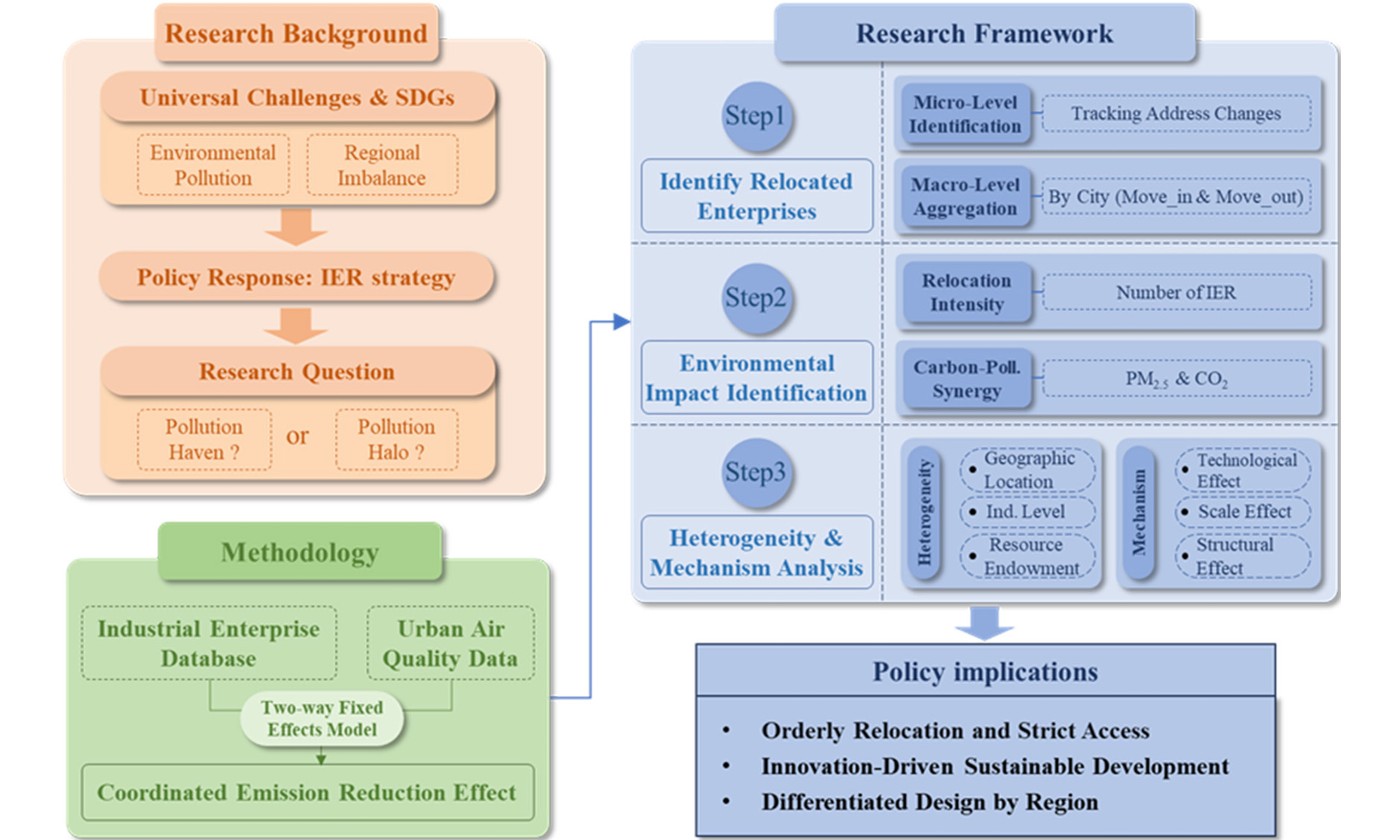
Keywords
INTRODUCTION
Environmental pollution and regional development inequality are common challenges faced by developing countries such as China, which are addressed by the United Nations’ Sustainable Development Goals (SDGs)[1,2]. To tackle these challenges, China has implemented industrial relocation to optimize the spatial distribution of industries, establish a rational production division system, and promote regional coordinated development[3]. Inland regions of China have actively embraced industries relocated from more developed coastal areas, seeking to create employment opportunities and foster economic development[4-6]. In practice, such industrial relocation is often implemented in an organized manner through development zones and industrial transfer parks, where local governments provide land, infrastructure, and regulatory management to facilitate firm entry and industrial clustering, which may also shape environmental outcomes[7]. A representative example is the “Replacing Old Capacity with New Capacity” policy implemented in the Beijing-Tianjin-Hebei region, which aims to utilize space freed up by relocating polluting industries to introduce new enterprises, promote industrial upgrading, and enhance regional efficiency[8]. For instance, Shougang Group, a major state-owned steel company with a production capacity of about 8 million tons (equivalent to the UK’s national production in 2018), relocated from Beijing to Tangshan in 2010 to alleviate air pollution in Beijing[9]. While this relocation presented destination regions with opportunities for economic development, it also posed challenges regarding environmental pollution[8]. Given these dynamics, this paper aims to investigate the environmental impacts of industrial enterprise relocation (IER) on both the destination and origin regions. Specifically, does IER transform the destination regions into pollution havens?
A growing body of literature has examined the environmental impacts of industrial relocation, yet the findings remain highly contested[10,11]. Much of the debate centers on the Pollution Haven Hypothesis, which suggests that pollution-intensive industries migrate to regions with laxer environmental regulations, thereby exacerbating local environmental degradation[12], versus the Pollution Halo Hypothesis, which argues that relocated firms may introduce cleaner technologies and management practices, leading to environmental improvements[10]. For origin cities, industrial transfer often reduces pollution sources, thereby lessening environmental pollution[13,14]. In contrast, destination cities might experience increased environmental issues due to the incoming industries’ pollution[13,15-18]. However, some relocated enterprises may leverage the opportunity to upgrade technologically and adopt greener practices, potentially leading to reduced pollution[8,19-21] and beneficial technology and management spillovers[12,22].
Recent studies further suggest that the environmental effects of industrial relocation critically depend on a range of influencing factors that shape firms’ relocation decisions and post-relocation behavior. On the one hand, environmental regulations and compliance costs can act as push factors, encouraging pollution-intensive firms to relocate and potentially generating pollution haven effects[17,23]. On the other hand, relocation decisions are also influenced by broader economic and institutional factors, including differences in factor prices, industrial land policies, and place-based industrial transfer strategies adopted by local governments[24]. Destination regions may attract relocating firms through industrial parks and policy incentives that facilitate agglomeration, while regional resource endowment and development stage condition firms’ technology choices and energy use after relocation[7]. These considerations imply that industrial relocation is not merely a mechanical transfer of pollution, but a complex process in which firm behavior, regional characteristics, and policy environments jointly determine environmental outcomes. Consequently, relocation may worsen pollution when driven primarily by regulatory arbitrage, but may also generate co-benefits when accompanied by technological upgrading, process optimization, and knowledge spillovers[23].
Despite these advances, important limitations remain in existing literature. Empirical research has predominantly adopted a macro industrial perspective, utilizing city and industrial-level economic data to construct indirect indicators for assessing industrial transfer, such as industrial location quotients, deviation-share measures, or multi-regional input-output tables[15,17,19,25]. While these macro-level methods allow estimation of the relationship between inter-regional industrial scale changes and pollution intensity, they often fail to accurately capture the spatial dynamics of IER. Consequently, they may not effectively distinguish between the environmental impacts of relocating enterprises and those of local peers, potentially resulting in unreliable or biased findings[26]. Furthermore, macro-level industrial transfers are driven by large-scale firm relocations, where enterprises directly influence both industrial transfers and environmental behaviors[26]. Therefore, it is essential to evaluate the impacts of IER from a micro-level perspective to obtain accurate and actionable insights.
This study develops a theoretical and empirical model to identify the impact of IER on the environmental outcomes of both origin and destination cities using an industrial enterprises dataset in China. First, the analysis of the spatial and temporal characteristics of IER reveals distinct patterns. Southeast coastal and southwestern cities, along with provincial capital cities, are the main outflow cities of industrial enterprises, while the west, central, northeast, and non-provincial capital cities are the main inflow cities, which validates the industrial gradient transfer in China. Second, we assess the impacts of IER on the environmental outcomes of cities and find that IER can achieve a win-win situation for air quality improvements and carbon emissions reduction in both the destination and origin cities. Furthermore, we explore the mechanisms through which IER impacts environmental outcomes. We find that enterprise relocation promotes environmental benefits through technological innovation and changes in economic structure, without significantly affecting the regional economic scale. Moreover, our heterogeneity analysis indicates that the impacts of enterprise relocation are more pronounced in western regions and in areas with lower industrial development. Additionally, resource endowment weakens the environmental improvement in destination cities and enhances it in origin cities, validating the effectiveness of industrial gradient transfer in improving the environment. Lastly, while environmental regulations drive enterprises to move out, they are not the main factor attracting enterprise relocation.
This study contributes to the literature in the following aspects: First, we provide a nuanced understanding of IER from a micro perspective. Previous research predominantly examines industrial relocation from a macro perspective with industrial-level or region-level data, which cannot distinguish the effects of relocating enterprises from local enterprises entering or exiting the market, and also cannot precisely determine the direction of enterprise relocation. This can lead to inaccurate assessments of IER’s true environmental and economic impacts, resulting in potentially misguided policy recommendations. By utilizing a comprehensive database that reflects actual changes in enterprise locations, our study captures the trends and scale of IER in China more precisely, offering a detailed and reliable analysis of its real environmental impacts. Second, this study constructs theoretical and empirical models to explore the mechanisms through which IER impacts environmental outcomes. By focusing on innovation, structural, and scale effects, the research provides a nuanced understanding of how IER influences environmental performance and contributes to the application and development of the industrial gradient transfer theory. This analysis offers new insights into the complex dynamics of enterprise relocation. Third, our results expand the understanding of the Pollution Haven Hypothesis by showing that IER can lead to pollution reduction and carbon emission mitigation in both origin and destination regions, achieving win-win outcomes. This theoretical advancement provides a deeper understanding of how enterprise relocation can achieve sustainable development goals and offers valuable insights for both researchers and policymakers.
THEORETICAL HYPOTHESIS AND MODEL
According to the pollution haven hypothesis, the relocation of industrial enterprises could deteriorate the environmental performance in destination cities and improve the environmental performance in origin cities[27].
For destination cities, with the influx of industrial enterprises that can lead to an increase in pollution sources, industrial production scale, and aggregation, thereby may heightening environmental pressures[27,28]. After the relocation of enterprises with advanced production technologies and management experience, the destination cities may adopt these technologies and experience in the production control of local enterprises through “Learning by Doing”[29]. Moreover, the introduction of new technologies can improve efficiency and reduce costs, prompting enterprises to invest more in innovation to gain profits and increase market share[19]. If these technologies are used for pollution control, they will enhance environmental performance. However, if used to enhance production levels, they might contribute to increased energy consumption and a deteriorating environmental situation[19,30].
In origin cities, the departure of industrial enterprises leads to a reduction in pollution sources and industrial scale, likely to improve local air quality. Additionally, enterprises that remain in their origin location will increase their investment in innovation to capture the market and increase their market share.
Hence, we propose the following hypothesis:
Hypothesis 1a. IER could deteriorate environmental situation in destination cities and mitigate air pollution in origin cities.
According to industrial gradient transfer theory, a country or region tends to transfer industries in which it has a relative disadvantage to countries or regions with a comparative advantage, aiming to achieve higher marginal returns on investment[31].Relatively backward production capacities in developed regions could still be advanced and practical for less developed regions. Therefore, enterprises from developed regions bring new, environmentally friendly technologies and production methods, which can help to improve energy efficiency and environmental conditions[8,32]. Moreover, enterprises from developed regions with better environmental management systems and higher energy efficiency have better environmental performance than local enterprises[33]. Through technological spillovers, enterprises from developed regions can have an impact on the production pollution control capacity of the destination regions. Additionally, the influx of enterprises increases the demand for productive services such as logistics, finance, R&D, and information technology, improving the efficiency and quality of these services[34]. As an intermediate input industry for industrial development, the productive service industry is knowledge-intensive, low-pollution, low-consumption, high-output, and high-employment. The concentration and development of productive service industry could reduce carbon emissions.
Furthermore, when companies with advanced technology and management skills relocate to regions with stringent environmental laws and standards, the pollution halo hypothesis comes into play. As destination regions have increasingly emphasized that “enterprise relocation should not equate to pollution relocation”, enterprises leverage the opportunity to eliminate outdated production capacities, upgrade equipment, implement green technologies, and optimize production processes during the relocation process[8]. Therefore, IER could lead to increased cleaner production technologies and management experience in destination cities[35].
Based on the above analysis, we propose the following hypothesis:
Hypothesis 1b. IER could improve environmental performance in origin and destination cities.
Theoretical analysis of IER is shown in Figure 1.
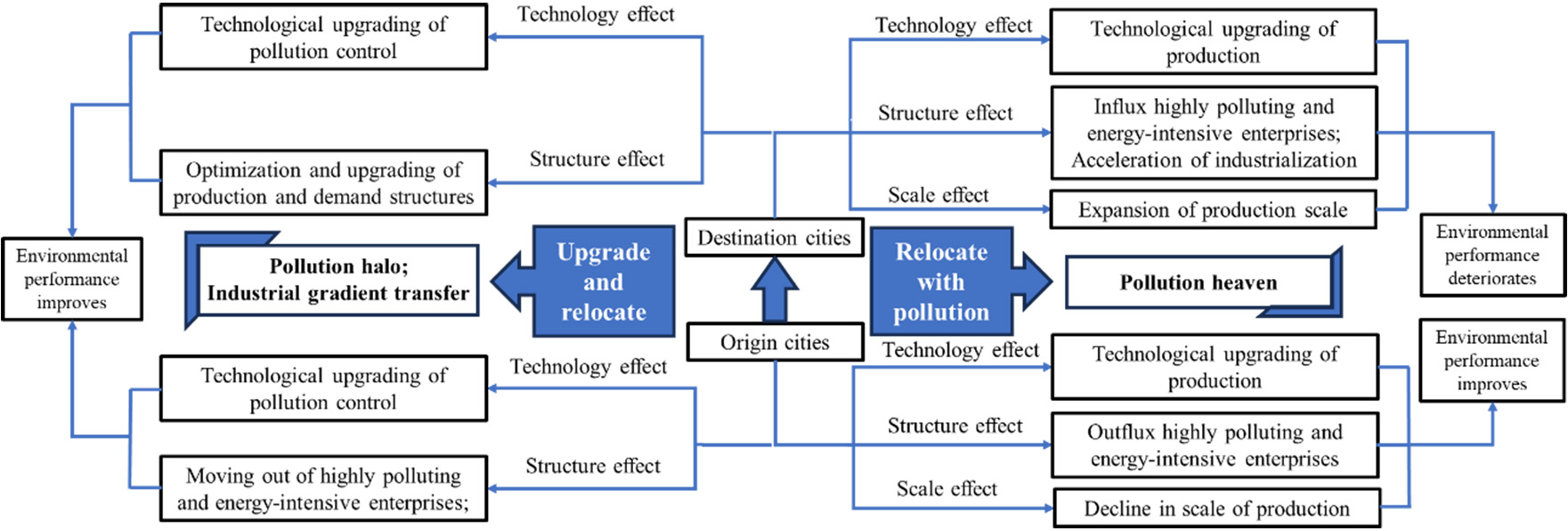
Figure 1. Mechanisms of environmental impacts of IER. IER: Industrial enterprise relocation.
To substantiate the aforementioned theoretical hypothesis and link them with empirical results, we propose a simplified analytical framework designed to examine how enterprises of two distinct types, situated in the origin and destination regions, adopt varying production technologies under environmental regulation, such as a pollution fee. In this model, no enterprises in the origin region are in competition with nd enterprises in the destination region. We assume that each enterprise possesses a primary technology for product manufacturing, characterized by a fixed unit production cost c and a quantifiable emission intensity α.
Enterprises may undergo technological adaptation upon relocation. For instance, if an enterprise enhances its production capacity in the destination region, the associated production cost c may escalate. Conversely, the adoption of greener technologies could reduce emission intensity α. The government imposes a pollution fee e for each unit of emissions, reflecting the regulatory stringency in the origin region, which is presumed to be more rigorous than in the destination region. Consequently, the introduction of IER results in a higher e in the origin region and a lower e in the destination region. Therefore, the total cost for unit capacity for each enterprise can then be articulated as c + αe.
Objectives. Enterprises in both the origin and destination regions aim to maximize their operating profits, producing q units of products at a market-clearing price p = A - b · (noq0 + ndqd), moderated by a sensitivity parameter b > 0 and a potential market demand A > α + ae to preclude trivial outcomes. The profit maximization equations for origin and destination enterprises are as the following equation (2-1) and (2-2):
Therefore, we can express the environmental situation and economic situation in two regions. First, in our model, the pollution generated by enterprises in the origin and destination regions is directly related to their production levels and numbers of enterprises. Specifically, the environmental situation in origin region (I0) and destination region (Id) can be defined as I0 = α · noq0 and Id = α · ndqd. Second, the economic situation is the total profit of all local enterprises, which can be shown as 0 = noπ0 in origin region and d = ndπd in destination region, respectively.
Equilibrium analysis. Utilizing the Cournot competition framework, we derive the market equilibrium outcomes, as delineated in Lemma 1.
Lemma 1. The optimal production capacities for enterprises in both the origin and destination regions can be shown as:
Lemma 1 delineates the pivotal role of several critical parameters - namely, the number of enterprises, production costs, emission intensities, and pollution fees - in determining the optimal production capacity for enterprises in both the origin and destination regions. The analysis reveals that there exists an inverse correlation between the optimal production capacity and the number of enterprises within each region. This inverse relationship is primarily driven by the heightened competitive pressures that emerge as the number of enterprises increases. Such competition dilutes individual market shares, leading to an elevation in the market-clearing price and consequently, a reduction in the equilibrium production level.
Moreover, the production cost, emission intensity, and pollution fees exert a negative influence on the optimal production capacity, underscoring the critical role of environmental regulations and the economic costs of pollution in shaping enterprise production strategies. This has significant implications for enterprise pollution migration: higher production costs and pollution fees discourage high production levels in regions with strict environmental regulations, incentivizing firms to adopt cleaner technologies or reduce output. Consequently, firms may relocate to regions with less stringent regulations to maintain higher production capacities without incurring significant costs. To mitigate this, policy harmonization across regions is crucial, preventing regulatory disparities from driving pollution migration. Additionally, promoting investments in clean technologies can help firms comply with environmental regulations, reducing the need to relocate.
Next, we will outline the environmental situation and economic situation in origin and destination regions.
The subsequent Proposition 1 and Proposition 2 will delineate the state of the environment and the economy in the origin and destination regions, providing a comprehensive framework for evaluating the multifaceted repercussions of IER.
Proposition 1. The impact of IER on the environmental situation can be shown as:
(a)
(b) If
(c)
(d)
Proposition 1 elucidates the intricate dynamics between economic factors and environmental regulations, highlighting how the environmental situation in both regions is influenced by IER. The environmental intuition behind Proposition 1(a) suggests that an escalation in production costs precipitates a diminution in environmental impact across regions. This phenomenon arises as heightened production costs diminish the economic feasibility of sustaining elevated production levels, resulting in reduced emissions and improved environmental conditions. This indicates that as production costs increase, enterprises are less likely to produce at high levels, thus reducing pollution emissions in both the origin and destination regions. The following empirical findings will support this, showing that IER significantly reduces CO2 emissions and PM2.5 concentrations, achieving environmental improvement. Furthermore, the impacts of enterprise relocation are more pronounced in western regions and in areas with lower industrial development, where higher production costs lead to more significant environmental benefits.
The impact of emission intensity on the environmental situation in Proposition 1(b) is contingent upon its relative magnitude to the other economic parameters. If the emission intensity is at the lower level, an increase in α results in a higher environmental impact in both regions. This counterintuitive result can occur because lower emission intensity of the present technology might not be sufficient to incentivize enterprises to adopt cleaner technologies or significantly reduce production. Instead, enterprises may continue their operations at similar levels, leading to higher overall emissions. Conversely, if the emission intensity surpasses a critical threshold, it serves as a potent impetus for enterprises to diminish emissions, either through the adoption of cleaner production methodologies or by reducing operational scale, thereby enhancing the environmental improvement in both regions. This will be consistent with the following empirical findings, where IER promotes environmental benefits through technological innovation and changes in economic structure, validating the effectiveness of industrial gradient transfer in improving the environment.
Proposition 1(c) indicates that pollution fees serve as a direct economic lever for curbing emissions. Higher fees raise the marginal cost of production for polluting enterprises, incentivizing them to either reduce their pollution levels through cleaner technologies or to relocate to regions with lower fees. This mechanism effectively mitigates the overall environmental impact by aligning economic incentives with environmental objectives, achieving a win-win situation in both origin and destination regions. However, we need to clarify that although environmental regulations in the theoretical model encourage companies to relocate and improve the environment, whether they are the main factors attracting companies to relocate still needs to be further verified by empirical models.
Proposition 1(d) highlights that an increase in the number of enterprises in both the origin and destination regions leads to a reduction in the environmental impact. The underlying mechanism can be attributed to reduced aggregate production and emissions when the enterprise count diminishes, which aligns with the broader goals of IER to mitigate environmental degradation.
Proposition 2. The impact of IER on the economic situation can be shown as:
(a) If
(b) If
(c) If
(d) The number of enterprises in both origin and destination regions cannot affect the economic situations.
Proposition 2 shows that the impact of IER on economic situation is different from environmental situations. Proposition 2(a) asserts that the impact of production costs c on the economic situation of two regions. When production costs are low, an increase in production costs negatively affects the economic situation in both regions. This is because lower production costs enable enterprises to operate more profitably, and any increase can significantly reduce their margins, leading to lower overall profitability. However, when production costs are high, enterprises are already operating under tight margins, and further increases can lead to cost efficiencies and technological innovations that may improve profitability.
Proposition 2(b) indicates that the impact of emission intensity on the economic situation is contingent upon its relative magnitude to other economic parameters. Low emission intensity fails to drive significant behavioral changes, raising operational costs without altering production processes. However, high emission intensity pressures enterprises to adopt cleaner technologies or relocate, leading to augmented profits from cost savings on emissions or pollution fees. Proposition 2(a) and (b) will be confirmed by empirical results that IER drives enterprises to adopt cleaner technologies, enhancing profitability, especially in regions with lower industrial development.
Proposition 2(c) suggests that the impact of pollution fees depends on their relative magnitude. Low pollution fees raise costs without incentivizing behavior change, while high pollution fees motivate cleaner technologies or relocation, reducing emissions, thereby enhancing the profitability of each enterprise. Empirical results will demonstrate that higher pollution fees drive economic improvements through innovation and structural changes.
Proposition 2(d) asserts that the quantity of enterprises in both regions does not independently influence the economic outcomes. This seemingly counterintuitive outcome may be rationalized by the assumption that market conditions or external factors may neutralize the impact of enterprise count, rendering the aggregate economic results in both regions agnostic to the number of individual enterprises. Empirical results will also show that IER promotes environmental benefits without significantly impacting economic stability, regardless of enterprise count.
DATA AND EMPIRICAL STRATEGY
Research sample
We collected data on IER from the Annual Surveys of Industrial Firms conducted by the National Bureau of Statistics of China, which includes information on over 80% of Chinese industrial enterprises, providing a comprehensive picture of the state of Chinese industry. To examine the environmental impact of IER on origin and destination cities, we conduct a two-step evaluation process.
In the first step, we match observations from the database to identify enterprises whose addresses have changed, following the method proposed by Brandt et al. (2012)[36]. This process yields a sample of 1876 enterprises that relocated to other cities between 2003 and 2015. The relocated industrial enterprises primarily belong to the manufacturing industry (86%), the production and supply of electricity (7%), gas and water (4%), and the extractive and mining industries (3%), all of which are pollution-intensive industries.
In this study, enterprise relocation refers to expanding spatial operations (by establishing new enterprises or departments) or adjusting the location of entire enterprises or partial departments, such as headquarters, research and development (R&D), sales and after-sales service, and production departments[26]. The sample industries typically involve significant capital investments in facilities, raw materials, and equipment. Due to substantial sunk costs, industrial enterprises tend to favor establishing new enterprises when relocating. Moreover, manufacturing processes are primary sources of pollutants. Therefore, this study focuses exclusively on entire enterprise relocations and spatial expansions within industrial sectors.
In the second step, we count the number of enterprises moving in and out of China’s prefecture-level cities. Due to more significant missing data prior to 2003, only data from 2003 onwards are considered in this study. From 2003 to 2015, 216 cities had enterprises moving out, and 203 cities had enterprises moving in, forming the research sample for this paper.
Model construction
Following Shen et al. (2019)[27], we explore the impacts of IER on the environmental and economic outcomes of origin and destination cities using the following fixed effects regression models:
where i denotes the city and t denotes the year. We use environmental indicators and economic indicators as the dependent variables, respectively. Environmental indicators include the logarithm of CO2 emissions, and PM2.5 concentrations, which provide an analysis of synergistic effects of IER on both air pollution and carbon emission. β0 is the constant term. The core independent variables are the number of enterprises moved in (Move_in) and moved out (Move_out) from city i in year t, respectively. Xit represents control variables including the logarithm of population size, fixed asset investment, electricity consumption, the proportion of secondary industry, real GDP, and carbon sequestration. γi and δt represent city-level fixed effect and year fixed effect, respectively. εit is the error term.
Further, we analyze the mechanism by which IER affects environmental performance from three perspectives: the technological effect characterized by the number of patent applications, including green patent applications; the structural effect characterized by the development of productive services; and the scale effect represented by industrial output. We perform a mechanism analysis based on the baseline regression model[37].
where Mit denotes the mechanism variables, and α2 is the core coefficient of concern. The number of patent applications, including green utility model patents and invention patents, were selected to study the technological effects of IER. The number of green invention patent applications is used to measure the quality of green innovation, reflecting substantial green technological innovation of enterprises. The number of non-invention patent applications in green patents reflects the strategic innovation in enterprises. Since the number of patents is a zero-valued variable, the number of patents is logarithmic by adding one to the number of patents. The proportion of the number of people in the production service industry to the tertiary industry is used as an indicator of the structural upgrading of the tertiary industry, and the ratio of tertiary employment to secondary employment is used as an indicator of economic structure. The total value of the industrial sector is used to express the industrial scale of each city.
To evaluate the impact of IER on regional environmental performance, we examine the regression coefficients of the main variables[38]. Initially, equation (1) is employed to identify the effect of IER on environmental performance in the destination and origin cities, examining the statistical significance of β1. Upon establishing significance, the analysis progresses to scrutinize θ1 in equation (2) and α2 in equation (3), thus exploring the mechanism pathway for the origin and destination cities. This structure enables a holistic comprehension of the mechanism of IER on air pollution, illuminating the multifaceted consequences of such enterprise behavior on environmental performance.
Data source
Leveraging novel enterprise-level geocoded panel datasets with detailed information on production, we merged datasets from enterprises and prefecture-level cities to conduct this analysis. The study period spans from 2003 to 2015. The IER data comes from the Annual Surveys of Industrial Firms. PM2.5 concentration data is sourced from the Atmospheric Composition Analysis Group[39].
Green patent data is classified according to the World Intellectual Property Organization (WIPO) and is based on statistics from the WIPO’s green patent database. WIPO divides green patents into eight categories, including transportation, energy, and water. Data on the proportion of the secondary industry, foreign direct investment, real GDP, fixed asset investment, electricity consumption, balance of deposits, and fiscal expenditure are sourced from the China Urban Statistical Yearbook. Population density data is obtained from the China Urban and Rural Construction Database. Employment data, including the number of non-private sector employees and the number of unemployed individuals, comes from the China Urban Database. Supplementary Table 1 presents the summary statistics of key variables. All data processing and econometric modeling were performed using Stata 16.0.
RESULTS
Spatial and temporal characteristics of IER
The temporal characteristics of IER exhibit a fluctuating and irregular pattern, varying across different stages of China’s economic and social development [Supplementary Figure 1]. A significant increase in IER occurred in 2008-2009, followed by a decline to pre-financial crisis levels in 2010, and another increase in 2011. This pattern reflects the far-reaching impact of the 2008 global financial crisis on the world economy, including China. In response to the crisis, the Chinese government implemented a series of economic stimulus programs, including large-scale infrastructure construction and policies to expand domestic demand. While these measures stimulated the recovery of the domestic economy to some extent, they also intensified competitive pressures among enterprises, prompting some to seek more favorable production and operating environments. By 2010, China’s economy had begun to gradually recover and maintain steady growth. In a stable economic environment, companies may prefer to stabilize their existing production bases rather than relocate to reduce uncertainty and relocation costs. Furthermore, China started to establish the National Industrial Undertaking Demonstration Zone in 2010 [Supplementary Table 2], leading to an increase in enterprise relocations in 2011.
From a spatial perspective, IER is more frequent in the central, western, and northeastern cities [Figure 2]. Southeast coastal and provincial capital cities are the main outflow cities of industrial enterprises, while west, central, northeast, and non-provincial capital cities are the main inflow cities. The Chinese government has implemented strategies such as the Western Development Strategy, the revitalization of Northeast China, and the Strategy for the Rise of Central China to promote balanced regional economic development. These initiatives effectively promote the flow of capital, labor, and other production factors, facilitating enterprise relocation.
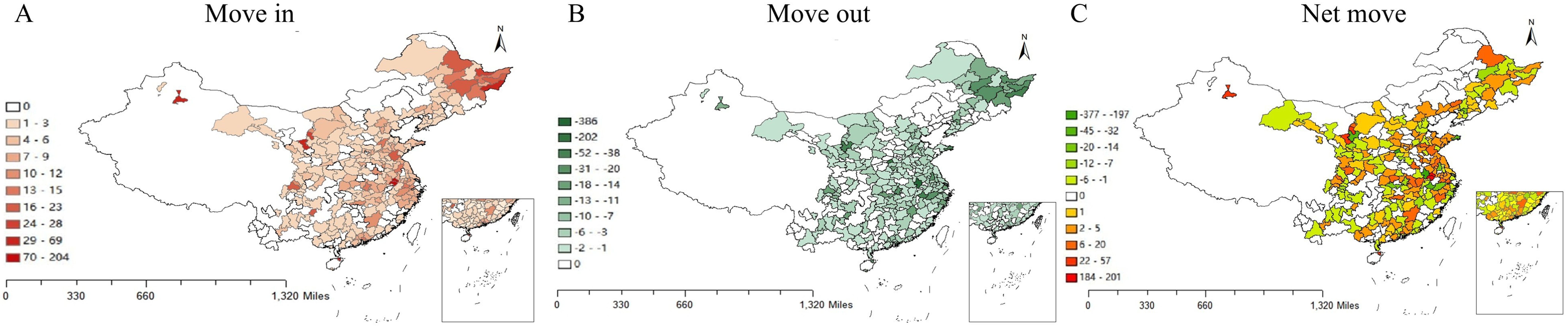
Figure 2. Spatial characteristics of IER. The base map is sourced from the Ministry of Natural Resources of the People’s Republic of China (http://bzdt.ch.mnr.gov.cn/), approved under No. GS(2019)1822. It is used solely for academic research purposes, and the figure was generated using ArcGIS. Figure 2A displays industrial enterprises moving in. Figure 2B shows industrial enterprises moving out. Figure 2C represents net relocation (industrial enterprises moving in minus industrial enterprises moving out). IER: Industrial enterprise relocation.
The effect of IER on environmental outcomes
We present the results on the environmental impacts of IER from estimating Equation (1) in Table 1. The results indicate negative and significant coefficients for β1 in Columns (1)-(4), suggesting that IER reduces carbon emissions and PM2.5 concentrations in both origin and destination cities, supporting Hypothesis 1b.
Baseline regression results
| Destination cities | Origin cities | |||
| (1) | (2) | (3) | (4) | |
| CO2 | PM2.5 | CO2 | PM2.5 | |
| Move_in | -0.020*** | -0.029*** | ||
| (0.008) | (0.011) | |||
| Move_out | -0.021** | -0.041*** | ||
| (0.009) | (0.012) | |||
| City FE | Y | Y | Y | Y |
| Year FE | Y | Y | Y | Y |
| Observations | 2,625 | 2,625 | 2,806 | 2,806 |
| R-squared | 0.814 | 0.275 | 0.818 | 0.275 |
For destination cities, one unit increase in the IER variable is associated with significant decreases in CO2 emissions and PM2.5 concentrations by 2% and 2.9%, respectively, with the estimated coefficients being significant at the 1% level [Columns (1) and (2)]. Specifically, IER leads to annual reductions of 3,610 tons of CO2 emission and 1.173 ug/m3 of PM2.5 concentration per city on average. These negative coefficients imply that enterprises relocating to destination cities leverage the opportunity to eliminate outdated production capacities, upgrade equipment, implement green technologies, and optimize production processes[8]. Furthermore, the influx of industrial enterprises fosters industrial agglomeration and intensifies market competition. This, in turn, optimizes the allocation of human and material resources and the spatial layout of industries, alleviating negative environmental impacts through technology spillovers and advancements.
For origin cities, one unit increase in IER results in significant decreases in CO2 emissions and PM2.5 concentrations by 2.1% and 4.1%, respectively, significant at the 5% and 1%level [Columns (3) and (4)], which is annual reduction of 3,790 tons of CO2 and 1.658 ug/m3 of PM2.5 concentration for each city on average. The negative coefficients in origin cities suggest that IER helps reduce local pollution levels. This can be attributed to the departure of outdated and polluting production processes, which leads to an overall improvement in environmental quality. The relocation allows for a more efficient reallocation of resources, further contributing to the reduction of emissions.
Robustness checks
To ensure the validity of our empirical results, we implemented a series of robustness checks, including a placebo test, a Double/Debiased Machine Learning (DDML) analysis, considering the influence of industry policy, time trends, the substitution of the independent variables and consideration for sample selection bias.
Placebo test
To mitigate potential influence from random factors, we implemented a placebo test by randomly assigning the number of relocated enterprises[40]. Using Monte Carlo simulations, we conducted 500 iterations of randomly selecting the number of relocated enterprises, resulting in 500 coefficients. The distribution of these coefficients centered around zero, conforming to a normal distribution as illustrated in Supplementary Figure 2. The outcomes from the placebo test indicate that our estimation results remain unbiased by extraneous factors, thereby confirming the absence of any placebo effects.
DDML
To further address potential concerns regarding model dependence and functional form misspecification, we employ a DDML approach as an additional robustness check. The DDML framework is designed to handle high-dimensional control variables and flexible nonlinear relationships while providing consistent estimates of the parameter of interest by orthogonalizing the treatment variable from the control set. In the implementation, we include both the linear and squared terms of the control variables, allowing for richer nonlinear adjustments compared to the baseline specification. The results show that the coefficient on IER remains negative and statistically significant [Supplementary Table 3, Panel A], indicating that the baseline conclusions are robust.
Industry policies
Existing research indicates that the establishment of national-level industrial undertaking demonstration zones has contributed to the improvement of air pollution[20]. We integrated additional industrial policies into the baseline regression. Detailed information on National Industrial Undertaking Demonstration Zone is shown in Supplementary Table 3. The results consistently show that IER still brings environmental improvements [Supplementary Table 3, Panel B]. The coefficient remains negative, confirming the robustness of the baseline results.
Time trends
Changes in pollution may exhibit trends not explained by other control variables and fixed effects. We incorporated time trends [Supplementary Table 3, Panel C], and the results show that our conclusions remain robust.
Substitution of independent variables
We redefined the independent variable as the output value of relocated enterprises. We find that the coefficient of IER is still statistically significantly negative [Supplementary Table 3, Panel D], further confirming the reliability of the baseline results.
Sample selection bias. In the baseline regression, we excluded samples without enterprise movements. In the baseline regression, we excluded samples without enterprise movements. To avoid the influence of sample selection bias, we further considered cities where enterprises do not relocate [Supplementary Table 4, Columns (1)-(4)], and the effects of both incoming and outgoing enterprise relocations in all samples [Supplementary Table 4, Columns (5)-(6)]. We then re-estimated the robustness check results. This approach enhances the robustness of our conclusions, demonstrating that our findings remain consistent when considering all samples.
Endogeneity analysis
After documenting the positive relationship between IER and pollution reduction in both origin and destination cities, we proceed to address the endogeneity issues that could challenge our results. On one hand, IER can facilitate pollution reduction and decrease carbon emissions. On the other hand, cities with superior environmental performance may attract more enterprises to relocate. Therefore, the potential reverse causality between core and dependent variables cannot be ignored. To draw accurate conclusions, it is crucial to address the endogeneity of the explanatory variables. We use the instrumental variable (IV) method to resolve reverse causality issues and conduct exogeneity tests for enterprise relocation. The results for pollution reduction are presented in Table 2, and the results for carbon reduction are shown in Supplementary Table 5, both supporting our previous conclusions.
Endogeneity issues analysis
| Destination cities | Origin cities | |||||
| (1) | (2) | (3) | (4) | (5) | (6) | |
| PM2.5 | ΔMovein | ΔAmountin | PM2.5 | ΔMoveout | ΔAmountout | |
| Movein_IV | -0.246*** | |||||
| (0.088) | ||||||
| L.PM2.5 | -0.025 | -0.029 | ||||
| (0.044) | (0.045) | |||||
| Moveout_IV | -0.453*** | |||||
| (0.093) | ||||||
| L.PM2.5 | -0.005 | 0.002 | ||||
| (0.033) | (0.034) | |||||
| KP LM | 48.767*** | 58.022*** | ||||
| CD Wald F | 69.793 | 100.828 | ||||
| City FE | Y | Y | Y | Y | Y | Y |
| Year FE | Y | Y | Y | Y | Y | Y |
| Observations | 2,220 | 2,040 | 2,039 | 2,780 | 2,554 | 2,554 |
| R-squared | 0.680 | 0.352 | 0.385 | 0.561 | 0.344 | 0.298 |
Instrumental variable approach
Tackling the reverse causality with an IV approach, we follow Dong et al. (2024)[41] and Fisman and Svensson (2007)[42] by using the average enterprise relocation within the same province (Movein_IV, Moveout_IV) as the instrumental variable for individual city enterprise relocation. This selection is justified by two primary reasons: first, the number of enterprise relocations at the provincial level is highly correlated with the number of relocations within individual cities; second, the provincial-level enterprise relocation figures reflect macroeconomic policies that are unlikely to directly influence the relocation decisions of individual cities. The results show that IER significantly reduces regional PM2.5 concentrations [Columns (1) and (4)], indicating that the baseline regression conclusions remain robust.
Exogeneity test
To verify whether changes in the scale of enterprise relocation are exogenous to regional pollution levels, we replace the dependent variables in model (1) with whether a city has enterprise relocation each year (ΔMovein, ΔMoveout) and the change in the number of enterprise relocations relative to the previous year (ΔAmountin, ΔAmountout). The explanatory variable is replaced with the previous year’s pollution level (L.PM2.5). The results show that the coefficients are not significant, indicating that prior environmental performance does not predict changes in enterprise relocation decisions [Columns (2)-(6)]. Hence, our conclusions remain valid.
Heterogeneity analysis
The impact of IER on environmental performance varies among cities due to differences in geographic location, resource endowment and industrialization level. We further investigate the heterogenous impacts of IER across different groups by incorporating interaction terms between IER and city-specific characteristics into the baseline regression framework. The results are presented in Table 3.
Heterogeneity analysis
| Geographic location | Resource endowment | Industrialization | ||||
| (1) | (2) | (3) | (4) | (5) | (6) | |
| CO2 | PM2.5 | CO2 | PM2.5 | CO2 | PM2.5 | |
| Panel A. Destination cities | ||||||
| Move_in | -0.003 | -0.010 | -0.061*** | -0.005 | -0.071*** | -0.139*** |
| (0.009) | (0.012) | (0.015) | (0.017) | (0.026) | (0.047) | |
| Move_in×Location | -0.026* | -0.034* | ||||
| (0.014) | (0.017) | |||||
| Move_in×Endowment | 0.054*** | -0.033 | ||||
| (0.017) | (0.021) | |||||
| Move_in×Industrial | 0.001** | 0.002*** | ||||
| (0.001) | (0.001) | |||||
| City FE | Y | Y | Y | Y | Y | Y |
| Year FE | Y | Y | Y | Y | Y | Y |
| Observations | 2,599 | 2,599 | 2,599 | 2,599 | 2,599 | 2,599 |
| R-squared | 0.814 | 0.274 | 0.814 | 0.273 | 0.814 | 0.277 |
| Panel B. Origin cities | ||||||
| Move_out | 0.032 | -0.022 | 0.004 | -0.012 | -0.018 | -0.235*** |
| (0.023) | (0.022) | (0.011) | (0.022) | (0.027) | (0.053) | |
| Move_out×Location | -0.029* | -0.011 | ||||
| (0.015) | (0.012) | |||||
| Move_out×Endowment | -0.030** | -0.038 | ||||
| (0.015) | (0.027) | |||||
| Move_out×Industrial | -0.000 | 0.004*** | ||||
| (0.001) | (0.001) | |||||
| City FE | Y | Y | Y | Y | Y | Y |
| Year FE | Y | Y | Y | Y | Y | Y |
| Observations | 2,780 | 2,780 | 2,780 | 2,780 | 2,780 | 2,780 |
| R-squared | 0.819 | 0.272 | 0.818 | 0.273 | 0.818 | 0.285 |
Geographic location
The Location variable is set to 1 for the western regions and 0 for the central and eastern region. The results show that IER is more effective in improving the environment performance in the western cities [Columns (1) and (2)]. Compared to coastal or other developed cities, the western cities generally have lower levels of economic development, less robust environmental protection measures, and higher availability of renewable energy resources such as hydropower[43,44]. From a technology-upgrading perspective, when enterprises relocate from developed to western cities, they bring advanced production technologies and management experience. This facilitates the diffusion of technology and knowledge, enhancing the technological level and environmental awareness of local enterprises, thereby significantly improving the environmental conditions in these cities. At the same time, Western China hosts abundant renewable energy resources and has experienced rapid expansion of hydropower, wind, and solar generation in several provinces, which can lower the carbon intensity of electricity supply relative to coal-dominated systems. To the extent that relocated enterprises rely on local electricity, a cleaner power mix may amplify the carbon mitigation effects associated with relocation.
Resource endowment level
Following Gylfason and Zoega (2006)[45], the regional resource endowment is evaluated from the perspective of resource dependence, which is represented by the number of employees in the mining industry. The Endowment variable is assigned a value of 1 if the average resource dependence level is greater than the average level of cities, and 0 otherwise. The results show that, for destination cities, resource endowment impedes the carbon reduction effect of IER [Panel A, Columns (3) and (4)]. Resource-endowed cities tend to have higher natural resource dependence, which usually results in the loss of green resources and clean technologies, thereby weakening the carbon reduction effect of relocating enterprises. For origin cities, resource endowment strengthens the carbon reduction effect of relocation [Panel B, Columns (3) and (4)]. This is because a higher proportion of heavily polluting enterprises moved out of resource-rich cities, significantly realizing the carbon reduction effect in origin cities.
Industrialization level
The ratio of industrial output value to local GDP is used to measure industrialization level. The Industrialization variable is assigned a value of 1 if the average level of industrial output is greater than the average level of cities, and 0 otherwise. The results show that environmental improvement effect of IER is more evident in cities with low industrialization levels [Columns (5) and (6)]. Cities with lower industrialization levels have more space and potential for development, allowing for greater optimization in energy structure and resource utilization. IER brings advanced technology and management experience, promotes industrial upgrading, and improves local environmental conditions. In cities with higher levels of industrialization, newly relocated enterprises may simply integrate into existing industrial clusters, resulting in less significant changes.
The heterogeneity results highlight that the environmental effects of IER are highly context-dependent rather than uniform across space. The more pronounced effects observed in western and less industrialized cities suggest that regions with greater scope for technological upgrading and structural adjustment benefit more from relocation. In contrast, differences in resource endowment indicate that local production characteristics and energy use patterns condition the effectiveness of carbon mitigation following relocation.
MECHANISM ANALYSIS
The baseline estimates suggest that IER contributes to a win-win situation in environmental improvement in both destination and origin cities. This section further explores the mechanisms through three channels: technological effects, structural effects, and scale effects.
Technological mechanism analysis
IER can lead to green innovation, which stimulates green improvements [Table 4]. IER has increased the technological level of both the destination and origin cities [Column (1)]. Specifically, for every one unit increase in IER, green innovation in destination cities increases by 7.2%, and in the origin cities by 7.1% increases [Column (1)]. However, the increase in innovation capacity did not lead to an improvement in the environmental quality of the destination cities [Panel A, Columns (2) and (3)]. This result suggests that these technologies and experiences were not fully optimized for environmental protection and thus do not have a significant moderating effect on pollution and carbon emissions.
Technological mechanism analysis
| (1) | (2) | (3) | (4) | (5) | (6) | (7) | (8) | (9) | |
| Patent | CO2 | PM2.5 | GIn | CO2 | PM2.5 | GUm | CO2 | PM2.5 | |
| Panel A. Destination cities | |||||||||
| Move_in | 0.072*** | 0.008 | -0.046 | 0.101*** | 0.010 | -0.012 | 0.068** | -0.007 | -0.042* |
| (0.022) | (0.035) | (0.041) | (0.036) | (0.016) | (0.019) | (0.029) | (0.019) | (0.025) | |
| Move_in×Patent | -0.005 | 0.003 | |||||||
| (0.005) | (0.005) | ||||||||
| Patent | 0.056*** | -0.029*** | |||||||
| (0.014) | (0.010) | ||||||||
| Move_in×GIn | -0.012** | -0.003 | |||||||
| (0.005) | (0.005) | ||||||||
| GUm | 0.004 | -0.021*** | |||||||
| (0.007) | (0.006) | ||||||||
| Move_in×GUm | -0.004 | 0.004 | |||||||
| (0.005) | (0.005) | ||||||||
| GUm | 0.01 | -0.018*** | |||||||
| (0.008) | (0.005) | ||||||||
| City FE | Y | Y | Y | Y | Y | Y | Y | Y | Y |
| Year FE | Y | Y | Y | Y | Y | Y | Y | Y | Y |
| Observations | 2,599 | 2,599 | 2,599 | 2,078 | 2,078 | 2,078 | 2,574 | 2,574 | 2,574 |
| R-squared | 0.867 | 0.818 | 0.281 | 0.667 | 0.799 | 0.306 | 0.678 | 0.815 | 0.283 |
| Panel B. Origin cities | |||||||||
| Move_out | 0.071*** | -0.053* | -0.114** | 0.086*** | -0.032 | -0.039** | 0.041 | -0.015 | -0.081*** |
| (0.018) | (0.032) | (0.045) | (0.029) | (0.024) | (0.019) | (0.034) | (0.013) | (0.028) | |
| Move_out×Patent | 0.005 | 0.012** | |||||||
| (0.004) | (0.006) | ||||||||
| Patent | 0.034** | -0.024*** | |||||||
| (0.015) | (0.009) | ||||||||
| Move_out×GIn | 0.005 | 0.005 | |||||||
| (0.006) | (0.005) | ||||||||
| GIn | -0.003 | -0.020*** | |||||||
| (0.008) | (0.006) | ||||||||
| Move_out×GUm | 0.000 | 0.012** | |||||||
| (0.003) | (0.006) | ||||||||
| GUm | 0.003 | -0.016*** | |||||||
| (0.007) | (0.006) | ||||||||
| City FE | Y | Y | Y | Y | Y | Y | Y | Y | Y |
| Year FE | Y | Y | Y | Y | Y | Y | Y | Y | Y |
| Observations | 2,806 | 2,806 | 2,806 | 2,210 | 2,210 | 2,210 | 2,770 | 2,770 | 2,770 |
| R-squared | 0.864 | 0.819 | 0.281 | 0.663 | 0.795 | 0.3 | 0.674 | 0.817 | 0.279 |
Conversely, the increase in innovation capacity tends to increase the concentration of PM2.5 in origin cities [Panel B, Column (3)]. IER caused the remaining enterprises to focus more on technological progress and efficiency improvement. At this point, technological progress might focus mainly on improving production efficiency and economic output, without sufficient emphasis on reducing environmental impacts, thus driving economic growth and increased energy demand. Consequently, technological progress indirectly increased PM2.5 concentrations, weakening the impact of IER on regional PM2.5 concentrations, which is a cause for concern.
Further, for the destination cities, IER improves environmental performance through green technology innovations. Each one unit increase in IER moving in leads to a 10.1% increase in the quality of green innovation and a 6.8% increase in the quantity [Panel A, Columns (4) and (7)], implying that relocated enterprises or local enterprises begin to pay more attention to and invest in environmentally friendly technologies. The increase in the quality of green innovations further strengthens the inhibitory effect of IER on carbon emissions [Panel A, Column (5)], but the increase in the quantity of green innovations does not have a substantial moderating effect [Panel A, Columns (8) and (9)].
The reasons are as follows: First, and most directly, enterprises from developed regions have brought advanced production technologies and management experience, facilitated the flow, and sharing of technological knowledge, and accelerating technological innovation and application[46], thereby raising the technological level of the destination cities. Second, enterprises from developed regions might invest in local green R&D activities to promote the development and application of new technologies. Such investment is not only beneficial to the enterprises themselves but may also foster local technological innovation and R&D ecosystems. This means that the enterprises have seized the opportunity of location adjustment, eliminating outdated production capacity, completing green technology upgrades, and optimizing production processes[8]. Third, through competition and cooperation, enterprises from developed regions might incentivize local enterprises to improve their own technological levels and productivity. This competitive pressure forces local enterprises to adopt more advanced technologies to remain competitive. While for the origin cities, the quality of green inventions increased, but this did not have a moderating effect on the relocation of enterprises and local pollution and carbon emissions. The number of green inventions was not affected by IER [Panel B, Columns (5)-(9)].
Structural mechanism analysis
IER improved environmental performance by enhancing the agglomeration of productive service industries in the destination cities and adjusting the industrial structure in the origin cities [Table 5]. For the destination cities, IER increased the proportion of productive service industries within the tertiary sector [Column (1)]. This agglomeration of productive service industries positively moderates the relationship between IER and carbon emissions and pollution levels, thereby amplifying its effect on reducing pollution and carbon emissions [Columns (2) and (3)]. Moreover, IER caused the ratio of tertiary employment to secondary employment to decrease in destination cities while increasing in origin cities [Columns (4)-(6)]. However, changes in economic structure did not impact the relationship between IER and the environment. Despite these structural shifts, the primary driver of improved environmental performance remained the enhancement of productive service industry agglomeration and the associated technological and managerial advancements[47].
Structural mechanism analysis
| (1) | (2) | (3) | (4) | (5) | (6) | |
| ProdServ | CO2 | PM2.5 | EconStr | CO2 | PM2.5 | |
| Panel A. Destination cities | ||||||
| Move_in | 0.004* | 0.072* | 0.028 | -0.085** | -0.050*** | -0.023 |
| (0.002) | (0.039) | (0.025) | (0.033) | (0.017) | (0.015) | |
| Move_in×ProdServ | -0.277*** | -0.160** | ||||
| (0.106) | (0.068) | |||||
| ProdServ | 0.004 | -0.300** | ||||
| (0.137) | (0.117) | |||||
| Move_in×EconStr | 0.018 | -0.001 | ||||
| (0.013) | (0.008) | |||||
| EconStr | 0 | -0.013 | ||||
| (0.006) | (0.009) | |||||
| City FE | Y | Y | Y | Y | Y | Y |
| Year FE | Y | Y | Y | Y | Y | Y |
| Observations | 2,586 | 2,586 | 2,586 | 2,586 | 2,586 | 2,586 |
| R-squared | 0.217 | 0.818 | 0.284 | 0.089 | 0.279 | 0.817 |
| Panel B. Origin cities | ||||||
| Move_out | 0.002 | -0.067** | 0.01 | 0.092*** | -0.012 | -0.027* |
| (0.002) | (0.031) | (0.024) | (0.023) | (0.022) | (0.016) | |
| Move_out×ProdServ | 0.133* | -0.141* | ||||
| (0.079) | (0.076) | |||||
| ProdServ | -0.179 | -0.258** | ||||
| (0.135) | (0.111) | |||||
| Move_out×EconStr | -0.021 | 0.003 | ||||
| (0.016) | (0.011) | |||||
| EconStr | -0.028* | 0.009 | ||||
| (0.014) | (0.022) | |||||
| City FE | Y | Y | Y | Y | Y | Y |
| Year FE | Y | Y | Y | Y | Y | Y |
| Observations | 2,767 | 2,767 | 2,767 | 2,767 | 2,767 | 2,767 |
| R-squared | 0.203 | 0.82 | 0.275 | 0.123 | 0.276 | 0.819 |
Scale mechanism analysis
The competitive effect of IER is further supported by the observation that IER did not significantly affect the industrial size of the city [Table 6]. The scale effects of IER are not significant [Column (1)]. For the destination cities, the increase in the scale of production weakened the positive environmental impact of incoming enterprises, thereby increasing the environmental burden [Panel A, Columns (2) and (3)]. Conversely, for the origin cities, an increase in industrial scale enhanced the environmental improvement effect of relocating enterprises [Panel B, Columns (2) and (3)]. This suggests that most origin cities are characterized by higher technology and cleaner production capacities, whereas destination sites need to strengthen their focus on cleaner production capacities to mitigate the environmental burden associated with increased production scales.
Scale mechanism analysis
| (1) | (2) | (3) | |
| IndScale | CO2 | PM2.5 | |
| Panel A. Destination cities | |||
| Move_in | 0.003 | -0.189*** | -0.361*** |
| (0.005) | (0.071) | (0.127) | |
| Move_in×IndScale | 0.044** | 0.088*** | |
| (0.019) | (0.032) | ||
| IndScale | 0.175** | -0.127** | |
| (0.074) | (0.064) | ||
| City FE | Y | Y | Y |
| Year FE | Y | Y | Y |
| Observations | 2,599 | 2,599 | 2,599 |
| R-squared | 0.369 | 0.818 | 0.285 |
| Panel B. Origin cities | |||
| Move_out | -0.002 | -0.019** | -0.037*** |
| (0.005) | (0.008) | (0.011) | |
| Move_out×IndScale | -0.004** | -0.003 | |
| (0.002) | (0.002) | ||
| IndScale | 0.158** | -0.158*** | |
| (0.076) | (0.057) | ||
| City FE | Y | Y | Y |
| Year FE | Y | Y | Y |
| Observations | 2,780 | 2,780 | 2,780 |
| R-squared | 0.354 | 0.821 | 0.28 |
FURTHER DISCUSSION: THE ROLE OF ENVIRONMENTAL REGULATION
Existing research has demonstrated the effectiveness of environmental policies in agglomeration economies and enterprise relocation[48]. This section further explores the role of environmental regulation on IER. We use the frequency of environmental-related terms in government documents as a proxy for the government’s emphasis on environmental protection and the pollution fee per pollution equivalent as a proxy for enterprise pollution costs.
The results indicate that environmental regulation significantly influences enterprises moving out [Table 7]. Increases in pollution fees and the importance placed on environmental issues by the government drive enterprises to move out, validating the pollution haven hypothesis. Specifically, for every unit increase in pollution fees and governmental emphasis on environmental issues, enterprise relocation increases by 21.1% and 1.1%, respectively [Columns (3) and (4)]. However, environmental regulation does not significantly impact the attraction of enterprises to new locations [Columns (1) and (2)], suggesting that the relaxation of environmental regulations is not a primary factor in attracting enterprise relocation.
The role of environmental regulation analysis
| Destination cities | Origin cities | |||
| (1) | (2) | (3) | (4) | |
| Move_in | Move_in | Move_out | Move_out | |
| EnvProtection | -0.041 | 0.211* | ||
| (0.119) | (0.126) | |||
| PollutionFee | 0.002 | 0.011* | ||
| (0.010) | (0.006) | |||
| City FE | Y | Y | Y | Y |
| Year FE | Y | Y | Y | Y |
| Observations | 2,625 | 2,625 | 2,806 | 2,806 |
| R-squared | 0.050 | 0.078 | 0.036 | 0.045 |
CONCLUSION
This study provides evidence that IER generates simultaneous reductions in carbon emissions and air pollution in both origin and destination cities in China, indicating a clear win-win environmental outcome. These findings challenge the conventional view that industrial relocation necessarily creates pollution havens in receiving regions. Instead, our results show that relocation can promote environmental improvement through technological innovation and industrial structure upgrading, without undermining local economic output. The environmental benefits are more pronounced in western regions and in cities with lower levels of industrialization, while resource endowment weakens the carbon-reduction effect in destination cities but strengthens it in origin cities, providing empirical support for the mechanism of industrial gradient transfer. In addition, stricter environmental regulations play an important role in driving enterprises to relocate from their original locations. These results suggest that the key policy challenge is not whether industrial relocation occurs, but how it is guided, governed, and complemented by innovation and environmental regulation to ensure sustainable regional development.
The results carry important policy implications for coordinated regional development. First, industrial relocation should be guided in an orderly manner under stringent environmental regulations to prevent the inflow of highly polluting activities into less developed regions. Policies that encourage green technological innovation and industrial upgrading can help ensure that environmental improvements do not come at the expense of economic performance. Second, policymakers should implement strategies that minimize negative impacts while optimizing resource allocation for coordinated economic development. Western and less industrialized cities should receive targeted institutional and infrastructural support, while more developed regions should maintain high entry standards and avoid transferring pollution-intensive production. In addition, achieving a sustainable “win-win” outcome may require the establishment of cross-regional coordination and compensation mechanisms. If western regions contribute to national carbon mitigation by accommodating industrial transfers, eastern regions, which benefit from improved environmental quality and industrial upgrading, could provide financial compensation, technology transfer, or capacity-building support to help destination regions strengthen environmental governance and maintain ecosystem service functions. Such mechanisms could enhance policy fairness, reduce long-term environmental risks, and promote more balanced and sustainable regional development.
Despite providing valuable insights, this study has several limitations. Identifying all relocating enterprises in China remains challenging, and data constraints may limit the representativeness of the sample. Future research could compile more comprehensive firm-level datasets to better capture relocation dynamics and enterprise characteristics. A full life cycle assessment would be required to comprehensively evaluate the embodied carbon and ecological footprints generated during the relocation process. In addition, while green technology innovation is used as a proxy for technological upgrading, future studies that link innovation outcomes to the actual adoption of pollution control equipment or cleaner production processes would allow a more direct assessment of improvements in eco-efficiency.
DECLARATIONS
Authors’ contributions
Writing - original draft, visualization, data curation, formal analysis, conceptualization: Ma, J.
Methodology, investigation, formal analysis, data curation: Ping, Z.
Methodology, investigation, formal analysis: Wang, T.
Methodology, investigation, formal analysis: Wang, H.
Conceptualization, visualization, formal analysis: Jia, X.
Writing - review and editing, data curation, validation, investigation, funding acquisition: Feng, T.
Availability of data and materials
Data and Supplementary Materials in this study are available from the corresponding author upon reasonable request.
AI and AI-assisted tools statement
During the preparation of this manuscript, the AI tool ChatGPT (version GPT-5, released 2025-08-07) was used solely for language editing. The tool did not influence the study design, data collection, analysis, interpretation, or the scientific content of the work. All authors take full responsibility for the accuracy, integrity, and final content of the manuscript.
Financial support and sponsorship
This research was supported by the National Natural Science Foundation of China (Grant No. 72574160 and No. 72204184), Tianjin University of Finance and Economics Support Program for Outstanding Young Teacher (Grant No. 2463), National Natural Science Foundation of Tianjin (Grant No. 24JCQNJC00550), Tianjin Municipal Young University Teachers’ Research and Innovation Capability Support Program (U40 Cultivation Project), Young University Teachers’ Research and Innovation Capability Support Program of China (U40 Project).
Conflicts of interest
All authors declared that there are no conflicts of interest.
Ethical approval and consent to participate
Not applicable.
Consent for publication
A written informed consent for publication was obtained.
Copyright
© The Author(s) 2026.
Supplementary Materials
REFERENCES
1. Zheng, S.; Yao, R.; Zou, K. Provincial environmental inequality in China: measurement, influence, and policy instrument choice. Ecol. Econ. 2022, 200, 107537.
2. Soergel, B.; Kriegler, E.; Weindl, I.; et al. A sustainable development pathway for climate action within the UN 2030 Agenda. Nat. Clim. Chang. 2021, 11, 656-64.
3. Flaaen, A.; Hortaçsu, A.; Tintelnot, F. The production relocation and price effects of us trade policy: the case of washing machines. Am. Econ. Rev. 2020, 110, 2103-27.
4. Cheng, L.; Mi, Z.; Sudmant, A.; Coffman, D. Bigger cities better climate? Results from an analysis of urban areas in China. Energy. Econ. 2022, 107, 105872.
5. Lin, B.; Wang, C. Does industrial relocation affect green total factor energy efficiency? Evidence from China’s high energy-consuming industries. Energy 2024, 289, 130002.
6. Zheng, W.; Wang, X.; Tian, D.; et al. Water pollutant fingerprinting tracks recent industrial transfer from coastal to inland China: a case study. Sci. Rep. 2013, 3, 1031.
7. Zhang, J.; Qi, Y.; Song, Y.; et al. The relationship between industrial transfer parks and county economic growth: evidence from Guangdong Province, China. Habitat. Int. 2023, 139, 102894.
8. Liu, X.; Du, H.; Tang, L.; et al. Relocating industrial plants delivers win-win emission reduction benefits to origin and destination regions. Environ. Sci. Technol. 2022, 56, 16043-54.
9. Steel giant Shougang to move out of Beijing. China Daily (Beijing, China), updated February 8, 2005. Available online: https://www.chinadaily.com.cn/english/doc/2005-02/08/content_415990.htm. (accessed 2026-01-03).
10. Duan, Y.; Jiang, X. Pollution haven or pollution halo? A Re-evaluation on the role of multinational enterprises in global CO2 emissions. Energy. Econ. 2021, 97, 105181.
11. He, K.; Mi, Z.; Zhang, J.; Li, J.; Coffman, D. The polarizing trend of regional CO2 emissions in China and its implications. Environ. Sci. Technol. 2023, 57, 4406-14.
12. Kellenberg, D. K. An empirical investigation of the pollution haven effect with strategic environment and trade policy. J. Int. Econ. 2009, 78, 242-55.
13. Liu, T.; Pan, S.; Hou, H.; Xu, H. Analyzing the environmental and economic impact of industrial transfer based on an improved CGE model: taking the Beijing-Tianjin-Hebei region as an example. Environ. Impact. Assess. Rev. 2020, 83, 106386.
14. Presberger, D.; Bernauer, T. Economic and political drivers of environmental impact shifting between countries. Global. Environ. Change. 2023, 79, 102637.
15. Song, C.; Zhang, Z.; Xu, W.; Elshkaki, A. The spatial effect of industrial transfer on carbon emissions under firm location decision: a carbon neutrality perspective. J. Environ. Manage. 2023, 330, 117139.
16. Wei, D.; Liu, Y.; Zhang, N. Does industry upgrade transfer pollution: evidence from a natural experiment of Guangdong province in China. J. Clean. Prod. 2019, 229, 902-10.
17. Xu, J.; Dong, Y.; Xie, L.; Chen, S. The pollution haven strikes back?–Evidence from air quality daily variation in the Jing-Jin-Ji region of China. Environ. Sci. Policy. 2022, 138, 105-21.
18. Yin, J.; Zheng, M.; Li, X. Interregional transfer of polluting industries: a consumption responsibility perspective. J. Clean. Prod. 2016, 112, 4318-28.
19. Dou, J.; Han, X. How does the industry mobility affect pollution industry transfer in China: empirical test on Pollution Haven Hypothesis and Porter Hypothesis. J. Clean. Prod. 2019, 217, 105-15.
20. Ge, T.; Lv, X.; Ma, L.; Shen, X. Can industrial relocation reduce air pollution? Evidence from a quasi-natural experiment in China. Front. Environ. Sci. 2022, 10, 910668.
21. Zhao, X.; Yin, H. Industrial relocation and energy consumption: evidence from China. Energy. Policy. 2011, 39, 2944-56.
22. Li, X.; Chen, X.; Hou, K. FDI technology spillovers in Chinese supplier-customer networks. Int. Rev. Finan. Anal. 2024, 94, 103285.
23. Wang, X.; Zhang, C.; Zhang, Z. Pollution haven or porter? The impact of environmental regulation on location choices of pollution-intensive firms in China. J. Environ. Manage. 2019, 248, 109248.
24. Gerritse, M.; Wang, Z.; Van Oort, F. Industrial Transfer Policy in China: migration and development. J. Urban. Econ. 2026, 151, 103815.
25. Wang, S.; Wang, X.; Tang, Y. Drivers of carbon emission transfer in China - an analysis of international trade from 2004 to 2011. Sci. Total. Environ. 2020, 709, 135924.
26. Peng, Y.; Zhu, H.; Cui, J. Changes in environmental performance with firm relocation and its influencing mechanism: an evidence of chemical industry in Jiangsu, China. J. Environ. Manage. 2023, 336, 117712.
27. Shen, J.; Wang, S.; Liu, W.; Chu, J. Does migration of pollution-intensive industries impact environmental efficiency? Evidence supporting “Pollution Haven Hypothesis”. J. Environ. Manage. 2019, 242, 142-52.
28. Zeng, D.; Zhao, L. Pollution havens and industrial agglomeration. J. Environ. Econ. Manage. 2009, 58, 141-53.
29. Feng, W.; Li, J. International technology spillovers and innovation quality: evidence from China. Economic. Analysis. and. Policy. 2021, 72, 289-308.
30. Zhao, H.; Liu, Y.; Lindley, S.; Meng, F.; Niu, M. Change, mechanism, and response of pollutant discharge pattern resulting from manufacturing industrial transfer: a case study of the Pan-Yangtze River Delta, China. J. Clean. Prod. 2020, 244, 118587.
31. Zhou, Z.; Cui, B.; Che, H. Research on industry and carbon emission gradient under the background of carbon emission peak in the Beijing-Tianjin-Hebei region. In Proceedings of the 6th International Conference on Economic Management and Green Development, Stanford University (online), August 6-12, 2022; Li, X., Yuan, C., Kent, J., Eds.; Springer: Singapore, 2023; pp 943-54.
32. Al-Emran, M.; Griffy-Brown, C. The role of technology adoption in sustainable development: Overview, opportunities, challenges, and future research agendas. Technol. Soc. 2023, 73, 102240.
33. Gómez‐bolaños, E.; Hurtado‐torres, N. E.; Delgado‐márquez, B. L. Disentangling the influence of internationalization on sustainability development: evidence from the energy sector. Bus. Strat. Env. 2019, 29, 229-39.
34. Jiang, X.; Liu, J. Achieving low carbon finance of the iron and steel industry in China. Carbon. Footprints. 2025, 4, 9.
35. Singhania, M.; Saini, N. Demystifying pollution haven hypothesis: role of FDI. J. Bus. Res. 2021, 123, 516-28.
36. Brandt, L.; Van Biesebroeck, J.; Zhang, Y. Creative accounting or creative destruction? Firm-level productivity growth in Chinese manufacturing. J. Devel. Econ. 2012, 97, 339-51.
37. Ma, J.; Chen, X.; Feng, T.; Xu, B.; Lu, H.; Guo, Q. The synergistic effects of demand-pull and supply-push policies on firm’s green innovation: evidence from China. Econ. Anal. Pol. 2026, 89, 527-41.
38. Feng, T.; Ma, J.; Yang, Y.; Mi, Z. Synergistic effects of air pollution control policies: evidence from China. J. Environ. Manage. 2025, 373, 123581.
39. Van Donkelaar, A.; Martin, R. V.; Park, R. J. Estimating ground‐level PM2.5 using aerosol optical depth determined from satellite remote sensing. J. Geophys. Res. 2006, 111, 2005JD006996.
40. Dreber, A.; Johannesson, M.; Yang, Y. Selective reporting of placebo tests in top economics journals. Econ. Inq. 2024, 62, 921-32.
41. Dong, H.; Zhang, L.; Zheng, H. Green bonds: fueling green innovation or just a fad? Energy. Econ. 2024, 135, 107660.
42. Fisman, R.; Svensson, J. Are corruption and taxation really harmful to growth? Firm level evidence. J. Devel. Econ. 2007, 83, 63-75.
43. Hu, X.; Zhang, Y. W.; Geng, Y.; Yu, H.; Li, L. Exploring carbon emission effects of national-level industrial park policies on cities in China. Carbon. Footprints. 2024, 3, 16.
44. Liu, X.; Mu, R. Public environmental concern in China: determinants and variations. Global. Environmental. Change. 2016, 37, 116-27.
45. Gylfason, T.; Zoega, G. Natural resources and economic growth: the role of investment. World. Econ. 2006, 29, 1091-115.
46. Chen, F.; Wang, M.; Pu, Z. The impact of technological innovation on air pollution: firm-level evidence from China. Technol. Forecast. Soc. Change. 2022, 177, 121521.
47. Liu, H.; Zhao, H.; Li, S. Future social change of manufacturing and service industries: service-oriented manufacturing under the integration of innovation-flows drive. Technol. Forecast. Soc. Change. 2023, 196, 122808.
Cite This Article
 Open Access
How to Cite
Download Citation
Export Citation File:
Type of Import
Tips on Downloading Citation
Citation Manager File Format
Type of Import
Direct Import: When the Direct Import option is selected (the default state), a dialogue box will give you the option to Save or Open the downloaded citation data. Choosing Open will either launch your citation manager or give you a choice of applications with which to use the metadata. The Save option saves the file locally for later use.
Indirect Import: When the Indirect Import option is selected, the metadata is displayed and may be copied and pasted as needed.
About This Article
Copyright

Data & Comments
Data
0








Comments
Comments must be written in English. Spam, offensive content, impersonation, and private information will not be permitted. If any comment is reported and identified as inappropriate content by OAE staff, the comment will be removed without notice. If you have any queries or need any help, please contact us at support@oaepublish.com.