

From computational task automation to adaptive computational strategies: emerging roles of agents in computational materials science
 0
MAIN TEXT
Computational methods such as density functional theory (DFT), high-throughput calculations (HTCs), and data-driven modeling have greatly expanded the range of materials that can be studied at relatively low computational cost. With the continued development of computational software and platforms, many tasks in computational materials research, including model construction, simulation, data analysis, and visualization, can now be carried out within integrated environments. Several recent platforms have further combined these capabilities to simplify the organization and execution of computational workflows[1]. However, setting up an appropriate workflow still requires researchers to choose computational methods, adjust parameters, and identify and resolve failed calculations. Such tasks can be time-consuming and often require specialized knowledge. Recent advances in large language models (LLMs) provide a possible approach to reducing this burden. LLMs can understand natural-language instructions, reason over a sequence of tasks, and interact with external tools, leading to growing interest in LLM-based agents for scientific workflow automation and adaptive decision-making.
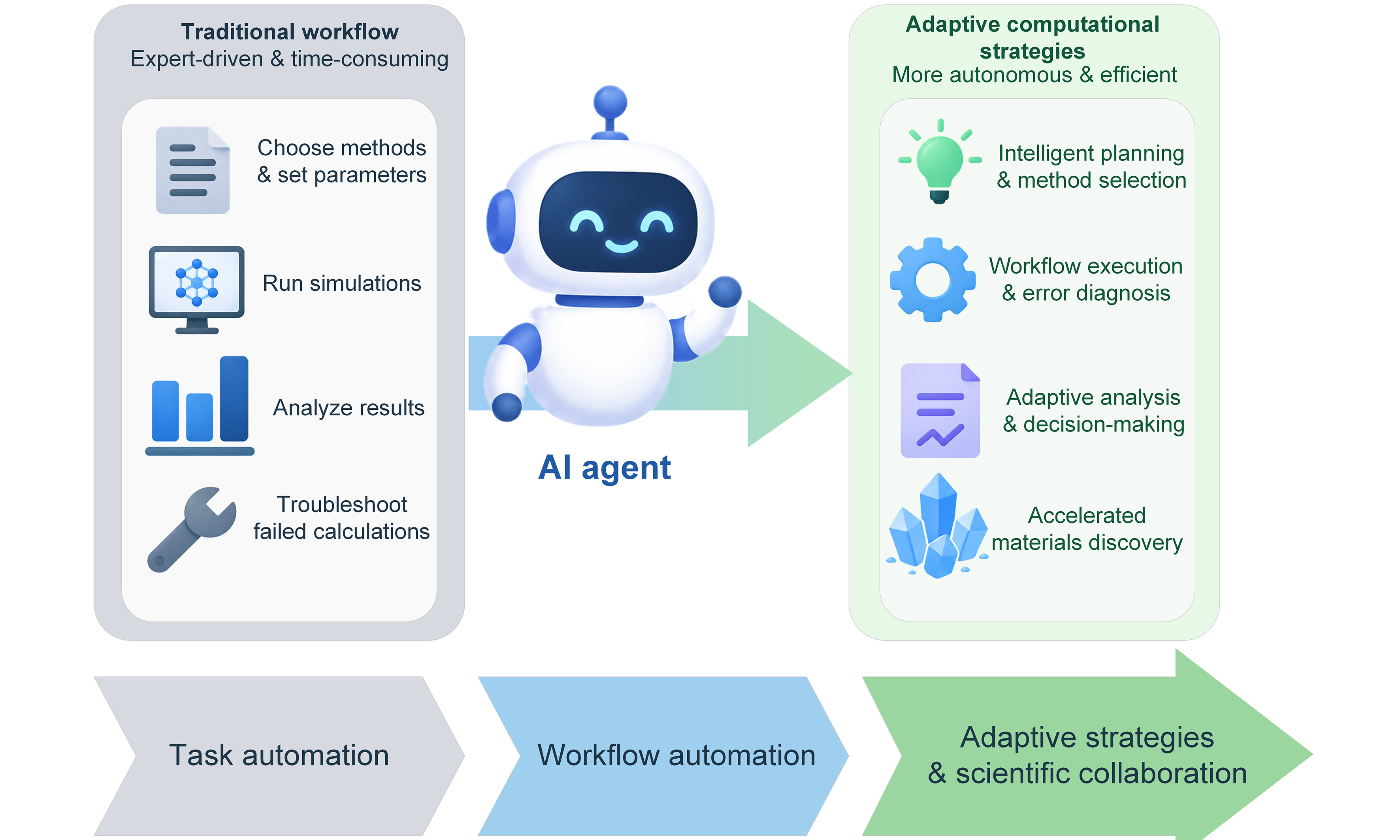
Artificial intelligence (AI) agents now support increasingly broad tasks in computational materials science. Early work integrated thermodynamic analysis, DFT, machine learning (ML), and Bayesian optimization into automated materials-discovery loops, reducing the need for manual intervention during materials screening[2]. More recent LLM-based agents have been developed for computational planning, adaptive simulation, error diagnosis, and tool use. Some systems can also revise workflows based on intermediate results[3,4]. Applications have expanded from individual simulations to cross-software quantum simulations, research-information integration, structured knowledge extraction, and solid-state materials calculations[5-7]. Multi-agent systems have further extended these capabilities by coordinating literature analysis, computational execution, experimental design, and robotic experimentation within broader scientific workflows[8]. Collectively, these developments suggest a progression from task automation to workflow automation, adaptive computational strategies, and scientific collaboration [Figure 1]. In this context, Masgent and ChatMat represent two complementary directions. Masgent focuses on reliable orchestration of computational infrastructure, whereas ChatMat extends agent involvement to adaptive computational planning and method selection.
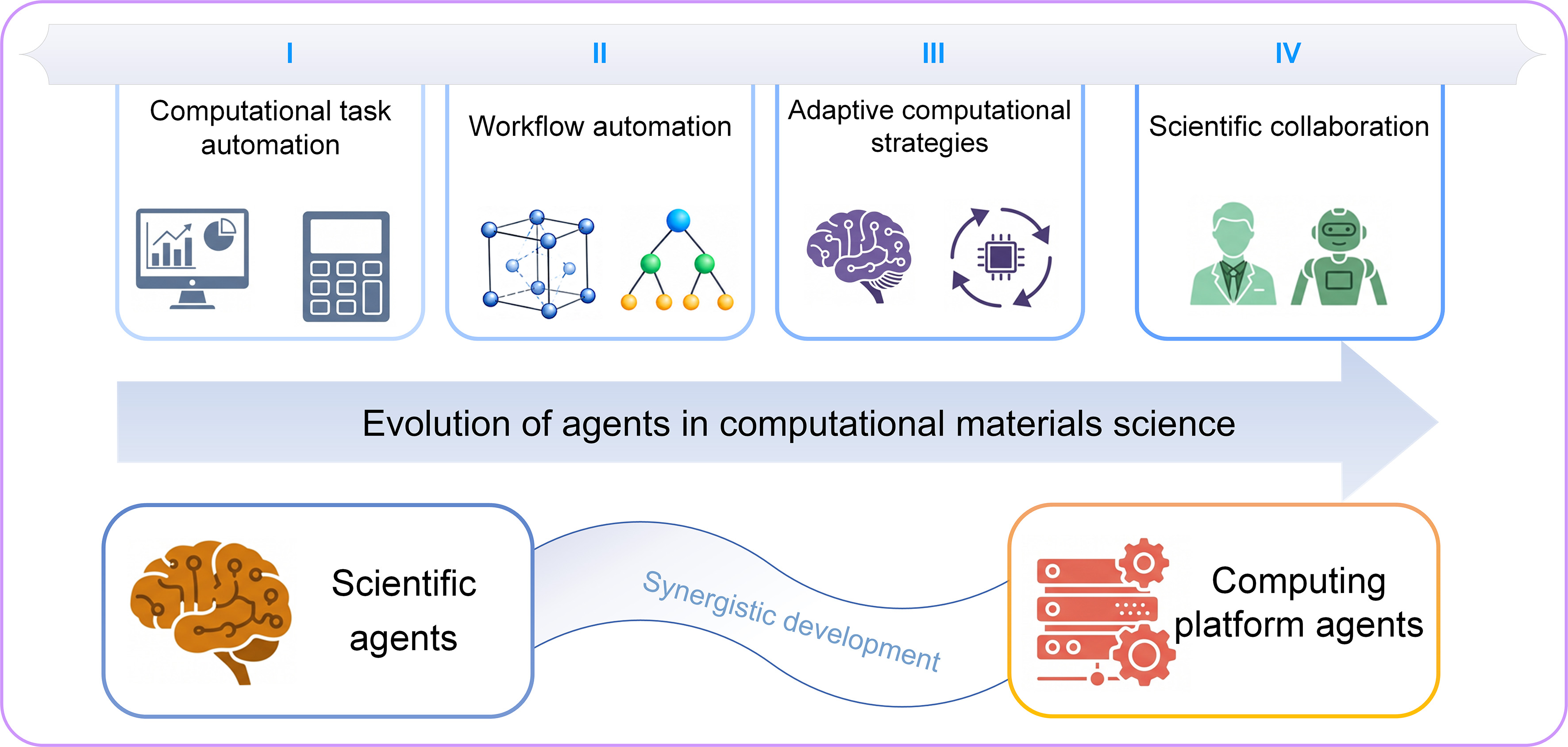
Figure 1. Evolution of agents in computational materials science.
Masgent connects AI agents to computational infrastructure through an LLM-based interaction layer and tools for structure manipulation, Vienna Ab initio Simulation Package (VASP) input generation, workflow construction, high-performance computing (HPC) job script preparation, and result analysis[9]. It translates natural-language research requests into executable simulation workflows [Figure 2A]. In representative materials simulation workflows, Masgent generated in 30 s an equation-of-state workflow that would otherwise require several hours of manual preparation. Across the tested systems, equilibrium energies differed from Materials Project references by less than 0.05 eV·atom-1, and equilibrium volumes deviated by less than 1%. These results show that Masgent can reduce workflow-preparation effort while maintaining consistency with the selected benchmarks[9]. Its main contribution as an interface to simulation infrastructure is the reliable and accessible orchestration of complex computational workflows, enabling researchers to manage multistep calculations through natural-language interaction. However, the reported results were obtained for selected workflows and benchmark systems. Further tests are needed for chemically complex, defective, interfacial, and out-of-distribution materials problems.
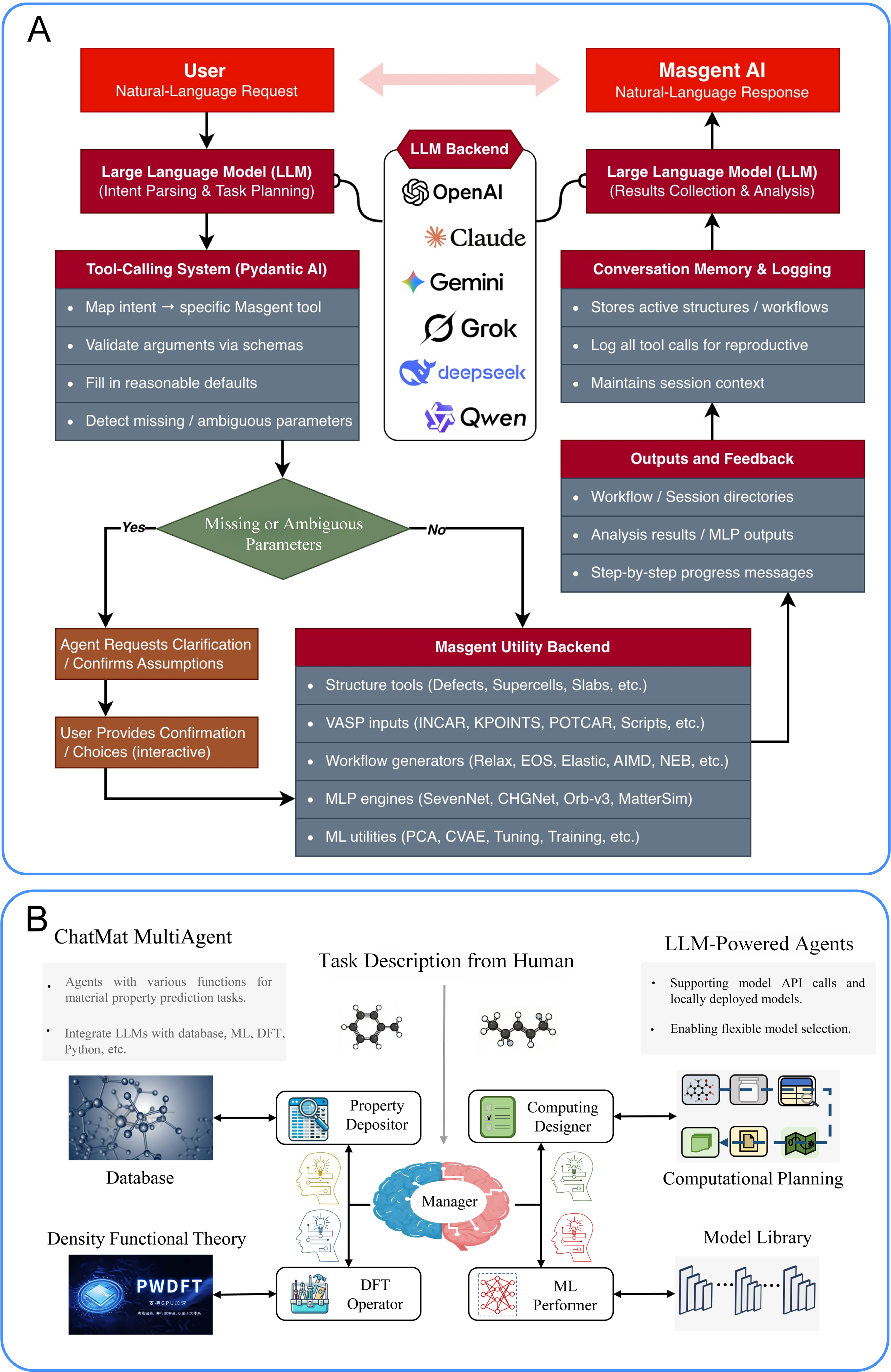
Figure 2. Representative agent frameworks in computational materials science. (A) Masgent framework[9]. Adapted from reference[9] under the terms of the CC BY 3.0 License; (B) ChatMat framework[10]. Adapted from reference[10] under the terms of the CC BY-NC 3.0 License. AI: Artificial intelligence; LLM: large language model; VASP: Vienna Ab initio Simulation Package; MLP: machine-learning potential; ML: machine learning; INCAR: VASP input parameter file; KPOINTS: K-point sampling file; POTCAR: pseudopotential file; EOS: equation of state; AIMD: ab initio molecular dynamics; NEB: nudged elastic band; PCA: principal component analysis; CVAE: conditional variational autoencoder; DFT: density functional theory; API: application programming interface.
ChatMat moves beyond workflow execution and addresses adaptive computational planning and method coordination [Figure 2B][10]. Its multi-agent architecture has a central Manager that interprets the scientific request, divides it into subtasks, and coordinates four role-specific agents. The Property Depositor retrieves and organizes materials information. The Computing Designer formulates the computational strategy and selects the appropriate method. The ML Performer executes ML-potential energy surface (PES) predictions. The DFT Operator carries out first-principles calculations when higher-fidelity evaluation is required. The Manager then combines the returned results. The four agents can work toward a common materials-prediction objective.
An ablation benchmark of 100 randomly selected material-property queries compared the approaches. The ML-only and DFT-only agents achieved success rates of 48% and 88%, respectively, whereas ChatMat reached 95%[10]. This metric reflects end-to-end task completion rather than the intrinsic physical accuracy of a converged DFT calculation. In the DFT-only pipeline, 3%, 7%, and 2% of queries failed because of self-consistent field (SCF) non-convergence, timeouts, and input/output (I/O) errors during unattended batch processing, respectively. ChatMat reduces these workflow-level failures through uncertainty-aware routing: queries whose ML-PES predictions fall within the model-deviation threshold are assigned to the lower-cost ML Performer, whereas those outside the reliable interpolation regime are sent to the DFT Operator for higher-fidelity calculations. The average number of DFT calls per query consequently decreased from 1.15 to 0.35, corresponding to a 69.6% reduction[10].
The Computing Designer does not simply switch between two preset workflows. It assesses model reliability and selects the method based on expected accuracy and computational cost. ChatMat thereby determines how a computational task should be carried out and which method is appropriate. Its main contribution lies in computational planning and coordination between ML and DFT. This approach represents a step toward adaptive computational decision-making in materials science. Nevertheless, the reported success rate and reduction in DFT calls are benchmark-specific measures of task completion and routing efficiency and do not by themselves demonstrate general scientific reasoning or universally improved physical accuracy.
Masgent and ChatMat address complementary aspects of computational materials research. Masgent is currently suited to standardized atomistic-simulation workflows, such as structure manipulation, VASP input generation, equation-of-state fitting, elastic-property calculations, ab initio molecular dynamics (AIMD), and nudged elastic band (NEB) calculations. It also supports machine-learning-potential (MLP)-assisted simulations. ChatMat has been demonstrated for structure acquisition, charge-density calculations, materials-property database management, ML-PES construction, and uncertainty-aware coordination between ML and DFT. Their modular architectures could support applications in energy materials, including batteries and electrode-electrolyte interfaces[11]. However, these applications have not been directly validated in the two original studies. AI-agent approaches have also been explored for battery materials, including solid-state electrolytes[12].
The development of agents in computational materials science therefore marks a shift from merely executing calculations to organizing computational processes and helping determine how those calculations should be performed. Computing-platform agents prioritize reliable, accessible, and extensible infrastructure that simplifies simulation workflow construction and execution. Scientific agents, by contrast, emphasize interpreting research objectives, integrating evidence, and selecting computational strategies. These approaches are unlikely to remain separate. A promising direction is to combine scientific reasoning with robust computational infrastructure, enabling agents to assist with complex materials problems while remaining constrained by physical principles and supported by transparent validation.
Important limitations remain before such systems can approach broader scientific autonomy. Reliability and generalizability across materials classes, simulation methods, and tasks beyond predefined workflows remain uncertain, especially when domain-specific knowledge or specialized computational judgment is required. Current benchmarks are limited in scale and scope, while uncertainty thresholds, model coverage, and error-recovery procedures may not transfer reliably to out-of-distribution problems. Workflow provenance, decision traceability, and independent validation are essential for reproducible scientific use. Human expertise remains necessary to clarify ambiguous objectives, choose physically defensible assumptions, detect plausible but incorrect outputs, and determine whether computed results actually address the underlying scientific question. In the near term, agents may be most valuable as collaborative interfaces linking scientific questions, computational methods, and research decisions, helping researchers organize calculations and compare strategies while supporting more open and reproducible computational materials research.
DECLARATIONS
Acknowledgments
We sincerely thank Dr. Darshan Kumar at Henan Academy of Sciences for his assistance in polishing the manuscript.
Authors’ contributions
Conception and design of the article, literature analysis, and manuscript writing: Liu, J.; Cao, W.; Fu, Z.; Li, W.
All authors read and approved the final manuscript.
Availability of data and materials
Not applicable.
AI and AI-assisted tools statement
During the preparation of this manuscript, the AI tool DeepSeek (version V3, released 2025-03-24) was used solely to enhance the clarity and readability of the manuscript through language polishing and grammar refinement. The AI tool Google Gemini (version 3.1 Pro, released 2026-02-19) was used to generate selected graphical elements, including brain, human, gear, and other illustrative components, incorporated into Figure 1 and the graphical abstract. The tools did not influence the study design, data collection, analysis, interpretation, or the scientific content of the work. All authors take full responsibility for the accuracy, integrity, and final content of the manuscript.
Financial support and sponsorship
This work was supported by the Advanced Materials-National Science and Technology Major Project (No. 2024ZD0607500) and the National Natural Science Foundation of China (No. 52271355).
Conflicts of interest
All authors declared that there are no conflicts of interest.
Ethical approval and consent to participate
Not applicable.
Consent for publication
Not applicable.
Copyright
© The Author(s) 2026.
REFERENCES
1. Liu, Z. R.; Yao, B. N.; Zhang, R. F. SPaMD studio: an integrated platform for atomistic modeling, simulation, analysis, and visualization. Comput. Mater. Sci. 2022, 210, 111027.
2. Montoya, J. H.; Winther, K. T.; Flores, R. A.; Bligaard, T.; Hummelshøj, J. S.; Aykol, M. Autonomous intelligent agents for accelerated materials discovery. Chem. Sci. 2020, 11, 8517-32.
3. Wang, Z.; Huang, H.; Zhao, H.; et al. DREAMS: Density Functional Theory Based Research Engine for Agentic Materials Simulation. arXiv 2025, arXiv:2507.14267. Available online: https://doi.org/10.48550/arXiv.2507.14267 (accessed 8 October 2026).
4. Zou, Y.; Cheng, A. H.; Aldossary, A.; et al. El Agente: an autonomous agent for quantum chemistry. Matter 2025, 8, 102263.
5. Gustin, I.; Mantilla Calderón, L.; Pérez-Sánchez, J. B.; et al. El agente cuántico: automating quantum simulations. Rep. Prog. Phys. 2026, 89, 077602.
6. Hari Kumar, S. G.; Zou, Y.; Wang, A.; et al. El Agente Sólido: A New Age(nt) for Solid State Simulations. arXiv 2026, arXiv:2602.17886. Available online: https://doi.org/10.48550/arXiv.2602.17886 (accessed 8 October 2026).
7. Chen, W.; Xu, H.; Cheng, D. From unstructured to structured: opportunities, risks and engineering practices for LLM-based data extraction in chemistry and materials. AI. Agent. 2026, 2, 12.
8. Song, T.; Luo, M.; Zhang, X.; et al. A multiagent-driven robotic AI chemist enabling autonomous chemical research on demand. J. Am. Chem. Soc. 2025, 147, 12534-45.
9. Liu, G.; Yang, S.; Zhong, Y. Masgent: an AI-assisted materials simulation agent. Digit. Discov. 2026, 5, 2151-71.
10. Lv, S.; Peng, L.; Jiao, S.; Yao, Y. Wu, W; Hu, W. ChatMat: a multi-agent chemist for autonomous material prediction and exploration. Digit. Discov. 2026, 5, 2886-98.
11. Bin Faheem, A.; Han, Z.; Wu, D.; Li, H. AI-driven big data frameworks for electrode-electrolyte interphases in batteries. Adv. Mater. 2026, 38, e21975.
Cite This Article
 Open Access
How to Cite
Liu, J.; Cao, W.; Fu, Z.; Li, W. From computational task automation to adaptive computational strategies: emerging roles of agents in computational materials science. AI Agent 2026, 2, 29. https://dx.doi.org/10.20517/aiagent.2026.49
Download Citation
Export Citation File:
Type of Import
Tips on Downloading Citation
Citation Manager File Format
Type of Import
Direct Import: When the Direct Import option is selected (the default state), a dialogue box will give you the option to Save or Open the downloaded citation data. Choosing Open will either launch your citation manager or give you a choice of applications with which to use the metadata. The Save option saves the file locally for later use.
Indirect Import: When the Indirect Import option is selected, the metadata is displayed and may be copied and pasted as needed.
About This Article
Copyright

Data & Comments
Data
0




Comments
Comments must be written in English. Spam, offensive content, impersonation, and private information will not be permitted. If any comment is reported and identified as inappropriate content by OAE staff, the comment will be removed without notice. If you have any queries or need any help, please contact us at support@oaepublish.com.