


Axial electron-conduction engineering of single-atom copper catalyst for kinetic-fast oxygen reduction
 0
0 Abstract
Single-atom catalysts with metal-N4 sites demonstrate good activity in the oxygen reduction reaction (ORR), yet the symmetric electronic structure limits its ability to differentially regulate oxygen-containing intermediates, resulting in sluggish kinetics. To address this, we have developed an axial chlorine-mediated strategy to break the symmetry of the copper-N4 structure, thereby achieving superior ORR activity. Ax-Cl-Cu/NC catalyst was synthesized by coordinating an axial chlorine atom to the Cu-N4 sites on an NC support. The as-prepared Ax-Cl-Cu/NC catalyst exhibits outstanding ORR performance, achieving nearly 99% four-electron selectivity and a large mass activity of 4,430.6 A gmetal-1 at 0.85 V - 67.4 times higher than Pt/C (65.73 A gmetal-1). The superior performance of the Ax-Cl-Cu/NC catalyst is further demonstrated in a lab-assembled Zinc-air battery, which achieves stable operation for over 100 h. A series of experimental characterizations confirmed that the introduction of an axial chlorine atom reduced the electron density of the Cu center, alleviating the over-stabilization of oxygen intermediates and facilitated the cleavage of the O-O bond. This work establishes a new paradigm for designing high-efficiency non-precious metal ORR catalysts.
Keywords
INTRODUCTION
The oxygen reduction reaction (ORR) is the crucial cathodic process for advanced energy-conversion devices, such as zinc-air batteries (ZABs) and fuel cells[1-3]. However, its intrinsically sluggish kinetics, stemming from the four-electron-proton coupled transfer pathway, severely limits cathodic ORR performance[4]. The core of current alkaline ORR catalysts consists of precious metal (e.g., Pt) benchmarks, non-precious metal alternatives, and non-metallic carbon-based materials[5]. Among these, non-noble metal M-NC materials
Numerous strategies including elemental doping, morphology engineering, and coordination control have been employed to improve the activity and stability of M-NC catalysts[14]. However, many current approaches primarily modify the in-plane local structure without fundamentally disrupting the symmetrical electron density distribution, creating a persistent bottleneck for performance enhancement[15]. Crucially, the activity and selectivity of SACs are intrinsically linked to the electron occupancy of the central metal's d-orbitals, as these orbitals directly participate in σ bonding with oxygen-containing intermediates[16]. Therefore, tailoring the microenvironment of the M-NC site presents an effective pathway to modulate d-orbital occupancy and, consequently, optimize the adsorption strength of key oxygen intermediates. To overcome this limitation, axial coordination engineering—introducing ligands above or below the M-N4 plane with varying atomic radii and electronegativity—has emerged as a highly promising strategy[17-19]. For example, Yu and colleagues enhanced performance through heteronuclear metal synergistic effects, but this approach involves high costs associated with precious metals, while the ratio of diatomic species is difficult to control[20]. Gao and colleagues successfully constructed halogen-coordinated FeN4X SACs on a nitrogen-doped carbon support via a halogen-assisted one-step pyrolysis strategy[21]. However, the complex multicomponent system makes the structure of the active sites ambiguous. Hu and colleagues successfully constructed atomically dispersed Sb site catalysts with an SbN4-Cl structure for efficient ORR[22]. Nevertheless, the large ionic radius of the Sb metal center limits its coordination stability with nitrogen, and its cost is relatively high compared to Cu. Indeed, Cu with its high d-electron density, exhibits strong orbital hybridization with the p orbitals of oxygen molecules, precisely illustrating this interaction. Yet, when anchored within an NC matrix, Cu typically adopts a symmetric Cu-N4 configuration[23]. This planar symmetry impedes the optimal adsorption/desorption of the *OOH intermediate, a critical step in the four-electron (4e-) ORR pathway[24-26]. This approach of introducing axial Cl deliberately breaks the planar symmetry and conjugation, inducing electron redistribution within the Cu-N4 center[13,27]. Herein, “breaks the planar symmetry and conjugation” refers to the distortion of the originally highly symmetric square-planar Cu-N4 configuration caused by the introduction of an axial Cl ligand. This axial coordination disrupts the planar ligand field, leading to a non-centrosymmetric geometric structure and a reorganized electronic configuration of the Cu center. Such precise electronic structure modulation holds significant potential for enhancing the intrinsic activity and selectivity of Cu-based SACs towards the efficient 4e- ORR[2,4,28-31].
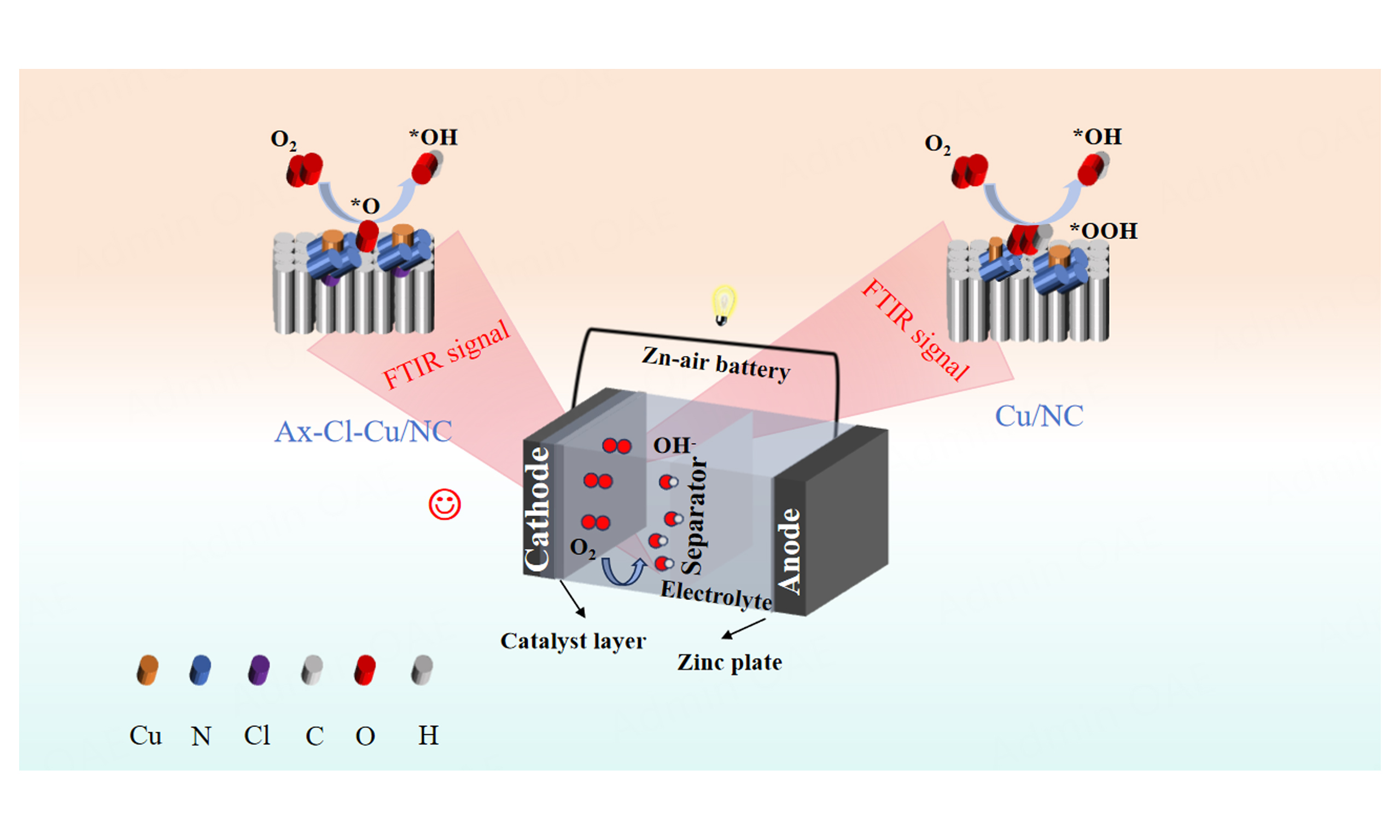
Herein, to address the limitations of symmetric M-N4 sites, we designed an axial chlorine-coordinated copper single-atom catalyst (denoted Ax-Cl-Cu/NC). X-ray photoelectron spectroscopy (XPS) and extended X-ray absorption fine structure (EXAFS) confirm that axial Cl coordination induces both electronic symmetry breaking and geometric symmetry breaking at the Cu center, while in situ infrared spectroscopy further reveals the dynamic evolution of *OOH/*O intermediates and the accelerated cleavage of the O-O bond. Consequently, Ax-Cl-Cu/NC exhibits significantly enhanced ORR activity and stability. The optimized catalyst achieves exceptional performance metrics: near-unity 4e- selectivity (99%) and a high half-wave potential (0.89 V). When deployed as the cathode in a ZAB, Ax-Cl-Cu/NC delivers an impressive open-circuit voltage (OCV) of 1.53 V and a maximum power density (156.6 mW cm-2) surpassing that of commercial Pt/C (127.3 mW cm-2). Our work establishes a novel paradigm for M-NC catalyst design through concurrent “electronic structure-coordination geometry” regulation. This dual-dimensional modulation strategy opens new avenues for developing highly efficient ORR electrocatalysts.
EXPERIMENTAL
Materials
The copper source, copper(II) nitrate trihydrate (Cu(NO3)2·3H2O, ≥ 99% purity), was purchased from Aladdin (China). The nitrogen/carbon sources, 2-methylimidazole and zinc nitrate hexahydrate (Zn(NO3)2·6H2O, both ≥ 99% purity), were also purchased from Aladdin (China). Sodium chloride (NaCl, analytical grade) was used as the chlorine source and purchased from Sinopharm Chemical Reagent (China). Methanol (CH3OH, ≥ 99.5%) and ethanol (C2H5OH, ≥ 99.7%), both of analytical grade, were purchased from Macklin (China), while deionized water was prepared in the laboratory. Nafion solution (5 wt%) was purchased from Sigma-Aldrich (USA), and commercial Pt/C (20 wt%) was purchased from Macklin (China). Potassium hydroxide (KOH, ≥ 99.99% purity) used as the electrolyte was purchased from Aladdin (China). All aqueous solutions were prepared using 18.2 MΩ·cm Millipore water purified in a Millipore system. All chemicals were of analytical grade and used without further purification.
Synthesis of ZIF-8
9.5 g of Zn(NO3)2·6H2O and 20 g of 2-methylimidazole were dissolved in 200 mL of methanol, respectively. The reaction mixture was then stirred at room temperature for 24 h. The precipitate was collected by centrifugation at 6,000 rpm for 6 min, and the resulting solid was washed three times with methanol, and dried in a vacuum oven at 70 °C for about 12 h.
Synthesis of NC
The ZIF-8 powder prepared above was ground and then high temperature pyrolysis. Under the protection of nitrogen (N2) atmosphere, the temperature of the furnace was increased to 1,000 °C at a rate of 5 °C /min and maintained at a constant temperature for 2 h.
Synthesis of Cu/NC
0.8 g of ZIF-8 was homogeneously dispersed in 100 mL of methanol, followed by the slow dropwise addition of a methanolic solution of 1 mmol of Cu(NO3)2·3H2O to the above system, and magnetic stirring
Synthesis of Ax-Cl-Cu/NC
The Ax-Cl-Cu/NC catalyst was prepared by mechanical milling combined with high-temperature pyrolysis: Cu/NC was fully milled and mixed with NaCl at a mass ratio of 1:1, heated to 1,000 °C at an elevated rate of
The additional detailed experimental data, such as reagents, characterizations, and electrochemical measurements, are provided in the Supplementary Materials.
RESULTS AND DISCUSSION
Morphology and structure characterizations of Cu based catalysts
Ax-Cl-Cu/NC catalyst in which coordination-regulated Cu sites were confined in N-doped carbon carrier was prepared via a facile pyrolysis strategy. As seen in Figure 1A, ZIF-8 was prepared using a common method, and then the copper source (Cu precursor) and chlorine source (Cl precursor) were anchored to the ZIF-8 substrate surface using injection and grinding methods[7,32]. Use a microinjection to drop metallic copper into the ZIF-8 solution, allowing Cu to be uniformly and stably anchored on the substrate. Grind NaCl and Cu-ZIF in a 1:1 ratio so that the Cl source can coordinate with Cu along the axial direction. The final sample is named Ax-Cl-Cu/NC catalyst and Cu/NC samples without sodium chloride were used as controls. Analyze the morphology of the sample using scanning electron microscopy (SEM) and transmission electron microscopy (TEM). As shown in Supplementary Figure 1A and B, both Ax-Cl-Cu/NC and Cu/NC exhibit a rhombic dodecahedral morphology similar to that of ZIF-8. High-resolution TEM (HRTEM) analysis showed [Supplementary Figure 1C and D] that no discernible lattice fringes were observed in either the Ax-Cl-Cu/NC or Cu/NC samples. X-ray diffraction (XRD) patterns further corroborate this conclusion. Only two distinct carbon diffraction peaks appear in the diffraction patterns of all samples [Supplementary Figure 2A] and XRD test results of samples at different temperatures
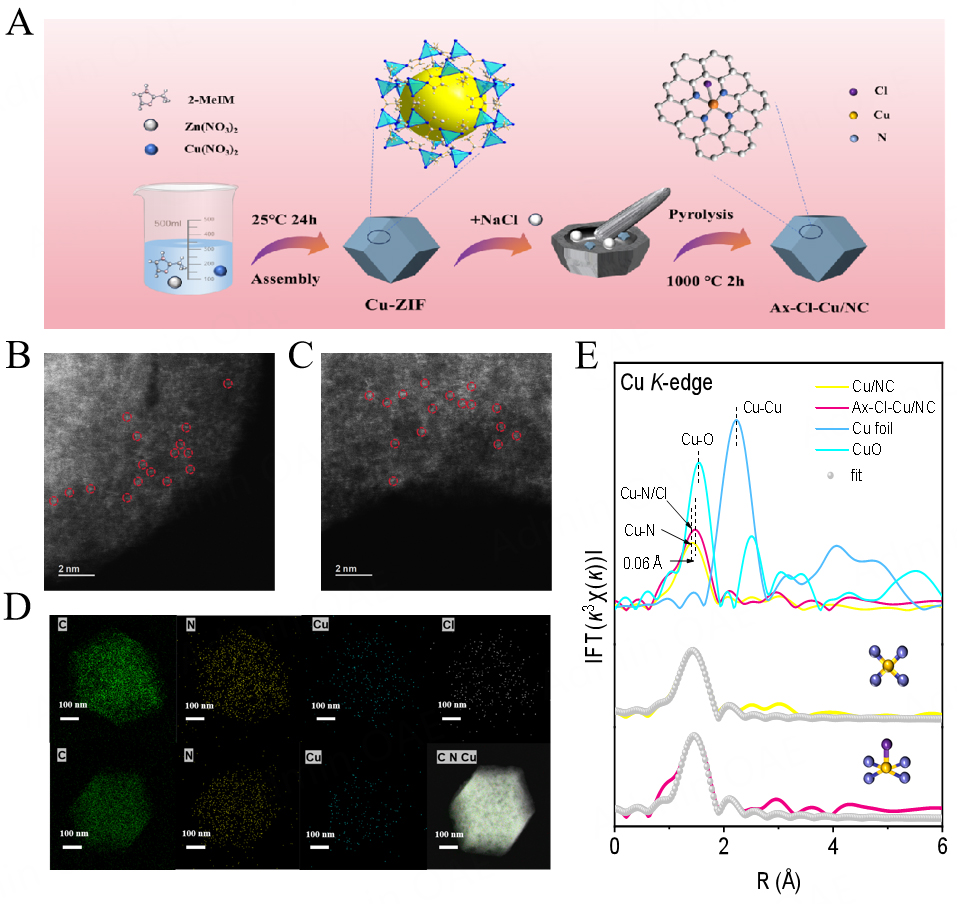
Figure 1. (A) Preparation process of Ax-Cl-Cu/NC, HAADF-STEM of (B) Cu/NC and (C) Ax-Cl-Cu/NC, (D) TEM-EDS mapping image of Cu/NC and Ax-Cl-Cu/NC (green, yellow, blue and white represent C, N, Cu and Cl elements), (E) FT-EXAFS spectra of the Cu K-edge for Ax-Cl-Cu/NC and Cu/NC and fitting spectra of Cu/NC. The inset shows Cl, Cu, and N atoms indicated by purple, gold and blue.
The energy-dispersive X-ray spectroscopy (EDS) elemental distribution map of Ax-Cl-Cu/NC [Figure 1D] shows that carbon (C), nitrogen (N), copper (Cu), and chlorine (Cl) elements are uniformly distributed in the nitrogen carbon co-doped matrix, indicating the successful introduction of Cl. Further analysis of the coordination environment of Cu was performed using EXAFS spectroscopy [Figure 1E]. Compared with Cu foil and CuO, the prominent peak at around ~1.5 Å can be attributed to the Cu-N bond, while no Cu-Cu scattering peak appears in Ax-Cl-Cu/NC and Cu/NC. Interestingly, the Cu-N peak in Ax-Cl-Cu/NC shifted positively by 0.06 Å compared to the Cu/NC sample, indicating the formation of a Cu-Cl coordination structure. In addition, the fitted curves of the k3-weighted Cu K-edge EXAFS spectra in Figure 1E, as well as the corresponding data listed in Supplementary Table 1 for Ax-Cl-Cu/NC and Cu/NC, indicate that the coordination number (CN) of the Cu-N bond in Cu/NC is 3.9. For Ax-Cl-Cu/NC, the additional Cu-Cl pathway was taken into account during the fitting process, containing 3.9 Cu-N bonds and 1.0 Cu-Cl bonds. To highlight the local structure around the Cu site and the axial Cl coordination, a local structure model is shown in Figure 1E. These results demonstrate that the Cl element is indeed involved in the coordination of Cu-N4 in an axial fashion. Quantitative analysis by inductively coupled plasma optical emission spectroscopy (ICP-OES) showed that the copper loading of Ax-Cl-Cu/NC and Cu/NC was 1.1 and 1.4 wt%, respectively.
Analysis of electronic structure and LCE
The chemical composition and structure of each element in the catalyst were examined systematically. Firstly, the chemical composition of the catalyst was characterized using XPS. The full spectrum analysis in Supplementary Figure 3A shows the Cl characteristic peak, indicating the successful doping of Cl element in the Ax-Cl-Cu/NC catalyst. The C 1s XPS spectra of different samples are presented in
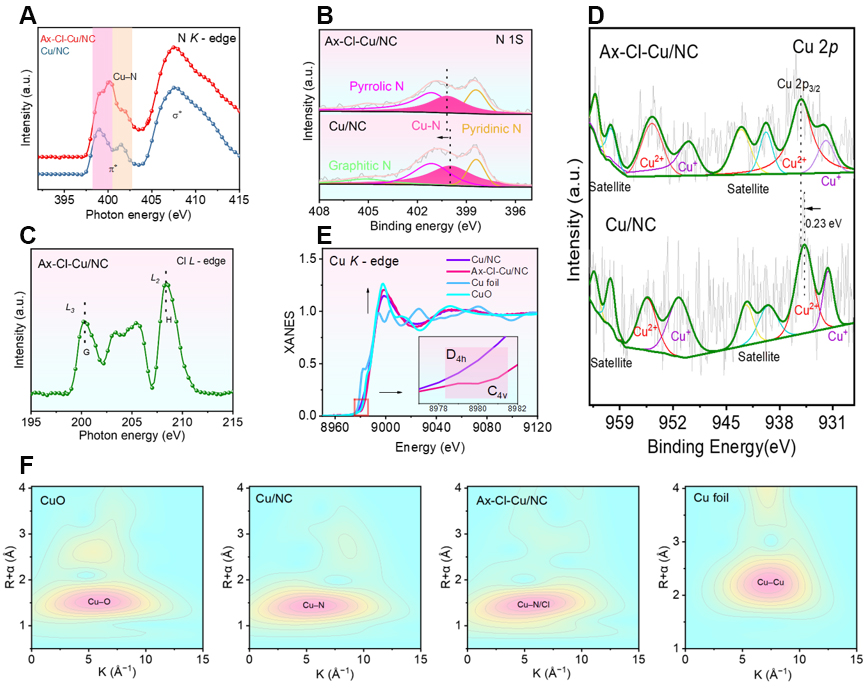
Figure 2. (A) N K-edge XANES spectra of Ax-Cl-Cu/NC and Cu/NC, (B) N 1s XPS spectra, (C) Cl L-edge XANES spectra of Ax-Cl-Cu/NC, (D) Cu 2p XPS spectra of Ax-Cl-Cu/NC and Cu/NC, (E) Cu K-edge XANES spectra and (F) Wavelet transforms of k2-weighted XAFS spectra of CuO, Cu/NC, Ax-Cl-Cu/NC, Cu foil.
Electrochemical oxygen reduction performance
Informed by the analysis of these results, the systematic evaluation of the ORR performance of the catalyst was carried out in an O2-saturated 0.1 M KOH electrolyte using the RotatingRing-disk Electrode technique (DC DSR, PHYCHEMI)[35]. As shown in Figure 3A, Ax-Cl-Cu/NC exhibited optimal ORR activity with a half-wave potential (E1/2) of 0.89 V, which was significantly better than 20 wt% Pt/C (0.86 V), Cu/NC
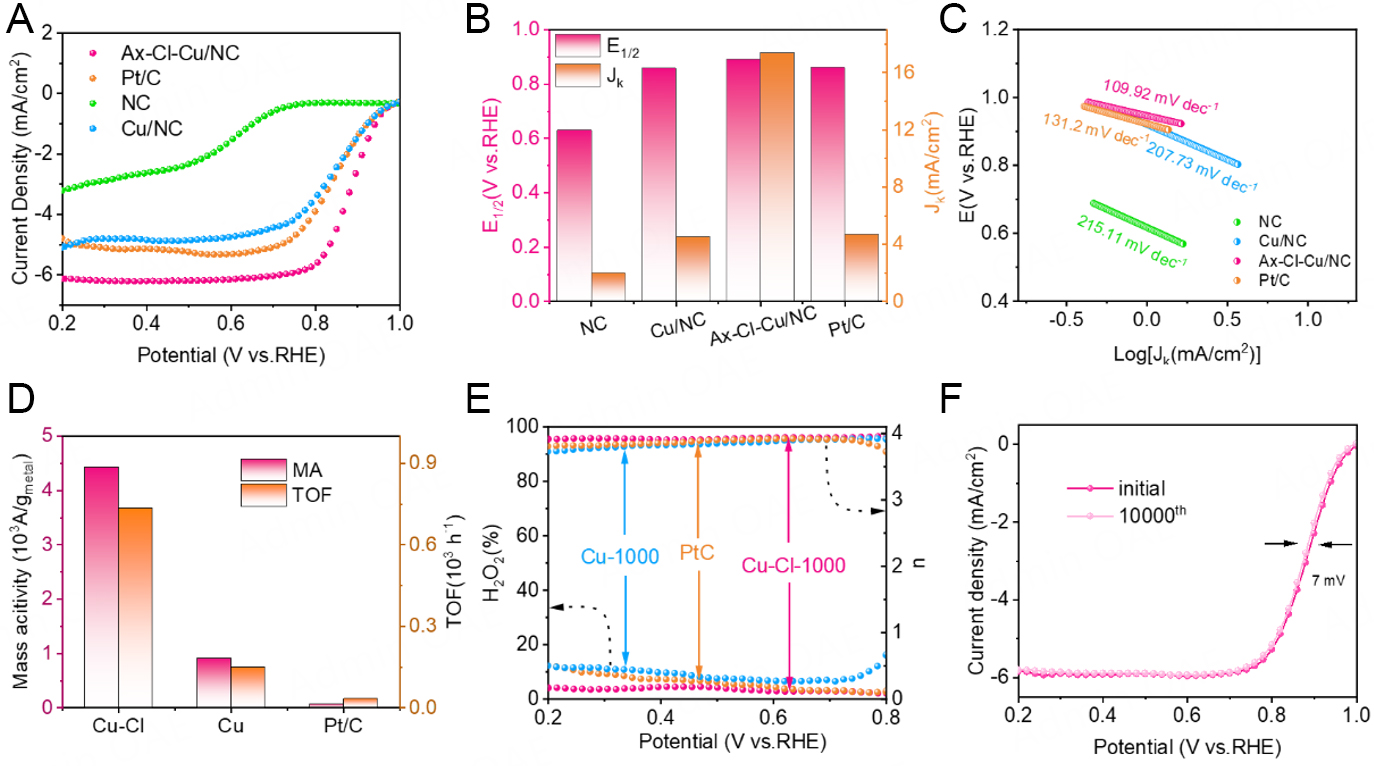
Figure 3. (A) Polarization curves at 1,600 rpm, (B) kinetic current density (Jk) at 0.85 V and E1/2, (C) Tafel profile kinetics, (D) mass activity (MA) and turnover frequency (TOF), (E) electron transfer number and H2O2 yield of the Ax-Cl-Cu/NC and reference sample, (F) durability test plots (ADT) of Ax-Cl-Cu/NC in 0.1 M KOH solution.
The electron transfer number (n) and H2O2 yield of the catalyst are key indicators of ORR selectivity[37]. As measured by the rotating ring disk electrode (RRDE) technique [Figure 3E], the electron transfer number of Ax-Cl-Cu/NC is about 3.96, which is close to the ideal 4e- transfer pathway, confirming its excellent ORR selectivity. The results of fitting the Koutechy-Levich (K-L) equation at different rotational speeds [Supplementary Figures 13 and 14] showed a high degree of consistency in the linear slopes, which further verified that the catalyst followed an efficient 4e- reaction mechanism over a wide range of mass transfer. The H2O2 yield of Ax-Cl-Cu/NC was only 2.03 %, which was significantly lower than that of the other reference samples, suggesting that Cl doping inhibits the occurrence of side reactions. More importantly, this outstanding activity can remain stable even under rigorous testing conditions. Additionally, the stability and durability of the Ax-Cl-Cu/NC catalyst were measured via chronoamperometry (CA) and accelerated durability testing (ADT). ADT results showed [Figure 3F] that the half-wave potential (E1/2) of Ax-Cl-Cu/NC only decays ~7 mV after long-term cycling, exhibiting a structural stability superior to that of most SACs. However, the E1/2 of Pt/C and Cu/NC catalysts decreased by 18 and 11 mV, respectively
In situ characterizations of the evolution of active sites
To elucidate the mechanism behind the outstanding ORR activity and stability of Ax-Cl-Cu/NC, in-situ EIS and in-situ synchronous radiation infrared spectroscopy (SRIR) technique studies were conducted. The distribution of relaxation times (DRT) of Cu/NC and Ax-Cl-Cu/NC at different voltages [Figure 4A and B] reveal two dominant characteristic peaks, corresponding to mass transport (10-1~100 Hz) and charge transport (~101 Hz) processes, respectively[38-40]. Comparative analysis demonstrates that Ax-Cl-Cu/NC exhibits significantly reduced peak intensities with all peaks shifted toward higher frequencies compared to Cu/NC. Charge Transfer Resistance (Rct) is related to the charge transfer at the electrode interface; the higher the Rct, the weaker the charge transfer. Figure 4C shows that the reaction kinetics of Ax-Cl-Cu/NC are stronger than those of Cu/NC at any voltage. The EIS plots of the Ax-Cl-Cu/NC and Cu/NC catalysts at different voltages are shown in Supplementary Figure 18. These observations indicate that Ax-Cl-Cu/NC possesses lower charge transfer resistance, which are more favorable for facilitating the ORR process.
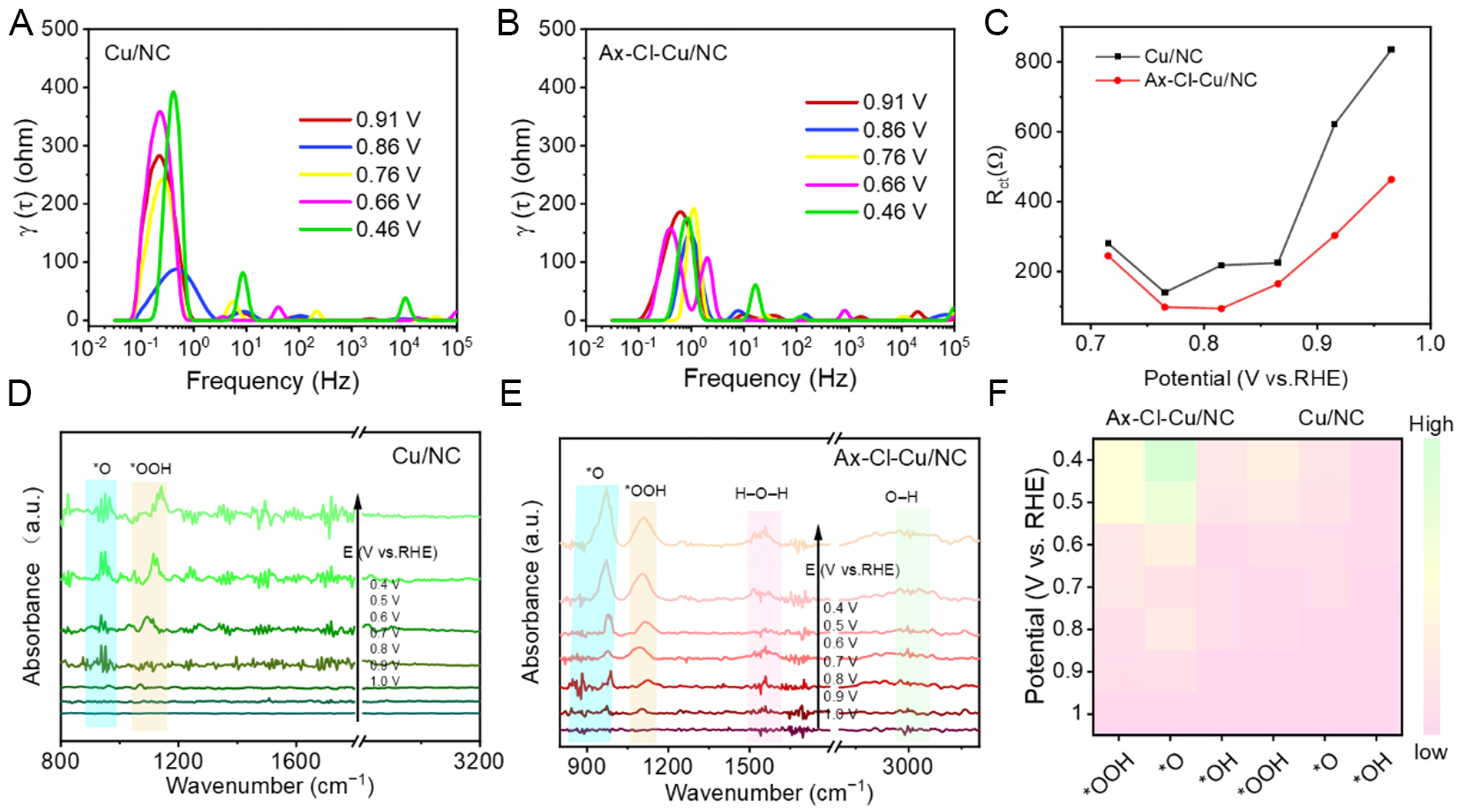
Figure 4. DRT and in situ SRIR characterizations. DRT analysis of (A) Cu/NC and (B) Ax-Cl-Cu/NC at different voltages, Charge transfer resistance (RCT) plots of the catalyst under different applied potentials of Ax-Cl-Cu/NC and Cu/NC (C), in situ SRIR measurements at different potentials of (D) Cu/NC and (E) Ax-Cl-Cu/NC, (F) Intensity differences of ORR intermediate at Ax-Cl-Cu/NC and Cu/NC.
In-situ SRIR technique monitor the evolution of active species in the ORR process of Ax-Cl-Cu/NC and Cu/NC catalysts, and the regulatory mechanism of coordination Cl on the reaction path was revealed[41]. As shown in Figure 4D and E, both catalysts were tested for potential from 1.0 to 0.4 V in O2-saturated 0.1 M KOH[42,43]. From the figure, we can see that the infrared spectrum of Cu/NC only shows *O
Zn-air battery performance
In order to verify the practical application value of Ax-Cl-Cu/NC catalyst, it was used as the cathode material to construct ZABs and compared with commercially available Pt/C catalysts[53,54]. The ZAB was assembled using a polished zinc plate as the anode, Ax-Cl-Cu/NC loaded on carbon paper as the air cathode, and 6 M KOH as the electrolyte [Supplementary Figure 19]. All tests were conducted under high-purity O2 (99.999%) atmosphere at a flow rate of 50 mL min-1, eliminating CO2 interference and minimizing carbonate formation in the electrolyte. As shown in Figure 5A, the Ax-Cl-Cu/NC equipped ZAB exhibited an OCV of 1.53 V, which was significantly higher than that of the Pt/C based battery of 1.44 V, indicating that the catalyst could drive higher theoretical output voltage of the battery. The discharge polarization curves and power density tests in Figure 5B showed that the Ax-Cl-Cu/NC based ZABs exhibited a maximum output power density of 156.6 mW cm-2, higher than that of the Pt/C based cells at 127.3 mW cm-2, and a superior discharge voltage plateau reflecting a more efficient oxygen reduction kinetics. The performance that surpasses most of the catalysts reported in the literature [Supplementary Table 4]. At a current density of 10 mA cm-2, the specific capacity of the Ax-Cl-Cu/NC based ZAB was 751.1 mA h gZn-1, which was significantly better than that of the Pt/C based cell
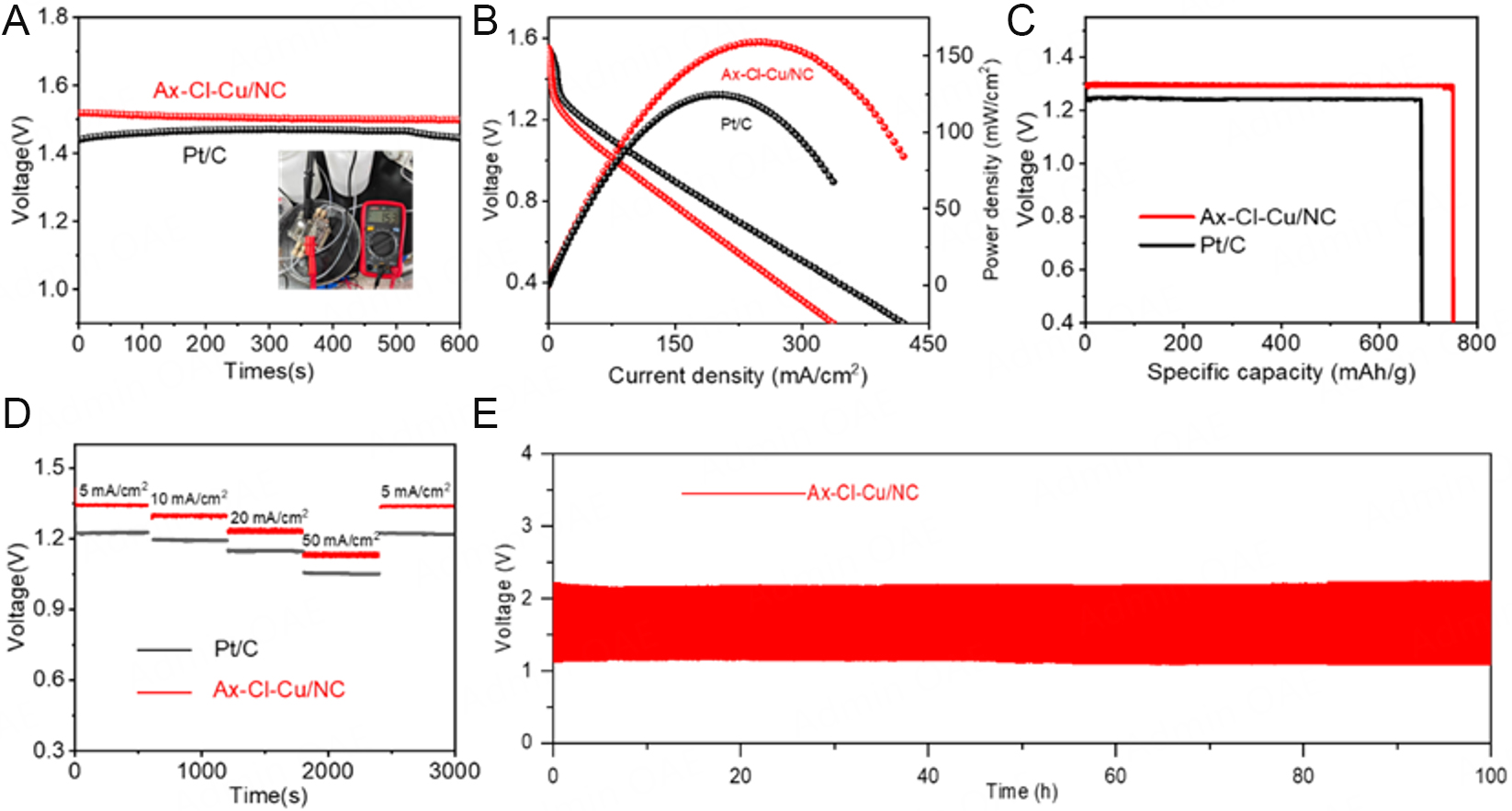
Figure 5. Performance diagram of assembling Zn air battery. (A) Open-circuit voltage plots, (B) Discharge polarization curve and power density plots, (C) specific capacity at current density of 10 mA cm-2, (D) Diagram of galvanostatic discharge curves at different currents of Ax-Cl-Cu/NC and Pt/C, (E) Galvanostatic discharge-charge cycling curve performed under 5 mA cm-2 for the Ax-Cl-Cu/NC based ZABs.
CONCLUSION
This study demonstrates that axial chlorine coordination effectively breaks the symmetry constraints of conventional Cu-N4 catalysts. The resulting Ax-Cl-Cu/NC exhibits remarkable ORR performance due to its optimized electronic structure, achieving a 0.89 V half-wave potential with near-ideal 4e- transfer (n = 3.96) and outstanding stability (< 7 mV decay after 10,000 cycles). Advanced characterization reveals that Cl-induced axial coordination optimizes the interaction between the Cu-N4 active center and the ORR intermediates, thereby steering the reaction toward a highly favorable 4e- pathway. The work establishes a novel coordination strategy for designing high-performance SACs while providing fundamental insights into symmetry engineering for electrocatalysis.
DECLARATIONS
Acknowledgments
The authors thank Key Laboratory of Light Energy Conversion Materials of Hunan Province College, for support of the XPS, XAFS, and in-situ SRIR technique monitor.
Authors’ contributions
Writing-original draft and Data curation: Li, S. (Shuang Li); Li, S. (Shiyu Li)
Formal analysis and Writing-review & editing: Wu, Y.; Wang, J.
Investigation and Formal analysis: Yan, J.; Liu, K.
Methodology and Revised the paper: Su, H.; Yang, Y.
Availability of data and materials
The details of materials and reagents, instrumentation and characterizations, and electrochemical measurements were shown in the Supplementary Materials. Additional data supporting the findings of this study are available from the corresponding author upon reasonable request.
AI and AI-assisted tools statement
Not applicable.
Financial support and sponsorship
This research was funded by the National Natural Science Foundation of China (Grants 12205300, 12575344 to Su, H.), the Hunan Provincial Natural Science Foundation (2024JJ4027 to Su, H.), and the Hunan Normal University Research Program (05311204666 to Su, H.). We are grateful to the 1W1B station at BSRF, BL14W1 and BL20U at SSRF, and BL01B, MCD-A at the National Synchrotron Radiation Laboratory for beamtime access.
Conflicts of interest
Su, H. is Guest Editor of the special issue "Advanced Hydrogen Energy Materials and in situ Characterization Technologies" of the journal Energy Materials. Su, H. was not involved in any steps of editorial processing, notably including reviewers' selection, manuscript handling and decision making, while the other authors have declared that they have no conflicts of interest.
Ethical approval and consent to participate
Not applicable.
Consent for publication
Not applicable.
Copyright
© The Author(s) 2026.
Supplementary Materials
REFERENCES
1. Liu, J.; Liu, Y.; Nan, B.; et al. A two-in-one strategy to simultaneously boost the site density and turnover frequency of Fe-N-C oxygen reduction catalysts. Angew. Chem. Int. Ed. 2025, 64, e202425196.
2. Yang, J.; Liu, W.; Xu, M.; et al. Dynamic behavior of single-atom catalysts in electrocatalysis: identification of Cu-N3 as an active site for the oxygen reduction reaction. J. Am. Chem. Soc. 2021, 143, 14530-9.
3. Shang, H.; Zhou, X.; Dong, J.; et al. Engineering unsymmetrically coordinated Cu-S1N3 single atom sites with enhanced oxygen reduction activity. Nat. Commun. 2020, 11, 3049.
4. Zhang, M.; Li, H.; Chen, J.; et al. Transition metal (Co, Ni, Fe, Cu) single-atom catalysts anchored on 3D nitrogen-doped porous carbon nanosheets as efficient oxygen reduction electrocatalysts for Zn-air battery. Small 2022, 18, 2202476.
5. Ji, S.; Wang, Y.; Liu, H.; et al. Regulating the electronic synergy of asymmetric atomic Fe sites with adjacent defects for boosting activity and durability toward oxygen reduction. Adv. Funct. Mater. 2024, 34, 2314621.
6. Wang, Q.; Shang, L.; Sun-Waterhouse, D.; Zhang, T.; Waterhouse, G. Engineering local coordination environments and site densities for high-performance Fe-N-C oxygen reduction reaction electrocatalysis. SmartMat 2021, 2, 154-75.
7. Bai, J.; Guan, X.; Qu, H.; et al. Multiscale structure regulation induced by fluorine coordination enables high-performance and durable PEMFC. ACS. Energy. Lett. 2025, 10, 2743-51.
8. Li, J.; Bao, M.; Pan, J.; et al. Chlorine-nitrogen doped hollow polyhedral carbon-based catalysts for high performance zinc-air batteries. Ind. Eng. Chem. Res. 2024, 63, 19498-505.
9. Shen, H.; Jia, Y.; Qi, Y.; et al. Steering structural mesoporosity and working microenvironment of Fe-N-C catalysts for boosting cathodic mass transport of zinc-air batteries. Sci. China. Chem. 2022, 65, 1670-8.
10. Tang, C.; Jin, R.; Xia, Y.; et al. Asymmetric low-coordination tailoring of single-atom cobalt catalysts enabling efficient oxygen reduction reaction. Nano. Energy. 2025, 137, 110776.
11. Wang, P.; Zhang, R.; Wang, K.; et al. Simultaneously constructing asymmetrically coordinated cobalt single atoms and cobalt nanoclusters via a fresh potassium hydroxide clipping strategy toward efficient alkaline oxygen reduction reaction. Energy. Mater. Adv. 2023, 4, 0042.
12. Kang, Z.; Wang, X.; Wang, D.; et al. Carbon-based single-atom catalysts: impacts of atomic coordination on the oxygen reduction reaction. Nanoscale 2023, 15, 9605-34.
13. Zhang, L.; Meng, Q.; Zheng, R.; et al. Microenvironment regulation of M-N-C single-atom catalysts towards oxygen reduction reaction. Nano. Res. 2023, 16, 4468-87.
14. Bai, J.; Lian, Y.; Deng, Y.; et al. Simultaneous integration of Fe clusters and NiFe dual single atoms in nitrogen-doped carbon for oxygen reduction reaction. Nano. Res. 2023, 17, 2291-7.
15. Wu, M.; Wu, Q.; Yang, Y.; He, Z.; Yang, H. Regulating Lewis acidity and local electron density of iron-based metal organic frameworks via cerium doping for efficient photo-Fenton process. J. Colloid. Interface. Sci. 2023, 630, 866-77.
16. Ma, N.; Duan, L.; Ma, D.; et al. Demonstration of a high-density alkali-metal atomic magnetometer based on the frequency-symmetrical detuning effect of two pumping lights. Opt. Express. 2022, 30, 45930.
17. Wang, Q.; Lu, R.; Yang, Y.; et al. Tailoring the microenvironment in Fe-N-C electrocatalysts for optimal oxygen reduction reaction performance. Sci. Bull. 2022, 67, 1264-73.
18. Xu, Q.; Hu, J.; Yao, H.; et al. Pyridinic-N regulated electron injection to modulate *OH adsorption at Fe-N-C sites for an efficient oxygen reduction reaction. ACS. Appl. Mater. Interfaces. 2024, 16, 42352-62.
19. Lu, X.; Yang, P.; Wan, Y.; et al. Active site engineering toward atomically dispersed M-N-C catalysts for oxygen reduction reaction. Coord. Chem. Rev. 2023, 495, 215400.
20. Yu, Z.; Si, C.; Lagrow, A. P.; et al. Iridium-iron diatomic active sites for efficient bifunctional oxygen electrocatalysis. ACS. Catal. 2022, 12, 9397-409.
21. Gao, H.; Shang, L.; Qian, S.; et al. Precise axial coordination tailors the spin state of single-atom iron for boosted oxygen reduction electrocatalysis. Adv. Funct. Mater. 2026, 36, e31932.
22. Hu, Y.; Niu, S.; Zhang, Z.; et al. Axial chlorine engineering of p-block antimony atomic sites boosts oxygen reduction. J. Am. Chem. Soc. 2025, 147, 21231-40.
23. Liu, M.; Liu, Y.; Zhang, X.; et al. Altering the symmetry of Fe-N-C by axial Cl-mediation for high-performance zinc-air batteries. Angew. Chem. Int. Ed. 2025, 64, e202504923.
24. Yin, L.; Sun, M.; Zhang, S.; Huang, Y.; Huang, B.; Du, Y. Chlorine axial coordination activated lanthanum single atoms for efficient oxygen electroreduction with maximum utilization. Adv. Mater. 2024, 37, 2416387.
25. Li, L.; Huang, S.; Cao, R.; et al. Optimizing microenvironment of asymmetric N,S-coordinated single-atom Fe via axial fifth coordination toward efficient oxygen electroreduction. Small 2021, 18, 2105387.
26. Yu, C.; Xiao, W.; Huang, J.; Hao, C.; Shen, P. K.; Tian, Z. Q. Single yttrium atom coordinated by nitrogen and oxygen with an asymmetric 4d orbit as efficient oxygen reduction electrocatalyst. J. Colloid. Interface. Sci. 2025, 691, 137425.
27. Li, Y.; Zang, K.; Duan, X.; Luo, J.; Chen, D. Boost oxygen reduction reaction performance by tuning the active sites in Fe-N-P-C catalysts. J. Energy. Chem. 2021, 55, 572-9.
28. Wu, L.; Wang, Y.; Shao, C.; Wang, L.; Li, B. Copper single atom-modulated functionalization of iron clusters on a porous carbon nanosheet for the oxygen reduction reaction. J. Mater. Chem. A. 2025, 13, 5974-86.
29. Yang, L.; Xu, H.; Liu, H.; et al. Oxygen-reconstituted active species of single-atom Cu catalysts for oxygen reduction reaction. Research 2020, 2020, 7593023.
30. Bai, J.; Sun, Z.; Zhang, H.; et al. Modulating the local coordination environment of M-Nx single-atom site for enhanced electrocatalytic oxygen reduction. Adv. Funct. Mater. 2024, 35, 2417013.
31. Tong, M.; Wang, L.; Fu, H. Designed synthesis and catalytic mechanisms of non-precious metal single-atom catalysts for oxygen reduction reaction. Small. Methods. 2021, 5, 2100865.
32. Liu, J.; Zhang, W.; Zhang, Y.; et al. Fe, Ni, co-doped ZIF-8 derived in situ grown carbon nanotubes as Zinc-air battery cathode for self-powered electrochemical sensing glucose. J. Alloys. Compd. 2025, 1020, 179475.
33. Zhang, Y.; Li, F.; Li, S.; et al. Asymmetric dual-atomic catalyst with axial chloride coordination for efficient oxygen reduction reaction. Adv. Mater. 2025, 37, 2507478.
34. Peng, J.; Hu, B.; Li, Z.; et al. Regulating atomic Fe/Cu dual sites with unsymmetrical Fe-N6 and Cu-N1S2 coordination for promoting bifunctional oxygen electrocatalysis in advanced zinc-air batteries. Energy. Storage. Mater. 2024, 68, 103342.
35. Cheng, H.; Sun, H.; Dai, M.; et al. Optimizing the ratio of metallic and single-atom Co in CoNC via annealing temperature modulation for enhanced bifunctional oxygen evolution reaction/oxygen reduction reaction activity. Molecules 2024, 29, 5721.
36. Wang, M.; Wang, L.; Li, Q.; et al. Regulating the coordination geometry and oxidation state of single-atom Fe sites for enhanced oxygen reduction electrocatalysis. Small 2023, 19, 2300373.
37. Xie, S.; Jin, H.; Wang, C.; et al. A comparison study on single metal atoms (Fe, Co, Ni) within nitrogen-doped graphene for oxygen electrocatalysis and rechargeable Zn-air batteries. Chin. Chem. Lett. 2023, 34, 107681.
38. Sabhapathy, P.; Raghunath, P.; Sabbah, A.; et al. Axial chlorine induced electron delocalization in atomically dispersed FeN4 electrocatalyst for oxygen reduction reaction with improved hydrogen peroxide tolerance. Small 2023, 19, 2303598.
39. Chen, Y.; Liu, X.; Li, S.; Li, J.; Fan, M.; Shu, S. Crystalline-amorphous heterostructures with built-in electric fields enhance the tandem electroreduction of nitrate to ammonia. Adv. Funct. Mater. 2025, 36, e21409.
40. Li, S.; Huang, J.; Yan, J.; et al. Electronic bridges-stabilized Fe-Cu twin-sites circumvent scaling relationship for robust acidic oxygen reduction. ACS. Catal. 2026, 16, 2124-34.
41. Jia, B.; Xie, X.; Lin, J.; et al. Harnessing pyridinic N vacancy defect in microporous structures to induce the pre-adsorption of oxygen and boost oxygen reduction reaction kinetics. Angew. Chem. Int. Ed. 2025, 64, e202508674.
42. Chen, X.; Hu, H.; Liu, M.; Zhong, X.; Wu, D.; Su, H. Unveiling the spatially dependent cooperative effect in iridium sites for enhanced acidic water oxidation. Nano. Lett. 2025, 25, 15384-92.
43. Liu, M.; Su, H.; Liu, X.; et al. Dynamic modulation of electron redistribution at the heterogeneous interface nickel hydroxides/platinum boosts acidic oxygen reduction reaction. Nat. Commun. 2025, 16, 2826.
44. Wang, M. J.; Ji, R.; Huang, C.; et al. Synergistic strong-weak adsorption coupling in the FeN6-CoN4 dual-site modulates oxygen reduction pathways via oxygen adsorbate evolution-to-dissociation transition. ACS. Catal. 2026, 16, 2800-13.
45. Xu, S.; Zhang, Y.; Peng, Y.; et al. Breaking the scaling relationship for oxygen reductionvia amino-molecule-interface-mediated metallene electrocatalysts. Chem. Sci. 2026, 17, 7590-8.
46. Liu, C.; Cheng, K.; Chen, Q.; et al. Synergy of nickel single-atom and heteroatoms Co-doping in carbon for efficient hydrogen peroxide electrosynthesis. Angew. Chem. Int. Ed. 2025, 65, e21397.
47. Liu, J.; Zhang, Z.; Han, C.; et al. Ligand-modified nickel nitride for natural seawater H2O2 synthesis. Appl. Catal. B. Environ. Energy. 2025, 373, 125362.
48. Liu, Z.; Mo, M.; Xiao, B.; et al. Asymmetric coordination modulation on Co single-atom sites tunes selectivity of acidic oxygen reduction. Appl. Catal. B. Environ. Energy. 2025, 377, 125510.
49. Xia, H.; Sun, M.; Yang, D.; et al. Phosphorus/Sulfur-modulated p-band center of pentagonal carbon for efficient oxygen reduction reaction. J. Am. Chem. Soc. 2025, 147, 41472-80.
50. Xia, P.; He, T.; Sun, Y.; et al. Defective-engineered ZnO encapsulated in N-doped carbon for sustainable 2e- ORR: interfacial Zn-N bond regulated oxygen reduction pathways. ACS. Catal. 2024, 14, 12917-27.
51. Wang, Y.; Zheng, M.; Li, Y.; et al. p-d orbital hybridization induced by a monodispersed Ga site on a Pt3Mn nanocatalyst boosts ethanol electrooxidation. Angew. Chem. Int. Ed. 2022, 61, e202115735.
52. Wang, J.; Liu, W.; Luo, G.; et al. Synergistic effect of well-defined dual sites boosting the oxygen reduction reaction. Energy. Environ. Sci. 2018, 11, 3375-9.
53. Liao, Y.; Xiao, Y.; Li, Z.; et al. Structural engineering of Co-metal-organic frameworks via Ce incorporation for improved oxygen evolution. Small 2023, 20, 2307685.
Cite This Article
 Open Access
How to Cite
Download Citation
Export Citation File:
Type of Import
Tips on Downloading Citation
Citation Manager File Format
Type of Import
Direct Import: When the Direct Import option is selected (the default state), a dialogue box will give you the option to Save or Open the downloaded citation data. Choosing Open will either launch your citation manager or give you a choice of applications with which to use the metadata. The Save option saves the file locally for later use.
Indirect Import: When the Indirect Import option is selected, the metadata is displayed and may be copied and pasted as needed.
About This Article
Special Topic
Copyright

Data & Comments
Data
0







Comments
Comments must be written in English. Spam, offensive content, impersonation, and private information will not be permitted. If any comment is reported and identified as inappropriate content by OAE staff, the comment will be removed without notice. If you have any queries or need any help, please contact us at support@oaepublish.com.